Monday, February 28, 2022

Is Tyrannosaurus rex really 3 species?

 We've all grown up knowing a T. rex is a T. rex, and that's all there is to it.  A study published in the journal Evolutionary Biology suggests otherwise, According to the authors, there are three species.  Three times the Tyrannosaur goodness?  
After looking over the existing specimens of T. rex (there are only 38 in the world, according to one count) Paleontologist Gregory Paul and his coauthors believe they fall into three body types different enough from each other to be named species. He proposes we add T. imperator (emperor), and T. regina (queen), The world's most famous fossil skeleton, the Tyrannosaurus "Sue" in the Field Museum, is named as the type specimen for T. imperator. 
Some paleontologists were disappointed by the paper because there had been so much hype preceding it.  They expected a major discovery based on new fossils, not an argument for reclassification.  
This new royal family has sparked immediate controversy. We think of paleontologists as a serious lot, if not actually dull, but the debate in this case, while professional, is already getting fierce.  Dr. Steve Brusatte, author of the  superb popular book The Rise and Fall of the Dinosaurs (2018), thinks the differences cited are "...very minor and not indicative of meaningful biological separation of distinct species,,," PaleoTwitter, which is a VERY active community with a lot of calm professional discourse sprinkled with non-calm acrimonious discourse, is abuzz, and most of the buzz ia about how the paper is wrong.  But t
he storm of prehistoric dust is just starting. Many debates and studies lie ahead. Consensus may never come.  
NOTE: Dr. Alan Grant could not be reached for comment.
One vision of T. rex (public domain) 


Congratulations to Tetrapod Zoology

Congratulations to Dr. Darren Naish, whose blog Tetrapod Zoology marked its 16th birthday. Darren is a paleontologist who, among many other accomplishments, revolutionized our view of the largest pterosaurs. The blog offers posts about countless vertebrates, living or extinct, along a friendly skeptic's takes on the cryptozoological world.

Wednesday, February 09, 2022

What did Megalodon Look Like?

 New study conclusions: 

Body forms of extant lamniform sharks (Elasmobranchii: Lamniformes), and comments on the morphology of the extinct megatooth shark, Otodus megalodon, and the evolution of lamniform thermophysiology

Phillip C. Sternes, Jake J. Wood & Kenshu Shimada


One proposed comparison shape (marked "Free to Use and Share' on Creative Commons)


This is a really good example of what we can and can't know from incomplete fossils. Sharks, like my favorite fish
Dunkleosteus
, have a cartilaginous skeletons that rarely fossilize.  

Did they look like great whites? Did they look more like some other extant shark? 

We don't know. 

"...all previously proposed body forms for O. megalodon should be regarded as speculations (Figure 9) because there are no scientific means to decisively support or refute the accuracy of any of them. Any meaningful discussion on this specific topic would require the discovery of much better-preserved fossil specimens than what are presently known in the fossil record of O. megalodon."

Darn. 

Monday, February 07, 2022

Black History Month: the Astronauts

NASA's first three Black astronauts were picked in January 1978 as part of the first Shuttle program group of 35 astronauts. NASA had expanded the criteria for this group: all previous astronauts had to be test pilots, meaning the pool for Mercury through Apollo (which expanded the rule just a bit to allow scientists, with geologist Harrison Schmidt reaching the moon on Apollo 17), consisted almost entirely of white males.  The TFNG (Thirty-Five New Guys) also included the first American women. 

The first Black astronaut to fly was Air Force pilot Guion Bluford in 1983. (I met him 15 years later, when he was a VP at engineering services firm NYMA. He was a reserved fellow, the kind who didn't need to command attention as astronauts (and, by legend, all military pilots), sometimes do. Physicist Ron McNair first flew in 1984 and  died in the Challenger disaster in 1986. Air Force pilot Fred Gregory flew in 1985 and became become the first Black American to pilot, and later command, a space vehicle.  He became the NASA Deputy Administrator, at one point serving two months as the Acting Administrator.  A little-known fact is that he was the nephew of the famous physician, Dr. Charles Drew. Marine pilot Charles Bolden, selected in the next group in 1980, became the first permanent Black NASA Administrator.  One other Black astronaut has given his life for exploration: payload commander Michael Anderson, another Air Force officer, was on the shuttle Columbia on February 1, 2003.


Major Robert Lawrence, picked in 1967 by the Air Force for the to-be-canceled Manned Orbiting Laboratory (MOL), would likely have transferred to NASA and eventually flown the Shuttle had he not died in a crash a few months after his selection.


Captain Edward Dwight, Jr. was an Air Force pilot added as a candidate in 1963 from outside the usual process – JFK himself picked him to integrate the program - but he was still in the test pilot qualification program when selected, and he never did make the cut for selection by NASA.


The first person of African descent to reach space was Afro-Cuban cosmonaut Arnaldo Tamayo Mendez, who flew on Russia's Soyuz 38, orbiting on September 18, 1980.


Photographs (Dwight and Lawrence photos USAF, others NASA)


Bluford, McNair, and Gregory in 1978


Bluford

http://www.jsc.nasa.gov/Bios/htmlbios/bluford-gs.html


Anderson

http://www.jsc.nasa.gov/Bios/htmlbios/anderson.html

McNair
https://www.jsc.nasa.gov/Bios/htmlbios/mcnair.html

Lawrence

https://www.amfcse.org/robert-h-lawrence-jr

Bolden (as NASA Administrator, 2009)

https://www.jsc.nasa.gov/Bios/htmlbios/bolden-cf.html

Gregory (as NASA Acting Administrator in 2005)


https://www.jsc.nasa.gov/Bios/htmlbios/gregory-fd.html

Dwight

https://www.smithsonianmag.com/history/ed-dwight-first-african-american-space-until-wasnt-180974215/


.

Saturday, January 29, 2022

Book Review: The Cryptid Catcher

The Cryptid Catcher

Lija Fisher

Square Fish, 2018, 326 pp. + bonus material

Bigfoot hunter and educator Lija Fisher has written a wonderful adventure for middle-graders, Indeed, older kids and adults with an interest in cryptozoology will snork it up too.  Clivo Wren is the orphaned son of a cryptid-catcher who roamed the world looking for a cryptid with immortality-granting blood, which makes sense in the context of Fisher’s unique take on cryptids in general. Thirteen-year-old Clivo has an inherited contract with a mysterious man named Douglas who is not so much a mentor as a goad.  (Imagine Obi-wan throwing Luke a lightsaber and saying, “Good luck storming the Death Star. And I mean by tomorrow!”) 

Clivo will feel familiar to fans of Jonny Quest (from the original and ONLY series) and has a bit of Harry Potter in him, too. He meets a supportive cryptozoology club through, of course, the International Cryptozoology Museum. Soon, he’s off to Loch Ness and then Alaska, getting around via an unlimited credit card provided by Douglas, the outdoor and self-defense skills taught him by his dad, and innate cleverness.  Clivo has other problems, though, mainly people who are wiling to shoot him to find the cryptid that can help them use immortality to (what else?) take over the world.

This book, the first in a duology, is a funny, well-paced, globe-trotting tale of teenage derring-do. It’s stuffed with cryptozoology references both common and obscure, has a great supporting cast, and brims with originality. On to the sequel!

Saturday, January 22, 2022

Sasquatch: the Matt Bille Challenge

 We all love our buddy Bigfoot, despite his annoying habit of never leaving DNA, dead bodies, bones, fossils, partially eaten kills, or old copies of "The Smart Sasquatch: A Guide to Avoiding Humans." Even skeptics like myself HOPE the Bigfoot hunters finally find something.


So I posted the Matt Bille Challenge on a cryptozoology group.
I don't suppose it means much in the days of million-dollar book advances, but I'll write a personal check for $1,000 USD to the lead author of the paper in Nature, Science, or Journal of Mammalogy describing the creature known as Sasquatch.
I specified those three journals only because this would be earthshaking news: the peer review process would be extremely thorough there. Also, the authors would ONLY submit to the most prestigious journals. That paper is not going to Bubba's Journal of Mammalogy and Cheeseburger Recipes. (Which I would totally read.)
I'll add $1,000 to the person who finds the specimen used as the basis for the paper. Good hunting!

Monday, January 17, 2022

Book Review: Drunk Flies and Stoned Dolphins


Book reviews

Drunk Flies and Stoned Dolphins: A Trip Through the World of Animal Intoxication

Oné R. Pagán

BenBella Books, 2021. 320pp

Dr. Oné R. Pagán, a biologist, biochemist, and pharmacologist, has written a book that’s as much fun as the title indicates, with fascinating science as a bonus.  He explains the history of our research on naturally occurring pharmaceutically and psychedelically active substances and the many uses other animals, intentionally or unintentionally, put them to.  Did you know what happens to elephants on LSD (nothing good)? Have you ever heard the claim we evolved our brains because psychedelic plants expanded out consciousness? It’s called the Stoned Ape Theory, and an actual scientist was serious about it. This is not to be confused with the Drunken Monkey Hypothesis, which holds our ancestors found the ripest fruit by following their tastes for alcohol.  (One wonders at times what exactly the scientists consumed.)   


Pagán questions some popular stories. Elephants, it turns out, will greedily dive into liquor and can be very dangerous drunks, but the claim that they do this with fermented fruit is dubious. (Some smaller animals do get drunk that way.) The much-reported tale of dolphins passing around a puffer fish to get high is likewise unproven: they may just have been using it as an inflatable toy.  My favorite bit is that sea slugs apparently hallucinate on amphetamines. It’s not exactly useful knowledge, of course.

The author explains the chemistry of the subject in clear words and illustrations. He reviews the theories, adding a few of his own, about why intoxicating substances evolve and the way they have “unintended” effects (e.g., a plant may evolve an insecticide that’s an intoxicant to other animals). 

Pagán’s engagingly conversational style occasionally gets a little cutesy, but it succeeds in making the book a lively read that explains science without getting boring.  I came away knowing a lot more about biochemistry, animal behavior, and how to determine how drunk a fruit fly is. A unique book!


Sunday, January 16, 2022

Thanks to COSine 2022

I had a great time at COSine 2022. Thanks to the organizers, moderators, and panelists. I was on panels for Science Fiction predictions, appropriation, and the latest on dinosaurs. Thanks to Shannon Lawrence for this photo.  The organizers pulled it off despite COVID, the need to reshuffle presenters and work in remote presentations, and the conference hotel (I am not making this up) being sold for apartments two weeks before the conference!

Great photo by Shannon Lawrence. 


Tuesday, December 28, 2021

Changing Words for Birds

There's a growing movement in the United States focused on changing things likeplace names that have, or are connected to, racist or sexist themes.  These include institutional names like Fort Bragg (why would the Army name a post for Confederate General Braxton Bragg in the first place? Have they READ the guy's combat record?) and localities like Coon Lake in Washington state, now Howard Lake.

Things are moving slower, with more debate, in areas like the names of animals. Concerning birds especially, there's been some movement pushed by several scientific and volunteer bodies to change  some comon names. McCown's longspur has been renamed because McCown was an ornithologist but also a Confederate general. (Photo below bythe Smithsonian.)


Hammond's flycatcher will go soon: Hammond was a Surgeon General who late in the 1800s was still writing that "Indians and Negroes" were subhuman. Scott's oriole, named for General Winfield Scott, despised by Native Americans for directing the forced relocation called the Trail of Tears, may go next. Ornithologists are arguing over the iconic Audubon, a scientific giant who, among other highly offensive actions, once traded slaves. There's a practical reason to not change all the challenged names abruptly: they're how birders and everyone else outside ornithology distinguish birds.   Changes require education and updating of much documentation. 

Some non-bird terms like "squawfish" and "gypsy moth" are also officially out, and oceanographer Kim Martini launched an effort in 2019 urging scientists and media to stop using "Bobbit worm" for a polychaete also known as the sand striker. The overall movement to rename species has been slow, though, because neither governments nor scientific bodies have agreed on what guidelines to apply. It's not just an American problem: in places like the Democratic Republic of the Congo and New Caledonia, the presence of dozens of indigenous languages makes it a huge challenge to even identify the "local" names. so almost all of the names applied by Western scientists are still in place in scientific and general literature.

A topic that has been raised, if rarely so far, is changing binomial scientific names like Rhynchophanes mccownii. Binomials are supposed to be fixed, forever, for scientific precision. They allow, say, a scientist in Tahiti in 2021 to know exactly what species was meant by an English naturalist in 1780. The International Commission on Zoological Nomenclature (ICZN) doesn't even have a process for this. Scientists have stopped using names the ICZN has deemed inaccurate (e.g., Linnaeus' Homo ferus, or wild man) or which are no longer valid because the species has been reclassified, but there are procedures for that.

It's easier with modern discoveries: Western scientists have begun asking indigenous people for names (as with the amphibian Tiktaalik rosae, where the genus was suggested by Inuit elders in Nunavut [it's an Inuktitut word for a local fish English-speakers call burbot]), and of course scientists in Africa, Asia, and South America have long been working local names into the binomials.

There's a lot to work out.


Don't forget: now available in all formats! 


www.mattbille.com


Wednesday, December 22, 2021

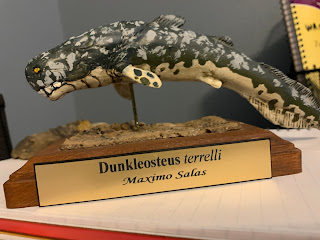
Max Salas's Beautiful Dunk Sculpture

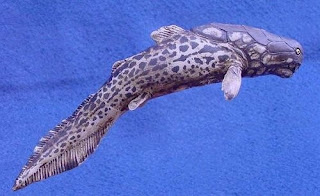
I finally got my hands on a Max Salas Dunkleosteus terrelli sculpture, one of the specimens I’ve always wanted.  This limited-production resin kit may not be the most accurate Dunk representation, but it is certainly a memorable one. I don’t know who assembled and painted this example. The kit is out of production.

Salas made some interesting conjectures about that the Dunk looked like.  The relatively slim, vertically arched body, combined with a prominent forehead and low dorsal, made me think of a cetacean, somewhat similar to an elongated dwarf sperm whale.

Granted, there are Dunk details we don’t know, and there were more when this sculpture was made (mine is dated 2008). Still, there are some questionable choices concerning the anatomy. The fins look reasonable, although I personally suspect the dorsal was bigger. The small second dorsal fin is a conjecture. No other Dunk reconstruction I can find has it, and neither do any other placoderms, including those like Cocosteus cuspidatus and Titanichthys agassizi used to support conjectures about the Dunk's body. The eel-like tail used on the model was once a common idea but today is losing favor compared to a more shark-like tail. There are no lips, a feature still debated although the pro-lip view is gaining ground and makes more sense to me for streamlining.  

Now, for the artistic side: it’s beautiful. The stock kit photo (first photo below) has the armor solid-colored, and the whole animal, with its complex pattern, is gorgeous.  On my copy, it looks like the owner went for an easier approach, so the armor is blended in. The sculpt conveys life and motion in a way so many others (including more technically accurate ones) often fail to do. This thing LOOKS like it’s hunting you down, and you won’t have a prayer…


Matt Bille
MattBille@gmail.com
www.mattbille.com
Twitter: MattWriter
NEW BOOK: https://www.amazon.com/Books-Beasts-Cryptozoologists-Library/dp/1955471274


Saturday, December 18, 2021

New Species and Of Books and Beasts update

 I enjoy posting on new species, and this paper bearing news from the tropical island of Sulawesi is an interesting one. Scientists surveying the shrews of this very large (174,600 square km) island collected over 1,300 specimens of shrews. When the hard work of taxonomy started, it took years to sort them out.  There were 21 species, an astonishing 14 of them new. The resulting paper named more species than any single paper in the last 90 years. Most people consider shrews unimportant at best and annoying at worst, and they (the shrews) committed the serious offense of "starring" in one of the worst monster movies ever made.  


Meanwhile, Of Books and Beasts is getting some very good feedback (not all posted on Amazon reviews yet, but trust me) and is now on Amazon and B&N as well as being available from the 
publisher. Please buy, enjoy, and review!.

Saturday, December 11, 2021

And here it is! Of Books and Beasts

 I waited a bit on posting this until the book was widely available. Notw it's on B&N and Amazon,and in the formats for their e-readers, andit's time to celebrate!  

THE BOOK IS OUT!!!!

The first-ever guide to the books of cryptozoology, related sciences, and fiction.  Enjoy! Give feedback! Post reviews! (please) Hangar 1 Publishing did a great job, and I'm proud of it.  


https://www.amazon.com/Books-Beasts-Cryptozoologists-Library/dp/1955471274
https://www.barnesandnoble.com/w/of-books-and-beasts-matt-bille/1140576461


Friday, November 26, 2021

Book Review: The Brilliant Abyss

The Brilliant Abyss: Exploring the Majestic Hidden Life of the Deep Ocean, and the Looming Threat That Imperils It

Helen Scales (2021: Atlantic Monthly Press, 288pp.)

Scales, a marine biologist and a very busy nature writer, spends the opening chapters of this excellent book explaining the geology and topography of the underwater world. She presents the vertical journey by dropping a marble from a ship and describing the changes of light and life until it hits the bottom of a deep trench six hours later. She highlights a three-year study that photographed 347,000 animals in the Pacific, only one-fifth of which were assignable to known species and genera. She mentions the origins and legends of the abyss (from abyssus, “bottomless pit” in Latin) and its monsters. 


The book goes on to describe the history of seafloor exploration from sampling lines through modern robots and submersibles. Then the author takes us to the seas, where she describes being on a research cruise where sperm whales breach around the ship while the scientists haul up samples from over 2,000 m (6,560 feet) down. She spends a chapter on introducing the sperm whale and its marvelous adaptations, how humans have studied it, and the bizarre bone-eating zombie worms that gather on sunken whale skeletons. On the same voyage, scientists dropped dead alligators to the seafloor and watched how the predators moved in.

We learn about Ernst Haeckel, whose 19th-century work on jellyfishes formed the basis of modern efforts to study the bewildering variety of undersea invertebrates. Scales includes the discovery of a whole new ecosystem, the geothermal vent community. The total of species living in vent communities worldwide is over 700 and climbing. The book includes other discoveries, like octopus nurseries and the Mariana snailfish (documented living 26,500 feet [8,080m] down). 

Next, Scales considers what the oceans mean to us and what we’re doing to them. She explains the function of the oceans in sequestering carbon, the role of photosynthetic algae in generating oxygen, the pharmacological value of marine life, and other benefits. Then she explores the threats: overfishing (notably the rise and fall of the orange roughy population), the destructive trawling of seamount ecosystems, the rise in twilight-zone fishing, and pollution by everything from microplastics to nerve agents, and seabed mining. She argues the deep sea needs to be protected completely by something akin to the International Antarctic Treaty.

It’s a book with a lot of science on fascinating animals, plus thought-provoking arguments and even a couple of cryptozoological lines. “When Yeti crabs were discovered, it would have been poetic if they were found to eat marine snow.” (They don’t.) She writes that plesiosaurs were “extinct oceangoing reptiles that looked like Loch Ness monsters” instead of the other way around. I liked that.  The copious source notes top off the book, serving as an excellent resource.


Matt Bille

website: www.mattbille.com

Twitter: MattWriter

Author, Of Books and Beasts: A Cryptozoologist's Library, due out December 1 from Hangar 1 Publishing 


Thursday, November 25, 2021

Cyptids and Comic Books: A Wild Bunch

 I came across this site today. It collects 152 appearances of cryptids in printed comics, and I wish I could read them all.  They range from specialized cryptozoology comics like Monster Hunters to mainstream comics like Hulk and the obvious ones like Scooby-Doo.  Tintin, the Powerpuff Girls, and Bart Simpson have all met cryptids. The specialized cryptid-focused comics are, I think, all gone at the moment. My favorite cryptozoology comic was Cryptid, which lasted one issue.  I still hope someone restarts it.  

Good as it is, this collection could be bigger. Jonny Quest, Tarzan, the X-Files, Batman, Superman, and many other comics feature heroes encountering cryptids. Marvel's Sasquatch character pops up many times and was on the Canadian superhero team Alpha Flight, although he never got his own book.  (Marvel's Sasquatch and the one Batman meets [see image below] look almost identical, yet very little like any reported Sasquatch.  Black Panther and the X-Men (some of whom arguably are cryptids) met the yeti. Aquaman and the Sub-Mariner must be sick and tired of meeting sea monsters all the time. There also were horror/science fiction comics like Challengers of the Unknown.

Among comics that are less known today, there was an independent comic ("independent" usually meaning not DC, Marvel or maybe Dark Horse) called Teddy and the Yeti. Champion of the Pines was a ten-issue indie comic featuring the Jersey Devil. There was Gold Key's run of Voyage to the Bottom of the Sea and the indie The Battle of the Sea Titans, a project that produced a gorgeous 20-page preview and was never seen again. The comic book version of Beany and Cecil featured the world's nicest sea serpent, A special hat tip to comic artist Steve Bisssette, who offered free Swamp Thing art to support cyrptozoologist Loren Coleman a few years ago when Loren had surgery. (I'm sorry I overlooked it at the time.)  

The team in Sea Devils (35 issues in the 1960s, and revived a few times between then and 2009) met sea monsters a lot (indeed, I'm not sure they had any other plots), and numerous war comics had someone meeting a monster, usually on a Pacific island.  Donald Duck met Nessie, and Dark Horse ran a 2012-2013 four-issue series of the uniquely titled Billy the Kid’s Old Timey Oddities and the Orm of Loch Ness. I'm going to find that one for myself.

I'm sure I'm missing a couple of hundred more examples, but much of the fun with comic books is digging up overlooked or forgotten gems. Keep looking!


Cover art copyright belongs to the respective comics. Shown here as educational illustrations, not for profit: they will be removed if I'm notified of an objection.


Sunday, November 21, 2021

New Species Keep Coming

 The parade of new species shows no signs of ending. 

Many people miss this because popular media covers only discoveries that are spectacular, extremely cute, or extremely scary.  A sizable new shark will turn up on the news services, as will a cute monkey and the occasional colorful bird, but the only sure things is a large land mammal, and those have been limited to reclassifications. Some of these do make the news: the Sundaland clouded leopard, split off from tits Bornean cousin in 2007, drew some attention. I almost forgot the beaked whales, which offer something new every few years - indeed, I wonder when they will STOP showing up. A new species drifted onto an island off Alaska in 2016 (as is not uncommon, it turned out there were some museum specimens) and scientists are actively searching for a beaked whale videotaped by a Sea Shepherd expedition in 2020.  But when is the last time you saw a story about a new mouse? Or lizard? Or frog? Or fish?

Rice's Whale (Balaenoptera ricei)  Image NOAA

There's a nice sampler in this article on Discover.com from June 15. Writer Brianna Barbu listed seven finds from the first half of the year (there were many more).  Among them are the Emperor Dumbo Octopus, with its ear-like fins, from 1,300 meters beneath the Pacific: the biggest species of the year, Rice's whale from the Gulf of Mexico, split off from Bryde's whale: and a deadly Chinese snake decked in handsome black and white scales, Suzhen’s krait.  Discovery rates for most classes of animals, including vertebrate animals, are still going up.  It's still a big planet. 

Countdown to Of Books and Beasts

 Only ten days now!  

Links published soon!


Thursday, November 04, 2021

Welcome a colorful bird

Five decades ago, Dr. Ernst Mayr wrote that we'd found almost all the birds.  The great evolutionary biologist (1904-2005) was happy to learn he'd been wrong, and new birds are still showing up. This spectacular yellow tanager is the newest example. The range of the Inti tanager (Heliothraupis oneilli) is within the Yungas bioregion, which straddles Peru and Bolivia.   The bird, first spotted in 2000 but languishing scientifically in the absence of a specimen, was unique enough to justify creating a new genus. 

In most bird species, the males are more spectacular, but what does that mean when both sexes are already eye-grabbing? Here the male does its best to show off by adding a black head stripe and a modest crest. 


Photograph Louisiana State University: Nonprofit/educational fair use claimed 

Tuesday, November 02, 2021

Review: In the Wake of the Sea-Serpents


This is one of the foundational works of cryptozoology, published in English in 1968. How does it hold up?

In the Wake of the Sea-Serpents 

Heuvelmans, Bernard (1968: Hill & Wang, 645pp.)

In this massive volume, Heuvelmans laid the foundation of marine cryptozoology, as he did for land cryptids in On the Track of Unknown Animals. It wasn’t the first good book on the subject, but was the most comprehensive, and remains so as I write this in 2021. After throwing out many reports as vague or mistaken, he identified 358 cases as offering good information. Heuvelmans provides a worthy starting point for all researchers of the topic. As one example of a case, he suggests the famous 1907 Valhalla sighting by two British naturalists involved a huge eel or eel-shaped fish swimming with its head and forebody out of the water, and he might be right about that one. 


Heuvelmans concluded there were at least seven unknown species involved (five mammals, a reptile, and an eel): he includes two others here, a giant turtle and an anomaly called the yellow-belly, but omitted them in his later works. Understandably, Heuvelmans’ fellow zoologists found the idea of a whole zoo of huge unknown animals hard to swallow. It didn’t help that he went out on a limb with the science, suggesting the ancient whale Basilosaurus had armor and side-fins (highly speculative in 1965 and known to be incorrect now) and saying that “eels are powerful constrictors,” which they are not.

Alas, as with On the Track, no new species have been found that fit any of Heuvelmans’ types. His brief tour of mystery cetaceans notes a few sightings that may match now-identified types lie the tropical bottlenose whale, and this was my first introduction to Wilson’s whale, an Antarctic animal which remains a genuine mystery. He focuses on the unknown species, though, and any that exist are still undiscovered. Nevertheless, this book is a trove of information, gathering most of the known sightings going back centuries. Heuvelmans tries to match these to order and family, even though his proposed genus and species names are invalid without holotypes (physical type specimens used in the formal description of species). 

Subsequent cryptozoologists have proposed both more and fewer categories in their own views. One common approach has been to collapse his mammals down to one possible species, as I did in Shadows of Existence (Hancock House Publishers, 2006) and Rob Cornes and Gary Cunningham did in The Seal Serpent: the Search for a Long-necked Pinniped (Independently published, 2019). But In the Wake of the Sea-Serpents remains essential reading for those studying the unknown animals of the deep.


This review is from Of Books and Beasts: A Cryptozoologist's Library, coming soon from Hangar 1 Publishers.  

Matt Bille
www.mattbille.com

Sunday, October 31, 2021

Fun with FanExpo

 Yesterday I dropped in on Denver FanExpo, formerly Denver Pop Culture Convention, formerly ComiCon. I said hi to other writers, handed out ads for the new book, met one other Harry Dresden, and won a LARP fight (staff vs sword, three touches to two, and the experienced guy half my age CLAIMED he didn't go easy on me.)  After a year of canceled meet-ups like this, it was good to renew the inner nerd!, 


Saturday, October 23, 2021

Rare African Owl: First photo in wild ever!

This is really cool, Shelly's eagle-owl (Bubo shelleyi) (aka the dark eagle-owl) was described in 1872 from a single specimen and remained very hard to find. Twenty specimens were collected over 150 years, but photos of the live owl were nonexistent, save for those of a specimen held in the Antwerp Zoo in the 1970s. The IUCN estimated the population as low as 1,500 when the species was assessed in 2018.  In October 2021, two scientists took photos in Ghana that captured the barred, brownish owl's yellow bill, black eyes, and impressive size (up to 61 cm / 24 inches long). Congratulations!

The photos are not reproduced here for copyright reasons, but Johannes Gerardus Keulemans painted it in 1875.