Friday, January 31, 2020

Anniversary: Explorer 1

The race to orbit ended with a victory by Russia's Sputnik 1 on October 4, 1957. But on this day, January 31, in 1958, the Unoted States answered with Explorer 1. Erika Maurer and I were proud to write the history of this dramatic contest that, as Wernher von Braun put it, "...open to man the gates of heaven." (His Soviet counterpart, Sergei Korolev, said it similarly: "The road to the stars is now open!")

Read the story here. 


Lost Astronauts: Salute to the Explorers

NASA held its Day of Remembrance for the astronauts who died in service to exploration: two Shuttle crews and the crew of Apollo 1, 17 brilliant, accomplished men and women.  While all three events involved technical failures on the spacecraft, all were, inexcusably, failures of management and leadership by people whose #1 job was making sure that, as astronauts braved the dangers of space, they had the safest possible equipment to take them there and back. 


The Explorers

Souls departing Earthbound life
Rise to heaven’s plane
Soldier, sailor, priest, or king
The destiny's the same
But in an even higher realm
With stars always in view
Meet those lost in exploration
Remembering how they flew

Komarov toasts Gus Grissom
And Resnik laughs with Clark
Ramon and Chalwa share a tale
As they look beyond the dark
Adams shares his glory days
With Husband and McNair
And always they urge us on
To rise above the air.

Don’t cling to mother Earth, they’d say
God has given us the stars
There’s a reason we aspire
To cross the celestial bar
We gave our lives
(we don’t regret)
To push back the frontier
Remember us by challenging
And conquering your fears

Patseyev, Onizuka
Anderson and Brown
Salute each new endeavor
That lifts us from the ground
To every new thrust into space
They raise their glasses high
And remind us we were always meant

To voyage beyond the sky.


Saturday, January 25, 2020

Book Review: Underland by Robert Macfarlane

UNDERLAND: A Deep Time Journey 
Robert Macfarlane
W.W. Norton
2019
496pp.

We all know there's a world under our feet - animal burrows, mines, caves, and so on. But MacFarlane, in a series of adventures in which he probes the depths and complexities of that world (or, rather, many worlds), shows us a whole new way of thinking about the earth.  

As he descends into Italian caves, salt and potash mines that reach far our under the seabed, the catacombs of Paris, and the world beneath glaciers and icecaps, he meets cavers, miners, fishermen, Arctic hunters, and the  sceintists who search for neutrinos filtered through thousanmds of feet of rock and soil. He ventures (arduously) to a cave in Norway where red-painted figures dance, to a repository in Finland meant to store atomic waste for tens of thousands of years, to bunkers and fortresses, and to underground rivers where countless explorers have perished. I count at least three points where the author came close to losing his life.  He does all this to share thoughts on the surface world as, in effect, an alien emerging from the underland, and the superb writing - often reflecting the author's effort to grapple with phenomena for which existing language is insufficient - takes the reader along. We feel his journeys as much as we read about them. 
He spends a lot of time documenting the effects of climate shange in Greenland, including the appearance of ice caves, military bases, and prehistoric ice itself from places where they were thoguht buried forever.  Two items that especially held my interest were his introduction to the astonishingly dense, varied, and interwoven network of plants and fungi beneath the forest floor and the challenges of burying nuclear waste to shield future generations (I used to work with nuclear weapons). He notes that we bury things for two reasons - to preserve them for future use or to inter them for undisturbed rest.  
This isn't a book you can speed through. The dense, multifacted tangle of facts and feelings involved in each adventure will force you to slow down and think - a lot.  MacFarlane knows the history and literature of the underland throughout human existence, and his take on it will leave you looking very differently at the ground beneath your feet.  This is original, memorable, and just a superb book in every possible sense. 

Sunday, January 19, 2020

Intriguing new Dunk model appears online

This looks like a new contender for "best Dunk model."

These folks at Paleozoo Evolutionary Models are advertising a seriously great-looking Dunkleostus model along with a very good description page. They describe it as up to 9m long (it came close, although that specimen, from the Cleveland shale, is a decided outlier) and, I think, get the controversial tail structure right. It says you can buy this as a 200m model, but the Store part of the site reads, "Closed for Maintenance" and I can't find it through any other site. Does anyone know where it can be found?

https://www.paleozoo.com.au/Dunkleosteus.php

Pictute posted as advertising, copyright PEM, fair use claimed


Image result for paleozoo dunkleosteus model

Thursday, January 16, 2020

Some Space Book Reviews (mostly good)


LINKS TO RECENT SPACE BOOK REVIEWS

Bringing Columbia Home: The Untold Story of a Lost Space Shuttle and Her Crew

By Michael Leinbach and Johnathan Ward. Arcade Publishing, 2018
The Columbia disaster was a horrible day in history, made worse by the knowledge it was preventable.  The authors tell that story, but they also tell the story of hope and dedication and that old-fashioned and much-maligned thing called the American spirit. 

Space Shuttle: The History of the National Space Transportation System: The First 100 Missions. Dennis R. Jenkins, published by the author, 2001.
What Jenkins did here is phenomenal. No other book on the Shuttle or any other spacecraft provides this level of authoritative detail. Every idea, version, and system is here in words and diagrams.


Rocket Men: The Daring Odyssey of Apollo 8 and the Astronauts Who Made Man's First Journey to the Moon, by Robert Kurson, 2018.  It's hard to express how much I enjoyed Rocket Men. I was an "Apollo kid" and something of a space historian myself, so I knew the story, but what the author does here is make us FEEL it. (Caution: there's another space history book called Rocket Men: not nearly as good.)

Live from Cape Canaveral: Covering the Space Race from Sputnik to Today
Jay Barbee, Smithsonian, 2007.  Journalist Jay Barbree had a front-row seat to much of the American program.  It's a fun read, although it feels a bit too much like the reader is on a rushed tour bus, hitting the highlights with some pauses for personal interludes. You will learn some new stuff, though!

I wanted to like this book by a respected (formerly, anyway) journalist on a fascinating topic. Some of the airplane test stories are good.  But a ton of research is undone with careless misreporting on several projects and a "Soviet/Mengele" Roswell crash theory that is batshit crazy. 

Riding Rockets, by Mike Mullane
Three-time Shuttle astronaut Mike Mullane has produced a unique memoir of his time with NASA. It offers more than you want to know about space bathrooms along with good portraits of fellow astronauts and his own stories: lots of fun.

Shoot for the Moon: The Space Race and the Extraordinary Voyage of Apollo 11 by James Donovan,  Little, Brown and Company, 2019
There are more Apollo books than there are rocks on the moon, but stories can always be told better. There are mistakes in the pre-Apollo chapters, but the story of the Apollo program is first-rate, covering everything from personalities (to the engineering-focused Buzz Aldrin, "small talk was a foreign langiuage" - wow,has Buzz changed)  to politics and engineering.

Sunday, January 12, 2020

Ten new birds in one swoop

Discovery of a new bird is a big event. It only happens three or four times a year.  An expedition returning with 10 new birds - five species and five subspecies - is unheard of in modern times.

But it just happened.

OK, not "just." It takes years to formally describe a new species.  The expedition was in 2013, but scientists kept pretty quiet about it (amazingly so, really) until a publication in the msot prestigious American science journal, Science.  
We have, from islands off the east coast of Sulawesi in Indonesia:

Species:

Taliabu Grasshopper-Warbler
Taliabu Myzomela
Taliabu Leaf-Warbler
Peleng Leaf-Warbler
Peleng Fantail

Subspecies:

Togian Jungle-Flycatcher
Banggai Mountain Leaftoiler
Taliabu Snowy-browed Flycatcher
Taliabu Island Thrush
Sula Mountain Leaftoiler.  

Scientists attributed much of the success of the six-week expedition to preparation and study before they got ther. They studied the land connections of prehistoric times, looking at which islands had been part of the same landmass (or not), plus information from collector from past centuries including Alfred Russell Wallace. 
Amazing.
The lesson: yes, there are still new species to find, and not just bugs. It's still a big world out there.  


Friday, January 10, 2020

At COSine this weekend

Great SF conference in Colorado Springs this weekend (17-19 January)!

Thanks to Alastair Mayer for adding me to the 1PM panel Saturday on lunar exploration. When will we go back to the Moon, and why? There's a lot of science content at this con to go with the Manticorian Navy and the T-Space universe and Guest of Honor Eric Flint's 1632 and... well, it goes on.

https://www.firstfridayfandom.org/cosine/

Sunday, January 05, 2020

Book Review: To Reach the High Frontier

To Reach the High Frontier: A History of U.S. Launch Vehicles

Roger D. LauniusDennis R. Jenkinseditors Copyright Date: 2002
Edition: 1 Published by: University Press of Kentucky Pages: 528


This is an important book in space history, and not just because I had a hand in it. This is a very handy one-volume collection of the highlights of American launch vehicles up until the publication date.  Some of this ground, such as the histories of the Delta rocket and Space Shutttle, had already been fairly well-trod, but even here the authors provide new facts and insights.  Roger Launius, former Chief Historian of NASA, provides the Introduction and the first chapter, "Rocketry and the Origin of Space Flight." From there follow chapters by experts on Titan, Shuttle, Saturn V, Atlas, Delta, etc. All are excellent. A few that stood out for me in providing new information included "Minuteman and the Development of Solid Rocket Launch Technology," Andrew J. Butrica's "The Quest for Reusability," and the Epoilogue by David Spires and Rick Sturdevant on military-civilian partnerships in launch.  


I left until last, of course,  "History and Development of U.S. Small Launch Vehicles." In this 43-page chapter, Dr. Pat Johnson (engineer), Ericka Maurer (nee' Lishock) (engineer), Robyn Kane (cost analyist), and I covered the sounding rockets that predated the orbital launchers and their contributions, the pioneering Vanguard, Jupiter-C, Jupiter, and Thor, the long-working Scout, and the appearance of new and proposed small launchers like Pegasus.  Rwecognition is due to Pat for her exhautive survey of Scout and Robyn for her skill in comparing rockets of different eras on a cost-per-kilogram basis, while my frequent collaborator Erika and I, drawing on material that would become our 2004 book The First Space Race, wrote the main narrative, throwing in such interesting bits as 1958's then-classified Project Pilot (call it a prehistoric Pegasus).  For the expert and the lay reader, this book, which has plenty of techncial content but avoids equations for accessibility's sake, offers a concise introduction to the American vehicles that that launched and sustained the Space Age.  (On Amazon, the new hardcover appears to be is out of print, so the few available command a high price, but sellers of used books have them as low as $20.  So get yours while they last!)
 

Wednesday, January 01, 2020

Thoughts on prehistoric models and toys

I grew up playing with those little dinosaurs that look ridiculous with what we know now: the upright T. rex, the perfectly symmetrical humped stegosaur, etc.  I was too early for the really good ones, which started appearing (to my recollections as a dino fan) in the 70s and of course exploded after Jurassic Park.  To take my favorite creature, Dunkleosteus, we have toys/models (the distinction isn;t always clear) from silly monstrous-looking one to the Mojo and CollectA figures that look like they'd take off swimming in a heartbeat. The people who produce these top-quality critters use artists who really know palentology and put superb craftsmanship into them. 


Mojo (L) and CollectA Dunks.

So, how do you decide what's worth buying? Source 1 is the Dinosaur Toy Blog, a wondrous corner of the Web in which you can get lost for hours looking at specimens and reading reviews. Second is Prehistoric Times magazien, which caters to both the scientist and the fan.  I'm not sure what's third.  There are some other blogs out thee with lesser reach than DTB, and of course there is this blog and the associated Dunkleosteus terrelli FaceBook page for reviews of Dunk models and toys.  

A last note here is that even models can be used for cool photo-artwork, and not just by filmmaking geniuses. Herewith a plug for my friend Aurora Rayn, whose page showcases what she can do with good commercial

models and imagination to produce photos that look like they were taken from life. She sells prints, so check it out! 


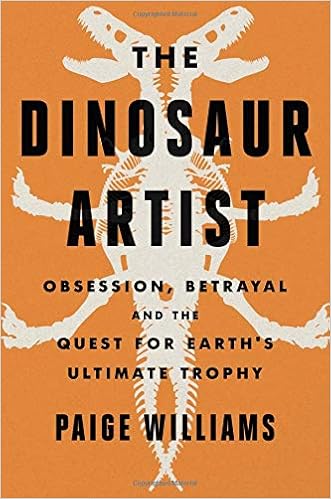
Book Review: The Dinosaur Artist


THE DINOSAUR ARTIST

By Paige Williams

Hatchette, NY, 2018. 410 pp (278 text, 132 endnotes, index, etc.)


This much-praised book opens a window into a world those of us in the general dinosaur-aficionado community don’t know much about: the trade in illegally or quasi-legally trafficked fossils.  Fossil prices have gone through the roof, so the average hobbyist has to save a long time to afford a small T. rex tooth ($2,499.00 as of today on eBay) in a market full of fakes.   Williams explains how this situation arose, including the effect of movie stars like DeCaprio and Cage bidding huge sums for theropod skulls. 


Williams’ centerpiece is the famous case in which American fossil hunter/dealer Eric Prokopi went to jail for selling a Tarbosaurus bataar (a close relation to T. rex) shipped out of Mongolia with deceptive documents.  The main text begins and ends with Eric's story.
Williams takes us on long treks through the Mongolian desert, including the famed Flaming Cliffs site, where Roy Chapman Andrews and associates found the first confirmed dinosaur eggs almost a hundred years ago.  She also takes us through changing Mongolian politics and through the lives of Propokpi and his many associates.  We get to know people like the pioneering Mongolian paleontologist, Bolortsetseg Minjin, a woman who did more than anyone to make Mongolian fossils a national resource rather than an easily plundered source of “art” for auction in New York or horse-trading in the famed Tucson Gem and Mineral Show. (Williams emphasizes that the large majority of people and transactions at this show (now on my bucket list) are legitimate, but some strange things happen.)
The book also explores a never-ending source of tension in fossil hunting. One one side are the professional paleontologists, who prize documenting fossils in place before removal so they can visualize not jsut the dinosaur but its world. On the other are private fossil hunters, who are accused of taking fossils out of the vital context of location and strata and defend themselves by arguing they save many fossils that would otherwise be destroyed by weathering or development (both statements are true, but rarely so at the same time in the same dig site, so the tension's not going to end). Customs and other law enforcement personnel struggle to handle affairs involving changing laws, artifacts most of them know little about, and impossible-to-establish provenance (no one can match a fossil to a precise location once it’s been removed).

It’s all exhaustively researched and documented and end-noted. Williams clearly went to enormous lengths to unearth personal stories and the scientific, commercial, and legal context for them.

The generally sterling prose includes some odd bits. Williams’ seemingly pointless one-time effort at a phonetic rendering of a heavy Southern accent took me out of the story, as did the execrable mutant verb “centerpieced.”  The whole book doesn’t quite flow for me, as the side topics made me lose the main thread a couple of times. Don't forget to read the endnotes through: like post-credits scenes in Marvel movies, they hold some fascinating nuggets.  

On balance, it's a terrific book. So safari hats off to Williams for taking us on this journey. 

Sunday, December 29, 2019

2019: A Momentous Year for the Oceans

It was a momentous year. Not all the moments were bad, but let's take a look.
The conservation website Mongabay.com offered its top 10 stories for year about the oceans. 

Top 10 


Writers E listed 1) Climate change, including acidification, which scares me more than warming itself; 2) Youth leadership (not merely by Ms. Thunberg, but globally) 3) Progress toward a global ocean biodiversity protection treaty, with the U.N. hosting promising negotiations), 4) Progress in establishing marine protected areas, 5) A serious oil spill off Brazil that, for all our improved monitoring technology, has yet to be traced to a particular ship), 6) Increasing plastic pollution. with some progress here and there on regulation, 7) Arguments over seabed mining, 8) Progress on ending subsidies for fisheries, 9) Whale news - 10 more washed-up North Atlantic right whales, some glimmers of hope for vaquitas, and a great success story, restoration of the Atlantic humpback - and 10) "Marine Weirdness," a catchall for new discoveries, out of place animals, and so on.  


I don't have any disagreements here, although a couple of things merit a bit of amplification. The amazing comeback of the Atlantic humpback - arguably the most impressive comeback for a protected marine species ever - came despite an Unusual Mortality Event along the U.S. coast that saw 110 whales die of a variety of causes. 
Humpback whale breaching.
Humpback celebrates comeback (photo NOAA)

The vaquita still lives on the thinnest of razor edges.  A handful of 2019 sightings and photographs have indeed given it some hope, but only some. The most endangered of the large whales, the North Atlantic right, continued to take a beating from ship collisions and ghost gear despite increasingly tight regulations. 

North Atlantic right whale breaching out of the water.

N. Atlantic right (NOAA)

There's good evidence that protected areas increase the fish available for human consumption by creating breeding sanctuaries of a sort, with fish populations rising on all sides of the protected area.  The United States, which if often criticized (sometimes properly) on marine protection issues, has been a leader on this one, with huge protected areas being declared by the Bush, Obama, and Trump administrations. On the other hand, Russia and China have blocked an attempt to create a sanctuary in the Southern Ocean, which needs a 24-nation consensus among the Conservation of Antarctic Marine Living Resources (CCAMLR),  plus the European Union.. 

Seabed mining has long been a bone of contention. It's  not certain which types of mining for which resources could be made to pay commercially, but countries in need of particular resources (for domestic use or for strategic advantage) may not care about that.  The U.S. in particular, through five Administrations, has never found a treaty the President and Congress would both buy into. The Pew Environmental Trust has a good overview of the topic here. 

So there's a lot of work to do, but as 2019 closes, we can at least say there's no one who doesn't  KNOW there's a lot of work to do.  

Thursday, December 26, 2019

Air Force historian's review of The First Space Race (and a discount sale!))


This is our favorite of the First Space Race reviews, by a professional aerospace historian.  

Published in government (not subject to copyright) publication High Frontier, Air Force Space Command's professional journal (the journal is now, sadly, extinct: we hope it will be picked up as the AFSPC transition to U.S. Space Force continues).  
(The paperback version is now on sale via Amazon at only $4.85!!!!)


Book Review

The First Space Race: Launching the World’s First Satellites. 
By Matt Bille and Erika Lishock. College Station: Texas A&M University Press, 2004. Illustrations. Photographs. Notes. Glossary. Bibliography. Index. Pp. xviii, 214. $19.95 Paperback ISBN: 1-58544-374-3

Nobody should assume the history of American and Soviet space programs during the 1950s has been chiseled in stone. Matt Bille and Erika Lishock [ed: now Erika Maurer] make this perfectly clear in their new book titled The First Space Race. 
Through thoughtful analysis of events generally familiar to space historians and vigorous pursuit of details obscured by the passage of time, the authors supply new insights to one of the Cold War’s most dramatic chapters. As the legendary James Van Allen admits in the foreword, this volume even provides still-living participants in that race with a “much improved context for their own fragmentary knowledge.” 
It took several centuries to lay the foundations for successful launch of the world’s first artificial, earth-orbiting satellites in the late 1950s. During the 17th century, Johannes Kepler and Sir Isaac Newton formulated the necessary theories of motion. Edward Everett Hale and other science-fiction writers in the 19th century inspired serious spaceflight theoreticians like Konstantin Tsiolkovsky, Hermann Oberth, and Robert Goddard at the dawn of the 20th century. The pace of actual hardware development quickened at mid-century under the leadership of brilliant engineers like Wernher von Braun, Sergey Korolev, Theodore von Karman, and others. 
Long-range rockets built by the US and USSR could travel through outer space to deliver thermonuclear warheads halfway around the globe. 
Informed visionaries recognized the feasibility of using those same rockets to launch satellites that would enhance national security. While long-range rocket and satellite development occurred within the military establishments of the US and USSR, plans for the International Geophysical Year (July 1957-December 1958) committed both countries to launching satellites for scientific research. The Soviet Academy of Sciences created a Commission for Interplanetary Communication, chaired by academician Leonid Sedov, to oversee its IGY satellite program. Meanwhile, a committee headed by the Jet Propulsion Laboratory’s Homer Stewart selected the US launcher and satellite from among several proposals by the military services. 
On 4 October 1957, the USSR launched Sputnik, the world’s first artificial satellite. After the US Navy’s failure to launch a Vanguard satellite on 6 December, the Army put Explorer 1, America’s first satellite, into orbit on 31 January 1958. Both nations commenced “storming the heavens” with civil and military satellites. 
Bille and Lishock drew information from a variety of sources—written and oral, primary and secondary, older and recent— to tell this complex story in a relatively straight-forward, simple style. They discuss how erroneous “facts” have crept into the literature over time. For example, the color scheme on museum models of Explorer 1 differs from the actual flight article. Furthermore, the Goldstone tracker could not have confirmed that Explorer 1 was in orbit, because Goldstone was set up months later to support the Pioneer lunar probes. The authors analyze in depth the Stewart Committee’s choice of the Navy’s proposal over the Army’s, the relationship between early military and civil satellite programs, and the question of whether the US purposely refrained from being the first to launch a satellite. Finally, they surprise readers with a description of NOTSNIK, a “secret competitor” that aimed to place tiny satellites in orbit via a five-stage booster launched from a US Navy fighter aircraft. 
When one considers that neither Bille nor Lishock is an academically trained historian, the rigor of their research methodology becomes all the more remarkable. Anyone wanting to know how these two associates with the global consulting firm Booz Allen Hamilton successfully managed this project should read their article titled “Chronicling Space: Adventures in Space History” in Quest 11:4 (2004), pp. 7-13. The authors explain its genesis and evolution from a manuscript titled “Little Star: The History and Promise of Small Satellites” toward the published work that is the subject of this review. 
Along the way, Bille and Lishock had the good fortune to interview such space luminaries from the 1950s as James Van Allen, Milton Rosen, Ernst Stuhlinger, Fred Durant, and William Pickering. They also learned that obstacles sometimes thwart research plans, that serendipity can play a delightfully rewarding role in the discovery of information, and that the practice of historical writing involves more than merely recording names and dates. 
The First Space Race engages interested readers to the point where they will have difficulty putting it down before turning the last page. Bille and Lishock have achieved a wonderful balance between the American and Soviet sides of the story. Their new research and refreshing analyses correct inaccuracies that have crept into the literature over the decades and prompt space historians to question causal connections they once took for granted. Despite a few editorial errors, this volume offers space professionals a window on how past spaceflight successes might broaden our perspective on future possibilities.
Reviewed by Dr. Rick W. Sturdevant, Deputy Command Historian, HQ Air Force Space Command

Tuesday, December 24, 2019

A few favorites from Paleontology


Dinosaurs: How They Lived and Evolved by Darren Naish and Paul Barrett  
Smithsonian, 2016: 224pp.
Naish, a paleozoologist, and Barrett, a paleontologist, have given us an altogether splendid treatment of what, as of just a couple of years ago (this business changes fast, especially regarding feathers) we know about dinosaurs.

The Rise and Fall of the Dinosaurs: A New History of a LostWorld by Steve Brusatte
William Morrow, New York, 2018. 404pp.
In Rise and Fall, the latest in dinosaur science is presented in a highly readable science book doubling as a rip-roaring adventure tale. The story of dinosaurs, not just as fossils but as real animals, is masterfully presented

Fossil Legends of the First Americans by Adrienne Mayor
Princeton University Press (May 1, 2005) 488 pages
 Mayor is a scholar of the overlooked chapters of history and prehistory, such as historical Amazons and early automata. Here she asks what Native Americans thought of the fossils in fossil-rich North America, and uncovers a treasure trove of anecdotes, myths, and fossils.

Prehistoric Animals.  Text by Joseph Augusta, illustrated by Zdenek Burian. Translated by Greta Hort. Spring Books, London. (Reviewed edition is 1963: numerous versions and reprints exist.).
While much of the knowledge in this book is outdated, its influence and the excellence of the writing and illustrations enthralled a generation of professional, student, and public readers. Dr. Augusta's text is fine and the 60 plates, many in color, by the great Zdenek Burian are classic.


Saturday, December 14, 2019

The starry night frog and other rediscovered species

Rediscovery of a species missing for decades. This is one of those cases where scientists could have rediscovered it much earlier, but they neglected to ask the locals in Columbia about it., or asked the wrong one.

Here's an article from a couple of years ago listing five more rediscoveries. While the Javan elephant  may not count (that case is about identifying the ancestry of a known population), it's a good reminder that hope can be abandoned too quickly when a species goes missing. 

Collected Reviews: Books on Zoology and the Environment

Books are the best Christmas gifts, right? The best idea is to buy my books, but if you don't, here are some I liked from the past two years.  I'll collect the ones on other topics in upcoming posts. 

Vaquita, by Brooke Bessesen
The tragic, infuriating story of how humans are driving the vaquita to extinction.

Spying on Whales, by Nick Pyenson
One of the truly great books on cetaceans, with the latest research.

Orca: How We Came to Know and Love the Ocean's Greatest Predator   
by Jason M. Colby 
A unique book tracing the beginnings of the orca's transition from the target of fear and hatred to an (unwilling) performer.  

David C. Xu, Coachwhip 

On Thin Ice: The Changing World of the Polar Bear. 
Richard Ellis,  Knopf  
A biography of the world's most remarkable bear and its conservation

The Bountiful Sea
Seabrook Hull, Prentice-Hall, 1964
Revisiting an old classic on how humans would explore and live in the sea

Gold Rush in the Jungle
Dan Drollette, Jr
Amazing book on the discoveries of new mammals in Southeast Asia and the reports of still-mysterious ones

The Lives of Hawai‘i’s Dolphins and Whales: Natural History and Conservation
Robin W. Baird, University of Hawaii Press 
  • Gorgeously photographed and stuffed with the latest information, including some eye-openers like false killer whales including humans in a game of "pass the dead fish."