Sunday, February 10, 2013

When should we see sea serpents?

A thought experiment... I'm one person who suspects there is still, after all these years, a grain of truth behind the sea's most magnificent legend, that of an unknown creature misleadingly but universally called the "sea serpent."  There are many hundreds (maybe thousands) of sightings, and, in the consideration of two experts writing decades apart, around 350 interesting ones.  

Sea serpent reports have definitely dropped off in recent decades, to less than one per year.  But how often should they be sighted, if there is a real animal involved?

I caution at the outset there are no good numbers for many of those figures, and I chose numbers that seemed reasonable and made the math simpler. So this is a simplification of a complex situation using arbitrary numbers, but one has to start with something, and the problem of how often humans might be expected to spot a possible sea serpent niggled at me until I had to try something.
 

The world’s oceans cover139,000,000 square miles (statue miles). A variety of Web sources give figures of 12,000 to 90,000 vessels on the oceans at any moment.  Let’s use a high number, 50,000, which covers (we are presuming) everything large enough to have a lookout (small pleasure craft, for example, would be excluded for the moment). A lookout can see 1.17 times the square root of his or her eye height above the ocean, in nautical miles (note the diversion in units here: you'll see it's not enough to matter), so from an arbitrarily chosen 49-foot spot on a mast or bridge that’s 8.19 miles.  An object rising above the water essentially raises the horizon: you could, in perfect conditions, spot the head/neck of an animal rearing 9 feet out of the ocean 8.19 + 3.51 miles away, or 12.7 nm.     
In practice, no one can identify much of anything at that range, especially if sea serpents are sometimes wont to stick only the head or a small section of body or neck (if it has a neck) above water. Let’s say you can definitively identify a sea serpent (assuming there is such a thing) and rule out debris or known marine life at one half a statute mile.   There’s no way to calculate the average eye height of the lookouts of all the ships at sea (and not every ship will have a lookout at all), not to mention who’s carrying what binoculars, so this business quickly gets rather silly, but if we assume, say, a ship can watch a circle of ocean a mile in diameter (area 3.14 miles) for sea serpents, and there are 50,000 ships with lookouts, then you get a figure of 157,000 square miles being observed.  If there are 139 million square miles of ocean, then 1/874th (0.1129 percent) of the surface would be under observation, and a population of 1,000 sea serpents showing themselves for, say, five percent of their time at the surface (it could be far lower), 20 might be visible somewhere, and if they are identifiable in an area of 3.14 square miles, you get an area of 62.8 square miles, or 1/221338 the area of the sea (or 0.0005 %) showing sea serpents at any time, and if you try to calculate the likelihood of these areas intersecting  the other the math goes from extremely hypothetical to absurd (any readers care to take a crack at it?).  Actually, it’s worse than this: half the time it’s dark, a considerable percentage of the time there is a sea state that makes identification harder, or it’s raining, or it’s foggy, and the fact that lookouts on the open sea spend most of their time looking forwards… well, you get the picture.  Or no one gets any pictures.

Comments and brickbats welcome.

Saturday, February 09, 2013

New fish from New Zealand

Every once in a while, it's important to remind ourselves we're still finding stuff.  Take this eelpout. Please.  A decent-sized fish by deepsea standards.
Dr. Alan Jamieson sent a press release that celebrated the find and added, "A voyage such as this is testament to how feasible scientific research in the deep sea has become. It is no longer the inaccessible, out of reach, part of the world it once was. The technological challenges of the past no longer exist.." it's hard to agree the challenges no longer exist. A world of complete darkness and crushing pressures is always going to be a challenge.  But we're getting better.  

Thursday, February 07, 2013

African tragedy: Elephant poaching zooms again

A decade or so ago, conservation authorities thought a ban in trading ivory had helped them get a handle on African elephant poaching.  Sadly, it didn't last.  Concentrating on the forest elephants of Gabon, whose hard, pink-tinged ivory is in (mostly illegal) demand in Asian markets, poachers have killed 11,000 elephants in the last eight years. In the protected national park of Minkebe, 44 to 77 percent of the elephants have been wiped out. (Forrest elephants are hard to count precisely, being smaller than their savannah cousins and residing in, of course, forests.)

The World Wildlife Fund has asked people to sign this petition. I have always been unsure of the impact of such petitions, but it's worth a try. Scientists hope an upcoming CITES meeting will be persuaded to close loopholes allowing the ivory trade to ocntinue.

Monday, February 04, 2013

Loren Coleman's new online digs

Loren, perhaps the most prolific American writer of cryptozoology, has left the site www.cryptomundo.com and oepned a new blog here at CryptoZoo News.  He has archived about four thousamd (!) posts from Cryptomundo and a variety of other forums.  It's well worth your perusal!

Dinosaurs, Cryptozoology, and all that from Darren Naish

Dr. Naish is a major contributor on cryptozoology as well as the describer of several new species of dinosaurs and their relatives. Here he has gathered all his publications, most available online or as pdfs. If you like donosaurs, flying reptiles, icthyosaurs, or sea serpents, enjoy.

Thursday, January 31, 2013

New Study: Thylacine never had a chance

According to new research and mathematical modeling, Tasmania's marsupial "tiger" might hvae been on a path to extinction before it even met humans. But once the two species did meet, the ending was grimly predictable.
The thylacine was already set up for trouble in the long run by low genetic diversity.  That itself is survivable: the cheetah has the same problem.  But when humans put bounties on it, converted prime habitat to sheep farms, and wiped out its prey species (a factor not much taken into account by earlier studies - I'd never thought about it), the modeling shows it had nowhere to go but down. A distemper-like disease was suspected because of how fast the "tiger" slid into extinction, with the last definite specimen dying in a zoo in 1936.  But apparently, we needed no help from microbes.
COMMENT: Cryptozoologists still look for this animal, and a trickle of sightings in Tasmania, on the Australian mainland, and in New Guinea give some reason to keep looking.  But while the animal definitely survived past 1936 - I think the evidence is very solid on that - its current chances, while not zero, are tragically small.

History: The family that time forgot

Or rather, they forgot time.  Driven into the wilderness by the Communist purges of the 1930s, this family built a home 150 miles from the nearest village.  They relied on faith and what they could harvest or scrape from the Siberian woods around them for decades, never seeing another human, improvising everything from shoes to cooking stoves with no source of metal, teaching their children to read and write from an old Bible.  A remarkable story. 

Tuesday, January 29, 2013

How many people DON'T see cryptids?

Something I don't think I've ever seen figured out in a cryptozoology article: if X number of people in a position to see something (for example, boating on Loch Ness) have seen the local "cryptid," how many have not, and does the ratio matter? Granted, the number of reports made is the only firm number in such cases, but could a guess be made of how many people boat on Loch Ness, or live and travel on the shores with a view of the water? Surely pretty much all of them are aware there is something famous to look for.
It would take a lot of work (surveys, I guess) to even estimate what the ratio between "Reported" and "Saw Something but did Not Report" is, but it's still an interesting topic, and Loch Ness might be the easiest target for such research.
This has always troubled me with spectacular cryptid creatures.  How many zillion birders do NOT report seeing Thunderbirds in the Ohio Valley, etc.

Monday, January 28, 2013

Discovery's show "Monster Squid"

Well, Monster Squid: The Giant Is Real does ramble a bit, including some peripheral material to stretch it out and build suspense before the big  reveal - the first direct human observation and first video of Architeuthis.  Edie Widder told an interesting story, with very clear video, of filming a six-foot (1.8m) squid off Monterrey Bay that she "couldn't even place in a scientific family." There are good comments from Clyde Roper and Steve O'Shea, who have been after this thing for decades, and Richard Ellis, among others.  Then you get to the big video, and yes- it's everything you can want in a monster. Alien, big (over 8m if the long tentacles had been intact), rippling, flowing, not so much swimming as flying underwater. No creature created for the movies quite conveys the essence of this truly bizarre animal. (The promos for the new documentary Africa looked pretty good, too.) Amazing work!

Sunday, January 27, 2013

Name all the species!

These folks opine that it's not quite as overwhelming a task as we'd thought.

What Cryptids Should We Give Up On?

What Cryptids Should We Give Up On?


It might be the toughest, though rarely spoken, question in cryptozoology. Should cryptozoologists forget about some cases?

It’s a hard question for a number of reasons. First, no one has the authority to make a list and dictate to anyone what they should forget about. Second, the evidence for different cryptids can get better over time (or worse, if a hoax is revealed).

Finally, what standards do you apply? If the evidence doesn’t improve for 50 years, say, do you drop the case? A hundred years? A thousand?

I pulled the “50 year” example from the old IUCN standard that a species unreported for 50 years was considered extinct. They no longer use that – it’s now “When there is no reasonable doubt the last individual has died” – but that’s not a perfect standard either. Witness the extinction and subsequent evidence for Miss Waldron’s Red Colobus.)


Sometimes it’s not difficult to give up. If a cryptid fish or lizard or bird, for example, was reported from a restricted habitat, and the habitat has been drained or paved over, ok. But wait. Is even that an easy rule? What about the ivory-billed woodpecker? Almost everyone gave up after the last known habitat, the Singer Tract in Louisiana, was logged out. But the bird was rediscovered (briefly) in the form of a Cuban population written off after its habitat was destroyed, and then again in the U.S. in Arkansas. The bird had been extirpated from its known habitat but found another suitable patch, or it was there all along. (Yes, I think the rediscovery was genuine, but I realize that creates a whole additional layer of judgment/opinion.)

Let’s focus from here on out on the large animals. Draw a line for terrestrial or marine creatures at about 20kg, just because you have to draw a line somewhere. Insects, rodents, small fish, and birds often get around too easily to be sure about. Let’s also set aside reclassifications, when someone making a DNA study, for example, finds that a known group of dolphins should be divided into two species based on genetics. We’ll focus on sizable animals looked for by scientists (calling themselves cryptozoologists or not) in the field. As shown by van Roosemalen’s peccary, such discoveries do still happen, and I’m quite certain that more are coming.

So when can we be sure of abandoning a search? Well, some very small lakes in Ireland and Scotland reported to house sizable animals have been cleared with nets and/or dynamite. So I’d forget about those. But those are easy cases, or they should be.


Possible standards: Here are Seven Rules for When to Give Up. These are a bit messy and overlapping, and there are known exceptions to all of them, but we must start somewhere.

- No one has reported the animal in 25 years (somewhat arbitrary, but ½ of the old IUCN standard feels about right: the standard was written when travel and communications were much more limited)

- A large majority of the known or suspected habitat has been destroyed

- Scattered sightings have continued, but the quality of evidence hasn’t changed in 25 years – that is, all we have are a limited number of additional sightings, no hard evidence or good imagery

- The animal is very unlikely based on the habitat, food chain, etc. and there’s no hard evidence

- We have no fossil evidence of it or its recent ancestors in the region in question

- With presumed-extinct species, the opinion of authorities like government bodies, the WWF, and the IUCN is lined up solidly on the “extinct” side

- When the creature was reported once, or in a brief period, and there are no credible sightings since.

An animal meeting one or more of these standards is at risk unless the evidence is good. For example, the fossil rule is helpful but not by itself definitive: all the known chimp and gorilla fossils could go in my hat. We certainly don’t know all the fossil species even on well-trodden continents. But it’s a factor. Even an animal meeting three or more rules might reappear: the Bermuda petrel survived habitat destruction and three centuries without sightings – but it makes it so improbable the limited resources should go elsewhere.

So on to some practical cases. If there was a single global cryptozoological organization, and I was head of it, where would I stop expending resources?

Here are some I would give up on:

Champ. While some of the reports seem compelling, the lake freezes over. If you postulate a reptile or mammal evolved gills, you can argue that – stranger things have happened – but the further out on an evolutionary limb you have to go, the weaker that limb gets. The odds are just too long to make it worth the effort of looking, especially with no decent film/video evidence (the Mansi photo, I think, was of a floating log). Chad Arment pointed out to me the pattern of freezing should allow for significant amounts of air to be trapped beneath the ice, and some seals survive in similar situations, but I can’t see that as a long-term survival strategy: one unusually hard and fast freeze, and the whole species is dead at one blow..

This gets into the tricky business of evaluating eyewitness reports, especially for those of us who have not met the witnesses. But even the most ardent cryptozoologist has to admit that not all the large creatures around the world supported by apparently sincere eyewitness accounts are real. As Frederick the Great once said, “He who defends everything defends nothing.” Unless the world is swarming with large undiscovered species, you have to throw some of them out. Once you’re past that hurdle, what standard applies? You have to dismiss some animals despite what witnesses swear to, because there’s no other evidence and/or the environmental factors make it unlikely. The reports of sasquatch-like creatures in the British Isles are a good example: we have no evidence for any primate life on the islands ever, the wild habitat has steadily shrunk, the reports are rare and unsupported by any other type of evidence. Whatever people’s experiences, there is no physical giant primate involved.

Live dinosaurs as a group. Yes, the coelacanth proved a Mesozoic creature could exist despite a gap in the fossil record. However, every post-1938 discovery of an animal from that era has been tiny (neopilina, remipedes, graptolites, and so on.) Every one. At some point, you have to quit. No part of the terrestrial habitat went through the K-T event untouched, and no place has been static dino-suitable habitat continually for 60 million years. (See Jacobs’ Quest for the African Dinosaurs (sneering in tone, but scientifically persuasive) concerning the habitat for Mokele-Mbembe. There might still be something, like a big monitor lizard, at the heart of the Mokele-Mbembe tales, but no dinosaur.)

Nessie. Yep, Nessie. It hurts me to write off this beloved myth, but I think it is a myth, or, at best, a lone creature that found its way into the lake as a youngster and has since died. (I do believe there’s at least one elongated marine animal reported as a “sea serpent,” so I’m not contradicting myself here.) I don’t consider all the evidence explained (the Dinsdale film still doesn’t look like a boat to me, although I could be wrong), but there’s been nothing since the 1970s that made me really pay attention, and the ecosystem to support a standing colony or large predators isn’t there. There are few reports and no photographs of anything traversing the River Ness, and the water level rules out an underwater tunnel, so I don’t think we’re dealing with something that comes and goes.

A few years ago, I would have chucked Sasquatch into this Phantom Zone. Missing a huge primate in North America seemed absurd. Frankly, it still does. But a few of the 2000-and-later reports, plus Pyle’s ecological analysis, have moved the needle on my “Real or Imaginary” gauge just a bit. I don’t find any of the imagery to be definitive, not even the PG film, but I want the Big Guy to exist, and maybe, just maybe, he does.

We don’t have to dismiss all the large land animals. New populations of very large land animals have been found recently, and that’s not very different from finding new species. We have the mainland population of the Javan rhinoceros (soon re-exterminated by poachers), the distinctive-looking Asian elephants of Nepal’s Bardia National Park, and the spectacular discovery of an estimated 100,000 or more western lowland gorillas in 2007. It’s been a while since a new species of land animal over the 100kg threshold was found (Vu Quang ox, 1992), but there are quite a few examples since then of smaller but still substantial animals and the aforementioned new populations. So we don’t have to forget about all large cryptids on the basics that all large animals have been found. They may well not have. The orang-pendek and van Roosmalen’s jaguar (the latter likely being a subspecies) are examples of such animals likely to be confirmed soon.

Online Discussion Results

When I put this out on FaceBook pages, I got some interesting suggestions. First, Matt Wetzel pointed out that investigations of remote areas normally produce some useful scientific data even if no cryptid is found, or if it’s a known animal that was outside its known habitat or activities (the ri case comes to mind), and that’s true as far as it goes. Ian C. Thomas suggested this rule: “Definitely once an environment that purportedly supported the species is gone.”

Karianne Muckle on MonsterTalk offered a helpful response: “When your lack of evidence (and evolutionary evidence against) your subject is so overwhelming that it can no longer be ignored.”

Kyle German added a point I hadn’t thought of: “When it appears and disappears within a very short timeframe, say twenty-four to forty-eight hours. Think of the Dover Demon and the Enfield Horror. Both creatures that have yet to reappear.” I added that one to my Rules.

Skeptical writer Ben Radford felt that “if something hasn't been reported in decades (such as the thylacine), it's probably safe to assume that it's no longer alive, even if it was recently.” In fact there have been a few recent thylacine sightings, but the point is valid, and I already had a version of it in my rules.

Someone (I can’t find the post) suggested, “When your book about it no longer sells.” Oft in laughter is the ring of truth: when you can’t spark any interest outside the small circle of cryptozoologists, you may still be right, but it is cause for reflection. As someone said, “To claim the mantle of Galileo, you must not only be suffering ridicule: you must also be provably right.”

Now, what about recent extinctions? I’ve written separately about the fact that cryptozoologists must understand there may never be a solution to every mystery. The Queensland marsupial tiger or yarri is an example of an animal that may well have existed (there are fossils of thylacoleonids that might fit the bill) but might now be gone. The suggestion of “one and done” sightings of now extinct animals has been offered in other cases, such as Steller’s sea monkey and the predator photographed by Rilla Martin in Australia in 1964 (which might in fact be the yarri, though the match to descriptions of the living animal is problematical.) Discovering that an animal did recently exist (for example, finding thylacine remains from the late 20th century) can be a significant scientific find. So some searches are worth doing even if no one is sure a species is still breathing. I wonder if the yeti might turn out to belong in this category.

Some people will find this list too harsh, too skeptical. Others might think the opposite.  But I repeat, these are indicators I'm offering.  No one rule suffices to declare a species beyond the pale.  But the fact is we do have limited resources, and that is true of any branch of science.  No one, astronomer or zoologist, has all the resources he or she might desire.  So hopefully, I'll start a worthwhile conversation.

There ARE new animals out there, and some will be spectacular.  Keep exploring!

Top 10 lists - new species of 2012!

There are plenty of Top 10 lists of new species or of animal discoveries.  A lovely box jelly, a monkey with an upturned nose, a millipede with 750 legs, a blue tarantula, a toothless rat... some of these actually reach back to 2011, but here's the lesson... never stop exploring!

Popular Science

International Institute for Species Exploration

National Geographic

The Week

TIME (one of those including fossil discoveries, like the "shield croc")

Have fun!


Saturday, January 26, 2013

Cool Cats in Colorado

We are so worried about the state of so many species that's it's a refresher to take a moment and appreciate a conservation success, especially when it's this beautiful.  Steve Chaney, a retired National Parks Service ranger, in the southwest of my home state of Colorado.  Lynx were thought, 40 years ago, to be extirpated from the state (About that time, the same situation was declared for the Colorado grizzly bear population, although a trickle of evidence continues to suggest that might be wrong.)  Anyway, in 1999 an aggressive reintroduction program began, eventually totaling some 200 animals.  There have, through 2010, been at least 141 kittens born to this population.  Tthis view of two lynx crossing a snowy road has gained impressive popularity, with thousands of views and Reddit upvotes, whatever those may be. 

Thursday, January 24, 2013

"Neanderthal Cloning" = media ignorance of science

The guy who is widely reported to be looking for a mother for a cloned Neanderthal baby is doing nothing of the kind.  George Church, a Harvard geneticist, was quoted accurately in the magazine Der Spiegel when he speculated about whether such a thing could be done.  But this led immediately to global headlines saying he was going to do it and was looking for a suitably adventurous woman to carry the baby. 
Thoughts:
There was a thread on the National Association of Science Writers group I belong to complaining scientists talk less to the media than they used to.  Well, this episode illustrates why.
This item on LiveScience explains how hard this would actually be, and how unlikely it is with near-term technology.  Because we have sequenced Neanderthal DNA doesn't mean we can jump from that to a clone. We can't, at present.  And a really troubling point is that, even if we could, we'd have dozens of failures for every success.  There's no ethical way to think about that.
Of course, if someone really WERE looking for a surrogate mother, in this age of people doing anything to be on reality TV, someone would do it. And it would be televised.
Finally, Isaac Asimov wrote a very touching story, The Ugly Little Boy, about a woman asked to be caretaker for a Neanderthal boy, albeit one brought back through a time-sampling device. It was later expanded into a collaborative novel.

Monday, January 21, 2013

A thought on "living dinosaurs"

No one can resist dinosaurs. Even more than dragons (see post from a few days ago), dinosaurs hold our imagination because they were the real dragons - and European and Chinese chroniclers of dragonlore never invented anything more impressive. 
Dinosaurs, it is almost universally thought, disappeared 60M years ago following the so-called K-T impact, when the world changed, the dust clouds and cold descended, the dinosaurs died off (not instantly, but pretty quickly in geological terms) and the way was cleared for the ascendancy of mammals and birds.  Occasional claims of post K-T dinosaur fossils are written off as mislabeled or reworked from older deposits as land folds, rises, or recedes under the pressures of millions of years' worth of geological processes.
Dr. Karl Shuker, always worth reading on this subject, offered a Top Ten claims of surviving dinosaurs. Some are easy to dismiss: there's no evidence motorists in Chile in 2004 saw velociraptors, or that a "stegosaur" bas-relief carved in Cambodia shows anything except a boring old tapir in front of a bush.  Stories from South America and Australia are, in general, sourced from one person, or someone claiming to quote indigenous people who are now long dead.  Trying to overturn the dinos-are-dead paradigm with this material is like charging an elephant armed with a broom handle. 
The one that pops up as relatively well-sourced is mokele-mbembe, known by several other names as well and described from various places in the Congo River basin in Africa.  I say "relatively" because there are some 20th-century sighting reports, and there are some photographs and videos, taken (either unfortunately or expectedly, depending on your point of view) from too far away to show anything useful. Dr. Roy Mackal, who went on an arduous expedition but didn't see the creature, thought it could be a small sauropod or possibly a huge monitor lizard.  He wrote an undeniably intriguing book on the subject. 
And yet - many expeditions later, we don't have a good sighting by an outside scientist, a good image, any remains of an animal.  Paleontologist Louis Jacobs, in the only book on African dinosaurs, ridiculed it, arguing this area is not a "lost world" unchanged since the Mesozoic. 
My take? We're not going to find a dinosaur. Not in Africa, not anywhere.  I think we are going to find more large land animals, but if we've already seen the best evidence, we haven't seen enough to support anything as science-shattering as living dinosaurs.
Unfortunately. 

Sunday, January 20, 2013

Manatee Nebula: A wonder in the cosmos

Officially, it's called W50.  What's that, a lubricant?  Boring.  Fortunately, astronomers, like the rest of us, can be moved by the beauty, however coincidental, of a natural wonder. So here we have the Manatee Nebula. 18,000 light years from Earth, the remnants of a star that exploded 20,000 years ago have swirled into this picture - surrounding a black hole.  So why can we appreciate beauty, anyway? There's no evolutionary advantage to it?  Is it - dare I say it - a spiritual gift? 

Saturday, January 19, 2013

Tigers of Korea and Sumatra

Wandering through the world of the tiger, the most magnificent cat that ever lived....

The tiger is believed extinct on the Korean peninsula, although there are occasional sighting reports.  Now Korean scientists, while speaking of their nation's tiger in the past tense, report they have identified its proper classification and affiliation. Studies from tiger remains up to a century old indicate the Korean specimens were of the same subspecies as the Amur tiger, which is still hanging on (about 400 survive in the wild)  in eastern Russia.  Professor Lee Hang takes heart in this: "The fact that the Amur tiger and the Korean tiger are of the same bloodline means the Korean tiger is still alive."
There was an article linked to on FaceBook recently saying a Javan tiger had been caught in a camera trap, but I can't locate it now, and it was likely old or incorrect: that would have been worldwide news, as the Javan tiger is widely considered to have joined the Bali and Caspian tigers in the darkness of extinction in the 20th century. The Sumatran tiger isn't doing much better.  it exists, but under extremely precarious conditions. So, as I wrote a few days ago, the global tiger population is up a bit, with some bright spots for subspecies like the Bengal tiger, but other populations (the aforementioned Amur, for example, and the South China tiger as well as the Sumatran) are still in deep trouble.
Everyone says William Blake's poem about the tiger was really about the Industrial Revolution or something, and Blake was a mystic who often melded themes, but has there ever been a better description? "Tiger, tiger burning bright / in the forests of the night / what immortal hand or eye / could frame thy fearful symmetry?" 

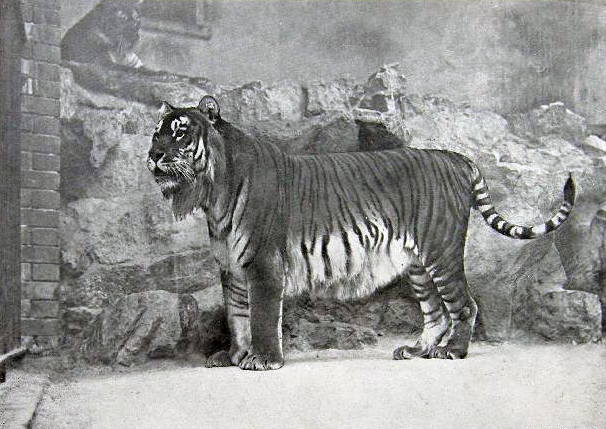
This was the Caspian tiger, photographed on exhibit in Berlin in 1899.


Tuesday, January 15, 2013

Major Ferret Find!

The black-footed ferret was declared extinct at least twice before being rediscovered by a mixed-breed dog named Shep who dropped one on the porch of his house in Wyoming.  Conservation biologists have put enormous effort into breeding them in captivity (there's a colony at the Cheyenne Mountain Zoo here in my hometown of Colorado Springs) and releasing them into the wild.  A biologist from Columbus, Ohio has found something  startling and potentially very important: a new wild population.  Over fifty miles from any relocation site, Mike Gutzmer found three ferrets on the Standing Rock Indian Reservation in South Dakota.  While the status of the ferrets is still being double-checked, the chance of introducing new genes into the population - all known ferrets are descended from 18 animals taken into captivity in a last-ditch effort to save the species - is exciting biologists. A "population bottleneck" is never a healthy thing, since the individuals bred from a small group will likely share some genetic weaknesses.  Gutzmer may have made a giant step toward the permanent survival of the little black-masked outlaw of the prairies.

R.I.P., Ivan Mackerle

Anyone outside cryptozoology will likely be unfamiliar with this name.  Ivan was a cryptozoologist, certainly the most eminent in the Czech Republic, but anyone can be "a cryptozoologist." What mattered, and why Macklerle mattered even though he never found a new species, is that he put his life where his mouth was.  Over four decades, he traveled, paying out of his own pocket, to New Guinea, Australia, Brazil, Madagascar, and other far-flung places.  He wanted to see everything for himself, look with his own eyes, follow up reports in person. Science depends on such people, be they amateur or Ph.D.  Read Karl Shuker's tribute here.

Sunday, January 13, 2013

Cryptozoology is not Parapsychology

There's always been a little disturbance in the force known as cryptozoology, one that gives the field some of its difficulties in achieving scientific credibility.  Some zoologists look askance at the whole endeavour because of the perceived focus on animals such as sasquatch which are perceived as highly unlikely, if not absurd.  I have no problems here: as long as the chance of finding an animal is not zero, people can look without making the field scientifically invalid.  In science, most long shots don't pay off, but some do.  The key is whether searching is being done in a scientific manner, proceeding from the evidence to gather more evidence and meeting Popper's classic criteria of the falsifiable hypothesis.  (There can be disagreement on how much negative evidence, or how strong a logical case, is needed to falsify a given hypothesis, but the point is that a hypothesis like "There is a large unknown primate in North America" is perfectly scientific.  The means to search every possible chunk of forest habitat definitively are not available, but the reasoning is fine.)

Then we get into another problem: the allegedly paranormal/psychic/parapsychological nature proposed for some cases.  I don't mean to pick on Nick Redfern, a very dedicated researcher, and a most enjoyable and often thought-provoking writer, but having just read his book Monster Diary, he is the example that comes to mind when thinking of people who class things that look like animals under cryptozoology, even if they are clearly not physical animals.  I'm well aware that sane and sober people have reported apparitions, and I have no particular insight into what mix of causes is behind that phenomenon.  It's not my field.  But here's the part where I and Nick depart ways.  He and other other like-thinking investigators argue that apparitions of animals are part of cryptozoolgy, and, as Nick puts it in his book, cryptozoologists in some cases will go on chasing sightings without results "unless the field of cryptozoology wakes up and and realizes that there needs to be a new approach to the subject."

I would flip that around.  My position is that, if there is no physical animal, or no reasonable chance of one, the case no longer pertains to cryptozoology or any kind of zoology.  If someone believes they saw a sabretooth tiger that disappeared into thin air, for example (and this happened, as Nick recounts) , then the fact that the apparition was in the form of an animal doesn't put the event under the heading of cryptozoology. It can be parapsychology or any other field one may think appropriate, but if it's not zoology, it's not cryptozoology.  People who thing sasquatch is so elusive because it's not a material creature are welcome to hold that opinion, but they shouldn't call that topic part of cryptozoology.  It's part of the whole business of apparitions and spirits and the paranormal. It also, critically, is not a falsifiable hypothesis (you can never prove such a belief to be wrong) and therefore is not part of the physical sciences.  If a definitive search (in the cases where it's possible) fails to find an animal, then it's because the animal either did not exist in the area, has gone extinct, or has migrated elsewhere.  

An animal is by definition a physical thing of flesh and blood. It's there or it's not.  I don't dismiss the possibility of a nonmaterial reality: as a Christian, I believe strongly that the material universe is not all that exists.  But an apparition is not an animal, any more than it can be a human being.  It may be reported sincerely to look like one, or even act or sound like one, but that's not the same thing.  

I wrote in my 2006 book Shadows of Existence that I was dismayed that a very good book by Healy and Cropper on Australian mystery animals spent a chapter on "zooform phenomena" after spending the rest of the book scientifically discussing unknown creatures. I feared that zoologists would dismiss the whole book because of this direction.  I don't know how to take a survey on this, but I have no doubt I was right, and still am.  Cryptozoology will never get the respect of zoology if paranormal entities are part of it. 

And, if cryptozoology is the search for hidden ANIMALS, then they should not be.  The experiences of people who see a big cat seemingly dive into the ground and vanish, or a small herd of camels appearing where none can be, are not beneath our notice. They are simply part of another field of study.

Saturday, January 12, 2013

Death Star remains fiction: What about NASA?

The White House has responded to a petition by declaring it will not put a Death Star into the budget anytime soon.  Paul Shawcross wrote that the government is not into blowing up planets and can't find room for the $850,000,000,000,000,000 necessary.  Shawcross went on to point out there are some really interesting space hardware items already out there, including the ISS and the Mars rovers. "Even though the United States doesn't have anything that can do the Kessel Run in less than 12 parsecs, we've got two spacecraft leaving the Solar System and we're building a probe that will fly to the exterior layers of the Sun. We are discovering hundreds of new planets in other star systems and building a much more powerful successor to the Hubble Space Telescope that will see back to the early days of the universe."
Shawcross doesn't mention a lot of htings, though. Like the U.S. being dependent on Russia for human access to space for the next few years. Like the Administration's goal of eventually (long after it has left office) landing on an asteroid being rejected by nearly everyone in the space and science communities as a bizarre detour from an intelligent program to explore the Moon and Mars.  Like the savage budget cutting of the planetary sciences program: the spacecraft now up there or now under contruction are essentially all there is.  The Administration and Congress have determined that NASA's one half of one percent of hte Federal budget is some kind of indulgence rather than a future-oriented driver of technical and scientific progress with very real economic benefits.  Darth Vader would find this lack of faith disturbing. 


Friday, January 11, 2013

Giving up on China's Wildman?

The buzz about a "wildman" (presumed to be an unknown upright primate) in the undeveloped regions of China has  periodically made it into the popular, and even the sceintific, press, as hairs or body parts not immediately identified have been found and eyewitness reports collected.  Now, though, an anthropologist who has followed the topic for half a century reports "...a Chinese Wildman of biological significance still has not been shown to exist, and simply may not exist." All the biological samples in Bejing anthropologist
Zhou Guoxing's collection have turned out to be from known creatures, and he classes the most detailed eyewitness accounts as fabrications.  His disappointment is evident - he was once an enthusiastic field investogator of Wildman tales - but this is where the evidence has led him. 
COMMENT: Darn.  There were times when this case looked really intriguing.

A better look at "hobbits"

Just over a meter tall, the "hobbits" of Flores weren't very impressive physically. They had longer arms than legs, and their sloping foreheads and chinlessness made them look less like us than we might picture.  However, they were still, as further confirmed by new fossils, genuine humans, as in a species in the genus Homo.  While their brains were the size of, or at least not much larger than, those of chimpanzees, those brains were developed enough to allow them stone tools and the use of fire.  (Intelligence is correlated with brain size and brain-to-body-size ratio, but isn't directly equivalent - the structure of the brain matters more.)   The tool-making is interesting, because their wrists and hands were more "primitive" (essentially, more apelike) than ours, but they managed. It seems too much to ask of "hobbits" that they should have oversized feet, but they actually did.  So where did H. floresiensis come from? The popular theory is that they were an "island dwarfed" population of Homo erectus, although H. erectus fossils show some features more advanced. DNA studies on the bones haven't been done yet, and we still have only one complete cranium, so there's a lot more to learn. 

Wednesday, January 09, 2013

The first great predatory reptile

What replaced the fearsome Dunkleosteus terrelli as top predator of the seas? The sharks survived the Permian extinction, but the large marine reptiles arose much more quickly than we previously thought. This 8-meter monster appeared at least 244 million years ago. It was shaped something like an oversized four-flippered dolphin, but the head is unmistakeably that of an apex predator.  Thalattoarchon saurophagis ("lizard-eating ruler of the sea") was the first of the icthyosaurs, which would go on to produce giants three times this length - or more. 

Giant Squid - coming on Discovery Channel!

Not many years ago, Richard Ellis, writing on the subject of giant squid being taken for "sea serpents," notes one problem was a lack of comparative observations: "No one has ever seen a healthy giant squid doing anything." While we now have video of a hooked squid and various other observations, what we still don't have is video of Architeuthis hunting in its natural habitat.  Well, now we do, and it's coming to Discovery Channel on January 27.  The squid was about three meters long and was videotaped at a depth of 640 meters.  (It would be "more giant" than 3m, but it was missing its two long tentacles, presumably bitten off by a whale or shark.)  A Japanese expedition got the footage by using a custom-designed camera that operated on a wavelength of light that squid can't see. 
Here's the question we still don't have the answer to: how giant does the giant squid get? Confirmed lengths  of 18-20 meters are probably not the uppermost end of the scale. There are several 25-30m claims, and one of nearly 55m (OK, I'm writing that one off.)  But the appellation "giant" still fits in any case.

Tune in!

Sunday, January 06, 2013

Tigers: A little Good News

Tigers, as a whole, have taken it hard fro m humanity for the last two centuries. The Javan tiger is extinct; the Sumatran and South China tigers are on the edge; continued poaching and habitat destruction have ground down the remaining populations.  So it's very nice to see this article. While the The Wildlife Conservation Society estimates there are only 3,200 tigers in the wild, that's actually an uptick.  Years of all-out effort by the WCS, the government of India, and other conservation organizations have resulted in a surplus (from a total population of 600 or so) of tigers in the region containing the Nagarahole and Bandipur National Parks. Efforts in China, Russia, and Thailand are making progress, including rising or at least stable tiger populations thanks to increased arrests and stiffer punishments of poachers. 
I was pessimistic in my 1995 book Rumors of Existence, quoting the IUCN's Peter Jackson (not the filmmaker) as saying, “It is my belief that the end of the tiger is in sight, probably within ten years."  The situation is still critical, especially for the Sumatran subspecies (or species, depending on which authority one references), but we've shown that we can do some good for tigers in the wild.  We need to keep it up.

How big was the biggest bear?

How big do bears get - and how big did they use to get?

The 500-kg range seems about the upper limit for modern brown bears, with polars getting a little bigger.  There are always stories of bigger ones (the best attested being a polar bear who weighed roughly a metric ton) and we have, of course, the prehistoric giants. My favorite, the short-faced bear, was longer and taller than any modern bear, although there is disagreement over whether he was heavier. Recent fossils from S. America, though, indicate he had still bigger relatives, bears that would make a huge modern Kodiak poop in his fur.  This researcher has collected a lot of the accounts of outsized modern Kodiaks and polars.  It's not all scientific data - skins are stretched,  weights get exaggerated, and so on - but it's pretty darned eye-popping. 
He leaves out Samson. Samson was a bear trapped alive by John (not James) "Grizzly" Adams and hauled to antebellum New York to be exhibited.  He made a sensation.  He was the biggest bear Adams had ever seen in many years of hunting grizzlies, and when put on a hay scale he weighed 1,503 lbs.  (It's possible he had gained some "cage fat" by this point, but still, Adams' description of him as a "moving mountain" seems justified.  I've never read what happened to his remains. 


Saturday, January 05, 2013

Mapping Bigfoot

How do you map a creature not proven to exist? It's not easy. It inevitably involves subjective judgments about which sightings, footprints, etc. are considered credible enough to include. 
But this fellow has put an enormous amount of effort into the attempt, and I salute him for that. The sightings he includes reflect human population in many areas, notably Florida and the Northeast.  The Pacific Northwest has, as you'd expect, a cluster of sightings that exceeds what you'd see if sightings were strictly a reflection of human population density or numbers. 
This map shows one of the problems with Bigfoot in general. It is impossible - not unlikely, impossible - that a large unknown mammal exists in nearly every US state and Canadian province.  A range covering most of North America, including the most populous areas, argues against the chance such a species exists at all: the odds of it going undiscovered are too great.
IF Bigfoot turns out to be real, I'd expect a cluster of up to a few hundred in the Northwest, possibly with some small relict populations as geographical outliers, reflecting a wider distribution thousands of years ago.  Despite the number of sightings and the dedicated efforts of searchers, I'd be stunned if anyone ever turned up solid proof of such an animal in the Northeastern or Southeastern US. 

Friday, January 04, 2013

Humans, Be Not Proud: Last Vietnamese rhino extinct

One of the startling large-mammal discoveries of the recent years was the finding that the critically endangered Javan rhinocerous, long presumed extinct on the Asian mainland, survived in Vietnam. 
Well, not anymore.
The Vietnamese subspecies of the Javan rhino was down to one animal in  Cat Tien National Park in 2009. Someone should have made the decision to take it into captivity: in April 2010, it was shot by a poacher and its horn stolen.
There are maybe three dozen Javan rhinos left in Indonesia.
Sometimes I want to resign from my species.

Physics: reaching impossible temperatures

It's sometimes said that the politics of the extreme right and the extreme left merge, creating a circle rather than a continuum.  Could the same be true of temperatures?
Well, no. When all atomic motion is stopped, absolute zero (0 Kelvin) is reached, and you can't go any further.
Only you can.
It turns out that a situation can be created where atoms are impossibly cold. At the same time, they are impossibly hot.  Negative temperatures - essentially temperatures for which the all-inclusive Kelvin scale does not exist - have been demonstrated in a lab.  Atoms in this state attract each other.  This state can only exist at negative pressure.  It is, in other words, impossibly weird.
In theory, this could one day be put to use, with engines that are more than 100% efficient.  Can's wrap your mind around that?  Me neither. Such engines would not only absord energy from hotter regions, but colder ones as well.  It's way off.  But it's only the beginning of theorizing about a realm we thought could not exist. 

Wednesday, January 02, 2013

Where be dragons?

Everyone loves dragons. Fictitious ones.  As Ben Radford notes here, there are some bits of fact mixed with the fun.  One comes from paleontology: bones of dinosaurs and giant prehistoric mammals were naturally ascribed to monsters, especially those already established in such sources as the Bible's Old Testament.  Another source is the exaggeration of real creatures, such as crocodiles.  Naming the world's largest lizard the Komodo dragon is a demonstration of the fascination we have with such creatures. (Douglas Adams wrote that his mind reeled when seeing one on display-  "...ten feet long and a yard high is entirely the wrong size for a lizard to be.") In modern fiction,  J.R.R. Tolkien gave us Smaug, plus occasional references to "worms" with names like Scatha and Ancalagon the Black.  Anne McCaffery gave us the Dragonflight books, and dragons appear in countless other stories (to cite one of the more obvious examples, see the Dungeons and Dragons games and  books).  In Chinese folklore, dragons were wise and snakelike: in European tales, they had batlike wings and died out at the hands of Saint George and his kind. (The European dragon, incidentally, is almost always drawn with unrealistically small wings for any living creature, compared to the body size: when Chinese dragons fly, they do it by magic and dispense with the whole business of wings.)
Real modern dragons? Well, without dinosaurs in the world (with apologies to some fellow cryptozoologists, we're not going to find live dinos of any sort in Africa or anywhere else), crocodiles and Komodos are the best we have.  And occasional "dragon photographs" circulated on the Net are beyond silly.  The sirrush, that odd dragonlike creature on Babylon's Ishtar gate, is interesting, though there's no reason to suppose it real. Maybe it, too, was born of the imaginative interpretation of dinosaur bones.  Modern studies of dinosaurs have given us creatures so fantastic that they outshine their make-believe counterparts. 
So we had dragons. We just came along too late to see them. 
P.S. In addition to a new book Ben mentions, Karl Shuker wrote a splendid dragon book.

Tuesday, January 01, 2013

The onza - a success for cryptozoology

The onza, the mysterious big cat of Mexico, is a cryptozoological success story.
That may sound funny, considering the only whole specimen examined was a definite member of the known species Puma concolor, the puma, panther, or cougar.  But bear with me. 

First, the story. Inhabitants of western Mexico's Sierra Madre Occidental region were  reporting a strange big cat since Aztec times. Records left by Europeans go back to the Spanish conquest, when the invaders saw both a puma and a leaner, unrecognized type of "lion" in Montezuma's royal zoo. 
     The onza was generally consigned to folklore, despite reports from Americans such as Dale Lee.  Lee, a professional hunting guide who had shot nearly 500 panthers, reported killing an onza in 1938.  He wrote that the slender, long-eared animal "differs from any of the cat tribe I ever saw."   J. B. Tinsley, in his 1987 book The Puma, reproduces photographs of this cat and of a similar beast killed by a trapper named Ruggles in 1926.
     The onza story languished until  1985, when Mexican rancher Andres Murillo shot a cat he didn't recognize.  Fortunately, the man had heard of the legendary onza and was curious enough to contact an interested friend who knew American zoologist/cryptozoologist J. Richard Greenwell.  Greenwell teamed up with a leading mammologist and puma expert, Auburn University's Dr. Troy Best, and the two brought the carcass in for study. They also tracked down two other onza skulls.  One of these dates from 1938 (it is not from Lee's specimen, so it seems two onzas were killed that year) and the other from about 1975. The onza, from the specimen, looked like a panther, but with longer legs and
a slimmer build.  The ears were long, and on the inside of the tawny cat's front legs were dark horizontal stripes.  The type specimen, a female about four years old, weighed less than 60 pounds, considerably less than a normal panther its size.  The researchers wondered at first whether the specimen was starving or diseased, but it proved to be healthy and well-fed.
     As Dr. Best explained to me even before the studies were complete, one specimen and two skulls don't provide enough material for a conclusion about the onza's classification.  I wrote in 1995 that "We may be dealing with a panther subspecies, a local variation, or even just a recurring abnormality born of normal panther parents.  A complication is that there are few "normal" puma specimens from that region of Mexico to compare the onza with."
     Well, eventually a full analysis was done and published, and there was no longer any doubt about the puma identity.  It wasn't even named as a new subspecies.  It appears to be an oddball, born occasionally the way the strikingly marked "king " cheetah of Africa is, to normal-looking parents.  We don't know how common an occurrence this is, but it certainly isn't frequent: no one has claimed a new onza specimen since.
     So why was this a success? Because the animal was identified. A proper scientific  investigation was done.  And, most importantly, in the late 20th century on a relatively well-known continent, a strikingly different animal reported by witnesses recent and historical was confirmed to exist. That the appearance is essentially skin-deep, and the animal wasn't a new type, is secondary. Like the elephants of Bardia National Park (huge, dome-headed specimens of the Indian elephant), the most crucial thing is that witnesses who said they saw a weird-looking large mammal were right. Such witnesses are not always right, but they were this time. Mother Nature, it turned out, still had her secrets.

Bille, Matt.  1995. Rumors of Existence. Hancock House.
Best, Troy.  1993.  Personal communication, January 15.
James, Jamie.  "Bigfoot or Bust,"  1988. Discover, March. 
Greenwell, J. Richard. 1992. Personal communication, July 7.
Marshall, Robert E.  1961. The Onza.  New York: Exposition Press.
Shuker, Karl.   2012. The Encyclopedia of New and Rediscovered Animals. Coachwhip Publications.
Tinsley, Jim Bob.  1987.  The Puma.  El Paso: Texas Western Press.


Is this life?

Lee Cronin of the University of Glasgow thinks it's close. He's developed iCHELLS, small bubbles based on "large polyoxometalates derived from a range of metal atoms, like tungsten" that duplicate some functions of life, like letting in "nourishment" and maybe, soon, evolution in response to their environment.  Oh, and a kind of photosynthesis is in the early, but promising, stages. 
COMMENT: Life? No.  What he's created, to me, is more of a micro-robot that functions by aping some life processes.  And evolution by itself is something many software programs have demonstrated.  But that's not to knock the rather fascinating experiments going on here.  I wonder if these bubble cells, tweaked for different environments, can be used in an adaptive swarm to explore or, eventually, terraform other bodies like asteroids.

Saturday, December 29, 2012

Any live moas out there?

(I wanted to title this, "Are there any moa moas?" but the pun was too bad even for me.)
New Zealand's ecosystem was dominated for millennia by birds, especially the giant moas. We mostly think about the giants, the predatory moas who dwarfed ostriches - and the early Maoris, who may have roasted the last giant moa over a campfire.  But what about the smaller ones, especially the meter-tall upland moa, known scientifically as Megalapteryx? Karl Shuker here discusses an impressive sighting from the 1880s and a scattering of other reports and rumors that might indicate the species survived until recent years - or still does. 

Friday, December 28, 2012

Doubtful News - Sasquatch 2012

Sharon Hill of Doubtful News rounds up the skeptical viewpoints and weak/silly stories on the Big Guy for 2012.  The year was dominated by claims, from Melba Ketchum and others, that progress was being made on the most important goal of sasquatch-hunters: getting a DNA profile published in a scientific journal. We're not there yet.  Then there are the endless blobsquatches (Loren Coleman  should have trademarked that term:)  ....  she does not mention the interesting nighttime photo from Washington state (not conclusive, but interesting) or the Oxford DNA project, which promises to come as close as we ever have to a definitive Yes or No.  The story strides on....

Free book - NASA at 50

NASA turned 50 in 2008, so this might seem a little dated. But the History Office has made available a download of the book NASA at 50.  The description reads: 
"The 50th anniversary of NASA on 1 October 2008 found an agency in the midst of deep transition. In the closing year of the presidency of George W. Bush, only a month before the presidential election and in the midst of a worldwide economic crisis, the Agency was implementing a new Vision for Space Exploration intended to return humans to the Moon, to proceed onward to Mars, and to study the cosmos beyond.
It was in this milieu that the History Division at NASA Headquarters commissioned oral history interviews to be undertaken with NASA senior management. This volume is the result and provides a snapshot of the thinking of NASA senior leadership on the occasion of its 50th anniversary and in the midst of these sea changes."

If you want to better understand how our space program developed and the thinking of some of its luminaries on the past, present, and future, it's available here.

Tuesday, December 25, 2012

Review: The Journal of Cryptozoology

 
The Journal of Cryptozoology
Volume One
November 2012

It’s been over 15 years since there was a peer-reviewed journal of cryptozoology.  The often-excellent pioneering journal Cryptozoology shut down with its patron, the International Society for Cryptozoology, and other attempts have stalled. Now we have a new journal, with the well-known Dr, Karl Shuker as editor. (The peer reviewers are, as standard for a scientific journal, anonymous.)
If the first issue of this slender journal (3-4 papers accepted per issue) is anything to go by, it’s a worthy effort.  After Shuker’s introduction (in which I appreciate that he  specifies the Journal is only concerned with flesh-and-blood animals, no paranormal topics), we get to the first paper, on digital search techniques for finding an unknown object in its most likely range, using a probability map as a starting point for a Digital Search Assistant. This isn’t my area of expertise, so I’ll just say it makes sense the way it’s described. Malcolm Smith contributes a paper on identifying a “Queensland Tiger” footprint sketched in 1871.  That seems a slender reed on which to base analysis, but slender reeds are often the starting point for cryptozoologists (and for "mainstream" zoologists, too!), so the “true unknown” conclusion is intriguing. Markus Hemmler writes on “pesudoplesiosaurs,” the oft-reported carcasses of decaying sharks which tend to look like prehistoric or unknown animals. Hemmler explains how varied these carcasses can be and how easy it is to misidentify them, particularly with respect to skull features. Finally, the always-formidable Dr. Darren Naish takes on an odd mammal carcass in Australia and identifies it with certainty as a domestic cat.  
The journal is professionally done, with such features as keywords for each article, well-referenced entries, and drawings and B&W video/film images. It closes with Instructions to Contributors, the most notable of which specify that personal belief in a cryptid isn’t relevant to a scientific paper, and anyone who posits a particular identity for an unknown animal needs to argue scientifically for that identity, not presume it.   
Overall, this journal is a big step in the right direction for cryptozoology as a scientific field of study.  I’ll be getting every issue, and, hopefully, making some contributions in the future.

Monday, December 24, 2012

God and cryptozoology

There are cryptozoologists who think approaching crypto from a Young Earth Creationist (YEC) position leads to the truth, while some other cryptozoologists are adamant that it can't. A very budy thread on this on the Journal of Cryptozoology page has been removed, apparently because it became a repeated volleying of arguments over creation and science.  On cryptozoology itself - that is, searching for new or presumed-extinct species - my point was that one's motivation and viewpoints didn't necessarily have anything to do with the methods used to find animals. From a YEC viewpoint, finding animals that should not, according to the accepted scientific timeline, exist is ammunition for the argument that the timeline is wrong. As a cryptozoological researcher and a Christian who views the Biblical creation as allegory rather than literal, I have no problem with anything we learn from science, and I can't believe God does, either. We can debate  the implications of a discovery AFTER we make the discovery.

33 new spiders from the US

From the deserts of hte Southwest comes a reminder that we don't even know all the species in the US - far from it.  Would you believe 33 new trapdoor spiders?  Arachnologists have gone a little silly with trapdoors lately, naming them for Stephen Colbet, Angelina Jolie, and President Obama, among others. Best name among the new group?  Aptostichus sarlacc for the Star Wars creature you might call the ultimate desert-dwelling underground predator.


A Christmas trove of new species

From the Mekong Delta of Southeast Asia, the WWF announces the results of a recent survey (done in 2011: it takes a while after these efforts to sort out what's new and what's known.)   Here are "126 new species (82 plants, 13 fish, 21 reptiles, 5 amphibians and 5 mammals)." The Delta, which most Americans know as a site of savage fighting in the Vietnam War, also includes parts of China, Laos, Cambodia, Myanmar, and Thailand. 

Remember: that's ONE expedition to ONE area of this still-vast planet.  

Saturday, December 22, 2012

Pygmy right whale finds its family

That's one way to put it.  Media headlines, though, seem to be getting it all wrong. It's always a variation on "Living Fossil Whale Discovered." We need to straighten that out. The pygmy right whale Caperea marginata was discovered in 1846 and has been around ever since.  It's always been rare (it appears on CITES Appendix I, the list of the world's most threatened species) but we've always know it's out there.  What's new is research showing the pygmy should not be lumped taxonomically with the larger right whales (which, incidentally, got their name by being the "right whale" to kill, as they were easy prey for whalers and floated well when dead.)  Instead, the skull morphology points to a family called cetotheres which arose about 15MYA and were thought to have died out about 2MYA.    While scientists generally dislike the term "living fossil" (seeing as it's rather self-contradictory), it means this rare whale is a window into the past of the cetaceans. Here's the actual paper

Pygmy right as photographed by NOAA mammologist Robert Pitman. 


New species: Spider that makes its own decoys

Decoying is not unknown in the animal worlds, but a creature usually decoys an enemy (or food source with part of its own body, as those weird deep-sea anglers do by hanging little "lanterns" to lure prey in.  Actually manufacturing a decoy that looks like the original animal, though, is a new one.  This spider does that.  This species from the genus Cyclosa is only about 6mm across, but it makes a ghostly decoy of itself more like 25mm across.  Arachnologist Linda Rayor said exactly what I would have said.  “That’s really kind of cool."  It's hard to even speculate on what series of events over time led natural selection to produce a creature with this capability buried in a brain the size of a pinpoint.  Hundreds of new spiders are found each year - biologist Jason Bond just named one for his favorite rock star, christening a new trapdoor spider from Alabama Myrmekiaphila neilyoungi - but sometimes it's what a new species does, not how it looks, that's really mind-blowing.

Friday, December 21, 2012

Beware the robot swarm (actually, it's ok)

The University of Colorado has developed robots one inventor compared to living cells. The size of ping-pong balls, the 20 robots built so far form a mini-swarm, and cooperative mass like "a liquid that thinks." Future versions have a variety of uses in space, including assembling structures and reconnoitering planets for humans.  As the team points out, what are human beings but masses of cooperating cells - kind of like tiny robots?

Wednesday, December 19, 2012

North Korea's first satellite kaput

Here's an excellent article recapping the North Korean satellite launch.  From this article and other sources, here's my FAQ on the launch:
 - Did they get a satellite in orbit? Yes.
 - Was the launch legal? Under a broad reading of the Outer Space Treaty, yes. According to specific UN resolutions, though, No.
 - Did the launch test components for a ballistic missile? Likely the first two stages and some other hardware, probably including the guidance system, were "dual use."
 - Will there be any consequences to North Korea? Not likely.
 - Did it function in orbit? No.
 - Is there any danger to the surface when it reenters? Possible, but unlikely: it's pretty small.

So North Korea can legitimately claims to be an orbiting space power, the first new nation to join that "club" since Iran.  But so far, there's not much of significance to the feat.

Tuesday, December 18, 2012

The Moon and Sally Ride

NASA ended its GRAIL (Gravity Recovery and Interior Laboratory) missionlunar research mission by crashing two lunar probes, Ebb and Flow, into the moon yesterday. The probes were at the end of their useful lives and added one last data set by hititng the lunar surface, creating seismic shock waves that lunar-surface instruments could "hear" to learn more about the stucture of the moon (which is surprisingly complex for a onetime chunk of Earth that pretty much doesn't so anything except get hit by meteors and stomped on by astronauts).
The impact site was named for a national hero - America's first woman astronaut, Sally Ride. (If you find a new feature on the moon, you get to name it, and the same is true when you create a new feature. ) So it's the Sally K. Ride Impact Site.  Given that her whole life was about making an impact on science and exploration, I think she'd appreciate that. 

Loren Coleman's annual Top 10 Cryptozoology books list

Every year, America's best-known cryptozoologist, Loren Coleman, brings out a list of the ten best books on cryptozoology.  It's said, with some truth, than many cryptozoolgy books spend most of their length rehashing old cases: such historical cryptozoology can be important, but Loren also tried to find fresh material, which makes his list particularly worth reading.

This year:

 Best Cryptozoology Book of the Year : The Beast Of Boggy Creek, by Lyle Blackburn (investigation of the case that started a movie franchise)


=
Best Cryptozoology Encyclopedias of the Year

All-New: The Bigfoot Filmography: Fictional and Documentary Appearances in Film and Television, by David Coleman

Updated/Revised: The Encyclopaedia of New and Rediscovered Animals, by by Karl P.N. Shuker

Best Sasquatch/Bigfoot Book of the Year

Sasquatch in British Columbia, by Christopher Murphy

Best Lake Monster Book of the Year

The Untold Story of Champ: A Social History of America’s Loch Ness Monster by Robert E. Bartholomew

Best Sea Monster Book of the Year

Sea Serpent Carcasses: Scotland – from The Stronsa Monster to Loch Ness by Glen Vaudrey

Best Autobiographical Cryptozoological Book of the Year

Monster Diary: On the Road in Search of Strange and Sinister Creatures, by Nick Redfern

Best Cryptozoology Journal of the Year

The Journal of Cryptozoology: Volume One (Matt’s note: I’ll be publishing a separate review of this important publication.)

Best Skeptical Cryptozoological Book of the Year

Investigating the Impossible: Sea-Serpents in the Air… by Ulrich Magnin

Loren adds some regional cryptobooks as well: see the list on Cryptomundo.com.

Indiana Jones' journal found?

Well, sort of.  Strange things can be set in motion on eBay!    (EBay is turning up in plenty of fiction, as well. My favorite example so far: Harry Dresden, Jim Butcher's wizard character, is captured by an opportunist who descide to auction off Harry to his many enemies via eBay. If you haven't read the Dresden Files novels, there's no excuse not to: think part Spenser and part Buffy.) 

Sunday, December 16, 2012

Book Review: Encyclopedia of New and Rediscovered Animals

The Encyclopedia of New and Rediscovered Animals


By Karl P.N. Shuker

Coachwhip Publications, 2012


Building on two of Shuker’s earlier works, The Lost Ark and The New Zoo, the Encyclopedia deserves its title. This is a mammoth collection of scientific achievements from 1900 to the present. It’s information-packed, sumptuously illustrated, and just plain fun.

Shuker does not, of course, try to include all discoveries, since the beetles alone would merit a library. He goes for creatures which are relatively large or scientifically important, and those are more than sufficient to fill this large-format 368-page book. Shuker is a highly knowledgeable writer (as you’d expect from a Ph.D. who’s been poking into the odd corners of zoology for four decades). He discusses both species and important subspecies (including those where there is some dispute about taxonomy: it’s not clear whether Rothschild’s giraffe is a subspecies, species, or just a local variation.) The zoologically inclined reader will enjoy every page of this romp through monk seals, giant stick insects, megamouth sharks, monitor lizards, and other discoveries simply too numerous to mention.

One thing Shuker does not do is set all the material into a context by showing any species discovery curves or discussing just how many new vs. known species are being found. He does, though, amply demonstrate his main theme: that discovery didn’t end with the “golden age” of the 1800s – indeed, it’s continued at a steady and often surprising pace right up to the present day.

Being a Shuker work, this book has plenty of mysteries along with the definite discoveries. Some are well-known: some, like a slow loris with a thick bushy tail, not yet recognized although it’s been held in captivity and photographed, surprised even a well-read aficionado like myself. Likewise, some of the stories of discovery, like the coelacanth’s, have been told many times (though Shuker always tells them well), but how many know the tragic tale behind the discovery of Flecker’s sea wasp jellyfish, or how Rudie Kuiter saw a flounder swimming along and discovered it was the most amazing mimic in nature: an octopus pretending to be a flounder?

Shuker also includes stories of animals which didn’t quite live up to their hype as new species, like Mexico’s onza (not a new species of big cat, just an odd puma.) He closes with a few words on possible future discoveries, a note on taxonomy, and a bibliography running 33 pages.

There are hundreds of images here to go with the text, ranging from photos to Bill Rebsamen’s wonderful color illustrations.

This is one of the classic books, not just of cryptozoology but of modern zoology and conservation biology. Readers will love it enough to revisit it many times. It’s a great achievement.


Saturday, December 15, 2012

Saving the slow loris

For those who enjoyed the article on the discovery of a new species of primate, here's the attempt by one of the scientists involved to make the world realize just how much trouble these creatures are in.  The pet trade, hunting, deforestation... the name loris always makes me think of Dr. Suess' Lorax, who said, "I speak for the trees." God bless Professor Anna Nekaris for speaking for the Loris.

Meet a new primate

Yes, we still find new primates! (I say things like that a lot, because I think they bear repeating.)  Meet Borneo's newest known inhabitant, a cuddly big-eyed nocturnal member of the group called the slow lorises.  Nycticebus kayan, take a bow! The lorises are the only primates with poison glands, but they are so cute they're being critically endangered for the pet trade anyway. 

Off topic: The Questions of Connecticut

As a parent, I did my share of crying yesterday. All of us did.  When you get into the policy - and medical/scientific - questions of what to do now, here's one that sticks in my head.   People are calling for gun restrictions and access to mental health services, and I see some merit in both. But turn the clock back 50 years. There was no gun control at all - you could buy a Tommy gun with no ID. There were no public mental health services (and psychiatry was still taking baby steps.) ). All the modern causes of stress: crime, unemployment, illness, poverty - were present. And yet, these kinds of school shootings were not only unheard of but unimaginable. What was different? A more widely shared Judeo-Christian moral system? A belief in self-reliance? The absence of pervasive violence-glorifying media? What prevented such things back then and is no longer working? 
It seems out of place in a blog devoted to science, but it's a day that makes me think about my mother's Catholic belief that the material universe is a fallen world, one where supernatural as well as natural evil has free reign.  We may never "understand" this shooter.  All I can say to my fellow parents is, "Love your kids."  
But Jesus called them unto him, and said, "Suffer little children to come unto me, and forbid them not: for of such is the kingdom of God."

Tuesday, December 11, 2012

Ecology: A message from Midway

For those of us who are history buffs, Midway Atoll is a name always associated with the crucial battle in 1942 when the U.S. Navy turned back the Japanese.  Some accounts of the period mention how personnel stationed on  Midway's two islands liked to watch the "gooney birds" - albatrosses, which are designed for life primarily in the air and are humorously clumsy in takeoff and landing.  This film is showing a new battle - one we're not winning.  Midway is Ground Zero for the Great Pacific Garbage Patch, maybe the biggest blot we humans have made on the world's oceans, and plastic pollution is endangering the albatross and many other species. This situation is worse - a LOT worse - than I knew.  Filmmaker Chris Jordan is asking for contributions to finish post-production.  
Thanks to Dr. Cherie McCollough for posting this on Facebook, where I first saw it.

Sunday, December 09, 2012

Cryptid Canines: Unknown Predators?

This is one of my favorite topics in cryptozoology: I'm not sure why, since the evidence is pretty thin, but maybe I just like dogs and wolves and doglike critters. Karl Shuker writes here of some predators reported across North America, from New Mexico to Greenland. They form a mixed bag of real wolves, spirit wolves, and something called the waheela which has been labeled a dire wolf (Canis dirus) or an amphicyonid, or "bear-dog," which is a really fierce-looking creature kind of like a short-legged wolf after some serious steroids and weight-lifting.  To add confusion, there is the wolf-like, or maybe hyena-like, Shunka Warakin, a stuffed specimen of which has actually turned up, but I can't find any report that testing has been completed.  Chad Arment, in his book Varmints, also chronicles some weird sightings of a scary carnivore from Arkansas.  To summarize, some of these look like giant wolves, some like much more robust canids, and some barely like canids at all.
There may be nothing unusual behind all this business. After all, humans just about wiped out the known wolves, so it's problematical that larger relations could have survived.  But I'm not quite ready to write off all the creatures of this type.  All you need is one big, really remote valley....

Cascade of new species

Are we finding new species? Heck yes. The California Academy of Sciences alone described 137 in 2012.  In environments from California to China, CAS scientists described  83 arthropods, 41 fish, seven plants , an amphibian, a reptile, and.four sea slugs. The descriptions came in 29 papers and included the first new spider family from North America in a century and a small deep-water shark nicknamed the "jaguar catshark" because of its similarity to the fictitious "jaguar shark" from the movie The Life Aquatic

Friday, December 07, 2012

The strangest ever "sea serpent"

It's the 107th anniversary of the most authoritative and puzzling sighting of all time concerning what appeared to be a long-necked unknown species of large marine animal (a sea serpent, if you must).  The only suggestion that this thing, well attested to by two British naturalists of major accomplishments and repute in a scientific journal, might be a known species is Richard Ellis' notion in his excellent 1994 book Monsters of the Sea that a giant squid might have been swimming tentacles first (they certain do that when approaching  prey) and might have been holding one tentacle out of the water (a possible but puzzling notion).  I think this one is still unexplained, and highly suggestive of something we still have not caught or classified. 

Bigfoot and Big Confusion

Well, the Bigfoot DNA thing is not about to quiet down. Dr. Ketchum asks everyone to calm down:  "The paper is still under review and the rumormongering is counterproductive. The science will speak for itself once the manuscript publishes."  OK, I say yes to that, but some people think the process is over, or will be soon.  Doubtful News reports the paper was rejected by one journal. Igor Burtsev in Russia, who keeps popping up in this thing, says it was rejected in the US and is now in submission to a Russian journal.   Unfortunately, he also has hauled out the "science refuses to give sasquatch a fair shake" card.  I'm tired of that one. Yes, the bulk of scientific opinion can be very conservative, even unreasonable: but if your evidence is undeniable, you will eventually "win." 
I don't know what's left to do here except hope some form of publication gets the data out.  Now Ketchum says she has good Sasquatch video to go with this, but I can't figure out any reason to not release the video now - it would make reviewers take her paper much more seriously. 

Tuesday, December 04, 2012

Sasquatch DNA Circus continues

There seems no end to the articles and comments in the online world on the claims about sasquatch DNA.  Sharon Hill's always-worth-a-read Doubtful News is one example.  Most coveraged has leaned to the skeptical: not just because of doubts sasquatch can exist, but because of the atmosphere of oddity that surrounds the project.
Here is my unsolicited advice to Dr. Ketchum and everyone else involved in the current sasquatch DNA kerfluffle: go quiet. Drop off the radar. Don't even give interviews. If you think you have something important, keep working keep gathering data, but do it with no reality-TV cameras, no press conferences. Be patient. Let the peer review process and the Oxford DNA study work, and make no more announcements about anything until final, hard, unquestionable results - one way or the other - come out. Peer review isn't perfect or sacred, but it should at least tell us whether there's any foundation for new investigations. Likewise the unrelated Oxford work: those folks will be cautious and only publish results they think will stand up. Being patient is hard if you genuinely think you have something earthshaking, but it's the right course if you want the end result to be respected.


Touring Loch Ness

People often send me links to their business or books, and ask me to post them.  (OK, not all that often - this isn't io9.com here). Anyway, Tony Harmsworth sent his collection of links on Loch Ness, and I found them to be a lot of fun. Tony runs the kind of tours I'd like to take if I ever get over there. He has a judicious eye for monster hoaxes, a broad knowledge of the local history and culture, and the good sense to not guarantee you a sighting of any strange creatures.  He has been doing this for a long time and so has many tales to tell.  Enjoy!

Tony's message:
I have a number of Loch Ness websites including:
www.Loch-Ness.info my Loch Ness Information website
www.LochNessNessieAndMe.com my book and info about me
www.LochNessUnderstood.com a way to read my book free of charge.


Saturday, December 01, 2012

Lazarus species... back from the abyss

I'm not sure how the author picked a Top 10, but the species on this inventory of rediscoveries are a good mix, demonstrating that extinct species can reappear on any continent (the Bavarian pine mole, missing for almost 40 years, qualifies) and after very long times - over a century in some of the cases here.  (The all-time champ among warmblooded animals, the Bermuda petrel or cahow, is not mentioned here - it spent some 300 years on the "presumed extinct" list. )   The record here belongs to the La Palma Giant Lizard Gallotia auaritae, which had been thought extinct for as much as 500 years before it was found in 2007.  We should never give up. 

Cryptozoology: Some mysteries will never be solved


Cryptozoologists, concerned as we are with the rare and the missing species of the world, have a very unsettling dilemma on our hands. And it’s not one we’ll ever solve. More than anyone else, even the mainstream of zoologists and biologists and paleobiologists and so on, we live in a world where some answers will never be found.

Cryptozoologists have a habit of endlessly mulling over some classic cases of animal sightings that don’t fit known species. The Shipton yeti tracks, the Valhalla sea serpent, Steller’s sea ape, and other examples of encounters that, in and of themselves, are compelling, but have never followed up by better evidence, or in some cases, any good evidence for continued survival.

Take one of my favorite cases, the Valhalla sea serpent. Two well-qualified naturalists, members of the Zoological Society of London, got a good look, directly and through binoculars, at an animal which didn’t fit – remotely – with any known species. Despite my respect for Richard Ellis, his suggestion of a squid behaving bizarrely doesn’t convince me at all. This is either an unknown animal or – well, there really isn’t another explanation. It’s a better case than any of the individual sea serpent reports before or since.

But if it’s an unknown species, why have we gone 107 years without proof? It may be this is a huge deepwater eel seen only on rare and fortunate occasions. I tend to think it is. But there’s another explanation: it’s a rare species, already on the way out when encountered. If, as one witness suggested, it was a mammal, I think it likely there are few of them left, and maybe none. Dr. Roy Mackal once wrote that the long-necked sea serpent, presumably related to the pinnipeds, might be an ascending species. He may have had the animal right but its status wrong. If so, cryptozoologists a hundred or a thousand years from now may still be debating the animal’s existence.

That’s the conundrum cryptozoologists must exist with. That no matter how hard we work, we won’t resolve every case. In some situations, no one will ever be certain.

It’s our duty to science, though, to think about such things. If we don’t run the risk of exploring what may be blind alleys, we run the bigger risk of writing some important discoveries – and that includes discovering a species is recently extinct.  Finding that yarri skull, or the skin of one of those parrots in a museum, will still tell us much. Even negative investigations matter in science. If a given creature did not survive in a given era or environment, that tells us something about nature as well.   Still, there have been, by one count, 13 recent mammal rediscoveries. Another study found only 36 percent of reported mammal extinctions were definite. So if it was there – whether established by a type specimen, or only hinted at by sightings—it may still be there. And that’s why we keep looking.

North Korea at it again?

Those wacky North Koreans.  Now they are going to launch a polar-orbiting satellite.  It will, of course, be "peaceful."  I would not bet my losing Powerball ticket on their chances of success.  They have failed repeatedly to launch a lower-inclination satellite, and a polar one is harder, not least because you are giving up roughly 1000 miles per hour from the Earth's rotation that you get as a free bonus of you launch eastward. So the rocket needs to be more powerful for the same payload weight.  (Israel, for political reasons, has to launch west, or retrograde, over the Mediterranean, so their Shavit booster has to add power to overcome what is in essence a 1000-mph headwind.) Also, an Earth observation satellite is going to be more complex and presumably heavier than the little propaganda-broadcasting satellites they've already dumped in the Pacific (I call this achieving CLO, or Clam-Level Orbit.)  So I think they have approximtely the same chance I do of being named the next Secretary of Defense (if you're reading this, Mr. President, I actually would take that job.)