Wednesday, May 31, 2023

Reviews: Low-Budget Creature Flicks (Humanoids, Giant Squid, and a "Lost" Ness Monster)


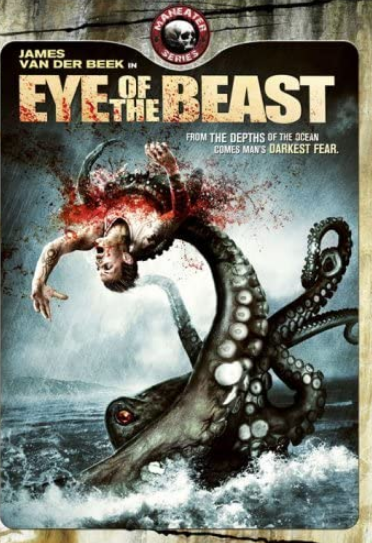
Eye of the Beast

The made-for-TV Eye of the Beast (2007) offers a giant squid migrated into a huge Canadian lake (go with it). The practical effects of squid tentacles are really bad, and the one time we see the body, it's worse (almost as bad as the method they use to attack it.) And that's too bad, because the film is decently acted, directed, and shot, and the script is not terrible. There are some nice details and moments (e.g., a table where books include Ellis' one on the giant squid, the scene where the squid doubters are proven wrong, some moments of real tension, and a government biologist who's sent here as punishment because his boss doesn't like him). If set on a seacoast and with a better effects budget, it could have been a contender.

Humanoids from the Deep

I’d never gotten around to watching Roger Corman’s 1980 classic Humanoids from the Deep, even (for some reason) when I was a teenager.  What’s ok? A decent setting and camera work.  An attempt at a scientific explanation for the monsters – impossible, but they made more of an effort than you’d expect from a film like this.  The suits are actually not bad. They bear no relationship to what the token biologist describes as their origin process, but do manage to look creepy and unhuman.  B movie and TV vets ng Doug McClure, Ann Turkel, and Vic Morrow get leading roles in this monsters-invade-small-town film. What’s not ok? It’s a Roger Corman film.  Someone gets naked about a half-hour in and darned if beautiful women who were not cast for their acting ability don’t keep turning up.  I’m sure teenage me’s first question would have been, “Where is this town, and when can I move there?”  The ending, a variation from 1979’s Alien, wasn't a surprise. Push this one out to sea.    

Loch Ness Monster of Seattle

This 2022 film is at least unique in some ways. It's shot as a documentary and played absolutely straight. It's the story of a fictitious Native American tribe and two cryptozoologists (a handsome man and a beautiful young woman, natch) trying to find and protect Willatuk. Willatuk is VERY loosely based on some Native American mythology, but created in its present form by the film's creator/director, Oliver Tuttle, a documentary writer and musician, in a song recorded in 2011. It's being pursued by vengeful, racist, and villainous fishermen. There's even psychological stuff about family dynamics and abusive parenting. Many of the actors here don't even try to talk like real people. The filmmaker took some pains with plenty of mentions of cryptozoological lore and the creation of "true" old articles and sighting reports, which even have specific dates. Weirdness: one fisherman dives into the water and SWIMS in pursuit of the creature, while a cryptozoologist shows off a device that - without even being submerged - can track the animal by the urea concentration of its urine in an ocean of water. (Really.) Congressman Jim McDermott, who represented this area until 2017, appears as himself. It's all narrated by no less than Graham Greene, whose voice lends this patchy but original film a bit of gravity it really doesn't deserve. 


 Matt Bille is a writer, historian, and naturalist living in Colorado Springs. He can be reached at mattsciwriter@protonmail.com. Website: www.mattbilleauthor.com.

Read Matt's Latest book, Of Books and Beasts: A Cryptozoologist's Library. This unique reference offers a friendly skeptic's 400 reviews of books on cryptozoology, zoology, related sciences, and cryptozoological fiction. Your search for the world's new and undiscovered animals begins here!


Monday, May 29, 2023

Book Review: The Lady and the Octopus

The Lady and the Octopus: How Jeanne Villepreux-Power Invented Aquariums and Revolutionized Marine Biology

by Danna Staaf  

Carolrhoda Books, 2022, 136pp.  

 Danna Staaf, marine biologist and science writer, has produced a gem. Rated for ages 10 and up but full of information interesting to all ages, The Lady and The Octopus gives pioneering scientist Jeanne Villepreux-Power (hereinafter JVP) the kind of overdue recognition recently given to her contemporary, Mary Anning. 


A Frenchwoman who lived from 1794 to 1871, JVP grew up in the town of Julliac and moved to Paris, where she became a renowned seamstress and dress designer. That led to a meeting with Irish merchant James Power
. Her lifelong marriage to a wealthy man who supported her scientific interests gave her an opportunity few women scientists of the day could dream of, and she took full advantage of it. While the term for JVP in her own time would be “naturalist,” Staaf uses “scientist” to connect better with modern readers, so this review follows her convention.

Staaf states up front that she’s making inferences and educated guesses to fill in the many missing details of JVP’s life. We have only a fraction of her notes and papers. Sometimes I think this is stretched a bit, as with the speculation that a stay in a convent in Orléans might have led to her being inspired by Joan of Arc (the “Maid of Orléans”).

At James’ home in Messina, Sicily, she took an immediate interest in the ocean and, as a childless woman of leisure, devoted her time to learning about it.  She spent her days exploring both sea and shore. She studied fish, reptiles, mammals, invertebrates, and plants. She even put a tree in the house for her still-fierce pet martens.  (I pity the servants.)  

Jeanne was not satisfied with the contemporary approach to studying and classifying animals based on deceased specimens. She wanted to study them alive, in situ when possible.  She got to know local fishers and sometimes went to sea in search of specimens to put in the water-filled glass boxes she devised. She used these to, among other things, prove numerous snails could regrow body parts and in one case half of a head! Her next invention was a wooden cage on the seabed, sometimes with a glass box suspended inside, the size of an adult rhinoceros. (Staaf uses “Mini Cooper” as a comparison, so I had to get inventive.) As Staaf evocatively writes, “Hour after hour, year after year, Jeanne sat in her boat…watching and recording her observations.” 

JVP was one of the first scientists to record an octopus using a tool. While her carefully recorded experiments led to countless discoveries, her greatest contribution came in revelatory studies of the small, enigmatic cephalopods called argonauts. She was the first to realize a “worm” inside the shells of females was the hitherto-missing male of the species, and that argonauts’ two membrane-equipped arms were not to use as sails at the surface (universally believed despite the fact no one had ever seen this happen) but to build and repair the animals’ shells. 

Then two scientific tragedies hit. In 1837, a French scientist named Sander Rang to with whom she had shared her work on argonauts presented it as his own.  The same year, the couple moved to London, and in 1838 lost most of her work, including specimens and her gorgeous drawings (only one has survived) when the ship carrying her belongings sank in a storm.  

JVP persisted.  She fought for her primacy as the scientist who’d solved the argonaut puzzle, and enough colleagues supported her to get the injustice rectified. She gathered new specimens and repeated her experiments with argonauts. She became the first woman allowed in numerous scientific societies and befriended some of the great naturalists of her time.  JVP’s aquarium work inspired a popular craze and numerous scientific efforts, including those of Anna Thynne, who learned how to keep living corals in saltwater aquaria, and the eminent Philip Henry Gosse, who coined the word “aquarium.” Some writers including the famous Sir Richard Owen gave JVP full credit for her work: others, predictably, did not. Her work extended to developing early ideas about fish farming and repopulating overfished bodies of water. Separated from her husband by the Franco-Prussian War, she died in her hometown at 76.

Staaf does something important that many shorter biographies skip over: the type and effects of past biographies. The first postmortem writings made her a sort of princess, adding fictional details and focusing on her romance with Power. While a French writer in 2009 published a popular (if inventive)  novelization, biologist Clause Arnel had already begun the diligent work of separating fact from fiction about JVP. He wrote a short biography, co-founded (with artist Anne-Lan) the JVP Association, and even convinced NASA to name a Venusian crater after her. Today there are parks and exhibits honoring her.  

This lively biography constitutes almost everything I know about JVP. What I learned about her in previous reading on marine life could be summarized in a paragraph. Staaf fleshes out the story in asides that give us context about how species are named, the ethics of animal experimentation, and so on.   She even includes one of the very few interesting acknowledgements sections I’ve ever read. Finally, it bears repeating that this well-illustrated work is accessible to students and the adults who enjoy her other works on cephalopods.  It’s an excellent book in every sense. 


 Matt Bille is a writer, historian, and naturalist living in Colorado Springs. He can be reached at mattsciwriter@protonmail.com. Website: www.mattbilleauthor.com.

Read Matt's Latest book, Of Books and Beasts: A Cryptozoologist's Library. This unique reference offers a friendly skeptic's 400 reviews of books on cryptozoology, zoology, related sciences, and cryptozoological fiction. Your search for the world's new and undiscovered animals begins here!


Monday, May 22, 2023

One Writer's View on Generative AI

 One writer's thoughts:

The problem with programs like ChatGPT is a mix of copyright issues and the insidious destruction of careers and the average quality of all written material.


Example: What I do when I write a book is not what authors (many now) who lean heavily on AI do, and shouldn't be classified together, but platforms like Amazon don't make any distinctions. If the cover and the blurb are good, it's easy for people to buy a novel or rely on a nonfiction book without knowing the primary author was an AI program with no ethical rules or "talent."

Everything I've read before essentially creates fertile soil to grow a new creation. It's usually my subconscious that has notions like "There was a neat twist in a Jack Reacher novel, and something like it should happen here." My having that thought consciously is rare, although it does happen, and when it does I make sure everything I write is original except for the basic idea.


AI does the opposite. If I give it the basic idea "write a thriller about a Southern PI who comes to New York to find a murderer," and maybe some supporting ideas like "he has sex with a cop" and "his girl from Mississippi gets murdered while he's gone" the program is going to pick bits out of PI novels, New York novels, Southern-set murder mysteries, novels with sex scenes, and "fish out of water" novels. Nothing will be original except my idea and some randomness in the mixing. I know people who are doing that now just to add "novelist" to their LinkedIn profile.


Some writers say they only lean on ChatGPT for things like "give me five ways an 18th century person  might describe the front of a mansion." But all of them are lifted, often word for word, from other, copyrighted works.  


A famous author with lots of books could, if she had the time or the assistants, do searches and see how many times her best lines reappear in AI novels.  Human writers steal like that, too, but it's ALL AI text programs do, and they do it on a scale that lets millions of people "author" books just by stealing bits and pieces. In practice, that means life is getting far, far worse for novelists and nonfiction writers alike. The flood of bad submissions that buried publishers and editors when the internet matured is going to be multiplied a thousandfold: new authors may see their chances of being noticed by major publishers and top agents go from well below one percent today to an almost unmeasurable fraction of that.


It also affects the ethical authors and all the readers using platforms like Amazon. Amazon now gets 5,000 novels uploaded a day: when that multiplies, it's terrible for readers looking for quality and writers trying to stand out. All based on millions of little thefts. Except for old books out of copyright, AI is being trained ENTIRELY on copyrighted work. If original work is grown from the soil of all the stuff an author is previously read, with AI generation programs the soil is pre-loaded with seeds stolen from other gardens: all the "author" has to do is water it.


It's much more insidious for writers of short articles and listicles for web sites. They are simply being fired and replaced. Some of them are hacks and some have real talent, but there's nowhere left for them to take that talent.


The situation is worse, in a different way, for readers seeking to learn from nonfiction. You can say writers are responsible for the truth of their work, but the market will flood with books from authors who don't care, and the current problem of incorrect facts becoming part of history (see "J. Edgar Hoover wore dresses," pulled from an unsourced rumor by one writer and now "fact"). Publishers can't and don't check every fact and footnote: that's the author's job, but some authors won't try and those who do will find it impossible, because they've no idea where a supposed fact in their book came from, or whether a footnote is accurate without hunting for every one, killing the fake ones, and being left with facts with no sources. Peer reviewers can say "this is inaccurate trash" and get a book sent back for rework or dumped entirely, but much of what's published in books, magazines, websites, and pay-to-play journals never gets true peer review.


Unscrupulous contractors or even inside staff writers could give government or corporate clients work that only SMEs will be able to tell is wrong, and clients who trust them aren't going to check everything. Think what that can do to, say, a weapon evaluation report. Think what it does to adversaries who say things like, "Oh, an official report to the Air Force says this, so it has X characteristic that must be aimed at our radars and they must specifically be building it to attack us." That may not be a common occurrence, but it will happen sometime.


Anti-AI software is an arms race. What's scary is that AI generation program writers have a thousand times the audience, and the big money to be made money is in ever more capable programs that disguise a work's origins.


This is not "the buggy whip makers being driven out of business by cars" problem. It's "one of the foundations of civilization being degraded, twisted, and often destroyed." It's also not like another comparison, the way musicians grumbled about American Idol winners becoming stars without "paying their dues" in little clubs and bars. These kids had still developed their talent enough to produce good performances. AI programs let people skip THAT part of the work, too.  Authors who have never developed their talent are flooding the market with "books" that crowd out the real thing, when I've spent 35 years developing the skills of a good writer.  This is why some authors are using their skills on Twitter to come up with imaginative combinations of four-letter words to describe these programs and their sellers.  


So I and, I think, nearly all genuine authors think this is a kind of theft no matter how you squint at outdated copyright law.  We certainly don't think it's ethical, and we hope copyright law does something in the next revision - which may take years. The recent CRS interpretation of copyright rules and decisions (linked here) is helpful, and I think it generally agrees with me, but it's not law.  One court decision or change in Administrations could sweep it all aside.  


We can only keep raising our voices to legislators and regulatory bodies as we try to do our best.


 Matt Bille is a writer, historian, and naturalist living in Colorado Springs. He can be reached at mattsciwriter@protonmail.com. Website: www.mattbilleauthor.com.

Read Matt's Latest book, Of Books and Beasts: A Cryptozoologist's Library. This unique reference offers a friendly skeptic's 400 reviews of books on cryptozoology, zoology, related sciences, and cryptozoological fiction. Your search for the world's new and undiscovered animals begins here!


Sunday, May 21, 2023

Cyptozoology: Odds and Ends from an Odd Field


Loch Ness Monster of Seattle


Here's a 2022 film I missed until now - a unique one. It's shot as a documentary and played absolutely straight. It's the story of a fictitious Native American tribe and two cryptozoologists (a handsome man and a beautiful young woman, natch) trying to find and protect Willatuk. WIlliatuk is VERY loosely based on some Native American mythology, but created in its present form by the film's creator/director. Oliver Tuttle, a documentary writer and musician. in a song recorded in 2011). It's being pursued by vengeful, racist, and villainous fishermen: there's even psychological stuff about their family dynamics and abusive parenting. Many of the actors here don't even try to talk like real people. The filmmaker took some pains here, with plenty of mentions of cryptozoological lore and the creation of "true" old articles and sighting reports, which even have specific dates. One fisherman even dives into the water and SWIMS in pursuit of the creature, while a cryptozoologist shows off a device that - without even being submerged - can track the animal by the urea concentration of its urine. Congressman Jim McDermott, who represented this area until 2017, appears as himself. It's all narrated by no less than Graham Greene, whose voice lends this patchwork but certainly original film a gravity that its sometimes-silly sincerity ALMOST deserves.


The Ivory-billed woodpecker: Gone for Good?


Historical photo, out of copyright

The government is sure the IBW is extinct, and I'm almost certain they're right. I hold out maybe a 2% chance, based on a few of the sighting reports but mostly sheer romantic stubbornness about America's largest, most spectacular woodpecker.

A Vanished Bird Might Live on, or Not...

Now, it seems, we have two birds in the bush but still need one in the hand, because experts are giving this new video very different ratings as evidence. Most are skeptical. They are probably right. Probably. It's an interesting case for cryptozoology, We have an extinct animal, in a known habitat, with a collection of sightings and a few videos, none of it providing the certainty we all crave. We know other birds have been declared extinct and rediscovered, including the flightless takahe and the cahow (lost for 300 years!) Even given the prevalence of cellphone cameras, the IBW habitat is still very big and not often penetrated in some areas,

If we don't know it exists, well, it has a better chance than Bigfoot.


Lost Evidence

This is an interesting source I've overlooked. Cryptids, in general, are cryptids because there's no enough evidence to establish their existence. There are some bits of evidence that definitely or probably existed, but no one can lay hands on them. This list includes seven specimens and four photos, although one (the alleged Thunderbird photo in the Tombstone newspaper) is certainly not real, as the newspaper archives still exist. There are other cases, but the author notes this article is still under construction. I'll put some together for a later posting. I immediately thought of a couple: a scale identified by one ichthyologist as an American coelacanth, now lost; a sea serpent head, which contemporary documents describe as being on board the whaler Monongahela when it sank in the 1850s.

The cryptozoologist who goes by the online name TruthIsScarier has made a more comprehensive list, which is must-viewing. See this graphic. It includes specimen, photos videos, audios, and written reports. A few of these are labeled as known hoaxes, but it sure would be nice if the others surfaced. Good luck and good hunting!


 Matt Bille is a writer, historian, and naturalist living in Colorado Springs. He can be reached at mattsciwriter@protonmail.com. Website: www.mattbilleauthor.com.

Read Matt's Latest book, Of Books and Beasts: A Cryptozoologist's Library. This unique reference offers a friendly skeptic's 400 reviews of books on cryptozoology, zoology, related sciences, and cryptozoological fiction. Your search for the world's new and undiscovered animals begins here!


Saturday, May 13, 2023

The Magnificent Meg returns

 The extinct shark Megalodon never ceases to amaze and enthrall. And so it's coming around again, in  film, fact, and fandom. 

The trailer for Meg 2 is out, and it's everything thriller fans want. It's also nothing that fans of accurate want. With its ever-bigger, roaring kaiju sharks, it looks like the most expensive SyFy Channel movie ever made. It opens with a Meg nabbing a T. rex in the shallows. This chronological no-no appeared in Steve Alten's original Meg novel. A 2018 reissue retconned it into a simulation people were watching. The movie, it appears, claims Meg has been the ultimate predator for 65 million years, so they're going to play it straight.

Meg tooth (author's collection)

Another trailer made me ask, "What are tentacles doing in my shark movie?" Apparently, the habitat that sheltered Meg until a rift opened also housed the kraken, and some weird amphibian-looking things the size of crocodiles as well.  There's a bit of irony here. While kraken tales go back a thousand years or more, the latest resurgence of the term came courtesy of a paleontologist who thinks there really was such an animal. As far as I can tell, Mark McMenamin is the only paleontologist in the entire world who thinks there was a gigantic Triassic cephalopod.  But his claim made in 2011, amplified in 2013, was embraced by author Max Hawthorne, whose novels share the prehistoric sea monster niche with Alten's, and thus gained wider awareness.  This was based on two instances of bones that seemed to be artificially arranged, and what looked to him like the beak of a gigantic octopus. No one else accepts either piece of evidence. The Meg movie is opting for a monster squid rather than an octopus.

The movie looks like good silly fun.  Jason Statham seems to have honed his sense of humor (a bit stilted in the first film to me) and everyone else is back.  The sharks is bigger and it brought company, so just enjoy.

 Matt Bille is a writer, historian, and naturalist living in Colorado Springs. He can be reached at mattsciwriter@protonmail.com. Website: www.mattbilleauthor.com.

Read Matt's Latest book, Of Books and Beasts: A Cryptozoologist's Library. This unique reference offers a friendly skeptic's 400 reviews of books on cryptozoology, zoology, related sciences, and cryptozoological fiction. Your search for the world's new and undiscovered animals begins here!


Wednesday, May 10, 2023

For my fellow authors: Notes on interviewing

Something I wish there'd been a guide to back when I chiseled my work on cave walls was interviews. So here's my advice for newer folks.

Research for your book can almost always be improved by interviews, and sometimes demands them.
Don't be shy. Experts love to talk about their fields, whether by chat, phone, or in person. The last is the most enjoyable and most likely to lead to other contacts, at least for me. That's a bit surprising, because I'm an introvert and needed to get used to interviewing, but take that as an example showing that you, too, can get used to it. In any medium, ask at the beginning if you want to record.

The author talking about Dunkleosteus with Dr. Robert Bakker.

It's ok to be a writer they've never heard of, so long as you're prepared and your questions are intelligent. Some people can't fit you in, but the only person who EVER flatly refused to talk to me was Neil Armstrong. And be flexible: work with their schedule. Finally, it's ok if you're not polished as long as you're prepared.
Do some Googling before reaching out and determine who's most likely to have the right information. Especially check people close to you in case you'd like to talk in person. You can also hang out online with groups who share your interest and introduce yourself. Mention one of the expert's publications, or perhaps an interview or presentation you saw, when you contact them. Remember the most famous names may be a bit swamped. If you can't get the primary author on a publication, for example, look at the secondary authors.
Prepare. Don't ask a paleontologist what the biggest dinosaur was: you can Google that. She'll be inclined to tune you out. Be ready with intelligent questions about the things books and searches haven't answered for you. Also, if you ask, "Was Source X right on this?" Source X needs to be a reasonable source to being with. Don't cite Andrew Wakefield on vaccines.
Experts enjoy talking about what-ifs if the scenario is at all possible. Don't bring up a novel about the Royal Family being lizard people. (Seriously, have you ever seen a lizard with ears like that?) Or a novel about thousands of Sasquatches in a remote valley: ask instead how many Sasquatches might remain hidden in that region. I had no trouble getting expert opinion on, assuming Dunkleosteus was still alive, whether it could end up where I wanted to set the novel.
Wrap up on time and ask for any recommendations if you still need to talk to someone else. Thank them even if the interview didn't produce much of use. You might, for in-person chats, leave a small gift, like your previous book. I keep a supply of Dunkleosteus pins I give to any expert or agent/editor who gives me time in person.
Those are my top tips for those new to interviewing. What are yours?

 Matt Bille is a writer, historian, and naturalist living in Colorado Springs. He can be reached at mattsciwriter@protonmail.com. Website: www.mattbilleauthor.com.

Read Matt's Latest book, Of Books and Beasts: A Cryptozoologist's Library. This unique reference offers a friendly skeptic's 400 reviews of books on cryptozoology, zoology, related sciences, and cryptozoological fiction. Your search for the world's new and undiscovered animals begins here!


Sunday, April 23, 2023

Book Review: Mighty Bad Land is a memorable scientific adventure

Mighty Bad Land: A Perilous Expedition to Antarctica Reveals Clues to an Eighth Continent

by Bruce Luyendyk, with Foreword by Edward J. Larson

Permuted Press, 2023, 320pp.

How many people have discovered a continent? While geophysicist Bruce Luyendyk makes a point of sharing credit, he is the man who named Zealandia, a mostly sunken continent half the size of Australia and represented above the water by New Zealand and scattered islands. In this book, he chronicles the first of his three Antarctic expeditions that provided proof the continent separated about 85 million years ago from the ancient supercontinent Gondwana.  

In 1989, Dr. Luyendyk led a six-person expedition to Marie Byrd Land, a huge, unclaimed region nicknamed Mighty Bad Land. There was no airstrip, and they were beyond the reach of helicopters. His team had to be deposited and retrieved by ski-equipped military C-130s landing on the open ice. It happens that, I, too, have many flights in C-130s. They're uncomfortable under the best conditions, and Antarctica offers anything but. 


Luyendyk was the right man for the job, scientifically, but he makes clear he just barely made it through this trip. Nearly fifty years old, concealing injury, with chronic asthma and no experience leading a group in such a remote area, he cleared the medical and mental hurdles basically by force of will. It was his first trip to Antarctica, and he describes his adjustment to everything from eternal sun to conflicting chains of command. Luyendyk also recounts two humorous incidents at the American base, McMurdo Station, where he drew interest from women in a place where women are very scarce but lost both due to indecision about a "sort of relationship" in California (that did not, sadly, work out).   

Then it’s on to the ice, and the gripping story of the oft-beleaguered expedition. With him went two mountaineers and three other scientists, including his graduate student Christine Smith (who, yes, had a couple of incidents with male jerks). Luyendyk is frank about his own errors and uncertainties. He discovered many unexpected hurdles, adjusting plans on the fly for weather, ground hazards, aircraft schedules, internal conflicts, two near-death incidents, and even proper supervision of his grad student’s work given they were in different subpecialties.  But his team had the chance to do historic science, and they persevered.

The results were spectacular. The ton of rocks hauled out (barely) by a heavily loaded C-130 provided key parts of the puzzle that is Zealandia. Luyendyk’s painstakingly-taken core samples showed the magnetic shifts the area had undergone and how the mountain ranges had been “twisted and shuffled” over time, while geochronologist Dave Kimbrough dated rocks in all the locations they visited. Steve Richard and Chris Smith studied metamorphic minerals from the Fosdick Mountain range to determine its history and past deformations. The data from this and subsequent expeditions, synthesized and analyzed, told them why and when the new continent split off from Gondwana and proved the mostly-submerged region highlighted by New Zealand – thus, Zealandia – met all the criteria to be declared the eighth continent. Luyendyk published the name in 1995. The result revolutionized our understanding of the hemisphere’s geologic history and, incidentally, greatly expanded the seafloor territory over which New Zealand could claim economic sovereignty.

The author deserves great credit for making all this understandable. As a non-geologist, it took me two reads of some of the more technical sections to make me feel comfortable that I understood it, but I'd have needed at least twice that effort to gain a comparable understanding through textbooks or Web courses. Education and adventure are memorably entwined in a book that will enthrall anyone interested in the exploration, history, or geology of this still-mysterious land and its more-mysterious spinoff – our newest continent. Take this harrowing trip with Luyendyk and company, and you'll learn as well. 

Photos from the expedition (used by permission: credits at https://bruceluyendyk.com/gallery/)

    1. The geologists relax on Christmas Eve, 1989, atop Swarm Peak 

    2. The author peers out the ramp of a C-130

    3. The full team (four geologists, two mountaineers) in the luxurious accommodations of a C-130 en route to the study site


The author wasn’t sure whether he should make another expedition after barely staggering through the first, but, as he says, “We get to discover,” and that drew him back twice. These  trips aren’t described here, but there is more information on www.bruceluyendyk.com.

  Matt Bille is a writer, historian, and naturalist living in Colorado Springs. He can be reached at mattsciwriter@protonmail.com. Website: www.mattbilleauthor.com.

Read Matt's Latest book, Of Books and Beasts: A Cryptozoologist's Library. This unique reference offers a friendly skeptic's 400 reviews of books on cryptozoology, zoology, related sciences, and cryptozoological fiction. Your search for the world's new and undiscovered animals begins here!

Saturday, April 22, 2023

Review: Beyond the Wild Blue: A History of the US Air Force

Beyond the Wild Blue 

by Walter J. Boyne, Colonel, USAF (retired)

1998: St. Martin's Griffin

Boyne took on a huge task here, a single-volume history of the Air Force’s first 50 years pressed into 321 pages plus appendices.  For the most part, he delivers very well. He’s a good writer, knows his subject, loves the Air Force but is willing to criticize it, and has the right touch for mixing the anecdotal and the epic. I’m not sure the task could have been done much better without doubling the length.  

Boyne covers the organizational and policy issues throughout.  The terms and policies of Secretaries of Defense and the Air Force, Presidents, Chiefs of Staff, and the like are all chronicled. So are major debates like strategic v. tactical airpower.


Most of the history and detail about operations is, of course, about flying.  I’m not an expert on the history of the flying side, so I won’t attempt to critique what Boyne might have gotten right or wrong. I will say that, to nonflier, this book reads as an understandable, well-explained, cogent account of activities that shaped, not just American airpower, but often the world. The evolution and changes of the major commands and organizations are here, and so are the lives of the flyers, maintainers, and support personnel at every level.  The descriptions of the planes and other weapons are compact, accurate to my knowledge (I did read a lot on the old airplanes), and fitted into the bigger context of strategy and tactics. 

I am an expert on missiles and military space programs, so this is an unusual review, one focused mainly on one side of the story That means I largely skipped over the main events before those programs began, including World War II, the post-war reorganization, and Korea. That also means there’s more of a focus than a flyer, or a general reviewer, would have on perceived errors and misunderstandings. 

Boyne’s Cold War ethos and solid support of all American’s modern wars have drawn criticism, some of it valid. Still, his view jibes with what military and civilian leaders thought at the times, and the “Cold War mindset” is to me, a Cold Warrior who spent years in a missile silo holding the keys to Hell, basically accurate. 

 His belief that Vietnam was a just war and we almost won it in 1972 are not popular opinions, although that’s not to say he’s wrong.  (Personally, I don’t think we could have won in 1972 no matter what you think of the effectiveness of the bombing: the ground forces, with Vietnamese troops of uneven quality and American troops reduced greatly in number, weren’t adequate to take full advantage of the damage aircraft did to the enemy.)

There’s no denying that American aviators, as Boyne vividly describes, valiantly did their duty In Vietnam despite every possible handicap. They had to deal with airplanes and tactics meant to fight the USSR in Europe, constantly increasing micromanagement by non-experts thousands of miles away, rules of engagement that killed countless American flyers, the universal American misunderstanding of the enemy, and endless changes of strategy. Boyne gets a point for even-handedness here: while he despises the Communist regime, he admires the way their soldiers, no matter what we threw at them, time and again adapted and fought even harder. 

I naturally wondered how a book that is, by necessity, 90% about flying would treat missiles and space. The answer is, “pretty well.” Boyne’s admiration for the multiple missile development programs General Bernard Schriever juggled and advanced, mainly in the decade 1955-65, knows no bounds. He thinks it was more difficult to pull off than the Manhattan project, and he makes a good argument.

There are a couple of places where he errs. He paints the USAF as having a continually advancing missile program from about 1947 on.  It didn’t happen that way.  Some Air Force leaders, military and civilian, were strongly against pouring billions into this new and uncertain weapon system. Successes like the Consolidated MX-774 were not part of a well-planned program but often made advances and then faded back into purgatory.  Once Boyne gets to the Schriever era, though, he gets it right.  He does not address the second-class citizen status of the missile people who were, he notes, an entirely different personality type compared to the gung-ho pilots from the WWII era with whom they had to work.  Nothing was ever done to give missileers the prestige, rated status, or promotion opportunities of pilots, and if that sounds to you like the disgruntled complaints of an ex-missileer who wanted to be a fighter pilot but was medically disqualified, you’re absolutely right. Boyne should have paid some attention to this topic.  

There is one other item about missiles that deserves attention, and it’s connected to Boyne’s unusually positive treatment of the controversial Chief of Staff Tony McPeak (1990-94).   To Boyne, if McPeak left behind a lot of broken crockery, from drastic reorganizations to the despised “bus driver” uniform, most of that crockery needed breaking to face political, military, and budgetary realities.  He notes McPeak’s unpopularity with many officers. Having been an Air Force officer until 1992, I would characterize what I heard from officers in flying units more as blistering hatred, even though Boyne makes his case that some of the McPeak reorgs were necessary. 

Oddly, Boyne cites McPeak’s move of the ICBM force to Air Combat Command instead of Space Command as one of McPeak’s few mistakes.  It wasn’t. When his successor moved ICBMs to Space Command, it created a culture clash that never ended. To people in the two organizations, it made as much sense as moving fighter squadrons into Military Airlift Command because they both used airplanes.  I honestly can’t remember meeting a leader in missiles or space who thought it a good idea.  

A couple of other thoughts. 

Boyle describes the 1982 creation and 1988 formalization of Total Quality Management as an unqualified success, and maybe it was in some organizations in the earlier years. His book, though, goes well into the years when it became a slog through square-filling and buzzwords, and he should have revisited it. 

On a broader scale, Army and Navy advocates won’t much like the extent to which Boyne says that, from the 1950s on, many USAF management and other practices and organizational structures were envied or copied by the other Services: I don’t know much about that, so I’ll let historians fight it out.

Boyne gives space forces their du. He endorses the creation of Air Force Space Command and the original U.S. Space Command.  He does a good job of documenting the major programs, activities, and benefits.  He has a warm spot, as do I, for the 1960s CORONA satellite people who persevered through 12 failures (something that would never be tolerated today) to get workable spy satellites in place.  The only mistake he makes, which he partly remedies later on, is saying the differing strategies of the US and USSR (a few exquisite satellites vs. many shorter-lived ones) developed out of differing experiences, when it was always a deliberate choice based on the Americans’ superior technology and desire for more and more standing communications capability and higher-resolution imagery.  That and Boyne's failure to treat the battle over large vs. small satellites, which was still one-sided but at least  heating up by 1997, or examine reasons for the endless schedule and cost overruns of the major space programs, are my nitpicks on space.

This is as good a place as any to note the book’s biggest weakness from a scholarly viewpoint. Inexplicably, it has no footnotes or endnotes. While many sources are cited in the text, and there are lists of interviews and so on, there’s no way the book can rank as the definitive history it should be without specific references for the decisions, battles, and activities it describes.  

As a writer of a book for a broad readership, though, Boyne generally navigates these five decades well and in the end lands on the runway pretty close to the centerline.  He tells a coherent story, works many, many complex events into a timeline that gives the reader a consistently good picture of how the Air Force was and what it was doing at any given time, and has made a valuable contribution, even if not a flawless one. 


 Matt Bille is a writer, historian, and naturalist living in Colorado Springs. He is a former USAF officer. He can be reached at mattsciwriter@protonmail.com. Website: www.mattbilleauthor.com.
 

Sunday, April 16, 2023

Book review: Monsters of the Pine Tree State

 Monsters of the Pine Tree State: Cryptids & Legends of Maine 

Eerie Lights Publishing, 2023, 240pp.
by David Weatherly. Foreword by Loren Coleman, art by Sam Shearon  
Weatherly's state-by-state collection of cryptid stories has reached my birth state, Maine, so I looked forward to this one. It's a lot of fun. Since there have been two recent Maine cryptid books by Michelle Souliere, there is some inevitable overlap, and Weatherly cites her a couple of times. Nonetheless, there's some new material here and many interesting stories. 


We meet Wessie, the out-of-place anaconda (surely dead of cold by now), "black panthers," Bigfoot and other apelike cryptids, and more. Weatherly's curiosity extends to topics outside cryptozoology, so we read tales of bipedal wolflike creatures, hard-to-describe horrors, and of course the state's huge, famous spectral moose. My favorite section is, as often happens, the one on sea serpents and strange marine creatures, and Weatherly has a couple of items here I'd forgotten about.  Weatherly also notes the Wendigo of Maine's Indigenous people is nothing like the horned monster of modern lore. He does not footnote, but some sources are given in the text, and there's a bibliography There is a list of publications and websites, which oddly consists of titles only, without addresses or URLs. Shearon's cover and interior art is, as always, superb. This is an enjoyable book best read in the evening, by a fireplace, with pine trees visible outside the windows. Good work!

 Matt Bille is a writer, historian, and naturalist living in Colorado Springs. He can be reached at mattsciwriter@protonmail.com. Website: www.mattbilleauthor.com.

Read Matt's Latest book, Of Books and Beasts: A Cryptozoologist's Library. This unique reference offers a friendly skeptic's 400 reviews of books on cryptozoology, zoology, related sciences, and cryptozoological fiction. Your search for the world's new and undiscovered animals begins here!


Saturday, March 11, 2023

Book Review: Sea Serpents with TV's "Beast Hunter"

Sea Serpents: On the Hunt in British Columbia: or, How I Went to the Bottom of the Ocean, and a Giant Fish Accidentally got me Drunk  

by Pat Spain   


I finished a very enjoyable evening with biologist/host Pat Spain's new book on sea serpents of the Northwest. Much of the book is taken up with his adventures trying to film his TV show, which are often hilarious - he has a way of getting himself into very weird spots.  He also visits a First Nations family who tells him a story I'd never heard about capturing a baby "Cadborosaurus."   

When he gets to analyzing Caddy, he does a chart based on reported characteristics, (I'm not sure how many sightings or witness interviews he included) and includes a seashore-hunting cephalopod among his likely candidates. Spain unabashedly considers a coolness factor when offering ideas.  This isn't a scientific treatise, but it's terrific fun, and it's worth noting that Spin rejects most "cryptids" but thinks there's something to find here. 

 Matt Bille is a writer, historian, and naturalist living in Colorado Springs. He can be reached at mattsciwriter@protonmail.com. Website: www.mattbilleauthor.com.

Read Matt's Latest book, Of Books and Beasts: A Cryptozoologist's Library. This unique reference offers a friendly skeptic's 400 reviews of books on cryptozoology, zoology, related sciences, and cryptozoological fiction. Your search for the world's new and undiscovered animals begins here!