Tuesday, June 27, 2023

Book Review: Lori Garver's NASA Memoir

Escaping Gravity: My Quest to Transform NASA and Launch a New Space Age

Lori Garver

Diversion, 2022 


NOTE: I should preface this by saying that, despite a long time in space affairs, I don't know Garver. We only talked once, and that was briefly at an AAS convention (where, frankly, I was irritated because what was announced as a speech on space policy was an end-to-end Clinton campaign commercial).  


BOOK REVIEW

Lori Garver had an inside view during NASA’s modern evolution towards commercial space, and this memoir includes her take on the upheaval as NASA cancelled Constellation and made other changes that eventually led to the Artemis plan. Garver headed the NASA transition team for President-elect Barack Obama and eventually became NASA’s Deputy Administrator. She will always best be known as one of the most influential promoters of Commercial Crew, Commercial Orbital Transportation Services (COTS), and other partnerships with the private sector.

I found myself agreeing with some of Garver's points about NASA. No matter how sharp and dedicated NASA's people are, it's just impossible for a large government agency 65 years old to avoid all ossification and the "we've always done it that way" syndrome.  I was a New Space booster before the term existed, and Garver includes examples of the problem. 

The book, though, is a bit mixed. A caution I always note in reviewing any memoir is that it relies on the author's recollection of private conversations, which are always subject to change over time.  Other people mentioned here have different memories, but I’m reviewing her book here and not trying to judge conflicting accounts. This valuable book is marred by a relentless us-and-them against the old guard of astronauts and administrators, who she calls “cup boys” as a swipe at the number who kept their old military-unit mugs handy. There is not much nuance to the way she portrays the supposed dinosaurs of NASA’s past or herself and the new commercial “space pirates” as the heroes. She has only enthusiastically positive things to say about Musk and Bezos. They certainly deserve some acclaim—especially Musk, of whom I was a major admirer for his work at SpaceX—but it’s still part of an oversimplified narrative.  Shoe does, though, admit to some mistakes on her part.

Garver was often criticized by her opponents in the agency as being a political appointee with only a superficial grasp of technology. I know how she feels being a non-engineer in space, but unfortunately, she does not do a great deal here to dispel that view. Her justification of Asteroid Redirect in particular vastly understates the complexity of the mission. 

Garver is at her best discussing budgets and policy. She offers an unobstructed view of how the budgeting process within NASA works and the budget decisions at important moments such as the period following the Augustine Commission. She skewers the existing budgeting process and the way NASA accepted bad contract terms and left costs fuzzy. She maintains the traditionalists not only were wedded to old ways of doing things but would not trust companies except the established giant contractors for major spaceflight responsibilities. SpaceX was the obvious example, but there are others. As a small satellite and launcher enthusiast who knew everyone in that particular sector, I can confirm how true this was for the people trying to get NASA to notice new ventures. (To be fair, NASA has always had some small satellites and probes, certainly a better record than the military.)  

Administrator Charles Bolden does not come off well in this book. Garver feels he was much too reluctant to say bluntly to the administration and Congress what the budget problems were and why they existed. She defends the cancellation of the increasingly unaffordable Constellation program, but she was not a fan of Bolden’s compromise that included the Space Launch System (SLS). If she is accurate. Bolden endorsed a non-SLS architecture one day and was talked out of it literally by the next day. 

Garver continually felt like a target. She says that, for promoting a shift away from NASA’s traditional approaches to human spaceflight and incorporating commercial options, the view of “a cabal of low-level functionaries led by me for driving an agenda that opposed human Space Flight was cultivated by people with a self-interest in keeping the existing program—including Charlie's own cup boys. Gaslighting prevailed.” History will note she WAS consistently proven right on one thing—that SLS and other traditional spaceflight programs were going to be far over budget and years behind schedule. (It would be good to hear the recollections of President Obama, but Garver is puzzled, as many were, that the President’s 700-page memoir of this time in office gave space a couple of sentences despite the massive changes under his administration.)

One thing I looked forward to in this book was her take on Bolden’s interview in Qatar. He said that President Obama had tasked him with three top goals, the foremost of which was to reach out to the Muslim world and help Muslim nations feel good about their historic contributions to science. The President's office and the Secretary of State's office adamantly denied anything of that sort had ever been said. As described here, Bolden was never able to pin it down in his subsequent statements, but he insisted it had been told to him by some appropriate official. Garver can’t find the origin either, leaving the impression it was a well-intentioned but flubbed bit of improv meant to nourish relations with his hosts. 

Garver was a major promoter of commercial reusable suborbital vehicles for research. I would have liked to have seen it too, but that was one thing she never got going. Commercial firms eventually did start providing flights for tourists, and some experiments are carried on these.  

Garver writes about the ridicule and disbelief SpaceX endured, not only because the older firms were afraid of them economically, but because many experienced people in NASA, the military, and industry held a genuine disbelief that these newcomers could do the job. She states, accurately enough, “The Air Force continued to award sole source contracts to ULA even after SpaceX was successfully flying national missions.” 

I also looked forward to her comments on the puzzling Asteroid Redirect mission. I’m biased here: I thought it was a highly risky mission and the objectives were not worth that risk.  Garver was a promoter of the mission and helped get the Agency leadership to endorse it, albeit never unanimously. She does get credit for one of the great briefing titles ever: the briefing on the challenge posed by asteroids was called, “Be Smarter than the Dinosaurs.” Her version of why the mission died was that it didn't offer “enough lucrative cost-plus contracts” to the traditional primes.  She feels NASA still has a system that creates programs to suit itself, including supporting those traditional primes, instead of programs primarily justified by their scientific and other purposes.

She tells an interesting story about creating a new vision statement for the agency. Garver and others came up with, “To discover and expand knowledge for the benefit of humanity” and “To reach for new heights and reveal the unknown.” She doesn’t explain why neither said anything about space, although some better language was added later.  (See Footnote) 

Garver, an outspoken political liberal (another thread that winds through this book), spends some time on the role of women and minorities in what of course was overwhelmingly a white male pilot-driven culture until recently. Garver herself took a lot of inexcusable and sometimes illegal crap (that's the softest word I can come up with) from sexual harassers. She argues here that the agency still has a problem with diversity. Garver describes the creation of three major fellowships developing the next generation of leaders, a more diverse generation. She clearly does not believe there's any danger of undermining excellence by pushing for increased diversity, but it is unfortunate that she simply ignores that topic instead of refuting it. She recounts a scary list of negative feedback she got for changes in the agency, some of it directly or indirectly referring to her sex as well as her qualifications. She received verbal and e-mail harassment, harsh critiques she had no chance to answer that were circulated in Congress and elsewhere, and several death threats. 

Garver’s book is most valuable for the history of the changes she worked on, especially in commercial involvement, which, looking back, have allowed progress NASA’s budget alone would not have permitted. Her ability to move the needle despite Bolden’s strong initial dislike of the Commercial Crew program was impressive. She ends this book with some fascinating accounts of attending key commercial launches, although she sours this a bit by closing with a harsh critique of defense spending that’s only partially relevant.  

Bottom line, this is an important book. Garver had a ringside seat (she might, say, “Yeah, in the lion cage”) for pivotal events and offers a unique perspective. A library of the last two decades of NASA history wouldn’t be complete without it. The politics, the oversimplified battles with “the cup boys” and her moments of self-righteousness are all distractions, but this is her view, and she lets you know it. 

There are no footnotes, but there is an extensive list of sources by chapter. 

Footnote: I like NASA's current Vision and Mission statement much better. 

Vision:

 Exploring the secrets of the universe for the benefit of all. 

Mission:

 NASA explores the unknown in air and space, innovates for the benefit of humanity, and inspires the world through discovery. 

Tuesday, June 20, 2023

Coming Soon: Real Stories of the Space Force

Ready for realistic space adventure? 

Baen Books' new anthology, Real Stories of the United States Space Force, is a collection of science fiction stories and fact articles illustrating the real-world need for space defense and dispelling misconceptions about the nation's newest military service branch. Out in 2024! 


Included: "The Kessler Gambit," my story of a crisis in 2034 that tests the Space Force's capability to its limit as an unknown enemy threatens to wipe American space forces from the cosmos.

13 Award-winning authors!   16 Original stories!  5 Fascinating articles!

Foreword by SDI Space Based Laser Chief Engineer, William F. Otto.

Contributions by nationally syndicated editorial cartoonists, Dave Granlund and Phil Hands.

Authors:  Arthur C. Clarke  /  Avery Parks  \  C. Stuart Hardwick  /  Brian Trent  /   David Brin  /  Greg & James Benford  /  Gustavo Bondoni  /  Harry Turtledove  /  Henry Herz  /  Jody Lynn Nye  /  Karl K. Gallagher  /  Larry Niven  /  Laura Montgomery  /  Liam Hogan  /  M.T. Reiten  / Marie Vibbert  /  Martin L. Shoemaker  /  Matt Bille  /  Michael Morton  /  Sylvie Althoff


Monday, June 19, 2023

The Majesty and Mysteries of Dolmens

 In 2014, I brought out a novel called The Dolmen.  In it, a wealthy eccentric (you never hear of the poor ones) illegally transports and entire megalithic tomb, or dolmen, from England for a museum in Los Angeles.  Too bad he was not smart enough to have someone sift through the dirt...  As the contract with the wonderful folks at Wolfsinger expires, this summer is the last change to grab one. They are on sale!


We keep finding new dolmens and new things about them. They were built over thousands of years, from England to Korea and south into the Middle East.    The basic dolmen, usually three vertical stone slabs with a capstone, had many variations, some much more elaborate.  Why are they found over such a range? Probably the same reason pyramids are: if you want to raise something that will last, pyramids and dolmens are two types that don't require much in the way of construction techniques.  (The best-known Egyptian pyramids show a very sophisticated system of design and construction, but there are cruder pyramids all over the world, many built of nothing but tramped-down earth.) Similarly, all you need to build a dolmen is four stone slabs and a HUGE amount of manpower.  See this (incomplete but VERY impressive) list on Wikipedia. 

Example dolmen (free clipart site)

A dolmen reported a few years ago from Galilee is decorated with rock art, a very unusual find: there is none like it anywhere in the Middle East.  The structure, with an interior chamber measuring about 6 square meters. is dated to approximately 4,000 years BP.  It is one of some 400 in a field near Kibbutz Shamir, but it's the largest, the most elaborate (surrounded by a boulder heap about 20m across and four smaller dolmens) and we have only fragments of knowledge about the people who built it. Israeli archaeologist Gonen Sharon notes the field of dolmens means, "a strong system of government was required here that could assemble a large amount of manpower, provide for the personnel and above all direct the implementation and control of a large and lengthy project.” Some stones weigh 50 tons.  

A cryptic message from the Bronze Age, only now being deciphered.  Is it any wonder I made one the center of a novel?

Tuesday, June 06, 2023

Book Review: River Monsters by Jeremy Wade

 River Monsters

by Jeremy Wade
Da Capo Press, 2011
(reprint of a former blog post lost to technical difficulty)

The host of River Monsters here unspools his adventures with rod and reel. Wade is clearly a master at the craft of fishing, but he makes it clear here that sometimes he's benefited from dumb luck. He has caught (and, when practical, released) the largest freshwater fishes on every inhabited continent. 


Along the way, he has plenty of harrowing adventures, in the water and out. Wade explains some points of fish biology (for example, adapting to fresh v. salt water) and conservation concisely and clearly. He also has some tidbits for the cryptozoologist. Remember, Wade is the guy who filed an "impossible animal:" a river dolphin with a weird sawtooth back, which turned out to be a wildly unlikely survivor of being hacked with a machete by a fisherman. He investigates Lake Iliamna (finding some data I did not, although the reverse is also true) and comes to the same conclusion I did, that it's an undocumented population of white sturgeon. This book is gripping fun from beginning to end.

 Matt Bille is a writer, historian, and naturalist living in Colorado Springs. He can be reached at mattsciwriter@protonmail.com. Website: www.mattbilleauthor.com.

Read Matt's Latest book, Of Books and Beasts: A Cryptozoologist's Library. This unique reference offers a friendly skeptic's 400 reviews of books on cryptozoology, zoology, related sciences, and cryptozoological fiction. Your search for the world's new and undiscovered animals begins here!

Wednesday, May 31, 2023

Reviews: Low-Budget Creature Flicks (Humanoids, Giant Squid, and a "Lost" Ness Monster)


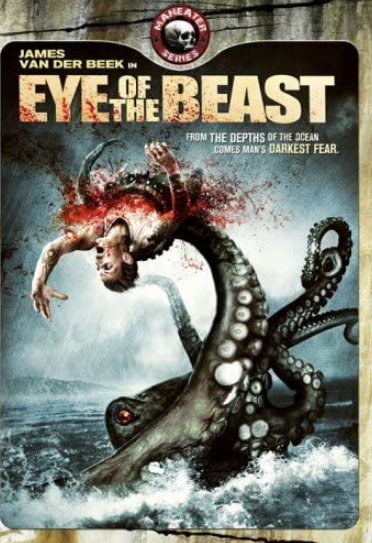
Eye of the Beast

The made-for-TV Eye of the Beast (2007) offers a giant squid migrated into a huge Canadian lake (go with it). The practical effects of squid tentacles are really bad, and the one time we see the body, it's worse (almost as bad as the method they use to attack it.) And that's too bad, because the film is decently acted, directed, and shot, and the script is not terrible. There are some nice details and moments (e.g., a table where books include Ellis' one on the giant squid, the scene where the squid doubters are proven wrong, some moments of real tension, and a government biologist who's sent here as punishment because his boss doesn't like him). If set on a seacoast and with a better effects budget, it could have been a contender.

Humanoids from the Deep

I’d never gotten around to watching Roger Corman’s 1980 classic Humanoids from the Deep, even (for some reason) when I was a teenager.  What’s ok? A decent setting and camera work.  An attempt at a scientific explanation for the monsters – impossible, but they made more of an effort than you’d expect from a film like this.  The suits are actually not bad. They bear no relationship to what the token biologist describes as their origin process, but do manage to look creepy and unhuman.  B movie and TV vets ng Doug McClure, Ann Turkel, and Vic Morrow get leading roles in this monsters-invade-small-town film. What’s not ok? It’s a Roger Corman film.  Someone gets naked about a half-hour in and darned if beautiful women who were not cast for their acting ability don’t keep turning up.  I’m sure teenage me’s first question would have been, “Where is this town, and when can I move there?”  The ending, a variation from 1979’s Alien, wasn't a surprise. Push this one out to sea.    

Loch Ness Monster of Seattle

This 2022 film is at least unique in some ways. It's shot as a documentary and played absolutely straight. It's the story of a fictitious Native American tribe and two cryptozoologists (a handsome man and a beautiful young woman, natch) trying to find and protect Willatuk. Willatuk is VERY loosely based on some Native American mythology, but created in its present form by the film's creator/director, Oliver Tuttle, a documentary writer and musician, in a song recorded in 2011. It's being pursued by vengeful, racist, and villainous fishermen. There's even psychological stuff about family dynamics and abusive parenting. Many of the actors here don't even try to talk like real people. The filmmaker took some pains with plenty of mentions of cryptozoological lore and the creation of "true" old articles and sighting reports, which even have specific dates. Weirdness: one fisherman dives into the water and SWIMS in pursuit of the creature, while a cryptozoologist shows off a device that - without even being submerged - can track the animal by the urea concentration of its urine in an ocean of water. (Really.) Congressman Jim McDermott, who represented this area until 2017, appears as himself. It's all narrated by no less than Graham Greene, whose voice lends this patchy but original film a bit of gravity it really doesn't deserve. 


 Matt Bille is a writer, historian, and naturalist living in Colorado Springs. He can be reached at mattsciwriter@protonmail.com. Website: www.mattbilleauthor.com.

Read Matt's Latest book, Of Books and Beasts: A Cryptozoologist's Library. This unique reference offers a friendly skeptic's 400 reviews of books on cryptozoology, zoology, related sciences, and cryptozoological fiction. Your search for the world's new and undiscovered animals begins here!


Monday, May 29, 2023

Book Review: The Lady and the Octopus

The Lady and the Octopus: How Jeanne Villepreux-Power Invented Aquariums and Revolutionized Marine Biology

by Danna Staaf  

Carolrhoda Books, 2022, 136pp.  

 Danna Staaf, marine biologist and science writer, has produced a gem. Rated for ages 10 and up but full of information interesting to all ages, The Lady and The Octopus gives pioneering scientist Jeanne Villepreux-Power (hereinafter JVP) the kind of overdue recognition recently given to her contemporary, Mary Anning. 


A Frenchwoman who lived from 1794 to 1871, JVP grew up in the town of Julliac and moved to Paris, where she became a renowned seamstress and dress designer. That led to a meeting with Irish merchant James Power
. Her lifelong marriage to a wealthy man who supported her scientific interests gave her an opportunity few women scientists of the day could dream of, and she took full advantage of it. While the term for JVP in her own time would be “naturalist,” Staaf uses “scientist” to connect better with modern readers, so this review follows her convention.

Staaf states up front that she’s making inferences and educated guesses to fill in the many missing details of JVP’s life. We have only a fraction of her notes and papers. Sometimes I think this is stretched a bit, as with the speculation that a stay in a convent in Orléans might have led to her being inspired by Joan of Arc (the “Maid of Orléans”).

At James’ home in Messina, Sicily, she took an immediate interest in the ocean and, as a childless woman of leisure, devoted her time to learning about it.  She spent her days exploring both sea and shore. She studied fish, reptiles, mammals, invertebrates, and plants. She even put a tree in the house for her still-fierce pet martens.  (I pity the servants.)  

Jeanne was not satisfied with the contemporary approach to studying and classifying animals based on deceased specimens. She wanted to study them alive, in situ when possible.  She got to know local fishers and sometimes went to sea in search of specimens to put in the water-filled glass boxes she devised. She used these to, among other things, prove numerous snails could regrow body parts and in one case half of a head! Her next invention was a wooden cage on the seabed, sometimes with a glass box suspended inside, the size of an adult rhinoceros. (Staaf uses “Mini Cooper” as a comparison, so I had to get inventive.) As Staaf evocatively writes, “Hour after hour, year after year, Jeanne sat in her boat…watching and recording her observations.” 

JVP was one of the first scientists to record an octopus using a tool. While her carefully recorded experiments led to countless discoveries, her greatest contribution came in revelatory studies of the small, enigmatic cephalopods called argonauts. She was the first to realize a “worm” inside the shells of females was the hitherto-missing male of the species, and that argonauts’ two membrane-equipped arms were not to use as sails at the surface (universally believed despite the fact no one had ever seen this happen) but to build and repair the animals’ shells. 

Then two scientific tragedies hit. In 1837, a French scientist named Sander Rang to with whom she had shared her work on argonauts presented it as his own.  The same year, the couple moved to London, and in 1838 lost most of her work, including specimens and her gorgeous drawings (only one has survived) when the ship carrying her belongings sank in a storm.  

JVP persisted.  She fought for her primacy as the scientist who’d solved the argonaut puzzle, and enough colleagues supported her to get the injustice rectified. She gathered new specimens and repeated her experiments with argonauts. She became the first woman allowed in numerous scientific societies and befriended some of the great naturalists of her time.  JVP’s aquarium work inspired a popular craze and numerous scientific efforts, including those of Anna Thynne, who learned how to keep living corals in saltwater aquaria, and the eminent Philip Henry Gosse, who coined the word “aquarium.” Some writers including the famous Sir Richard Owen gave JVP full credit for her work: others, predictably, did not. Her work extended to developing early ideas about fish farming and repopulating overfished bodies of water. Separated from her husband by the Franco-Prussian War, she died in her hometown at 76.

Staaf does something important that many shorter biographies skip over: the type and effects of past biographies. The first postmortem writings made her a sort of princess, adding fictional details and focusing on her romance with Power. While a French writer in 2009 published a popular (if inventive)  novelization, biologist Clause Arnel had already begun the diligent work of separating fact from fiction about JVP. He wrote a short biography, co-founded (with artist Anne-Lan) the JVP Association, and even convinced NASA to name a Venusian crater after her. Today there are parks and exhibits honoring her.  

This lively biography constitutes almost everything I know about JVP. What I learned about her in previous reading on marine life could be summarized in a paragraph. Staaf fleshes out the story in asides that give us context about how species are named, the ethics of animal experimentation, and so on.   She even includes one of the very few interesting acknowledgements sections I’ve ever read. Finally, it bears repeating that this well-illustrated work is accessible to students and the adults who enjoy her other works on cephalopods.  It’s an excellent book in every sense. 


 Matt Bille is a writer, historian, and naturalist living in Colorado Springs. He can be reached at mattsciwriter@protonmail.com. Website: www.mattbilleauthor.com.

Read Matt's Latest book, Of Books and Beasts: A Cryptozoologist's Library. This unique reference offers a friendly skeptic's 400 reviews of books on cryptozoology, zoology, related sciences, and cryptozoological fiction. Your search for the world's new and undiscovered animals begins here!


Monday, May 22, 2023

One Writer's View on Generative AI

 One writer's thoughts:

The problem with programs like ChatGPT is a mix of copyright issues and the insidious destruction of careers and the average quality of all written material.


Example: What I do when I write a book is not what authors (many now) who lean heavily on AI do, and shouldn't be classified together, but platforms like Amazon don't make any distinctions. If the cover and the blurb are good, it's easy for people to buy a novel or rely on a nonfiction book without knowing the primary author was an AI program with no ethical rules or "talent."

Everything I've read before essentially creates fertile soil to grow a new creation. It's usually my subconscious that has notions like "There was a neat twist in a Jack Reacher novel, and something like it should happen here." My having that thought consciously is rare, although it does happen, and when it does I make sure everything I write is original except for the basic idea.


AI does the opposite. If I give it the basic idea "write a thriller about a Southern PI who comes to New York to find a murderer," and maybe some supporting ideas like "he has sex with a cop" and "his girl from Mississippi gets murdered while he's gone" the program is going to pick bits out of PI novels, New York novels, Southern-set murder mysteries, novels with sex scenes, and "fish out of water" novels. Nothing will be original except my idea and some randomness in the mixing. I know people who are doing that now just to add "novelist" to their LinkedIn profile.


Some writers say they only lean on ChatGPT for things like "give me five ways an 18th century person  might describe the front of a mansion." But all of them are lifted, often word for word, from other, copyrighted works.  


A famous author with lots of books could, if she had the time or the assistants, do searches and see how many times her best lines reappear in AI novels.  Human writers steal like that, too, but it's ALL AI text programs do, and they do it on a scale that lets millions of people "author" books just by stealing bits and pieces. In practice, that means life is getting far, far worse for novelists and nonfiction writers alike. The flood of bad submissions that buried publishers and editors when the internet matured is going to be multiplied a thousandfold: new authors may see their chances of being noticed by major publishers and top agents go from well below one percent today to an almost unmeasurable fraction of that.


It also affects the ethical authors and all the readers using platforms like Amazon. Amazon now gets 5,000 novels uploaded a day: when that multiplies, it's terrible for readers looking for quality and writers trying to stand out. All based on millions of little thefts. Except for old books out of copyright, AI is being trained ENTIRELY on copyrighted work. If original work is grown from the soil of all the stuff an author is previously read, with AI generation programs the soil is pre-loaded with seeds stolen from other gardens: all the "author" has to do is water it.


It's much more insidious for writers of short articles and listicles for web sites. They are simply being fired and replaced. Some of them are hacks and some have real talent, but there's nowhere left for them to take that talent.


The situation is worse, in a different way, for readers seeking to learn from nonfiction. You can say writers are responsible for the truth of their work, but the market will flood with books from authors who don't care, and the current problem of incorrect facts becoming part of history (see "J. Edgar Hoover wore dresses," pulled from an unsourced rumor by one writer and now "fact"). Publishers can't and don't check every fact and footnote: that's the author's job, but some authors won't try and those who do will find it impossible, because they've no idea where a supposed fact in their book came from, or whether a footnote is accurate without hunting for every one, killing the fake ones, and being left with facts with no sources. Peer reviewers can say "this is inaccurate trash" and get a book sent back for rework or dumped entirely, but much of what's published in books, magazines, websites, and pay-to-play journals never gets true peer review.


Unscrupulous contractors or even inside staff writers could give government or corporate clients work that only SMEs will be able to tell is wrong, and clients who trust them aren't going to check everything. Think what that can do to, say, a weapon evaluation report. Think what it does to adversaries who say things like, "Oh, an official report to the Air Force says this, so it has X characteristic that must be aimed at our radars and they must specifically be building it to attack us." That may not be a common occurrence, but it will happen sometime.


Anti-AI software is an arms race. What's scary is that AI generation program writers have a thousand times the audience, and the big money to be made money is in ever more capable programs that disguise a work's origins.


This is not "the buggy whip makers being driven out of business by cars" problem. It's "one of the foundations of civilization being degraded, twisted, and often destroyed." It's also not like another comparison, the way musicians grumbled about American Idol winners becoming stars without "paying their dues" in little clubs and bars. These kids had still developed their talent enough to produce good performances. AI programs let people skip THAT part of the work, too.  Authors who have never developed their talent are flooding the market with "books" that crowd out the real thing, when I've spent 35 years developing the skills of a good writer.  This is why some authors are using their skills on Twitter to come up with imaginative combinations of four-letter words to describe these programs and their sellers.  


So I and, I think, nearly all genuine authors think this is a kind of theft no matter how you squint at outdated copyright law.  We certainly don't think it's ethical, and we hope copyright law does something in the next revision - which may take years. The recent CRS interpretation of copyright rules and decisions (linked here) is helpful, and I think it generally agrees with me, but it's not law.  One court decision or change in Administrations could sweep it all aside.  


We can only keep raising our voices to legislators and regulatory bodies as we try to do our best.


 Matt Bille is a writer, historian, and naturalist living in Colorado Springs. He can be reached at mattsciwriter@protonmail.com. Website: www.mattbilleauthor.com.

Read Matt's Latest book, Of Books and Beasts: A Cryptozoologist's Library. This unique reference offers a friendly skeptic's 400 reviews of books on cryptozoology, zoology, related sciences, and cryptozoological fiction. Your search for the world's new and undiscovered animals begins here!


Sunday, May 21, 2023

Cyptozoology: Odds and Ends from an Odd Field


Loch Ness Monster of Seattle


Here's a 2022 film I missed until now - a unique one. It's shot as a documentary and played absolutely straight. It's the story of a fictitious Native American tribe and two cryptozoologists (a handsome man and a beautiful young woman, natch) trying to find and protect Willatuk. WIlliatuk is VERY loosely based on some Native American mythology, but created in its present form by the film's creator/director. Oliver Tuttle, a documentary writer and musician. in a song recorded in 2011). It's being pursued by vengeful, racist, and villainous fishermen: there's even psychological stuff about their family dynamics and abusive parenting. Many of the actors here don't even try to talk like real people. The filmmaker took some pains here, with plenty of mentions of cryptozoological lore and the creation of "true" old articles and sighting reports, which even have specific dates. One fisherman even dives into the water and SWIMS in pursuit of the creature, while a cryptozoologist shows off a device that - without even being submerged - can track the animal by the urea concentration of its urine. Congressman Jim McDermott, who represented this area until 2017, appears as himself. It's all narrated by no less than Graham Greene, whose voice lends this patchwork but certainly original film a gravity that its sometimes-silly sincerity ALMOST deserves.


The Ivory-billed woodpecker: Gone for Good?


Historical photo, out of copyright

The government is sure the IBW is extinct, and I'm almost certain they're right. I hold out maybe a 2% chance, based on a few of the sighting reports but mostly sheer romantic stubbornness about America's largest, most spectacular woodpecker.

A Vanished Bird Might Live on, or Not...

Now, it seems, we have two birds in the bush but still need one in the hand, because experts are giving this new video very different ratings as evidence. Most are skeptical. They are probably right. Probably. It's an interesting case for cryptozoology, We have an extinct animal, in a known habitat, with a collection of sightings and a few videos, none of it providing the certainty we all crave. We know other birds have been declared extinct and rediscovered, including the flightless takahe and the cahow (lost for 300 years!) Even given the prevalence of cellphone cameras, the IBW habitat is still very big and not often penetrated in some areas,

If we don't know it exists, well, it has a better chance than Bigfoot.


Lost Evidence

This is an interesting source I've overlooked. Cryptids, in general, are cryptids because there's no enough evidence to establish their existence. There are some bits of evidence that definitely or probably existed, but no one can lay hands on them. This list includes seven specimens and four photos, although one (the alleged Thunderbird photo in the Tombstone newspaper) is certainly not real, as the newspaper archives still exist. There are other cases, but the author notes this article is still under construction. I'll put some together for a later posting. I immediately thought of a couple: a scale identified by one ichthyologist as an American coelacanth, now lost; a sea serpent head, which contemporary documents describe as being on board the whaler Monongahela when it sank in the 1850s.

The cryptozoologist who goes by the online name TruthIsScarier has made a more comprehensive list, which is must-viewing. See this graphic. It includes specimen, photos videos, audios, and written reports. A few of these are labeled as known hoaxes, but it sure would be nice if the others surfaced. Good luck and good hunting!


 Matt Bille is a writer, historian, and naturalist living in Colorado Springs. He can be reached at mattsciwriter@protonmail.com. Website: www.mattbilleauthor.com.

Read Matt's Latest book, Of Books and Beasts: A Cryptozoologist's Library. This unique reference offers a friendly skeptic's 400 reviews of books on cryptozoology, zoology, related sciences, and cryptozoological fiction. Your search for the world's new and undiscovered animals begins here!


Saturday, May 13, 2023

The Magnificent Meg returns

 The extinct shark Megalodon never ceases to amaze and enthrall. And so it's coming around again, in  film, fact, and fandom. 

The trailer for Meg 2 is out, and it's everything thriller fans want. It's also nothing that fans of accurate want. With its ever-bigger, roaring kaiju sharks, it looks like the most expensive SyFy Channel movie ever made. It opens with a Meg nabbing a T. rex in the shallows. This chronological no-no appeared in Steve Alten's original Meg novel. A 2018 reissue retconned it into a simulation people were watching. The movie, it appears, claims Meg has been the ultimate predator for 65 million years, so they're going to play it straight.

Meg tooth (author's collection)

Another trailer made me ask, "What are tentacles doing in my shark movie?" Apparently, the habitat that sheltered Meg until a rift opened also housed the kraken, and some weird amphibian-looking things the size of crocodiles as well.  There's a bit of irony here. While kraken tales go back a thousand years or more, the latest resurgence of the term came courtesy of a paleontologist who thinks there really was such an animal. As far as I can tell, Mark McMenamin is the only paleontologist in the entire world who thinks there was a gigantic Triassic cephalopod.  But his claim made in 2011, amplified in 2013, was embraced by author Max Hawthorne, whose novels share the prehistoric sea monster niche with Alten's, and thus gained wider awareness.  This was based on two instances of bones that seemed to be artificially arranged, and what looked to him like the beak of a gigantic octopus. No one else accepts either piece of evidence. The Meg movie is opting for a monster squid rather than an octopus.

The movie looks like good silly fun.  Jason Statham seems to have honed his sense of humor (a bit stilted in the first film to me) and everyone else is back.  The sharks is bigger and it brought company, so just enjoy.

 Matt Bille is a writer, historian, and naturalist living in Colorado Springs. He can be reached at mattsciwriter@protonmail.com. Website: www.mattbilleauthor.com.

Read Matt's Latest book, Of Books and Beasts: A Cryptozoologist's Library. This unique reference offers a friendly skeptic's 400 reviews of books on cryptozoology, zoology, related sciences, and cryptozoological fiction. Your search for the world's new and undiscovered animals begins here!


Wednesday, May 10, 2023

For my fellow authors: Notes on interviewing

Something I wish there'd been a guide to back when I chiseled my work on cave walls was interviews. So here's my advice for newer folks.

Research for your book can almost always be improved by interviews, and sometimes demands them.
Don't be shy. Experts love to talk about their fields, whether by chat, phone, or in person. The last is the most enjoyable and most likely to lead to other contacts, at least for me. That's a bit surprising, because I'm an introvert and needed to get used to interviewing, but take that as an example showing that you, too, can get used to it. In any medium, ask at the beginning if you want to record.

The author talking about Dunkleosteus with Dr. Robert Bakker.

It's ok to be a writer they've never heard of, so long as you're prepared and your questions are intelligent. Some people can't fit you in, but the only person who EVER flatly refused to talk to me was Neil Armstrong. And be flexible: work with their schedule. Finally, it's ok if you're not polished as long as you're prepared.
Do some Googling before reaching out and determine who's most likely to have the right information. Especially check people close to you in case you'd like to talk in person. You can also hang out online with groups who share your interest and introduce yourself. Mention one of the expert's publications, or perhaps an interview or presentation you saw, when you contact them. Remember the most famous names may be a bit swamped. If you can't get the primary author on a publication, for example, look at the secondary authors.
Prepare. Don't ask a paleontologist what the biggest dinosaur was: you can Google that. She'll be inclined to tune you out. Be ready with intelligent questions about the things books and searches haven't answered for you. Also, if you ask, "Was Source X right on this?" Source X needs to be a reasonable source to being with. Don't cite Andrew Wakefield on vaccines.
Experts enjoy talking about what-ifs if the scenario is at all possible. Don't bring up a novel about the Royal Family being lizard people. (Seriously, have you ever seen a lizard with ears like that?) Or a novel about thousands of Sasquatches in a remote valley: ask instead how many Sasquatches might remain hidden in that region. I had no trouble getting expert opinion on, assuming Dunkleosteus was still alive, whether it could end up where I wanted to set the novel.
Wrap up on time and ask for any recommendations if you still need to talk to someone else. Thank them even if the interview didn't produce much of use. You might, for in-person chats, leave a small gift, like your previous book. I keep a supply of Dunkleosteus pins I give to any expert or agent/editor who gives me time in person.
Those are my top tips for those new to interviewing. What are yours?

 Matt Bille is a writer, historian, and naturalist living in Colorado Springs. He can be reached at mattsciwriter@protonmail.com. Website: www.mattbilleauthor.com.

Read Matt's Latest book, Of Books and Beasts: A Cryptozoologist's Library. This unique reference offers a friendly skeptic's 400 reviews of books on cryptozoology, zoology, related sciences, and cryptozoological fiction. Your search for the world's new and undiscovered animals begins here!


Sunday, April 23, 2023

Book Review: Mighty Bad Land is a memorable scientific adventure

Mighty Bad Land: A Perilous Expedition to Antarctica Reveals Clues to an Eighth Continent

by Bruce Luyendyk, with Foreword by Edward J. Larson

Permuted Press, 2023, 320pp.

How many people have discovered a continent? While geophysicist Bruce Luyendyk makes a point of sharing credit, he is the man who named Zealandia, a mostly sunken continent half the size of Australia and represented above the water by New Zealand and scattered islands. In this book, he chronicles the first of his three Antarctic expeditions that provided proof the continent separated about 85 million years ago from the ancient supercontinent Gondwana.  

In 1989, Dr. Luyendyk led a six-person expedition to Marie Byrd Land, a huge, unclaimed region nicknamed Mighty Bad Land. There was no airstrip, and they were beyond the reach of helicopters. His team had to be deposited and retrieved by ski-equipped military C-130s landing on the open ice. It happens that, I, too, have many flights in C-130s. They're uncomfortable under the best conditions, and Antarctica offers anything but. 


Luyendyk was the right man for the job, scientifically, but he makes clear he just barely made it through this trip. Nearly fifty years old, concealing injury, with chronic asthma and no experience leading a group in such a remote area, he cleared the medical and mental hurdles basically by force of will. It was his first trip to Antarctica, and he describes his adjustment to everything from eternal sun to conflicting chains of command. Luyendyk also recounts two humorous incidents at the American base, McMurdo Station, where he drew interest from women in a place where women are very scarce but lost both due to indecision about a "sort of relationship" in California (that did not, sadly, work out).   

Then it’s on to the ice, and the gripping story of the oft-beleaguered expedition. With him went two mountaineers and three other scientists, including his graduate student Christine Smith (who, yes, had a couple of incidents with male jerks). Luyendyk is frank about his own errors and uncertainties. He discovered many unexpected hurdles, adjusting plans on the fly for weather, ground hazards, aircraft schedules, internal conflicts, two near-death incidents, and even proper supervision of his grad student’s work given they were in different subpecialties.  But his team had the chance to do historic science, and they persevered.

The results were spectacular. The ton of rocks hauled out (barely) by a heavily loaded C-130 provided key parts of the puzzle that is Zealandia. Luyendyk’s painstakingly-taken core samples showed the magnetic shifts the area had undergone and how the mountain ranges had been “twisted and shuffled” over time, while geochronologist Dave Kimbrough dated rocks in all the locations they visited. Steve Richard and Chris Smith studied metamorphic minerals from the Fosdick Mountain range to determine its history and past deformations. The data from this and subsequent expeditions, synthesized and analyzed, told them why and when the new continent split off from Gondwana and proved the mostly-submerged region highlighted by New Zealand – thus, Zealandia – met all the criteria to be declared the eighth continent. Luyendyk published the name in 1995. The result revolutionized our understanding of the hemisphere’s geologic history and, incidentally, greatly expanded the seafloor territory over which New Zealand could claim economic sovereignty.

The author deserves great credit for making all this understandable. As a non-geologist, it took me two reads of some of the more technical sections to make me feel comfortable that I understood it, but I'd have needed at least twice that effort to gain a comparable understanding through textbooks or Web courses. Education and adventure are memorably entwined in a book that will enthrall anyone interested in the exploration, history, or geology of this still-mysterious land and its more-mysterious spinoff – our newest continent. Take this harrowing trip with Luyendyk and company, and you'll learn as well. 

Photos from the expedition (used by permission: credits at https://bruceluyendyk.com/gallery/)

    1. The geologists relax on Christmas Eve, 1989, atop Swarm Peak 

    2. The author peers out the ramp of a C-130

    3. The full team (four geologists, two mountaineers) in the luxurious accommodations of a C-130 en route to the study site


The author wasn’t sure whether he should make another expedition after barely staggering through the first, but, as he says, “We get to discover,” and that drew him back twice. These  trips aren’t described here, but there is more information on www.bruceluyendyk.com.

  Matt Bille is a writer, historian, and naturalist living in Colorado Springs. He can be reached at mattsciwriter@protonmail.com. Website: www.mattbilleauthor.com.

Read Matt's Latest book, Of Books and Beasts: A Cryptozoologist's Library. This unique reference offers a friendly skeptic's 400 reviews of books on cryptozoology, zoology, related sciences, and cryptozoological fiction. Your search for the world's new and undiscovered animals begins here!