My friend R. Gilbert Moore has died. Gil Moore was an engineer of rockets and satellites and a relentless proponent of space education, from his first job as a rocket builder in 1947 to the microsatellites of today. He never ran out of ideas. He was key source for our book The First Space Race (and let me know it when I misread notes form an interview and made a mistake in the book). He was hatching new ideas for satellites and educational programs throughout his life. (I swear he had more energy at 90 than I did at 20.) He cofounded the Conference on Small Satellites, the premier conference in the world. His career spanned the history of small satellites from one of the first to launch (Vanguard 1, 1958) into the modern era where small satellites blanket the Earth providing imaging and communications. He lives on in the many satellites and programs he helped launch and in the thousands of students he inspired.
Tuesday, December 29, 2020
Farewell to a Leader of Space, Gil Moore


Monday, December 28, 2020
Propelling Dunkleosteus
THOUGHTS ON DUNKLEOSTEUS PROPULSION AND STEERING (TAILS AND
FINS)
By Matt Bille
This is one interested amateur’s view. I’m the creator of
the FaceBook Dunkleosteus terrelli site and author of the article “Dunkleosteus:
First King of the Ocean,” in the Summer 2018 Prehistoric Times (which,
ironically, had an editing error by me that swapped mentions of upper and lower
tail lobes). I have fiction and
nonfiction projects related to Dunk in progress, I’ve talked to a lot of
the experts, and I've looked at fossils and at models from toys to life-size museum exhibits.
The three tail options:
Eel-like tail:
Despite its presence in some illustrations and some scientific papers, I never liked it. I’ve never studied hydrodynamics, but I took a course in aerodynamics and have worked a bit with plane and missile designers. The main difference is that water is 830 times denser, and any propulsive movement that has to displace water is more difficult. That also means drag is worse.
If you look at big eels
like congers, the head isn’t much bigger than the body, and they’re not supporting
any big, heavy structure at the front end.
Wolf eels aren’t much different. I
think the eel body plan works for a larger creature than known eels (I’ve
suggested that an eel of 8 or 9 meters might cover some still-puzzling “sea
serpent” reports), but not something like a Dunk. You’re pushing a lot of water
to move that front end. This tail is common on some smaller placoderms, like Diandongpetalichthys
and the cool armor-plated Acanthothoraci, but nothing with the layout or mass
of a Dunk. I just don’t think that tail surface is big enough. I think there
are also stability and leverage problems stretching the body out well past the
center of mass: it might balance while static, but the front end is so much
more dense than the rear end that it’s hard for the latter to move the former.
Heterocercal tail with a large upper lobe and a small or nonextant lower one with a fin (I call this the scimitar tail):
The most common in scientific and popular works, and it may be correct. Still, you’re sweeping with a fin well aft of the body, and there’s a lot of water to push: for a predator that has to move fast (at least in spurts) and has maybe a ton of weight at the head, the surface and the musculature are both questionable. This one is so common because, with no impression fossils of Dunk to tell us what the tail looked like, the logical supposition is that it looks like a smaller placoderm of similar layout (Coccosteus cuspidatus) enlarged.
It’s a sensible approach: if you take a foot-long dogfish shark (Squalus acanthias) and blow it up the size of a whale shark, it’s still the same body plan and instantly recognizable as a shark. However: I don’t think our giant dogfish would move well, with the long, slender tail stock (peduncle) of the regular dogfish. That’s where I wonder about projections for the Dunk. It looks, generally, like Coccosteus, but Coccosteus is a foot long: blow it up to match a 20-foot Dunk and you have 20x20x20=800 times the mass. The body will not be identical.
It may be a reach, but what comes to mind is an anaology from aircraft and aerodynamics. You can look at a small jet, like a
two-place Air Force T-37 (29 feet long, 3,800 pounds), and the C-17 Globemaster
(174 feet, 500,000 lbs with moderate load).
The latter is about 6 times longer and 132 times heavier. You can see
they are both airplanes and both are designed to the same principles, but
they’re very different in layout, proportions, materials, etc. An enlarged T-37 wouldn’t work: the drag's too much, the propulsion's too weak, the structure won't hold up.
There are a lot of variations in the scimitar tail, of
course: I think the ones with the tail lobe rising at a more acute angle are
more likely to work.
It goes without saying that this stuff has been worked on
and modeled by icthyologists and paleoicthyologists with a zillion times my knowledge and
sophisticated tools, and I’m just spitballing, but if I had to bet I’d say that
tail is wrong.
The tail problem is also related to the reason I don’t like the fin “wrist”
joints outside the body: I don’t think the leverage is good. This configuration appears in some scientific
papers, and again I could be wrong, but the analogous modern fish in length and
bulk are big sharks like the great white, and the fins look quite different: the
joint is closer in to the pelvic girdle to reduce the “stroke length.” The pelvic fins are moving a lot of water .
Sharklike Tail:
So this is what I’ve thought for a long
time, and I was delighted to see real experts with real tools come out with
this in 2017:
https://peerj.com/articles/4081/
“Ecomorphological inferences in early vertebrates:
reconstructing Dunkleosteus terrelli (Arthrodira, Placodermi) caudal fin from
palaeoecological data”
Humberto G. Ferrón, Carlos Martínez-Pérez, Héctor Botella
Their modeling follows the shark analogy and concludes the
tail is sharklike. I think they’re
right. It takes major muscle mass to
move a fin quickly through water in a two-ton animal: I think convergent
evolution is going to work its magic here.
“…body design of fishes is determined, to a large extent, by their
swimming mode and feeding niche, making it possible to recognize different
morphological traits that have evolved several times in non-closely related
groups with similar lifestyles.” They produced logic similar to what I’d always
guessed about: “Our proposal suggests a caudal fin with a well-developed
ventral lobe, narrow peduncle and wide span, in contrast to classical
reconstructions founded on the phylogenetic proximity with much smaller
placoderms known from complete specimens.”
NOTE: I've looked for any response questioning this article and have not found one yet.
That’s why I think the Paleozoo model hits it on the head.
https://www.paleozoo.com.au/Dunkleosteus.php
There is, by the way, considerable debate on the skin covering of the Dunk and its close relatives. The Paleozoo model used denticles. The CollectA Dunk, one of my favorites, used more prominent denticles borrowed from the modern wolf fish. Predator fish today use denticles (sharks) or scales of varying sizes (easily visible on barracuda and tarpon, very small on tuna). The popular but problematic Scheich Dunk adds a row of huge scutes based on.. well, I don't know what. We many never be certain.

Sunday, December 27, 2020
Farewell to Barry Lopez
Barry Lopez, ascientist-poet who wrote memorably about humanity and nature, died yesterday of cancer. He was 75. Lopez' book Arctic Dreams is my favorite of his works. I never met him or heard him lecture: friends tell me I missed something special. God bless.

Wisdom:
“Everything is held together with stories. That is all that is holding us together, stories and compassion.”
“At the heart of this story, I think, is a simple, abiding belief: it is possible to live wisely on the land, and to live well. And in behaving respectfully toward all that the land contains, it is possible to imagine a stifling ignorance falling away from us.”
“How is one to live a moral and compassionate existence when one finds darkness not only in one's culture but in oneself? There are simply no answers to some of the great pressing questions. You continue to live them out, making your life a worthy expression of leaning into the light.”
“I lay there knowing something eerie ties us to the world of animals. Sometimes the animals pull you backward into it. You share hunger and fear with them like salt in blood.”
“Without intending to, they [human ancestors] separated themselves from the galaxy of African wildlife and emerged as something else, not yet the founders of civilization but no longer truly wild. These were the first creatures to shimmer with intentionality.”
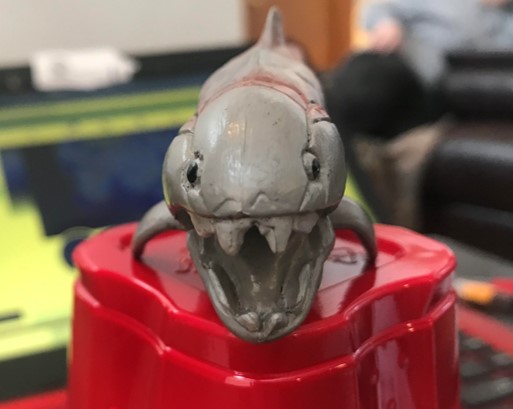
A new (to me) Dunk model reviewed
This is the latest Dunk model I've seen (I put up a hasty post with a rotten photo last night, sorry :)) Anyway, this one from Animal Paradise is a little under 6" (15cm). The coloration is clearly borrowed from the larger, popular Schleich Dunk. It's a toy and the sculptor didn't put in a lot of detail, but what's here isn't bad. It does have an odd, deep groove in each side of the body running back where the Schleich model has scutes, as if this were modeled by someone looking at an unclear picture of the latter. It's handsome nonetheless. I obtained mine from Amazon.

Saturday, December 26, 2020
A Dunkleosteus Christmas
Thanks to my family for understanding my fascination with this species. They had the sweatshirt and mug made up online and my daughter made the desk calendar.

Tuesday, December 08, 2020
New Whale Species! (bonus: a glowing sponge)
Three cetologists on a Sea Shepard Conservation Society expedition off the west coast of Mexico have spotted something amazing. We know of 23 species of the reclusive, deep-diving cetaceans called the beaked whales. The "23" is still approximate with such hard-to-study animals - some species might eventually be collapsed together, or new ones named. The biggest event in life sciences, though, is finding something new in the wild, and these folks may have done it.
Here are Markus Bühler's terrific illustrations of the new whale (above) and a comparison species, Mesoplodon perrini. Copyright 2020: reproduced by permission on this blog, no commercial re-use.


The actual photography (not shown here for copyright reasons, so see the link) and video is superb. Some experts are cautioning that it might be a known species, Mesoplodon perrini, but the scientists involved are sure it isn't. The placement of the two prominent teeth on the adult male (in almost all species) is a key differentiator between species, and the teeth on these were observed and noted to be in the wrong place for M. perrini.
It's taken scientists decades to untangle the beaked whales, and the job may not be done. The last new beaked whale (reported at sea by Japanese fishermen but never identified) washed ashore in Alaska only in 2016 and was formally described in 2019 as Berardius minimus. The people who found the newest whale were looking for a different whale whose unidentifiable "voice" had been picked up on hydrophones. This new species does not match that, so who knows what's down there?
“For
marine life, the age of discovery is not over.” –Jesse Ausubel, founding chair
of the Encyclopedia of Life
Free Bonus Sponge!
Until the 1990s, no one knew there were carnivorous sponges that didn't just sit there but used tendrils to snag food. Now we know there's one that glows. A submersible from the Monterey Bay Aquarium and Research Institute (MBARI) plucked the sample from the Pacific seafloor 4,000 meters down in 2017, but the description has just been published. Presumably it uses the light to draw in food. That's sometimes a low-percentage business on the seafloor, where a light can also signal, "Here I am, come eat me," but a sponge has to make a living, right?
NOTE Text was updated after the comments below from Markus.
Monday, December 07, 2020
Anniversary of a Still-Puzzling "Sea Serpent" Incident
Are there large and strange unclassified animals roaming the oceans of the world? The best eyewitness evidence of this possibility came 111 years ago today from two British men of science, Michael J. Nicoll and E.G.B. Meade-Waldo. In 1905, these witnesses observed a "sea monster" which has never been explained.
 |
| The original eyewitness drawing by Nicoll (out of copyright) |
Thursday, November 26, 2020
Book Review: Naming Nature
NamingNature: The Clash Between Instinct and Science
Carol Kaesuk Yoon (2009:
W.W. Norton & Co., 341pp.)

With the advent of increasingly sophisticated and quantitative approaches to taxonomy, we overlook the ways different
cultures label and group animals.
Biologist and top-flight science writer Carol Kaesuk Yoon set out to
write a book on the science of taxonomy and found a landscape much
more varied than she’d imagined. She embraces the concept of a near-universal
human way of perceiving nature, the umwelt, originating from our ancient
hunter-gatherer experience. The Linnean
approach is a bedrock technique for imposing order on the umwelt by deciding
what animal goes where, and she gives a lively history of the major figures
while foreshadowing the advent of cladistics.
This continues through Darwin and into the twentieth century, where
taxonomy became strictly the province of experts as the lumpers and splitters
continued their often-uncivil war.
(There were, at one point, 2,600 named genera of birds according to
lumpers, while splitters saw over 10,000 genera, more than the number of species
we accept today.) Darwin thought natural
selection would perfect taxonomy and end disputes: he couldn’t have been more
wrong. Evolutionary taxonomy was fully
as acrimonious as any other version. Other
conflicts, such as the worth of taxonomy itself, carried on, as did the never-ending
dispute over how to define a species. Ernst
Mayr’s Biological Species Concept held for several decades, but it was
challenged by Simpson’s revision of the evolutionary species concept and more
recently by the rise of DNA and then cladistics, both useful and widely used but
not yet dominant. [In October 2020, the American Museum of Natural History
reported new research, surprisingly not based on DNA but on morphology,
suggesting the 9,000-ish species of birds is far too low: the figure might be
double that. One for the splitters?]
In other cultures, Yoon reports, people tend to use Linnaeus’ binomial structure in their own way: there is a name
for a group and a name for each type.
Concerning the 137 known birds of paradise, not only do the locals of
Australia and New Guinea know and distinguish almost all, but their groupings
are very close to Mayr’s. Different
cultures classify things for different reasons – what mushrooms are edible,
what animals live within hunting distance, etc. – but the naming conventions,
based on the umwelt refined by accumulated practical knowledge, are not nearly
as dissonant as most of us would think.
We are, Yoon thinks, hard-wired to think about animals and nature a
great deal, even as small children, and notice types. A toddler who has seen
only a few dogs of very different breeds can still tell a newly-seen dog is dog
and not a cat. Where animals are lacking, imaginary ones or other things (like brand names) receive the benefit of this innate ability: her daughter's first word was "kiki," which she said while pointing at the Cookie Monster.
Animals, too, can distinguish between types of other animals:
witness the fact that monkeys have different cries to warn of different
predators. Even the simplest life forms have some faculty to distinguish
between their predators and their prey.
Yoon goes n to describe the new methods from Robert Sokal’s
computerized analysis of characteristics (species definition had long been a
matter of judgment, and in some ways still is), through the birth of molecular taxonomy
based on the chemistry of each organism, and then RNA and DNA, then to cladistics.
All of them, Yoon thinks, are valid, but also move us further from the umwelt
and into realms where comparing two animals visually becomes irrelevant. She
explains some of this very handily by assuming an ultra-simple animal, a blob, and
showing how some species diverge widely from the ancestor species and some
little, and how these developments can essentially be studied backwards to
analyze both evolution and relatedness.
The cladistics revolution began with Willi Hennig, a German fly specialist. The biggest impact of cladistics, to the lay reader, is the seemingly insane claim that there’s no such thing as “a fish,” only superficially similar tertrapods that may have had very different ancestries. The lungfish (her example) may be closer to the cow than the salmon. This technique not only supports now-common view that birds are dinosaurs, but suggests a reason to completely throw out existing taxonomy except where it aligns with cladistics.
The abandonment of the umwelt, Yoon writes, brings precision but loses the connection between humans and the natural world. She accepts the importance of continually improving the science of taxonomy but argues the now-dominant science of comparing molecules or DNA “has left us blind to our own view of the living world.” If animals are reduced to molecules and proteins, how much will we care to protect them? While taxonomy as practiced by societies historically living closer to nature is invariably local, with Aristotle a pioneer in trying to collect information from foriegn lands, there are reasons it continues to exist.
She discusses as an example the way people once thought of whales as fish [one need only consult
Melville for an example]. This view, while scientifically inaccurate, has
value in itself in understanding the umwelt and should not be forgotten. Yoon
also defends fish and considers that species are, to human senses, “the things
we cannot help but see.”
There’s much more in this book, from the loss of
ability to recognize living creatures in brain-damaged humans to various
thought experiments, and it adds up to a great deal to think about.
For my friends in cryptozoology, the book contributes to the longstanding debate about how well local cultures know their animal neighbors. There are published examples of indigenous groups, especially farming-centered as opposed to hunting-centered societies, whose members don’t know all the local fauna. Yoon offers numerous examples to the contrary, although she recognizes that need is a major driver of delineation. Indigenous cultures in Indonesia and the Philippines recognize 600 groups, which she considers equivalent to genera, of animals and plants. A striking example Yoon reports concerns the Tzeltal Mayans, among whom it's usual for four-year-olds to distinguish and name almost a hundred plants.
Many taxonomists, probably most (partitculary cladists, who Yoon more than once calls "rabid") will object to her phrasing of "science vs. the umwelt." I don't agree with it either, although I can also read her as not calling for the abandonment of science but for understanding that other concepts offer insights into animals and the people involved.
Yoon in this book does not just describe a science: she makes us think about what science is and how it affects us. It’s a very important work.
Friday, November 20, 2020
A Dunkleosteus-focused visit to Sea Monster Cove
I bought a trial membership in Meg author Steve Alten’s online venture, Sea Monster Cove (https://seamonstercove.com) to check it out. The basis is that there’s an island site where all the creatures from Alten’s fiction have been brought: there are tours, viewing opportunities, a trailer for a Web TV series, and even hotels with underwater views. I’m not going to review the science here, as my readers know (as Mr. Alten does) that I’ve critiqued him on that a lot. Today, though, I just wanted to see if there’s Dunk-related fun to be had.


Saturday, November 07, 2020
Progress on Cryptozoology Library book
For those interested, my project on a book of cryptozoology book reviews is humming. I intended to cap it at 200 books, but it'll be about 280. I've done all the acquiring / borrowing / etc. and "called a lid" as they say in politics. As it grew, my hope of having it out this year has faded: I'm shooting for January but might not make it. I'm still aiming for low cost as objective #1. Also, I WILL be having a book sale after this is done.
It looks like this:

Sunday, November 01, 2020
Tardigrades: Now Even Weirder!
I like tardigrades, the microscopic "water bears" that are most famous for being hard to kill. (You may recall some survived in a habitat stuck on the outside of the International Space Station. Vacuum, extreme temperatures, cosmic rays... yawn.) A newly discovered species glows blue in ultraviolet (UV) light. One of the effects of this is that UV light levels used to sterilize surfaces, able to wipe out bacteria, virus, nematode worms, etc.) don't kill it. It seems you're just giving it a spin in a tanning bed.
Wednesday, October 21, 2020
Book Review: Sea Fishes of Southern Africa, 1965
An old book to review, but worth it!
Prof. J.L.B. Smith
(1965 edition, text 1953(?), South Africa Central News Agency, 580pp.)
This is a 5th edition, dated 1965 but almost
unchanged in the text from earlier editions.
The first edition in 1949 is a landmark in that it was not only the most
comprehensive reference on the topic but included Smith’s discovery, the
coelacanth, as a species. The text here
was written after only the second specimen (20 December 1952) had been
obtained, and when Smith considered the Comoros coelacanth a different species
than the example from South Africa. Since the third specimen (24 September
1953) is not mentioned, that dates the text to between those events.
Looking back at this from 2020, it’s still very much a book
worth having. I’m still looking for an
earlier edition, but it’s been reissued enough that you can find used
copies.
First there is the sheer mass of data. Smith counts 1,325
species known from seas off the southern half of Africa. With help from his with his scientific
assistant / wife / artist Margaret (who did about half of the 1,320
illustrations) he catalogued fishes by classification and added notes such as
range, preferred environment, rarity, edibility, and so on: the number of
details written into this book is hard to visualize. Two Appendices add some
species not covered in the first edition.
Despite the age of the book, Smith’s explanations of such things as fish
classification, anatomy, the environmental effects of fishing, even how to
preserve a specimen are all good and not too technical for us amateurs. Side
note: there is a dual biography called The Fishy Smiths.
On to some major entries. The big one, of course, is the
coelacanth. Smith explains why it was surprising and why it was important, and
noted his division into two species might not be clear-cut, as the Comoros
specimen was damaged and the fins may not reflect their appearance in life.
[All coelacanths on the African side of the Indian Ocean are now one species,
with the second being from Indonesia.]
One of the most famous fishes of South Africa is the great
white shark. This entry is really interesting. At the time Smith wrote, Otodus
megalodon was not clearly distinguished from C. carcharias. While Megalodon had been classified by
Agassiz in 1843, ichthyologists of Smith’s time generally put it in the genus
Carcharodon, and Smith apparently considered the two sharks conspecifics. He
gives the maximum length of the great white shark as 40 (!) feet [a figure due
to gross overestimates and possibly misidentified basking sharks]. He writes. ”Teeth 5 in. long have been
dredged from the depths, indicating Sharks of 100 ft., with jaws at least 6 ft.
across. These monsters may still live in deep water but it is better to believe
them extinct.” He mentions they are claimed by sailors to develop a taste for
human flesh, but adds, “This sounds rather speculative and one would prefer not
to test it out.” He notes, “Only one
species in our area.” Which is also interesting, implying there were claims of other species at the
time.
On the thresher sharks, Smith writes, “This Shark is stated
to take part with Killer-Whales in attacks on whales, but positive evidence is
lacking.” Hammerhead sharks, we learn, were also known as mallet sharks. The
length given for basking shark is only 25 feet, an underestimate: in many
species, such as swordfish, Smith sticks to relatively conservative estimates
and avoids wild claims (assuming he knew of them). The whale shark is estimated
at 50 feet and probably more but is so are that he adds a request that any
specimen be reported to a museum. Smith includes a lot of fish in this book,
those known from one or a few specimens, for which he makes the same plea.
Things have changed since this was written – species found,
species reclassified, species demoted, etc. Sea Fishes of Southern Africa,
though, remains a classic that gives a baseline for modern ichthyologists to
work from, and it’s just plain interesting for any aficionado to browse through.
Tuesday, October 20, 2020
NASA grabs asteroid sample
It's still on the edge of science fiction - sending a robot to an asteroid to bring back a sample. NASA has pulled it off. I don't know how long it took to come up with the name Origins, Spectral Interpretation, Resource Identification, Security, Regolith Explorer (OSIRIS-REx), but it was worth it. The spectacular, perfect touchdown-grab space feat will return samples of the asteroid Bennu to Earth, some 320 million kilometers away. The spacecraft is staying on the asteroid until next March, when the optimal trajectory for a fuel-efficient return is available. Go NASA!

Saturday, October 17, 2020
New Species Still Show Up
This article points out some of the more spectacular recent finds and adds some information about where and how we find species. The author also wrote a very good book, The Species Seekers, which I've reviewed elsewhere. The money line: "The number of species being found today “compares favorably with any time since the mid-1700s”—that is, since the beginning of scientific classification."
Tuesday, October 06, 2020
T. rex, King of the Auctioneers
Tryannosaurus Stan, one of the largest and best T. rex skeletons ever found, went to auctions this evening. It was estimated to be worth $8 million, or (acocuonting for inflation) a couple million less than the famous Sue. Stan looked down from his three-meter-plus height as the first bid came in at $3 million, followed by one bid after another, until the insane number of $31.8m was reached. Who the bidding firm represented is not yet known, but someone is about to create a great museum exhibit - or have a showpiece that SHOULD be in a museum.
Sunday, October 04, 2020
Sputnik, 63 years on.
63 years ago, at a secret Soviet rocket base, Sputnik 1 rose into the night and changed the world forever. Read what Dr. James Van Allen himself called the "definitive account" of two nations reaching for Valhalla. Erika Maurer and I spent two years bringing the story to life, and we'll always be proud of it.
Read THE FIRST SPACE RACE.

P.S. OK, we made a mistake about a Viking sounding rocket launch taking part of the test stand up with it. We're sorry. Must have sniffed too much oxidizer.
Sunday, September 27, 2020
How many coelacanths?
We all know the basic story of the coelacanth, the animal the term "living fossil" came to be most identified with.

In 1938, a South African trawler pulled up a fish about the size of Marjorie Courtenay-Latimer, the museum curator who spotted the strange blue trophy. It was a coelacanth, descended from a line of lobe-finned fishes that had supposedly gone extinct 66 million years ago. Latimeria chalumnae. was certainly the most famous piscine discovery of the 20th century. It appeared this one had strayed from the species' usual range, later confirmed as the area immediately surrounding the Comoro Islands. In 1999, another species was described, thousands of miles east of the Comoros. Dr. Mark Erdmann, a biologist, and his wife Arnaz, a naturalist, were on honeymoon on the Indonesian island of Sulawesi, when she saw something odd on a fisherman’s cart. “Isn’t that one of those fossil fishes?” she asked. That species is now known as Latimeria menadoensis. (An African population, although not a new species, was confirmed in 2000.)
Now we have more - or we might. I missed the announcement of this in January - I've no idea how - but two of the Indonesian populations are separated by some 13 million years. We may have another species, or a group of related species (there's a LOT to be analyzed concerning the Indonesian coelacanths) where the boundaries are a bit fuzzy, called a species complex. A writer for Reef Builders notes, "The evidence comes from genetic analysis of a single sample of a Coelacanth that was fished up from 300 meters deep in West Papua, that was ‘mostly eaten’ before some tissue could be preserved." So we will see what comes out of this study and efforts to find other specimens to match it..
Oddity: In 1995, reports circulated about a coelacanth being caught off Jamaica. This startling tale made some newspapers, but no one was able to confirm it. Dr. George Brown, founder of a coelacanth conservation group, the Society for Protection Of Old Fishes (yes, the acronym is SPOOF), reported he’d heard nothing about it. Dr. Karl Shuker, an English zoologist who also tried to verify the story, believes it was a hoax or a case of mistaken identity.
There rests the mystery of coelacanth distribution. It’s likely there are (or were) populations between the Comoros and Indonesia. It’s also still possible we’ll find coelacanths in other parts of the globe. Perhaps this famous fish, while still fascinating and important, isn’t quite as rare as we thought.
Tuesday, September 22, 2020
Book Review: Devolution by Max Brooks
Devolution: A Firsthand Account of the Rainier Sasquatch Massacre
Max Brooks: Del Rey (2020) 304 pages
Brooks, who had a bestseller with World War Z, has
cooked up a story mixing cryptozoology with classic horror and survival tales
and some potshots at modern life. It’s
very interesting, but a bit patchy: I like it but don’t entirely love it.

The setup is fun. People move to the tiny ultramodern eco-community
of Greenloop, where everything you want comes daily by drone and everything you
do has minimal impact on the environment. One family includes Kate Holland,
whose journal forms the core of the story,
If most “creature” tales have the moral “Man is the deadliest animal,” this one goes with “Man can be the deadliest animal, but he’s certainly the weirdest.” A collection of colorful folks with absolutely no idea how the natural world works but also want out of the human world are cut off when Mount Rainer decides it’s been dormant long enough and buries a huge area in volcanic mud. Amid an enormous national disaster that makes Katrina look like a tea party and ensures no one even thinks about Greenloop, days and then weeks go by while people wonder what they will do without their online-ordered support. They don't even own toolchests, much less guns.
Meanwhile, Sasquatches who’ve been content to live on veggies and venison begin to get desperate for protein. It does not take them long to figure out one of the few protein sources left in their devastated habit is huddled in
Greenloop.
A lot of themes unfold in the weeks after the disaster, although there are some poky stretches before we get there. The humans display a mixture of helplessness and imagination. If not for an artist who seems to know a lot about war, they’d all be dead. Some of the people evolve under pressure: some crack. Meanwhile, the sasquatches lose their normal reticence about getting close to humans and “devolve” into sadistic-predator mode. Brooks does a good job in giving the sasquatches personalities and family/tribe dynamics rather than being indistinguishable monsters. Brooks has read his Bigfoot literature and ties this story in with folklore and cryptozoology. Sasquatches are not reported to have narrow waists, quite the contrary, and primates don’t have eyes that gleam red in the dark, but Bigfoot fans will otherwise find little to dispute except the question of whether the famously peaceful creatures would devolve in a situation like this. Hunger does a lot of things to people and Bigfoot alike...
Brooks’ descriptions and settings, including his blueprint of Greenloop (rim shot), are good throughout. So is his depiction of action. The series of battles marking the town’s last days is gripping. Tactics on both sides change as humans learn how much squatches hate fire and squatches learn it’s dumb to underestimate even small opponents if they have pointy weapons. (There are detailed instructions on making a spear out of a kitchen knife, which is only one of the improvised traps and weapons that make this sequence cool. It’s like Home Alone with murderers instead of idiots invading.)
The ending is very interesting. We don’t know exactly what
happened to the survivors, but one possibility offered is that humans, too, can
“devolve.”
Brooks works in a lot of commentary, some of it delivered
with a shovel, on human philosophy, the urge to cuddle nature vs. the urge to
ignore it, the overdependence on gadgets, etc. Not much of that is new, but
Greenloop concentrates it all in one place. There’s a familiar Jurassic Park
theme with the isolated humans, and it’s not hard to guess who’s going to die
first.
What really makes this novel go is the sasquatches. I wish
one of them had been able to keep a journal, too.
Friday, September 18, 2020
Book Review: A New Human
A New Human: The Startling Discovery and Strange Story of the "Hobbits" of Flores, Indonesia

Mike Morwood and Penny van Oosterzee (2007: Smithsonian,
272pp.)
The Indonesian island of Flores was just another spot in a
vast archipelago – until it became the locus of a scientific earthquake. Lead discoverer Mike Morwood here tells the
story of Homo floresiensis from his point of view. The Ling Bua cave and the diminutive
LB1, a woman who apparently died only 18,000 years ago [a date since moved back
to at least 60,000], is a fascinating tale of intuition, research, scientific
and academic rivalry, and grinding hard work. In 2003, the team is elated to
find the lower jaw of a “child” – and dumbfounded when they see worn adult
teeth.
The archaeology and paleontology involved is described
thoroughly and understandably. Morwood
explains why this area was interesting, geographically and geologically, as a
place to look for the first Asians to island-hop to Australia. He also takes us through the customs and
cultures of this vast archipelago, from a ritual contest using bullwhips to minibuses
that vie to be the loudest means of transportation on Earth.
Morwoord’s team's claim of a new human species, one that
looks like none other and challenges not just our history but what it means to
be human, sets off an international carnival.
LB1’s brain size was mid-range for a chimpanzee. It wasn’t possible for
primates with 380 cc of grey matter [one later paper says 417] to build fires,
make stone tools, and undertake cooperative hunting of large animals – except they
did. An apparent example of “island dwarfing,” which once gave the world pony-sized
elephants, apparently reshaped a species more closely related to its African ancestor
than to the only known early hominid of Indonesia, Homo erectus.
One of the interesting post-discovery episodes here is the
path to publication. It can take months to run the peer-review gauntlet and
well over a year to publish in a journal like Nature. But as whispers
curl around the edges of their closely-held story, threatening to ignite it and
let someone else name the species first, Morwood and the editors at Nature
do things on an unprecedented schedule, ramming the paper through peer review
in three weeks and publishing it in October
2004, seven months from the time Morwood first approached them. (Morwood’s team considers the species name hobbitus,
chortling about academic conferences discussing hobbits, but is eventually
dissuaded.)
LB1 (there were bits of 12-13 individuals found, but LB1 had
the only cranium, and there was only one other lower jaw) lived a hard life,
but nothing could have prepared her for this. Unconvinced scientists describe her as a Homo
sapiens with microcephaly or one of three other suggested maladies. As nationalist and academic feelings clash,
bones are taken without authorization for dating; an Indonesian institute lets
underskilled preparers take latex molds, damaging the priceless bones;
Morwood’s US-British-Australian-Indonesian team is accused of “neocolonial”
fossil-hunting; and Moorwood hears intriguing tales of the Ebu Gogo, the little
people who supposedly inhabit Flores to this day.
By the end of the book, the reader will, along with Morwood,
experience relief when the species is established and the intellectual arguments
won, even though the bones remain contested and locked away. Morwood died of cancer in 2013, having seen
his species widely accepted after much controversy. The search for more “hobbits” goes on.
(There is also an updated edition of this book, which came
out in 2009.)
Musings: At a cryptozoology conference, biologist/TV host
Pat Spain told us Morwood had evidence the species survived into the 1920s.
Morwood’s papers are still locked up in Indonesia, science held hostage to
disputes about ownership and jurisdiction. This is a well-told tale of an epic discovery, and readers will learn about much more than just a skeleton.
Other sources:
http://johnhawks.net/weblog/fossils/flores/sutikna-liang-bua-stratigraphy-dating-2016.html
https://phys.org/news/2017-04-indonesian-hobbits-revealed.html
https://phys.org/news/2013-07-homo-species-d-comparative-analysis-status.html