Monday, May 11, 2020

In Bearable News...

I love bears. They're adaptable, smart, and really magnificent-looking.  Indeed, bears have the largest and most complex brains of any large land mammal relative to their size, and their intelligence, while hard to test, probably overlaps that of the higher primates. Aa bear in California learned how to bounce on the roof of a Volkswagen Beetle and pop the doors open.   
And they're big.

HOW BIG ARE BEARS?
A polar bear weighing a metric ton (2,200 pounds) is on record from Alaska, the biggest brown bears may hit 1,500 lbs, and 800-lb black bears are known. All of these are outliers, of course, but darned impressive nonetheless. 
Bears in captivity may get even bigger if they are overfed or lack enough exercise. Take Samson, for example. Samson was a bear trapped alive by John "Grizzly" Adams and hauled to antebellum New York to be exhibited.  He was a sensation.  He was the biggest bear Adams had ever seen in many years of hunting grizzlies, and when put on a hay scale he weighed 1,503 lbs.  (It's possible he had gained some "cage fat" by this point, but Adams' description of him as a "moving mountain" seems justified.)  Here in my hometown of Colorado Springs, the Cheyenne Mountain Zoo reported in 1955 the death of a male Kodiak weighing 757kg (1,669 pounds)!    

Earlier Post: More on Big Bears


Samson. Painting by Charles  Nahl, 1855) this was the model for California's state flag. It is reported, although not certain, this paitning was the model for the California state flag another version is that a bear named Monarch deserves the honor.

Anyway,  I hadn't written about bears in a while, so I thought I'd just dip a toe into recent and ongoing bear items. 

Here in North America, we have black bears (Ursus americanus, which can be many colors including cinnamon and white), brown bears (Ursus arctos, with the grizzly and Kodiak bears being the local subspecies), and the totally awesome polar bears of the north.  The polar bear is getting the most concern of late.  Polars are not in danger of extinction - indeed, it's not clear their population is much below its historic highs - but their  preferred range is squeezed as the pack ice is reduced and the occaional polar-grizzly cross has popped up.  Grizzly range has been greatly reduced by hunting and so on - the grizzly on the Califonia state flag is the only one in the state outside of a zoo.  


Here in Colroado, the last grizzlies were supposed to be gone in the 1950s, but a bowhunter killed one that attacked him in 1979, and this was a sow who had had cubs. A few other good modern sightings are on record.  I wrote a paper once suggesting a few lingered in the San Juan mountains, although probably not a viable population. 


And, of course, I once talked (brilliantly, I'm sure) about the largest brown bears in this little episode of must-see TV.  MonsterQuest: Giant Bears. Alas, I can't find a still image of myself from it.


Chubby North Carolina bear compared to housebound humans... 

This black bear looks like a balloon. A sceintist reports the 700-pound teddy found cornfields where it just ate, lay around, ate, went off to sleep, came back, and ate some more. Jokers compare it to people trapped by the pandemic with nothing to do but snack.  
North Carolina's "chonk bear" (USFWS photo)

There's always controversy on bear conservation, for a number of reasons. One is that protecting bears means a lot of land: bears in North America are the biggest predators in every habitat, and they need space. Black bears, the males anyway, often wander 15 miles or so in pursuit of fodder and females, and sometimes go much further if the range is crowded or food is sparse. A male grizzly needs a range of 300-500 square miles, although such an area can support numerous bears. A grizz may defend a smaller home patch of ground, but won't try to police the whole range. 

With protected areas like Yellowstone, the issue arises of what to do with park bears that go hunting outside the park. 

BEARS AND HUMANS 

Yellowstone like any area, has a carrying capacity, although there is often furious debate over what that number is and how to keep the population healthy. Advocates like those served by the Grizzly Times fear culling bears or delisting populations is a dangerous step when the animal has already been extirpated from much of its range.  It gets more complicated because governments generally agree that problem bears, like repeat predators of livestock, can be killed, but of course the bears don't know the rules. And how far should the rules extend? This story out of Montana last month is an example of what bear advocates would call a borderline case at best. Bears don't view humans as their usual prey, but can be dangerous: this attack in Oregon occurred just this week, and here's a recent case from Alaska.

BEAR PROTECTION


The brown bear is a Threatened species in the Lower 48, while black bears, depending on locations/population/subspecies, may be protected or subject to hunting. That's another controversy altogether, with hunters arguing it's a smart, cheap way to control populations while supporting guiding and other occupations,  and opponents arguing on conservation as well as moral grounds.    (Brown bears may be hunted in limited numbers in Alaska.) The polar bear protected within the United States. 

Here's the plan for the polars. Threats include poaching, habitat loss, climate change, and pollution, although just to remind us we CAN get good things done, here's a report of how accumulated toxins in polar bears are decreasing after a long rise. 
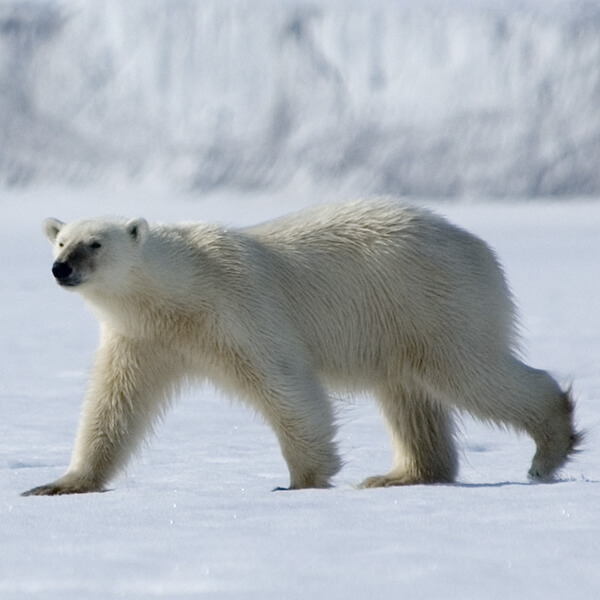

Polar bear, Hornsund, Greenland


Ursus maritimus (USFWS)

That's it for a roundup of bear stuff.   No big new insights or conclusions, but bears are fascinating enough to just read about and think about every now and then. 


A few bear references:
Day, David. 1990. The Doomsday Book of Animals. New York: Viking Press.
Domico, Terry. 1988. Bears of the World. New York: Facts on File.
Galbreath, Gary, et. al. 2008. "An Apparent Hybrid Bear From Cambodia." Ursus 19:85-86. 
Goodwin, George. 1946. "Inopinatus the Unexpected," Natural History, November.
Halfpenny, James. 1996. “Tracking the Great Bear: Mystery Bears,”  Bears, Spring.
Montgomery, Sy.  2003.  Search for the Golden Moon Bear.  New York: Simon and Schuster.
Wood, Gerald L. 1983. The Guinness Book of Animal Facts and Feats.  Sterling Publishing Co.
Woolford, Riley. 2007. "White Black Bears and Blond Grizzlies: Alaska Bears Wear Coats of Many Colors," Alaska Fish & Wildlife News, September.  
Discussion thread at http://shaggygod.proboards.com/thread/474/guinness-world-record-kodiak-bears

Thursday, April 30, 2020

Dino News: Spinosaurs and More

These days, there's not much to cheer about. Think about this, though: the pursuit of knowledge goes on. Science goes on. Not just in medical labs, but in every kind of endeavour humans engage in to learn more about the universe. It's a testament to our innate desire to learn, and what's more fun than to take some time out from COVID-19 to talk dinosaurs?
First, remember our friend Spinosaurus from Jurassic Park 3? Easily the coolest creature in a very uneven creature feature, the onscreen predator was just as much at home swinning up on people submerged as it was fighting T. rex.  Scientists have debated for a long time how aquatic Spinosaurus was. Did it swim, or was it just an occasional wader? The fragmentary nature of available skeletal material didn't answer that.  Now we know: Spinosaurus apparently was equipped for a crocodile-like lifestyle, tethered to the land but hunting fish, reptiles, and other dinosaurs in the rivers and shallows, snatching animals in the water or perhaps ambushing them as they came down to drink (which must have been hard with that sail). We know this because we have good fossils of the tail now, and it's a crocodile-like tail, flattened side-to-side, suited for propulsion for an animal that also shared the crocodilian tendency toward short legs and (we think) webbed feet. It was the first true swimmer we know of among the dinosaurs. The key fossils came from Morocco and were unearthed in 2017-18.
Coverage here from Nat Geo 


Spinosaurus at the George S. Eccles Dinosaur Park-Museum, Odgden, Utah  Rea;;y cool, but we didn't know about the tail. Photo by Matt Bille, 2018.


About unearthing dinosaurs. I've always wondered if some ancient traveler saw a Spinosaurus eroding out of a cliff and saw the sail as a pair of wings folded up. "So that's what a dragon looks like!"
The biggest dinosaur search of all time, called Mission: Jurassic, is on in Northern Wyoming, near the famed Morrision Formation.  Here's a fascinating story about the riches being uncovered and how one scientist has committed the next 20 years of his life to excavating the site.
Allosaurus - Wikipedia

Allosaurus, a common denizen of the Mission: Jurassic site and the Morrison Formation (photo origin unknown)


Thursday, April 23, 2020

Interview: Whales and the Marine Conservation Network

Kimberly Ray, cofounder of the Marine Conservation Network, did an interview with me a couple of weeks ago, focused on whale tracking and conservation.  I'm no cetologist, but I hope there is some good stuff here for everyone. Thanks!


Wednesday, April 22, 2020

HAPPY EARTH DAY

On the 50th anniversary. there is room for both continued concern and aspirational hope.  Here's an article I did about a small contribution to one aspect of conservation, improving the tracking of whales and other engendered species.  Since I wrote this, NOAA has teamed with a French project called ANGELS to demonstrate successfully that smaller satellites can be part of the solution.


https://blueocean.net/saving-whales-with-satellites-3/?fbclid=IwAR1xP8oia-FkfwW1iY9eXsLu95-OQ6TsRn_0xXhu3WO1raG6__xUndu93oo


Friday, April 17, 2020

Dinosaurs, Dr. Naish, and General Coolness


Darren and the Dinosaurs
(sorry, Darren, I couldn’t resist that. Danny and the Dinosaur was the first book I remember reading.)

I’ve talked about Dr. Darren Naish before.  A paleozoologist and science writer with a specialty in dinosaurs but interests everywhere, Darren’s blog Tetrapod Zoology is reliable and fascinating reading on everything from sea serpents to orangutans to every kind of zoological oddity.
The blog caught my attention this week for its headline about sauropod dinosaurs and whether scientists are creating too many species.  He notes some 50 “non-bird dinosaurs” are described every year, and there’s a proliferation of North American longnecks that some paleontologists think is overdone – there are 30+ species from just the Morrison Formation (Upper Jurassic Period).  One need not understand the subtleties of classifying dinosaurs (I certainly don’t) to wonder how complete the fossil record is and whether we know a few or most of the dinos from a particular place and time.  His response is that there are gaps where we know almost none of the dinosaurs.  Some caution is called for when we have only fragmentary remains, but given the time scale we’re dealing with (remember T. rex is closer in time to us than to most other dinosaurs we common folk have heard of) and the global spread of dinosaurs, there's a lot of room for discovery  Indeed, we sometimes, in effect, don’t have enough dinosaurs: an eternal war rages between those who think Nanotyrannus is a young T. rex and those who think it’s a species. (The latest research is on the T. rex side, leading me to brilliantly pun “sic semper nanotyrannus.”)
One estimate (not from this source) is that the average lifetime of a species is 3 million years.  In the 140 million years of the Mesozoic, there’s room for a LOT of dinosaurs.  The known species include cool mysteries like Amphicoelias fragillimus, now Maraapunisaurus, described in 1878 from a single, now-lost vertebra so large it indicates a dinosaur even bigger than the recently found South American giants.  It might, given its resemblance to the famous Diplodocus, be “a diplodocid diplodocoid, and probably a diplodocine diplodocid diplodocoid.” Umm, ok.
OK, that’s all the dino-rambling for today. Buy Darren’sbook.


Monday, April 13, 2020

Review: Voices in the Ocean, by Susan Casey


By Susan Casey
Doubleday, NY, 2015, 320pp.
Casey, author of very interesting books on waves (her best work) and great white sharks, here recounts her efforts to more about our aquatic analogues, the dolphins.  It is a personal journey, and some sections are more compelling than others, but it’s a trip worth taking.
Casey is enraptured with the animals, and that’s understandable. She witnessed everything from hunting and captivity to the exhilaration of open-ocean encounters off Hawaii, and there’s a very interesting closing section on how dolphins were venerated and memorialized in art by the Minoans and their neighbors.  She talks to some top-rank scientists like Robin Baird and Lori Marino, but she says her curiosity could not be satisfied in labs and tanks, only in the ocean.
Casey tells us early on that it’s easy to “go down the rabbit hole” with the mystical side of human-dolphin interaction, and down she goes, offering a sympathetic portrait of the brilliant but bizarre John C. Lilly (kudos to her for digging through his personal archives and not relying just on secondary sources) and spending time in Hawaii with Joan Ocean, who holds that dolphins are “multidimensional beings” with wisdom beyond our imagination.  The most fascinating bit, scientifically, is her discussion of dolphin brains with Lori Marino. The dolphin brain “design,” Dr. Marino explains, is very different from our own. It prioritizes speedy processing and reactions as well as sensory inputs.  The book includes numerous examples of dolphin intelligence, some of them pretty startling.   It also features tales of dolphins rescuing people: as Casey notes, this implies animals, for some reason, sometimes see us as kin.  
There are heartbreaking chapters on the slaughter and captivity of dolphins in the centers of the live-dolphin trade, Taiji Cove (Japan) and the Solomons, where Casey, at some personal risk, meets the brave and dedicated people trying to stop the carnage.  (Her description of the “Whale Museum” in Taiji is otherworldly, an example of how humans can warp their perceptions even about things they’ve personally witnessed.)   She looks at some of the marine parks where mistreatment and tragedy have occurred, including in Canada and the United States. She speaks to ex-trainers, most famously Ric  O’Barry, whose dolphins I once saw perform as “Flipper.” She denounces the “swim with dolphins” programs, which she shows include extreme confinement of the animals to make sure they’re available. A welcome counterpoint is her visit to Dingle, Ireland, to see Fungie, a bottlenose who has seemingly adopted the town and has spent 30-plus years interacting with the people who venture out to see him.  
This is a personal journey and not a treatise, but a few omissions seem odd. Casey never asks current dolphin trainers for their views - I agree with her that captivity should be phased out, but castigating it without those voices oversimplifies things.  She notes that dolphins are not all happy and gentle creatures, but ignores the details. Bottlenose dolphin females are forced into sexual congress by groups of males that ram them, bite them, and tail-bash them to make them submit. Some newborn calves are batted through the air and rammed until they die. Many other mammals do similar things, but there is a bit too much rosiness in the portrait of dolphins. Casey doesn’t entirely embrace the more extreme metaphysical beliefs, but there’s no skeptical counterpoint, either. Ancient and modern indigenous people who honor or commune with dolphins are celebrated, but the ones that killed and ate them go unmentioned.
Again, though, this comes back to being Casey’s own attempt to learn more and connect more with dolphins and it helps that she’s a very good observer and writer.  Dolphins are fascinating, and Casey shows us many of the reasons why. The book’s omissions make me think she loves her subject too much, but that’s not the worst of sins.  If this is not the whole story of humans and dolphins, it’s a compelling and often memorable chapter.  There’s a good set of chapter notes (neglected by many modern writers) and a bibliography.

Friday, March 27, 2020

Odds and Ends: Science and Survival


Odds and Ends March 27, 2020
By Matt Bille

It’s been such a crazy year so far, with the dominant threat of coronavirus wrecking the whole world’s plans.  (LISTEN TO THE EXPERTS!!!) But there are other things going on, some of them memorable. 

SHOOTING FROM THE HIPPO
I posted on FaceBook the question of a little oddity that turned up as I read Glynn Williams’ excellent book Naturalists at Sea (full review coming).  William Dampier was a British naturalist, self-taught but brilliant, whose voyages took him around the world three times.  (Some of that time was spent, incidentally, as history’s most inept pirate.) About 1700, in Australia's Shark Bay, he was present when a shark was caught whose stomach contained [his spellings] "the skull and boans of an hippopotamus." He specifically mentioned the jaws, lips, and teeth as identifying features. Dampier does not seem to have recorded the size or species of the shark. What could a man who wrote many volumes of exhaustive and precise notes of plants and animals all over the world have mistaken for a hippo?
German zoology expert Markus Bühler likely solved it when he suggested the dugong. “For a naturalist from 1700, who has never seen a dugong and who had likely also not exactly superior experience with hippos, it seems really not too far stretched that he would consider that a dugong´s head belonged to something hippo-like.”  OK. It was cool while it lasted.

SOCIAL DISTANCING FOR CRYPTOZOOLOGISTS
If you forget the required measurement for social distancing, it’s four Bluff Creek sasquatch tracks or a little over one coelacanth. 

LITTLE SURPRISE IN ANCIENT AMBER
According to the article in Science, the most prestigious journal in America, by Gretchen Vogel, “This tiny head, 14 millimeters long (including the beak), belongs to one of the smallest dinosaurs ever found.  …”  Oculudentavis khaungraae (eye-tooth bird) is an amazing find.
It’s one of the most controversial follis ever, though. The scientific controversy is that not everyone agrees it’s a dinosaur. Some suggest it’s an early true bird, some that it was a lizard. That will be argued out in future papers. The tough one, though, is that many publications debated covering it because it’s from Myanmar, where the province it was mined in. and from which it was smuggled to China, is mired in a brutal separatist conflict and funds one side or the other depending on who's in control of that bit of ground at any given time.
Joshua Sokol reports on that here.  
Read The Dinosaur Artist by Paige Williams for the big picture of dinosaur smuggling and sales. 

Want to read an old-but -great book in wilderness survival? Try Cache Lake Country: Life in the North Woods, by John J. Rowlands and Henry B. Kane (Norton, original edition 1947).  


Rowlands recounts his North Woods adventures in a friendly campfire style and along the way includes instructions, with drawings, on how to make everything from a shelter to a water-cooled refrigerator, all with materials from the wild and the kind of gear a camper could lay hands on way back in the 1940s, before all the flashy modern stuff was even thought of.  My dad had a copy of this when we were kids, and we loved it. It vanished, but I turned up a used one. It’s on Amazon as paperback, Kindle, or FREE audio book, although the hardback is now costly. 
“There’s a Cache Lake for everyone, but it won’t be found by a four-lane highway.” – John Rowlands.

In a year like this, I’m sorry I’m not up in Cache Lake Country myself.

Tuesday, March 17, 2020

Anniversary: Vanguard 1 satellite


“Nothing ever built arose to touch the skies unless some man dreamed that it should, some man believed that it could, and some man willed that it must.”   - Charles F. Kettering

  It’s often forgotten that long before Sergei Korolev, Chief Designer, launched Sputnik 1, an American satellite program was underway.  This is a story Erika Maurer and I were honored to chronicle in the NASA-sponsored publication of The First Space Race (Texas A&M, 2004).


The Stewart Committee assembled in 1955 selected Project Vanguard in what might be termed the ultimate Army-Navy game.  Vanguard, to be run by the Naval Research Laboratory, was to orbit a scientific satellite during the 1957-58 International Geophysical Year (IGY).  The Navy and the Soviet Union pressed towards the goal of the first satellite (with the Stewart Committee loser, the Army Ballistic Missile Agency, left, for the moment, on the bench). 
That competition has been second-guessed, then and now, and some annoyingly persistent and unproven claims have been made about it.  Since we have an opportunity here to mention those, and it’s my blog and these irk me, there are three such claims:

  1. The Committee (in some versions, directed or pressured by President Eisenhower) picked Vanguard because it was the “more civilian” satellite, with the National Academy of Sciences being the official sponsor even though the program was hosted and carried out by NRL.  The idea here (logical in itself) is that a civilian satellite would have more of a chance to establish a lasting principle of free overflight through space. But while the Stewart Committee was well aware of this logic, there’s no evidence they acted on it.   There’s also no evidence Ike pressured the Committee in any way. 
  1. That dislike of German engineers under the ABMA’s famous Dr. Wernher von Braun carried the day. Again, no evidence. Whether one or more people held an unconscious bias, or a conscious one never spoken of, is unknown and unknowable. 
  1. That Ike wanted the U.S. program slowed down so the Russians would establish freedom of space. Again, the Committee, the National Security Council, and the President were aware of this thinking, but Ike more than once criticized Vanguard for being behind schedule. The “slow down” idea was disproved by Ike’s post-Sputnik action of calling his R&D chief, Donald Quarles, on the carpet and demanding to know how the Russians came in first. 
Erika and I are convinced that, in this case, the official version of events is the true one.

On 4 October 1957, Korolev successfully placed a satellite in Earth orbit.  The spacecraft itself was an unimpressive-looking sphere, not much bigger than a basketball.  What it signified, though, was enormous.  The first phase of the first space race was over.  The Soviets quickly followed up with the far larger Sputnik 2.
Project Vanguard hustled to develop a response to the Soviet Union – and a questioning American public.  Everyone knew Ike had approved Project Vanguard but also that he’d watched with growing impatience as its timetable slipped and costs mushroomed.  Vanguard never had an explicit directive to be first, but it was widely assumed the Soviets were behind us in technology and so the first satellite would be American.
On December 6, 1957, what had originally been meant as a non-orbital Vanguard test vehicle but now fitted with a tiny satellite, attempted a launch from Cape Canaveral in full television view of the entire world.  The result was an embarrassment:  a massive explosion two seconds after launch.  Vanguard’s director, John P. Hagen, was remarkably reserved in his response: “Nuts.” The satellite, built quickly in a minor engineering miracle by a team led by Roger Easton, fell forlornly to the sand. Easton carried it back to Washington, where it languished, seemingly unwanted, in his house. (Years later, the Smithsonian put it on permanent display.)


NRL newsletter article

The Army Ballistic Missile Agency’s Explorer 1 became the first American satellite on January 31, 1958.
Vanguard did not give up. On March 17, 1958, on its third try, the program put a satellite into orbit.

“I heard a tremendous roar, as if a fire had started.  Suddenly, books, shoes, and other things flew over the balcony down into the hangar.”
- Propulsion engineer Kurt Stehling on the Vanguard celebration at Cape Canaveral

 In October 1958, the U.S. created the National Aeronautics and Space Administration (NASA) to run civilian space programs.  This organization eventually absorbed the Army and Navy satellite programs.  The NRL reconstituted a Satellites Techniques Branch under Martin Votaw, and the Lab continues working on small satellites today. 
Vanguard has been categorized as a flop. It wasn’t. It went over time, it went way over budget, and it had a launch failure at the worst possible moment, but that shouldn’t obscure its contributions, which echo into 2020 and well into the future. 
First, there was the rocket. The Vanguard launch vehicle, still the smallest ever to successfully orbit a satellite, pushed technology hard.  The margins were miniscule, and the rocket met with success only after great effort (and considerable infighting) by the Glenn L. Martin Company and the NRL team. The second and third stages, the Able and Altair, mated to a Thor missile first stage, became integral components of the longest-running and most successful American booster family, the Delta rockets. Vanguard’s engineering DNA was still traceable in the last Delta II launcher, flown in September 2018.
Vanguard’s satellite design packed a lot into a small space. There were two designs: the full-sized satellite and the miniature one.  Of the full-sized (24-lb) satellite that would become Vanguard 2, Constance Milton Green and Milton Lomask wrote in their book Vanguard: A History, that "Miniaturization, today a commonplace of technology, was a novelty in 1955. The Laboratory's proposal, however, hinged on it. satellite casing weighing eight pounds would carry miniaturized instruments weighing ten pounds for accumulating scientific data…Minitrack equipment weighing two pounds… and two pounds of telemetering equipment."    
There was a recognition even then that some power source besides heavy, short-lived batteries was needed for spacecraft. The first miniature Vanguard "grapefruit" satellite drastically shrunk the original design. Weighing only 3.25 lbs, it carried six solar cells into space and proved the utility of this brand-new technology. The satellite also had a mercury battery, two radio transmitters, and a temperature sensor.  The claim has been made that the NRL originally didn’t want solar cells, but an Army researcher put pressure on them. Roger Easton, discussing the satellite 50 years after launch, reported he had checked into this (and of course, he was also THERE) and it was groundless.  The occasional suggestion that Vanguard 1 was essentially a rickety thing slapped together that somehow worked also irked Easton and other program vets. The ingenious design of the satellite, using every cubic inch of space, and its long active life transmitting from orbit (until 1964) stand as refutation to that idea.
Then there was the tracking system.  Minitrack was another achievement led on the design side by Easton, who deserves his own biography (although his son Richard put a lot of the story into his book GPS Declassified, cited below).  Minitrack was a north-south line of 14 stations, built by the Army Corps of Engineers and stretching all the way down to Argentina. It was a predecessor to the Naval Space Surveillance System (NAVPASUR), created for more accurate tracking of Soviet satellites. That system (somewhat convolutedly) led to an Easton-led satellite project called Timation and then the invention of GPS. Richard Easton says, “I think the most important legacy of the Vanguard 1 satellite is the solar-powered transmitter. The second was Minitrack, leading as it did to Space Surveillance and eventually to Roger Easton’s Timation satellite and then onward to and GPS. But that was a long process.”

NRL Minitrack Station at BlossomPoint, MD


(Side Note: Victory has a thousand fathers (and mothers), and credit for GPS is a complex matter given the long gestation and many contributions leading to the Air Force-deployed operational system that changed the world. If one person and one program were absolutely essential, though, they would be Easton and Timation.)
The Vanguard program would end with the 52.5-pound Vanguard 3, launched on September 18, 1959. 
The full-sized satellite had a second life: it lent its structure, or bus, to NRL’s SolRad (Solar Radiation) satellites, along with its telemetry equipment and other technology. SolRad is best remembered for having a once-classified secondary mission as the first electronic intelligence satellite, called GRAB (Galactic Radiation and Background), which studied Soviet radar emissions, but it also did important science.  SolRad was the first satellite built by the revived Satellite Techniques branch.  The series opened with the launch of SolRad 1 on June 22, 1960 and put 11 satellites in orbit.
Not bad for a “flop.”

Key References
Constance McLaughlin Green and Milton Lomask, 1969.  Vanguard - A History (Washington, DC:  NASA SP-4202, Smithsonian Institution Press, 1969).
Kurt Stehling, Project Vanguard (Garden City, NY: Doubleday & Company, 1961).
Richard D. Easton and Eric F. Frazier, GPS Declassified: From Smart Bombs to Smartphones (Potomac Books, 2013).
Richard Easton, online discussion, March 2020.

Saturday, March 14, 2020

Review of The Whale in Fact and Fiction (1967)


Review: The Whale in Fact and Fiction
Robert K. and Martha L. Moffett: Harlan Quist, 1967


Why go back and review a book written for the junior high school level in 1967? Because it’s a window to the past of cetology and the public. What did we know in 1967? Judging by this book, what we did know was sort of reasonably accurate, but what we didn’t know filled oceans.
First, the book itself: it’s episodic rather than a survey, with one chapter devoted largely to the Essex sinking and major chunks on the whaling industry and a selection of cetacean. The rorquals get their day: among other tidbits, the authors mention a harpooned blue whale 113 feet long and a reported 70-foot right whale. “The dolphin” and “the porpoise” get introduced (albeit without trying to break down the number of species), and the beluga and narwhal have their moments. The orca is praised for its intelligence (plus the story of Namu is included) but damned as a “cruel” and vicious predator.  The writing is good, the illustrations a decent selection, and, while whaling (like captivity) is not tied to any moral questions, the authors bemoan the overhunting and near-extinction of larger species. The history of whaling is the book’s most interesting and best-done section.  
The rest of the book is a selection of writing on whales, including a Japanese whaling tale, a humorous poem, a bit from Arthur C. Clarke’s novel The Deep Range, the diary of a whaling captain’s wife, and of course a bit of Melville.  It is, in summary, not a bad book for its intended audience in 1967.
Now, to what we knew, or what the authors believed true. According to this book:
·         The dwarf/pygmy sperm whales are regarded as one species, known only from strandings and never seen at sea.
·         The small cetaceans are all happy-go-lucky: no one knew some species can be, by our standards, murderous thugs.
·         The giant squid-sperm whale battles are not one-sided.
·         Orcas will stalk and try to kill humans deliberately.
·         Gray whales attack small boats on sight thinking they pose a threat. (News to the tourists who routinely pet them now).
·         Little was known of whale ancestry and evolution: the (misspelled) Archoeoceti get two pages.
·         The beaked whales are either too poorly known or not interesting, as they never get mentioned. Neither do the pilot whales. 
·         The bowhead is a less-used name for a type of right whale.
As I said, an interesting look back.  


Sunday, March 08, 2020

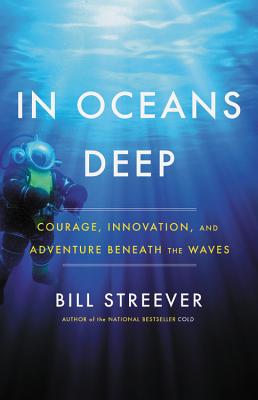
Review: In Oceans Deep by Bill Streever


IN OCEANS DEEP: Courage, Innovation, and Adventure Beneaththe Waves

By Bill Streever

Little, Brown, NY, 2019: 303pp.


In Oceans Deep: Courage, Innovation, and Adventure Beneath the Waves - Streever, Bill
This is a very good if somewhat episodic account of humanity’s descent beneath the sea by every means we’ve found: diving suits, free-diving, submarines, submersibles, habitats, and remotely operated vehicles (ROVs).  Streever is well-qualified to write this book: he is not just a science writer, but a biologist and a diver whose resume includes SCUBA diving, saturation diving as a young oil field worker, and free diving, a new sport to him (he takes us along as he learns it).  


There are fascinating facts and stories throughout this book, and some bits like the evolution from towed dredges to ROVs for exploration and the development of our understanding of “caisson disease” (the bends) stand out as especially well-explained.  He recounts some of his interviews with significant personalities in marine exploration and laments that some, like James Cameron, were unreachable: writers rarely if ever include such misses, and to me as a writer it’s very interesting. Of particular note is his talk with Don Walsh, one of two men on the Trieste when it dove to the bottom of the Mariana Trench. I didn’t realize what a shoestring operation that was. (Walsh thinks the flatfish he reported, generally believed to be a sea cucumber, might still have been a fish.) Streever elicits a striking comment from Dr. Sylvia Earle, who said the barely-surviving Haitian fishermen Streever was with had choices other than catching too-small conchs and lobsters but he didn’t ask what those were. (To be fair, Steever managed only a short telephone conversation.) He’s fascinated by new technology, like the latest nuclear submarines and ROVs: he even buys a small ROV himself to explore its utility. I expected a bit more detail on hard-suit diving and at least a mention of liquid-breathing experiments.

Somehow, I didn’t like the book as a whole quite as much as I liked the parts.  Maybe it needed just a bit more context on how the various segments of marine-exploration history affected the big picture of how we see and use the oceans. Also, while there are 21 pages of fascinating chapter notes, it’s very strange to find no bibliography.  
Streever, who closes with a review of recent environmental developments, obviously loves the ocean, and he knows it better than most of us ever will.  All quibbles aside, this book is a voyage worth taking.

Tuesday, March 03, 2020

Sale on The First Space Race

Only $4.85 for the papaerback on Amazon!
(Or you can post a comment or email MattBille@gmail.com if you want a signed copy)!  

Join the first generation of humans ever to reach beyond the atmosphere!  Come back to when space was a complete mysteryand visionaries, generals, and engineers collaborated in the U.S. and U.S.S.R., undaunted by rivalries, failures, or unknowns, in a world-changing race to Valhalla. 

Buy now! 


Saturday, February 22, 2020

Review: A wonderful Dunkleosteus model from Paleozoo

It might be possible to make a better model in the "under $100" category of Dunkleosteus terrelli replicas, but I doubt it. Even the gorgeous CollectA Dunk has to nod its bony head in salute to the latest entry, from Paleozoo in Australia.  
Thanks to great work by paleoartist Bruce Currie and the technology of 3D printing, the Paleozoo model is amazingly detailed: when they say "museum-quality," they're not kidding.  


Paleozoo image: my pedestrian pictures of the model I received are below.  

Anatomically, I think Bruce got it right.  The armor plates are covered by skin, but the joints and wrinkles allowing for movement are easy to see.  Currie used as source material a skull that was then in the Queensland Museum, along with articles and three papers linked to in the very good discussion Currie has prepared on the Paleozoo website. (I used two of these in my recent Prehsitoric Times article: if you're curious, they are here, here, and here,) 
The dorsal fin size is logical, the other fins all look good, and the tail is in line with the latest arguments that it was more shark-like than eel-like.  There's sculpting inside the open mouth, too. The coloring, if necessarily conjectural, makes sense and is the most detailed pattern I've ever seen, and while the pose is pretty much straight-line, the model projects the presence of a real animal.  The skin is textured all over, with a feel a bit like fine sandpaper.
The production using 3D printing has its advantages and a couple of slight disadvantages. The advantage is the detail I've been raving about: every fold, wringle, and bump is rendered to a level I've seen on no other Dunk model at any price.  The disadvantages are that there's a finger-sized hole on the bottom and there are small striations running longitudinally on the flanks if you look closely. 
The use of 3D printing means a different plastic composition that the vinyl models. It's inflexible,  allowing for all that detail to be scuplted in but also meaning you have to be a little more careful in handling it.  Despite elaborate packaging, mine came with a couple of millimeters of the upper tail lobe broken off. Bruce immediately offered to replace it in line with Paelozoo's 100% no-damage guarantee, but I think I can fix it with a tiny dab of superglue. The finish applied over the model makes it a little less reflective than on some of the vinyl Dunks, further adding to the realistic appearance.  The model even comes with a cool specifications card on the animal.
Recent Dunkleosteus replicas, especially from CollectA and Mojo, have raised the bar considerably for Dunk model-makers. This one is much more expensive than most rivals, about $64 U.S., but it's worth having.  Trust me. 


Monday, February 17, 2020

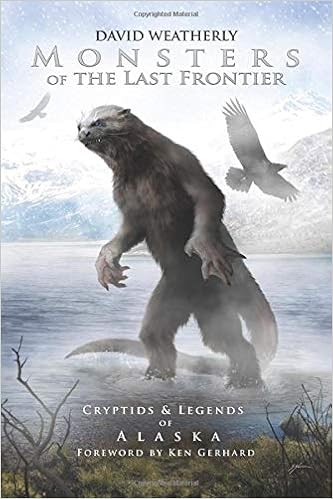
Book Review: Monsters of the Last Frontier


David Weatherly
Eerie Lights, 2020.


For a lover of monster legend and lore, this is a delightful book, with something interesting on almost every page. The book has a critical weakness (below) that prevented me from rating it as high aa it would otherwise deserve, but I read it avidly and was sorry when it ended.  Weatherly does not accept all the creatures here as real, but he doesn’t throw everything into the “hoax or myth” bucket, either.  Weatherly is always respectful of the First Nations/Alaska Native traditions but does not insist they have to be literally true.
Before I go on, I should mention Sam Shearon’s cover. The artwork, front and back covers, is gorgeous. 
The book is pretty comprehensive, covering everything from sasquatch to otter-men to thunderbirds (always a fun topic). It deals of course with the Iliamna Lake “monster.” Weatherly includes most of the stories I know of and a few I did not, although I wish there was some reason to believe the wilder “it snapped the fishing line” tales.  There are other water creatures of lake and ocean, as you’d expect in the state with the longest seacoast and the most lakes in the U.S.  I'd thought the biggest reported creature, that on the MV Mylark sonar trace, was almost universally discounted these days, but it still intrigues Weatherly.  A giant platypus report is, umm.. unique. 
 I've read some stories of large wolflike canines, known as waheela and other terms, and I agree with Weatherly that matter still merits some thought even though he has no new reports here. As to other critters, did you know an “African lion” has been reported from Alaska?
Hairy Man, sasquatch, call it what you will, there are plenty of hairy primates in modern reports and the stories from Native cultures.  He prominently mentions an old incident at Lake Iliamna which may be a hoax, but there are newer stories here, too, and they come from all over the state.
Weatherly, an Alaskan himself, has done a great job of collecting materials, and his writing is good. The only real disappointment is in the documentation. While many sources are mentioned in the text, they are not listed or detailed in any way that would enable readers to look them up. Indeed, the book has no footnotes, no endnotes, no bibliography by topic or chapter, and no index.  A couple of dozen books and three websites are listed, but that’s it. The website https://eerielights.com/ offers nothing more except the note David is “The Renaissance Man Of The Strange And Supernatural.”
So, to cryptozoologists and other readers: buy it. You’ll enjoy it whether you believe it or not.  To the author: please consider a future edition with thorough citations.  I’d buy a few of those.       

Friday, February 07, 2020

Dr. Paul LeBlond: R.I.P.

Dr. Paul LeBlond has passed away. 
He had a long and influential career as an oceanographer and professor at the University of British Columbia (see his UBC bio here). He studied waves, salmon runs, and many other aspects of the ocean, and was conservationist who was recognized with an award from the North Pacific Marine Science Organization.  He was also a cryptozoologist, one of the founders of the unfortunately defunct  International Society of Cryptozoology and the still-thriving British Columbia Scientific Cryptozoology Club.  He studied with an open mind reports of unclassified large aquatic animals, especially "Cadborosaurus." We met only once, but he was gracious with his time and we had much email correspondence. He came to believe there was a real species (Cadborosaurus willsi)  inaccurately called the "sea serpent" and published a (controversial) paper and two books on it. He was a friend and mentor to everyone in that field of inquiry. 

Waves in the Ocean, his textbook on waves

The second of his two books on Caddy.

Goodbye, Paul: I hope you have your answers now.

Wednesday, February 05, 2020

A rocket-load of space news

As readers know, I'm a space nut, and to some degree an established one, with a lot of articles and papers and the book The First Space Race to my credit (or to shared credit as I often had co-authors).  So I try to keep up.  The space news these days is flying so thick and fast that it's all I can do to keep a general awareness.  But a few things stand out.   
The US Air Force has put together its plan to organize the Space Force.  Some people are opposed to Space Force, for reasons financial or diplomatic, but the debate should be carried on with the understanding that that the USSF is not doing, at this point, anything the Air Force was not already doing in space.  (The bucks may shift, but still no Buck Rogers.)  The Air Force and Space Force commanders will be equals under the Department of the Air Force, a structure something like the Marine Corps' role in the Department of the Navy.  
Then there are the microsats. I was right about this in the 1990s, but nobody was interested, when I wrote papers and studies about their promise for the future.  That caught some flak, especially concerning imagery, where "immutable laws of physics" decreed that mirrors on imagery satellites be huge to get high-resolution photos.  The critics reckoned without the ingenuity of engineers and their ability to advance technology.  A string of technical tricks like "folded optics" made the mirrors much smaller, and then the power of software an d processing put what used to cost a billion dollars into a shoebox, as the company Planet provides the kind of worldwide coverage militaries never could.  A new example consists of two 3-unit CubeSats (about 5 kg), Rogue Alpha and Beta, which, as Jeff Emdee, of The Aerospace Corporation says. “contain both visible and infrared sensing, as well as a laser communications downlink, that will allow us to explore operations in low earth orbit to benefit future system concepts.”  In a 5-kilogram satellite. When I started writing about microsatellites, that might have taken a thousand-kilogram spacecraft. Now even organizations like Space and Missile Systems Center (SMC), famed for developing exquisite satellites costing hundreds of millions of dollars, has come around.
In-space propulsion is a knotty problem, and the gains come slower, but the tech is advancing nonetheless. Ion engines were a big step forward for craft that did not need rapid changes of orbit or acceleration.  One company is taking them further,  with tiny thrusters and nontoxic propellants..
Another question is whether the small satellite industry can be as profitable as it hopes, thus attracting more capital to take its capabilities still further.  Can the industry handle the debris problem? Can it keep growing as it is now? An interesting Space News report discusses that one,.
All for the moment, more to come! 

Monday, February 03, 2020

A Unique Astronaut Memorial

To Commander William C.McCool, US Navy, pilot of the space shuttle Columbia. Photo US Navy.

Sunday, February 02, 2020

Spectacular New Species Claimed, but....


Sometimes you don’t know what to make of a new-species claim.
New species are created and “destroyed” all the time by taxonomists and biological scientists re-evaluating existing specimens, especially in the age of DNA analysis.  (There were once 86 named species of the brown bear in North America, not one.) Sometimes we get a real surprise when a pretty clearly delineated species has been overlooked entirely due to a similar-looking species, the most spectacular example being Omura’s whale (Balaenoptera omurai, 2003).
Some animals are named and then disputed. Dr. Marc van Roosmalen has described many new mammals from Brazil, most of them without controversy, but there are sharp divisions over whether his dwarf manatee is real or a juvenile of the known species thereabouts. (There are similar doubts about his tapir and some of the monkeys, although everyone agrees he’d added much to primatology.) Here’s Dr. Darren Naish’s take.
Then we have a case from India which is considerably weirder.
Here at http://www.rarewildlife.org/, we have the statement of an Indian conservationist that he’d proved the existence of a new big cat. If he’s right, there’s no overstating the importance of the find. While there have been large land mammals created or lost by reclassification, a completely new big cat would be biggest find since the Vu Quang discoveries of the 1990s, and maybe a lot further back than that. 
Its location is in the western Ghats, one of India’s major mountain ranges. The discoverer estimates only 30 exist.  If they do. Dijo Thomas isn’t making this easy to verify.    His website (a little disjointed looking, although it is an English-language site for a man for whom this is a second language)  states he “Discovered & Scientifically Proved a NEW Species  + New Family, 1. Neelagiri Kaduva, {Neelagiri Tiger = Tiger of the Blue Mountains} {as Big as Tiger} which is Critically Endangered, …”
It then adds, “Dijo Thomas also Discovered & Scientifically Proved Raktha Athika {as Big as Dog}, a Vampire Kangaroo, the New Species + New Family, closely Related to Kangaroo Family, in Pavaratty, Thrichur, Kerala, India ...”
OK. Stop right there. There are no kangaroos in the Asian mainland, anywhere.  Thomas posted a photograph of some poor caged mammal with mange.  (A palm civet has been suggested).  The support consists of photos which don’t appear to show any type of kangaroo. https://www.deccanchronicle.com/nation/current-affairs/161119/ooty-kangaroo-cousin-lived-in-western-ghats.html
It doesn’t help that Dijo Tomas claims “a NEW Species was Scientifically Proved without 1. Photographs or 2. Direct Sighting !!!!” based on a formula he invented called  Features Based - Species Elimination Method [FB-SEM]}.
So what have we got? From this distance, I think it most likely the gentleman is sincere but has let this enthusiasm get way ahead of his science. WAY ahead.  Are there any new animals involved? There could be, but most scientists would need a lot more information to buy in.
Or maybe there’s no science at all, since he also says,   “I made some elephants obey me by giving instructions in my mind alone.”
Sigh