Saturday, July 06, 2019

Book Review: Gold Rush in the Jungle


I'm quite embarrassed now that I had this book in the house for a couple of years before I read it. It's amazing and very important. 
The "gold rush" of large mammals in and around the Vu Quang region of Vietnam and Laos in the early 1990s was like nothing zoologists had seen since before World War I.  New species of mammals had become rare (although not as rare as most people think), but the Vu Quang ox or Saola was not just a new species but a new genus and an animal with no close living relatives. It is, easily the largest (100kg) new mammal from all of Eurasia since the Kouprey in 1937.  New deer (belonging to a group of relatively small species, the muntjacs), a mysterious bovid with high-rise horns like motorcycle handlebars, new or rediscovered monkeys, a rediscovered wild pig, the identification of the world's biggest turtle in a shallow, polluted lake in the midst of Hanoi - nothing seemed too outlandish.   
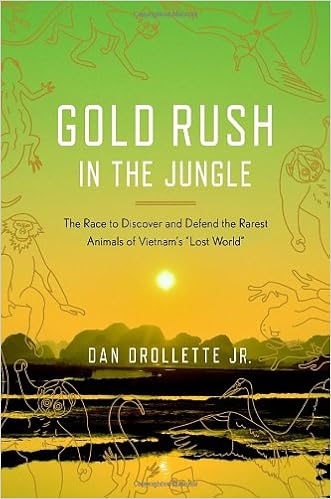


Dan Drollettte Jr. undertook in 1998 his first of several trips into Vietnam, meeting with the Western and Vietnamese scientists and lay researchers trying to identify and protect the remnants of the closest thing the Earth still has to offer to a genuine "lost world." In this book he visits sites from the Hanoi Hilton prison to the Endangered Primate Research Center, trying to understand the modern nation of Vietnam, its culture, and how those factors affect the mixed attitudes toward wildlife.    Some animals draw crowds to see them in preserves or in the wild: others are ruthlessly poached. Some Vietnamese furiously condemn poaching as a destruction of their natural treasures, while others aid poachers for money.  A tiger can be worth 250,000 dollars, which explains why the tiger may well be extinct in the country. And it's not only about money: some elites have an attitude that everything in Vietnam is theirs to eat. Making this all more complex is the lingering damage from Agent Orange and other defoliants, bug killers, and byproducts of war.  
Drollette loves especially Vietnam's endemic species of langur monkeys but also devotes chapters to several unique cases. These include the bizarre discovery of a giant turtle in Hoan Kiem Lake; the kouprey, which some scientists now doubt is a species vs. a hybrid of other cattle, and whose current status in its Cambodian homeland is a mystery: the rediscovered Vietnamese population of the Javan rhinoceros, quickly hunted back into to extinction: and the nguoi rung, the upright ape that has not been proven to exist but is not dismissed - it may be a species of orangutan, or something much stranger. (Drollette notes it's had to dismiss anything in an area that has seen an average of two new species discovered each week for ten years. )    
The author also offers perspectives from world-leading scientists and conservationists about habitat protection vs species protection, zoos vs. original habitats and reserves, and captive breeding. The late Dr. Alan Rabinowitz told Drolette he hated zoos, but when numbers of an animal like the rhino drop into single digits, you have very little choice left: in most cases: it must be brought in. 
In Drollette's recounting of his travels though this fast-modernizing nation, he discusses everything from the status of women to the Vietnamese attitudes toward Americans (generally benign 30+ years after the war: the Vietnamese fought China for a thousand years, and the war with the U.S. was hardly a blip on that timeline) to the country's favorite karaoke song (it's John Denver's "Take Me Home,Country Roads," and he has no idea why.)  
Drollette closes on a cautiously hopeful note. Vietnamese children are now being taught the value of wildlife and the richness of Vietnam's heritage, and a new generation of rangers and scientists is expanding the conservation efforts of the nation.  
A thorough reference section, with a glossary, bibliography, and index round out this indispensable book.

Thursday, July 04, 2019

Checking in on Bigfoot

No one, regardless of beliefs on the subject, can resist checking in on America's real (?) King Kong once in a while. If there's an iconic American monster, Sasquatch is it.  While very few scientists think we have a population of big primates (I thought it possible a long time, ago: I would bet heavily against it now, but I hope I would lose every dime.  (Of course, I could bet my house and the winner would get to deal with my mortgage...)  

Thousands of sightings, countless novels (the best is Eric Penz' Cryptidhere's an interview with the author)  probably dozens of movies and equally fictitious YouTube "documentations," con artists, hoaxers, sincere monster-hunters, cryptozoologists, eyewitnesses, and plain folks have been part  of this business for over 60 years now. 
There's no physical evidence of Bigfoot that has been scientifically verified, but no one doubts the best chance the Big Guy had for widespread recognition was when Roger Patterson and Bob Gimlin filmed Bigfoot or something that certainly looked like it in California in 1967.  Patterson died without ever hinting at a hoax, and Gimlin swears by the tale to this day, but what's actually in the frame? 

I'd bet "suit:" it looks baggier the more versions I see of it, and 52 years without anything remotely as intriguing is too much for me. I don't know who hoaxed who and who might be telling the truth and who might be lying, but I don't like it as an unknown primate. 

This comes up now because of a lot of discussion over a YouTube video where a man signing himself "Bigfoot Al" has used modern software to smooth out the film and give us a better look at our creature. Now, the troujble with enhancing or enlarging this beastie is that it was shot on 16mm film and the image is 1.8mm high. there's a limit to what you can do because there is limited data captured on the film. People get fooled by TV shows where grainy surveillance footage is sharpened up to reveal details like scars that were not on the original footage.)  Anyway, this effort doesn't make it any better for me: indeed, it looks lumpier, less well-defined, and thus more like a suit.    It always bothered a lot of viewers that the bottom of the foot was lighter in color than the rest of the fur or skin, not known to happen with apes: here it's more apparent.   

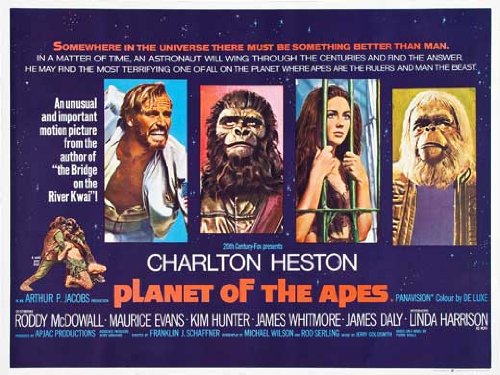
One commenter on a FaceBook thread remarked the PG suit (it it is one) looks better than the suits created by John Chambers for the movie Planet of the Apes, which were the pinnacle of spe-suit wizardry at that time.   That overlooks the facts, though: the Apes suits were filmed with the highest-definition professional cameras and most skillful cameramen available and included close-up shots, all projected on huge screens: of course you could pick out flaws if you looked for them. If you shot one of those suits at the distance of the PG film with a 1967 16mm hand-held and the lens Patterson had, I'm sure it would look at least as convincing, probably a lot more so. That's the experiment I'd like to see: take one of the more distant ape shots from the Planet film and degrade it to what Patterson's camera could pick up at that range, then put it side by side.

Planet of the Apes POSTER Movie (30 x 40 Inches - 77cm x 102cm) (1968) (UK Style A)
Fair use claimed

Id the film definitively, once and for all, disproven? No, because it can't be, unless maybe someone fiunds a picture of a man putting on a suit.  But we are close to it, and in any event that's not where the burden of proof lies.  It looks more to me like a suit in the various enlargements and enhancements, but I can't see a zipper pull (which ,if it existed, would likely be smaller than a spot of emulsion grain and thus undetectable anyway).  


I hope Bigfoot is out there.  And maybe it's best if we never find out. 

Tuesday, July 02, 2019

Movie: Jurassic World: Fallen Scriptwriters

I don't know why I'd waited so long to watch Jurassic World: Fallen Kingdom, but it turns out I didn't miss as much as I thought.' I only watched about an hour, starting with the beginning of reactivating the search function. It's hard to get into it from the beginning, because despite our heroes being partly at fault for countless human deaths, nothing seems to have happened to them, and no one has gone back to the island and nuked it - but Mother Nature has plans...
Kudos to the filmmakers for using more animatronics than last time, and the inclusion of new dinosaur species is nice. The CGI versions of the dinosaurs, though, despite nice attention to details like kicking up dirt and debris as they ran, didn't quite let me turn off my brain and accept them as real. (The state of the current art of giant creatures is, to me, the new Godzilla, where Ghidorah is just amazing.)
Chris Pratt isn't capable of a bad performance, but the other humans didn't give him much help, and neither did the script. To cite just one absurd bit out of many, how is Pratt inches away from advancing lava and the heat doesn't bother him the tiniest bit, let alone bake him? Or set all the vegetation on fire? Or burn the wooden LOG he sheltered behind? It's so obviously CGI'd in that it's painful to watch.
Also, what the heck would you do with a "weaponized dinosaur?" It might be cool and intimidating to keep one around your secret lair (Blofeld would probably have a couple to chase James Bond around), but surely it's cheaper to get a few more henchmen than what is basically a giant guard ostrich needing specialized and costly veterinary services. 
Interesting article here on the dinos, with comments from paleontologists about what is and isn't (mostly isn't) believable.  (Vulcanologists, by the way, were generally not thrilled with the volcano's role in all this, although there are differences of opinion.).
The next one is supposed to brign back our paleontological heroes from the original Jurassic Park.  Now that might be interesting. It might even be good. 

Friday, June 28, 2019

NASA reaches for Titan in daring mission

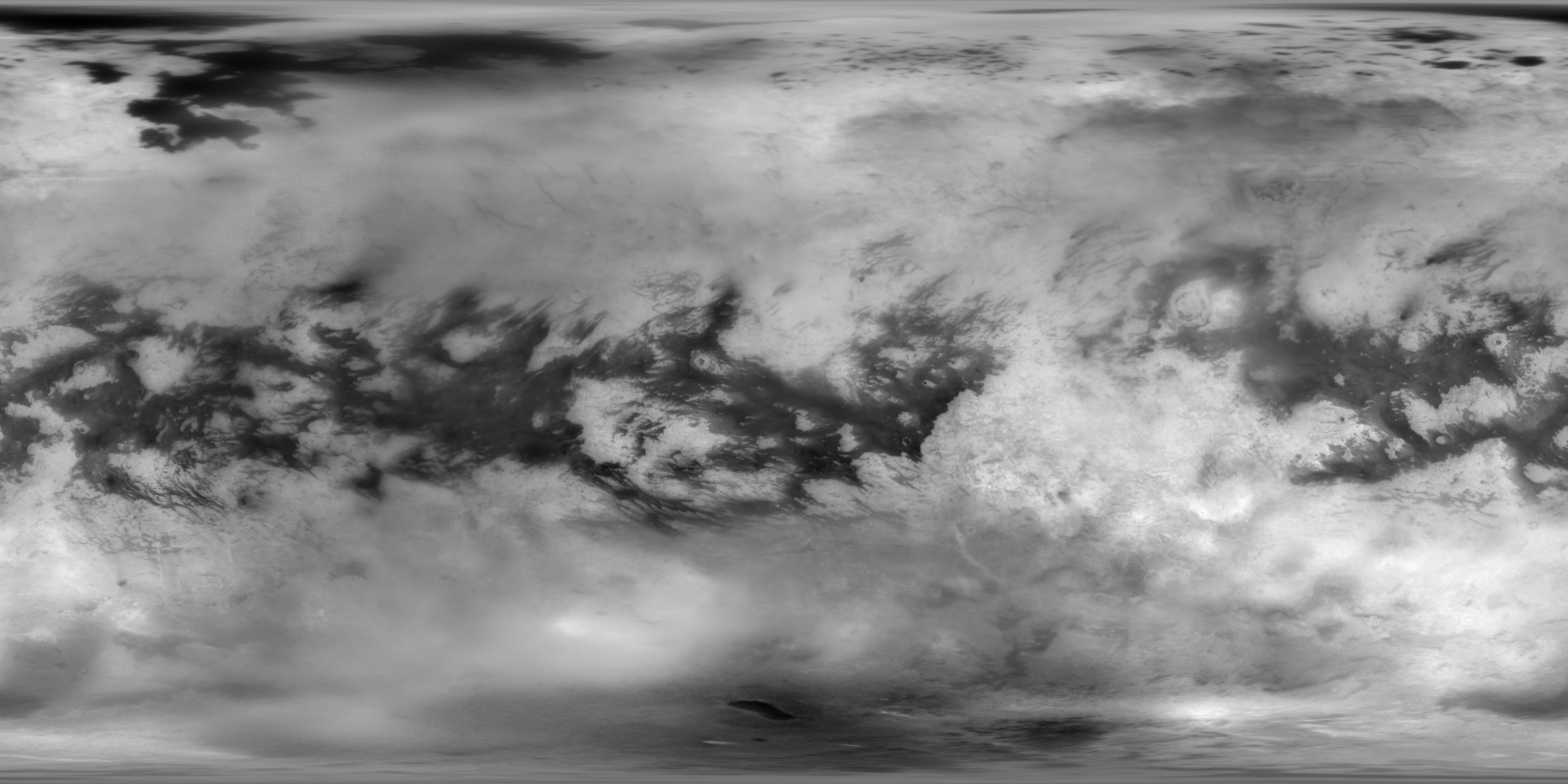
This is the most excited I've been about a NASA robotic explorer since the Mars Sample Return was canceled (which has happened about three times). The space agency will send a probe to Saturn's moon Titan, but they're not just going to fly by it or orbit it.  They're going to land with a quadcopter to fly to many locations and analyze the moon and its atmosphere with a mass spectrometer. 
This isn't humanity's first visit to the huge, rocky,cold (-179 C) moon. In 2005, the European Space Agency-built Huygens probe separated from NASA's Cassini probe and landed on Titan.  Now we're going back. NASA selected ,as the next mission in its New Frontiers "medium-cost" series, Dragonfly. Arriving in 2034, Dragonfly will make dozens of flights over the moon's land areas and the hydrocarbon "seas" of methane and ethane, looking for signs of subsurface liquid water reservoirs  and - if we are very, very lucky - signs of life. 
Said NASA Associate  Administrator Thomas Zurbuchen, "Titan is unlike any other place in the solar system, and Dragonfly is like no other mission, It's remarkable to think of this rotorcraft flying miles and miles across the organic sand dunes of Saturn's largest moon, ...Dragonfly will visit a world filled with a wide variety of organic compounds, which are the building blocks of life and could teach us about the origin of life itself."  The Principal Investigator will be Elizabeth Turtle of the Johns Hopkins University’s Applied Physics Laboratory (APL.)
Flyers have been proposed for several planetary missions, including several to Mars, but Titan has special appeal, not only for its composition, but for a nitrogen-based atmosphere (like our own)  four times denser than Earth's and thus able to support flight much easier than the very thin atmosphere of Mars.
This is a daring, ambitious, risky mission.  It's the kind of thing NASA was created for.  


An artist's depiction of the Dragonfly spacecraft on the surface of Titan.
Artist's concept of Dragonfly


Surface of Titan through atmospheric haze, from the Huygens probe

Good luck to NASA and the Dragonfly proposers at Johns Hopkins APL.  On to Titan!

Monday, June 24, 2019

A Majestic Documentary: Apollo 11

Last night I caught the new documentary Apollo 11 on CNN.  Wow.
Restored from sources including 11,000 hours of audio recordings and a huge cache of 70mm film that went overlooked for decades, it brought the event back vividly to those of us who were around for it - and for those who know it as a term in a history book. 
(One of my kids had a high school "history" textbook that mentioned only "an expensive race to the moon" without the words Apollo, Armstrong, or Aldrin: someone should be able to sue textbook writers for stupidity.  )
The found footage and the things that stitch it together (black and white newsreel type film, astronaut comments, the voice of Walter Cronkite) make a whole that is even more than the sum of its considerable parts.  Many bits stand out as especially meaningful: The size of the Saturn V and its crawler. The suiting-up process, and how everyone was "all business" on the launch morning. The beautiful summer day with countless people gathered to watch. (Note: if you've only seen the launch in the film First Man, director Damien Chazelle thought an overcast launch was more dramatic. He was wrong.) 
Finally, this film gives the viewer at least a small sense of how complex an endeavor this was, and how many thousand things had to go right - and almost all of them did. 
The launch and the Cape looked the way I remembered (I was 9), but more vivid. The footage did not, I regret to say, note a tiny white Piper Cherokee ten miles or so away, from which vantage point my brother, and my dad, who had his private license and worked at Piper Aircraft down the coast in Vero Beach, watched. (Thank you, Dad.)
There are a few nitpicks, although none are material, so I'm not even going to touch on them here. The defining event of a generation is beautifully rendered and should not be overlooked. This was a time when the whole country, indeed most of the world, pulled for three men and the thousands of men and women behind them. 
SEE THIS MOVIE.  


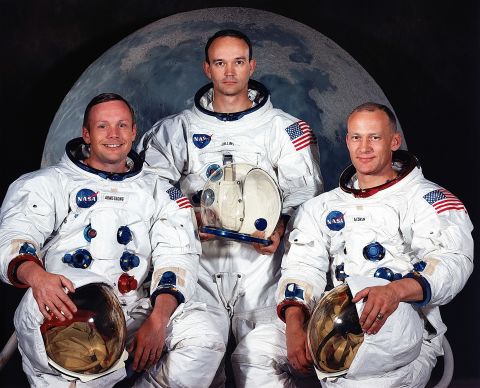
This is what heroes look like: ordinary men of flesh and blood, with extraordinary skills and courage.  (NASA) 


Friday, June 21, 2019

Giant squid captured on video

Actually, the title says it all.  A young (3-meter) Architeuthis, the monster squid of legend, was caught for the first time on video on our side of the Pacific, thanks to enterprising sciences who rigged LED lights into a jellyfish-like circle and lowered it deep into the dark domain...

Article and image from NOAA
NOAA-Funded Expedition Captures Rare Footage of Giant Squid in the Gulf of Mexico

A Whale of a Hybrid

In my 2006 book Shadows of Existence, I wrote:

".. the skull from a whale killed in Greenland in 1986 or 1987 appears to be evidence of a hybrid between the two known monodonts, the beluga and the narwhal. The skull was spotted in 1990 by Mads P. Heide-Jorgensen of the Greenland Fisheries Research Institute.  It was sitting on the roof of a tool shed in the settlement of Kitsissuarsuit. The skull belonged to a hunter named Jens Larsen.  Larsen had who killed three identical whales, one of which produced the mystery skull.   He recalled that the animals seemed very strange to him.  They were a uniform gray color, showing neither the distinctive white of a beluga nor the mottled back of a narwhal.  Their tails looked like a narwhal's, with their distinctive fan-shaped flukes and convex trailing edges.  Their broad pectoral flippers, though,  resembled a beluga’s.  While these cetaceans had no horns, analysis of the skull indicated two teeth showed growth patterns resembling the spirals of a narwhal tusk.  These teeth may have protruded outside the mouth."
Now we know more - a lot more.  New techniques for imaging the skull and reconstructing the head, plus DNA evidence, have led to a complete picture of this enigmatic cetacean.  
UPDATE: Scientist and artist Markus Buhler has kindly given permission to add his reconstruction of the "narluga."   Below is the link to his post explaining how he did it.
Image may contain: sky and water

Narluga by Markus Buhler. Used by permission. No reuse unless cleared by the artist. 


The parents: Narwhal and Beluga. 
Illustration of Narwhal
Beluga whale illustration

The skull, as the New York Times' JoAnna Klein wrote, ""belonged to an adult, first generation son of a narwhal mother and beluga father. " As to those teeth: Dr. Eline Lorenzen said, “It’s like if you took 50-percent beluga and 50-percent narwhal and shoved their teeth in a blender, that’s what would come out.” 

So welcome the "narluga."

Thursday, June 20, 2019

Don't Miss the chance to see this Apollo 11 documentary

Passed along by NASA historian Mike Ciancone

....

Rare free opportunity to view the incredible new Apollo 11 documentary that was released earlier this year .. will be on CNN this coming Sunday, June 23, at 8pm CT / 9PM ET


APOLLO 11
Crafted from a newly-discovered trove of 70mm footage, and more than 11,000 hours of uncatalogued audio recordings, the CNN Film “Apollo 11” takes viewers straight to the heart of NASA’s most celebrated mission – the one that first put men on the Moon and forever made Neil Armstrong and Buzz Aldrin household names. Immersed in the perspectives of the astronauts, the team in Mission Control, and the millions of spectators on the ground, we vividly experience those momentous days and hours in 1969 when humankind took a giant leap into the future. Premieres 6/23 at 9P/ET on CNN.


Re-live this most astounding achievement and accomplishment in human history … from 50 years ago

Wednesday, June 12, 2019

Revisting Godzilla: King of the Monsters

Yep, he's still king.

Godzilla, King of the Monsters is here. As a lover of zoology and giant monster films, I had to weigh in.  Zoology and giant monsters, of course, don't really mix: Godzilla's first step would break his legs, topple him, and leave a giant puddle of dying green gunk on the ground.  But everyone agrees to believe: if you can't, you're at the wrong movie. 

My initial list of likes:
Amazing monster effects and action. Seriously amazing.  Think about how hard it is to make a giant three-headed dragon look like it's actually there, not as a video-game creature but with the seeming weight and movement of a real animal. (Three different motion-capture performers played the heads.)  
There were some good performances (Kyle Chandler, Ken Wantanabe). There were Easter eggs for cryptozoologists and some good one-liners. 
My initial dislikes: Unremittingly dark, thematically and visually, with none of the fun such movies should have, lots of errors about the military operations, and Vera Farmiga (a talented actress giving a bad performance in a hideously written role). 
Not rated: Logistics, physics, plot - you don't expect them to make any sense in a monster movie. (Although they REALLY pushed it with planes including short-ranged fighters flying fast and easily all over the planet.)
Special dislike: Naming a base Castle Bravo (after the nuclear test that poisoned Japanese fishermen and gave the original Godzilla its serious theme) is in stunningly bad taste, especially in an American film. I know that in these movies Castle Bravo was really an attempt to kill Godzilla, but that doesn't make it any better. 

Thinking back on it a day later, I found a few other things worth mentioning:
1. The best shot might have been Ghidorah frozen in ice: it offered a real sense of awe as the humans/cameras looked up at the monster.
2. Ken Wantanabe's last scene with Godzilla (the idea for which might have been swiped from The Abyss) was touching in a way you don't expect in a monster film. 
3. It's not clear why the two extra monsters that showed up near the end were fighting each other. 
4. The filmmakers seemed to throw in extra PG-13 cursing just because they could: Jesus is named more often in this film than he is in the Book of John. 
5. There's a clever homage to the Japanese version of Mothra and its two priestesses that I didn't even catch until I read a review. 

So, a mixed bag, but some fun to be had.  Grade B-.  Let's hope Godzilla v Kong next year keeps the great animation and adds a bit of humor - and daylight.

Sunday, June 09, 2019

World Oceans Day

OK, I'm a day late posting this, but the oceans need our help as much today as they did yesterday.  We're not doing enough. We're not doing enough to stop pollution or overfishing or climate change or acidification (reduction in the ocean's pH due to absorption of carbon dioxide from the air), which scares me even more than temperature changes: many marine animals have evolved to live only within a narrow range of pH values. 
This is where our lives began, and it 's where our species' existence will end  if we don't act faster. So make sure your seafood is sustainable, cut your plastic use, support marine protected areas and marine research... the list is endless, but start somewhere.  

"Ten percent of the big fish still remain. There are still some blue whales. There are still some krill in Antarctica. There are a few oysters in Chesapeake Bay. Half the coral reefs are still in pretty good shape, a jeweled belt around the middle of the planet. There's still time, but not a lot, to turn things around." - Dr. Sylvia Earle 

Ocean Acidification Illustration

Sunday, June 02, 2019

Thanks to Denver Pop Culture Con

Yes, it's a ComiCon, and Pluto is a planet, and I'm right, but there seems to be some legal stuff. I had a good time visiting the Denver PCC Friday. They have a great series of NASA panels on space topics, but I regret I missed them all in my short visit this year.  I didn't find any new Enemy Ace comic books, except one for $132, and my wife would have shot me down in flames.  Doesn't matter: it's always a great time, just seeing people and talking to them and watching the other humans. My Wizard Harry Dresden outfit got some photograph requests.  I wasn't on any panels this year, but I absolutely need to look for more opportunities and plan for more time next year. Thanks, volunteers, staff, and all!


Monday, May 27, 2019

Book Review: Chasing American Monsters

Chasing American Monsters
Jason Offutt
Llewellyn Publications, 2019 

  • 384pp.


America has some well-known cryptozoolgical puzzles, like Bigfoot, but it also has a rich folklore, still developing in the present day, of monsters, lake serpents, and just plain odd creatures reported anywhere from once to 3,000 times (Bigfoot again).  
To take a quick tour of this richness, we have Chasing American Monsters.


Jason Offutt clearly had a good time creating this tour of states and their monsters, and readers will happily come along.   All fifty state entries have some interesting nuggets, even for a well-informed cryptozoology fan who's read collections like this before. In my favorite spot, Alaska, he mentions some recent sightings of the Lake Iliamna monster I'd forgotten, although he's another writer who refers to early Russian reports without  details or sources.
On Stellers' sea ape, Offutt expresses a healthy skepticism that's too often absent here.  To get the nitpicks out of the way, Offutt repeats some falsehoods (e.g., that a monster photo appeared in a certain issue of the Tombstone Epitaph when it's long been disproved), and some misstatements like the wels catfish being a species from Spain, when the wels is not native  (it has been introduced) and has a far greater range. There are few primary sources here: almost everything is from media and online materials. Nothing wrong with that, but a bit more investigation is warranted before giving us, say, the supposed Loess not-quite-human skeletons.    Some creatures presented here are clearly just tales not meant to be taken seriously  (no one is expected to believe in fish-eyed Night People, complete with clothes and children) , but many are treated as animals, and it's not always certain which is which (to which the author would no doubt reply that's part of the fun.) 
All that said, this isn't meant to be a zoological text book,but it succeeds handsomely in being an enjoyable romp through monsters both familiar (lake monsters show up a lot) and obscure. Who knew a California woman had reported human-size roaches, or that a Georgia woman was shot as a werewolf, or that a lizard bigger than a Komodo dragon was once reported from Kentucky?  Who has heard of the giant amphibious ape that supposedly attacks cars near Dewey Lake, Michigan?  Oklahoma is home to more than just football and cows - it has a wolfman, an elkman, and a boarman! Vermont has a pigman, and West Virginia a big primate called the Stone Man. Getting to Wyoming, I never knew that anyone had claimed to see an actual live jackalope. 
You too, will have a great time reading through these tales.  Offutt comments at the end he thinks a few of the monsters are real,but you don't need to believe in any of them to enjoy this book. Wonderful illustrations add to the fun.

Monday, May 20, 2019

What if Sputnik 1 had failed? (my new article in QUEST)

The new issue of QUEST, the History of Spaceflight magazine (Vol 26 #2), offers 13 articles exploring "What if?" Mine is "What if Sputnik 1 had failed?" 
All my friends in the space history community are here, including Jim Vedda (alternate plans to go to the moon), Dwayne Day (events resulting from JFK's death), John Logsdon (if Apollo 8 had failed), and many more, including my First Space Race co-author, Erika Maurer, who looks at the Space Race as a poker player might. 
Thanks to publisher Scott Sacknoff and all the staff at QUEST. 

Saturday, May 18, 2019

Iliamna's freshwater seals are unique

Lake Iliamna, in Alaska, has a population of a few hundred harbor seals. hey constitute the only freshwater seal population in the Americas. But were these animals born here, and were they permanent residents or transients that came and went to Bristol Bay via the Kvichak River? Studying their teeth and the minerals deposited therein has given us the answer. This is their home and has been for many generations, and they stay year-round despite the fluctuations of the food supply caused by the summer salmon run. 

Tuesday, May 07, 2019

A real "monster" in Alaska's Lake Iliamna?

The Iliamna "giant fish" stories have always fascinated me. It's the only story about a large "lake monster" I think will prove to have something real and unusual in it.  The thousand-square-mile lake, so remote there are no roads to it (only a mountainous portage from Cook Inlet littered with debris from old trucks and the boats they were transporting), hosts the world's biggest salmon run.  It's at least 800 feet deep.  Jeremy Wade (River Monsters) suggests it's a kind of sleeper shark, while a more common theory is an undocumented population of sturgeon that runs larger than most.  The reports are pretty consistent about shape and features, with color and size varying, and it's certainly possible for a fish to adapt to seasonal variations in the food supply (there are trout, char, etc. that don't migrate in and out via the Kvichak River as salmon do). 
Enter marine ecologist Bruce Wright, who is sure there's something down there and intends to use a moored underwater camera to try for a picture of it (it, they, them, whatever: since stories go back before the first white people showed up a few centuries back, obviously there must be a population that's stable over time).  A retired military colonel named Mark Stigar thinks, so, too, since he tried fishing for it with a line of hooks on the bottom, and something dragged the anchor and damaged the gear.  I've written about it myself, though I've not yet been able to visit. 
Will they find anything? It would not surprise me.  What will they find? It might be something to surprise all of us. I hope it is.  

DNA proof of when people entered the Americas?

When people came to the Americas (and how) has always been a huge puzzle to which we do not have (and may never have) all the pieces. The idea that the Clovis people came over the Bering land bridge 10-12,000 years ago has been largely set aside -they were important but they were not first. Pre-Clovis data are claimed in several places across both American Continents.  Evidence from the Pacific Northwest has pushed the arrival date back to at least 14,000 years, and sites like Monte Verde in Chile may come to be accepted as proven , which would not only raise the question of when but how.  Did people first come to the Americas via boat or raft, or did they come by land but sail down the coast, planting populations much further south than migration by foot could have done? "Dusty" Crawford of the Blackfeet tribe has, according to CRI Genetics, DNA which is unusually unmixed that is, his ancestors intermarried very little with other groups) shows that, through 55 generations, his ancestors arrived (and stayed) beginning 17,000 years ago.  The group he belongs to genetically  apparently originated in the U.S. Southwest, meaning his ancestors might have come down via the ocean in a pre-land bridge migration. The ocean migration theory is hard to prove because so much of what used to be the Pacific Coast has long since vanished under water, but everything we learn seems to point to a more complex series of events than a few groups walking over from Siberia.  

Wednesday, May 01, 2019

More cool stuff on Dunkleosteus terrelli

Dunkleosteus terrelli is the biggest, nastiest, and coolest species from the Devonian, the "Age of Fishes." In my quest to learn and collect everything about it, I add the following:

First, we have a link to an MSN clip on the predator, with very nice animation, and my friend Lee Hall of the Cleveland Museum of Natural History.  The "Makes a Great White Look Like a Goldfish" and the text "Twice as long as a Great White" are silly: they were probably close to the same length, with Dunks probably longer  Not Lee Hall's fault, he isn't the one who wrote that, and he knows better).  The outliers among great whites cluster just short of 7m, while Dunks of 7-8m existed: the monster of the group is a Cleveland specimen that may have been close to 9m depending on the size and construction of the tail, about which we know little.

Also, some neat discoveries of Dunk stuff: a little green Dunk in a game I have no idea how to play, and a beautiful embroidered Dunk patch framed into a trading card from Upper Deck.


Wednesday, April 24, 2019

Birds in Indonesia: New Species and Supertramps

Way back in the 1970s, leading ornithologists like Dr. Ernst Mayr thought the discovery of bird species was almost complete.  In my 2006 book Shadows of Existence, though, I quoted a South African ornithology, Dr. Phil Hockey. He said, "Ten years or so ago, ornithologists were saying that by now all bird species would be known.  But today new species are popping up all over the place.” They still are.
Now we have two new species from Indonesia. Scientists from universities in Dublin and Sulawesi using "mitochondrial DNA, morphometric, song and plumage analyses" The Wakatobi white-eye and the Wangi-wangi white-eye  come from the Wakatobi Isalnds off the larger island of Sulawesi.  
The formal description includes a term I hadn't heard before: birds living on only one island have long been called "endemics," but the term "supertramps" is used for species that found homes all over the archipelago. I'd missed it: the term apparently dates back to 1974, when it was popularized by Dr. Jared Diamond (a fan of the band Supertramp as well as an ecologist describing a phenomenon)  to mean a generalized species with wide distribution - that is, one colonizes a large area but without specializing enough to form distinct species. (If you think about it, that describes humans very well.)  
Sulawesi is an oddity to begin with, a sort of demilitarized zone where creatures from both sides of the Wallace line separating placental mammals with roots in Asia from the marsupials mingle.   This makes it something of a zoological laboratory for hybrid and new species.  The Wakatobi white-eye is similar to other species on Sulawesi (indeed, it was mistaken for something else until now), while the Wangi-wangi white-eye is a loner, with the closest relative three thousand kilometers (something humans around the holidays can only wish for) And yet, they are allied, both in the genus Zosterops.  This poses both a puzzle and exciting new evidence for scientists trying to play the record revealed through modern species in reverse, so to speak, and understand how birds and other species radiated through this region from the nearest continents. 
The team leader, Dr. Nicola Marples, wrote, “To find two new species from the same genus of birds in the same island is remarkable." And yet here they are, and no one now doubts more birds await the eyes of science.

Friday, April 19, 2019

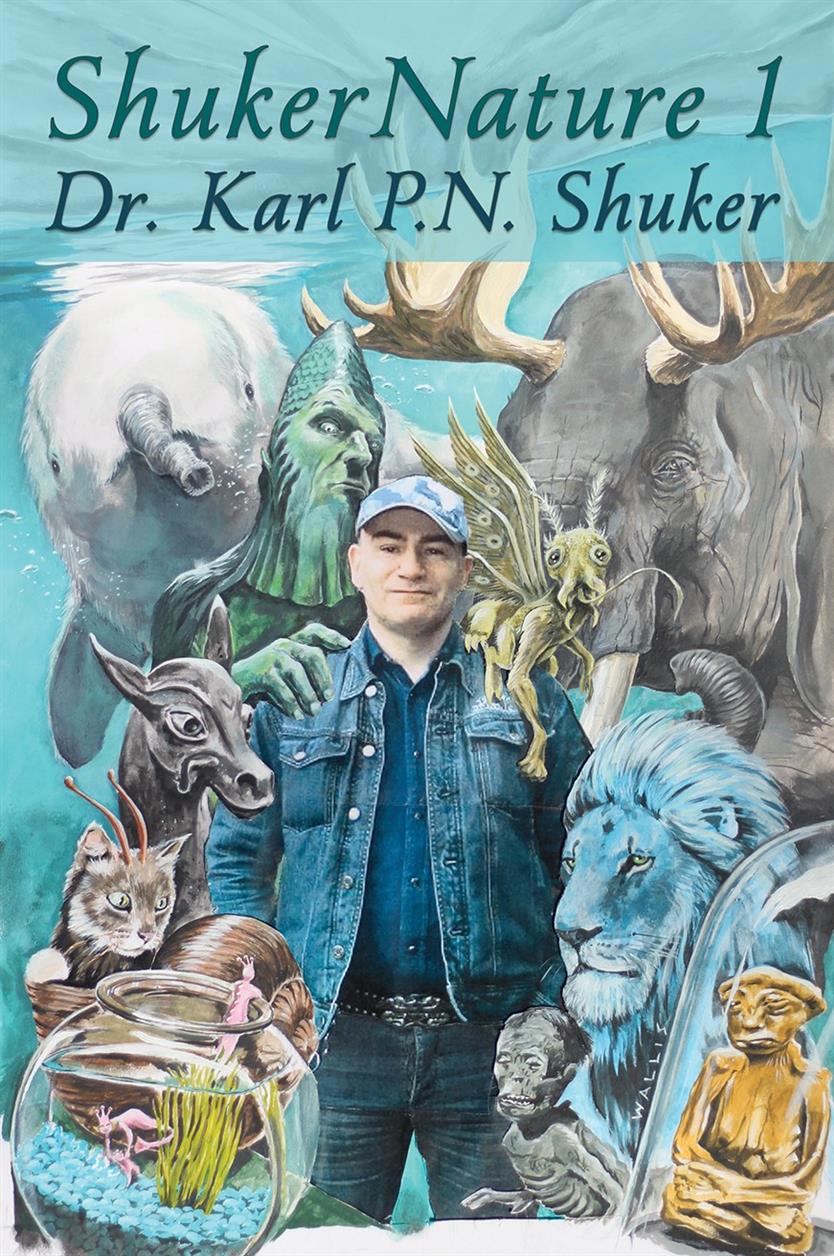
Book Review: ShukerNature 1, by Dr. Karl Shuker


ShukerNature Book 1Antlered Elephants, Locust Dragons, and other Cryptic Blog Beasts

Coachwhip Publications, 2019: 412pp.

Dr. Shuker’s curiosity about all things zoological is boundless.  In this volume, based on entries in his blog of the same name, the British zoologist plumbs the depth and breadth of of the animal world in fact, myth, and art.  Some topics will be familiar to most readers of cryptozoology, but what makes this such an enjoyable cabinet of curiosities is that many of them aren’t.  Shuker wonders about humans as much as beasts: why we put flying elephants in art, why monks put creatures half cat, half snail in the margins of illuminated manuscripts, and why stories of gigantic spiders drinking from whale-oil lamps popped up in cathedrals. We’ve all seen the silly postcards of a claimed half-man, half-alligator taxidermy fake (Karl loves “gaffs,” as these are called), but he’s uniquely identified how many of these were made (three) and how many he can locate (two).  Shuker explores his childhood fascination, Sea Monkeys™, tales of giant bunny rabbits, and Trunko, the bizarre “seagoing polar bear-elephant” that turned out, thanks largely to Shuker’s determined sleuthing, to be another dead whale.  And what was behind the poisonous “fury worm” classified first-hand by Linnaeus himself, but apparently nonexistent? 
Shuker also revisits the famous ape Oliver. While he agrees Oliver was just a chimp, he thinks the animal’s bipedal gait was too natural to be the result of training and there is still a bit of a mystery.  (I knew the man who gave Oliver sanctuary, Wallace Swett of Primarily Primates, and tried to help him out a bit, but I didn’t know Oliver had been cremated.) Concerning primates of another sort, the author explores legends and folklore about miniature humans from several Native American tribes and whether they are linked to Pedro, the mystery mummy from Wyoming, who has vanished despite serious attempts to track him down.   
Shuker closes with a mystery of his own, the dog-size, bounding mammal he met on a dark road in 2014.  He sifts through suspects and concludes this was likely a coypu, a species from South America that escaped captivity in Britain and bred its way to becoming a massively destructive pest and was supposedly wiped out by equally massive government campaigns. It seems to have slipped through the net. In one way or another, Shuker shows us, many creatures have. This is a book lovers of animals, odditites, and cryptids will wade into with gusto and finish anticipating an equally joyful experience when Book 2 appears. 


Toys R Us Dunkleosteus Review


Dunkleosteus Toy, Toys R Us™

Review by Matt Bille

I ordered this toy secondhand – it usually comes with a (modern day!) sea exploration playset. It is what you’d expect, a hard plastic toy with a lot of shortcomings in the realism department, but there are a couple of cool things about it anyway. 

It’s big, about 28cm.  It’s clearly modeled on the Schleich Dunk (shown below with it for comparison.)  It looks like a tank. The front armor is really impressive, like something Jaws’ Chief Brody could shoot at all day with his .357 without being more than a nuisance. There are armor plates (or platelike markings) all over the body, like a swimming ankylosaur. This certainly isn’t right, although this design would explain the Dunk’s disappearance from the fossil record: it couldn’t move. I assume the body armor is there just to keep the skin from looking flat and boring, There are scutes here and there, down the sides but also, weirdly, on the leading edges of the pectoral fins.     The choppers on the business end are appropriately scary-looking. The eyes are yellow with a small pupil (jaundice, or just the age of the toy?) The anal fin was not modeled, presumably to save a couple of cents in production.

Anyway, things I like.  I like the tail: the strong upper lobe indicates development in the direction of a full heteroceral tail, which I think is what they were, at the least, evolving toward. The coolest thing, though, is the action. The toy comes with the jaws wide open (of course), but if you press down on the dorsal fin, the cheek armor swings outward, creating a suction while the jaws close. We know the Dunk did feed this way, at least much of the time (some prey might have been too big), and kudos to the toymaker for including here.

So there we have it. It’s an interesting toy, not accurate but with some redeeming features. I would have LOVED this as a kid.