Sunday, April 17, 2022

Bigfoot Days, Part 2

 Part Two of Bigfoot Days

I wrote in the first entry about my visit to Bigfoot Days in Estes Park, Colorado, earlier this month. The events included a Friday night barbecue with socializing before that, and then a public festival lasting most of Saturday. Overall, this was a terrifically enjoyable event, without a great deal of science but with a lot of enjoyable discussions and souvenirs and all the other things one expects in a festival. 


As I said, there was not a great deal of scientific discussion here. This was about the legend more than the creature. However, I had several exchanges with Cliff Barackman, a well-known Bigfoot hunter and the only serious one in attendance. So here I’ve written my reactions to his thoughts as provided in discussions and his “Bigfoot 101” presentation.

These are my recollections based on memory and some notes I made at the time. I have not, since then, looked up any of the topics mentioned, looked at the slides Cliff presented, or followed up with questions. I wanted to present my impressions as I had them at the time. That means there are some gaps and maybe even some errors in the text that follows. 

This all started out at the banquet on the evening of March 31st. There was a little reception beforehand, and I only got there in time for the tail end of that. I did introduce myself to Cliff, as we knew each other only from correspondence. I didn’t see a reason to talk to the other headliners, the guys from Mountain Monsters: they’re good performers and probably great fun to have a beer with, but there’s no attempt at science on their show.

Cliff accepted a signed a copy of my book Of Books and Beasts A Cryptozoologist’s Library and we took photographs. He later posted a picture on his social media and recommended the book. So, I appreciated that, but I think I stayed objective. He knew I was a skeptic, and we talked a bit about why. A nice fellow came up and showed him cell phone pictures of a small tree broken off at the base and an indistinct depression he thought was a Bigfoot print. Both of these were from Colorado. Neither one, however, struck Cliff as useful evidence.   

Then it was banquet time. I joked about the “Bigfoot BBQ” and whether there was some law against barbecuing Bigfoot, but the organizers put together several types of BBQ, and I had no complaints except that the dinner wasn’t worth $95. Good thing I have an LLC now for my writing and can at least put it down as a business expense.

I've mentioned that one of the interesting things about the banquet was the diversity of people attending.  There were hunters in flannels, sure, but there were also at least five advanced degrees between the people at my table, including one belonging to a geneticist trying to cure sickle cell. Cliff came by all the tables and spent about half an hour at ours. I asked him about one of my biggest problems, the lack of a fossil record. Thinking back, we actually didn't get to that because we wandered off into the subject of what might be Bigfoot's ancestry. Cliff thought it was definitely not Gigantopithecus, but something in the hominid line. I agree on that. I’m quite sure Nature did not start with a giant quadrupedal bamboo-loving ape in China and end up with a bipedal primate walking around the forests of North America. However, if you assume Bigfoot is real, then obviously it had to come from somewhere. Cliff’s best guess is somewhere close to my own: that it must be some sort of descendant of one of the early branches off the human line, likely Paranthropus, that worked its way northward and across the bridges that came and went as ice and lands changed. After all, we know one large primate made the journey. If I had to write a novel about Bigfoot and make it as realistic as I could, that is the origin I would use. 

Cliff thinks the ancestral species would have gotten larger in accordance with Bergmann’s rule: that mammals increase in size as they get further north.  This is a useful rule but not a universal one. There are two ways for a mammal exposed to cold to develop a lower ratio of surface area to mass.  One is to get bigger, as brown bears have. Humans, though, went the other way. Artic peoples didn’t get taller, or larger overall: they got more compact.

Cliff showed some photographs on his cell phone that that he thought were among the best evidence. Cliff is certain the Patterson-Gimlin film is real. If you believe that, then photographs that look like it are more likely to be genuine. He had a few of these. They did not convince me, but I’ll admit they at least weren’t obvious suits. 

(The situation with the P-G film reminded me just a bit of that involving Bernard Heuvelmans. Heuvelmans got a lot of flak, deservedly, for mangling the history of Neanderthals. It was logical to him, though, because he was sure he’d examined a real one, the Minnesota Iceman, and everything else had to fit.)

Next day was the festival. I went over about 10:30 in the morning to be greeted by a huge inflatable Bigfoot, a couple of rather poorly costumed Bigfoots, and the Bigfoot monster truck.  There was a good live band, and a couple of dozen booths sold T shirts and casts and art of Bigfoot and so forth and then I bought quite a bit. My friend Lija Fisher put out some flyers from my own book, so of course I appreciate that. 


I bought a couple of things at Cliff’s table, notably the most unusual Bigfoot cast I have encountered. It was made when Bigfoot allegedly (while out of sight of any human) stuck its fingers into a bait jar of Nutella and left an impression as it pulled them out. The researcher who collected it still has the Nutella but has not yet tested it because of the expense. The cast is fairly interesting. The fingers in the cast are larger than mine, and I am 6-4 with big hands.  The fingers aren’t big enough to put them out of the human range, though. 

I went to see Cliff’s presentation in the historic village theater, a wonderful place. This was his Bigfoot 101, his basic introduction to the topic for all for all audiences.

Cliff stated his certainty that Bigfoot existed and went through his various lines of evidence. My comments on some of these: 

Footprints. It bears repeating that all the items Cliff discussed reflected his belief the P-G creature is real, so genuine footprints must be reasonably consistent with the ones cast at that site. He believes the much-disputed “mid-tarsal break” is one feature of all valid prints. There are thousands of tracks without that feature, and he believes that they are created by hoaxers or interpreted by enthusiastic witnesses looking at bear tracks or human tracks or whatever. On a related topic, he also thinks the placement of the ankle just ahead of where it is on the human foot is a consistent feature of genuine photographs that show that area. also based on the P-G film. 

Comment: It’s reasonable to think a primate the size of Bigfoot would have some adaptations to its foot, although I lack the expertise to offer a useful analysis. It did strike me that, if the Patterson-Gimlin film was a hoax, something like this would appear, because the impersonator was putting his feet into some sort of oversized shoe or flipper.

Native American lore.  Cliff stated that Native American stories and beliefs show a consistent concept of something resembling Bigfoot. He even said "all" Native cultures have something like this. 

Comment: Here, he certainly overreached. Some Native American cultures do have legends or stories of creatures that could match a modern description of Bigfoot. But others clearly refer to supernatural beings, shapeshifters, or giants that can walk across rivers and mountains, and there are many variations. Kathy Strain’s book on Native American beliefs, even though it's biased in favor of these being connected to Bigfoot, still shows how many of the stories she thought worth including do not support a flesh and blood animal of this type. It is fair to note that flesh-and-blood animals are sometimes given supernatural aspects in the beliefs and storytelling of cultures in many places around the world.  

Sightings and Photographs (I’m lumping them together here). Cliff thought most sightings could be dismissed. He had one sighting himself that he thought was genuine (“98 percent certain”), and that some sightings matching the Patterson-Gimlin type Bigfoot were valid. He showed what he thought were the best available pictures of the creature. (I think all of these have been discussed online before and dismissed by skeptics, although Bigfoot has not been a special interest of mine, so I can’t be sure.)  Cliff thinks that, based on the P-G film, Bigfoot has a conical head shaped by a sloping forehead. He takes this as indicating the creature does not have a human-sized brain, and thus not human-level intelligence. He dismisses the accounts of Sasquatch is talking to each other and talking to humans in a real language.

I asked him to tell us more about his sighting. He described it as an event that occurred while filming the first regular-season episode of Finding Bigfoot. It was not caught on film at the time because the producers and the Bigfoot hunters were physically as well as philosophically apart at that point in the late evening. Cliff reports seeing a figure scrambling over a North Carolina hillside in a way that looked very fluid, as if the creature was at home there and must have good night vision: a human wouldn’t needed a flashlight and would have carefully picked their way across that terrain. He advised that what we see on the Finding Bigfoot show is quite different from reality and that shots of a figure running up the hill were of Matt Moneymaker desperately trying to catch the creature on foot. So, there was no footage and Cliff didn’t see the figure again, but he remains certain that he saw Bigfoot.

Discussion: You've probably grasped by now that Cliff’s arguments did not change me from a skeptic to believer. Some of the individual pieces of evidence have been disproven, and the rest are not definitive to me. The lack of fossil or subfossil remains, and the quality of proof offered for the living animal, keeps me in the skeptical camp, even though I’ve talked to people who are certain they got a good look. I don’t know what they saw.

However, Cliff is a very good presenter, and I understand better now why so many people think he’s on to something. He answers all questions and comes across as a sincere believer who is certain that, sooner or later, he is going to get the proof he wants. We haven’t gotten that evidence, he thinks, merely as a matter of chance, as we’re hunting a few thousand creatures at most in a huge area that still contains a lot of wilderness. It’s true, as Cliff pointed out, that finding a naturally dead bear is a very rare event, and there must be many times more bears than Bigfoots. I understand the argument, although to me it gets less persuasive with every passing decade that fails to yield a Bigfoot. So, we parted in polite disagreement.

Well, that was the end of the Bigfoot events on this particular trip. Bigfoot did not show up, although there are plenty of sightings around the area to spark interest. That’s why the big guy is a local celebrity you can find in all the bookstores and the T-shirt shops, and why this gorgeous location is a perfect place to celebrate. I'll go back next year, and we'll see what's new.  


Saturday, April 09, 2022

Will we ever run out of Beaked Whales?

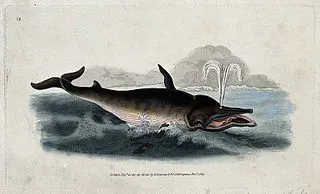
 The beaked whales are fascinating enough to make cetologists drool. Not only are they distinctive in themselves, and sometimes weird, like the strap-toothed whales, they seem to be innumerable. In October 2021, scientists announced the finding of the 23d species (depending how you count: there are some questions here) of this enigmatic group. This Southern Hemisphere cetacean, one of many species identified from stranded specimens, was christened Ramari's beaked whale, Mesoplodon eueu,


A 19th-century vision of a beaked whale


The newest discovery complements a long list of 21st century surprises and appearances.  

Until 2002, the Indopacific beaked whale (Mesoplodon  pacificus or Indopacetus pacificus) was known only from two skulls washed ashore thousands of miles and 73  years apart. Dr. Lyall Watson, in his Sea Guide to Whales of the World, suggested a large pod of beaked whales photographed near Christmas Island might belong to this species, which is also called Longman’s beaked whale. He made the same suggestion concerning brown whales reported in the Gulf of Aden by Captain Willem F.  J. Morzer-Bruyuns, although that witness was certain he was seeing an unknown type of killer whale. Numerous other possible sightings of Longman’s beaked whale, such as a report of two unidentified grayish whales seen near the Seychelles in 1980, were recorded, but no one was certain which ones –if any – referred to this enigma of the seas.

All that changed in 2002.  An odd beaked whale beached on July 26 in Japan, but no one thought much of it initially.  The carcass was photographed, then buried.  When a cetologist saw the pictures, he scrambled to get the thing disinterred as quickly as possible.  It was the first example of Longman’s beaked whale ever recovered intact.  In an odd coincidence, a second specimen identified as I. pacificus drifted ashore in South Africa the following month, although Japanese experts questioned this identification.   (Two old South African specimens, which had been identified as other species, were then re-examined and were reported to be Longman’s whale as well. By now you should be getting an inkling of how complex distinguishing beaked whales in.)  Until this point, cetologists knew nothing of the animal’s appearance (it’s predominantly grayish brown, with the head often appearing darker and sporting some small white side markings) and were unsure of the size (about twenty feet).

            The smallest beaked whale is the Peruvian, or Lesser, beaked whale.  Scientists had no inkling of its existence until 1976, when Dr. James Mead found its decaying skull on a beach in Peru.   By the time Mead formally published his description of Mesoplodon peruvianus in 1991, Peruvian scientists and fishermen had helped him assemble a total of eleven specimens.  All were found either washed up on shore or trapped in fishing nets. 

            The adult Peruvian beaked whale is normally about eleven feet long.  It is mainly dark gray, with a paler gray underside.  It has a small dorsal fin set well back on the body.  While all known mesoplodonts have such dorsal fins, there are differences in shape which help distinguish the different species.  In some beaked whales, like the Peruvian, the fin is a near-perfect equilateral triangle with a straight trailing edge.  In others, such as True’s beaked whale (M. mirus), the trailing edge is concave, so the fin is more falcate or sickle-shaped. 

            It turned out this whale has a wider distribution than originally thought.  Other specimens have since been found stranded in Mexico near Baja California and on the island of Espiritu Santo in the eastern tropical Pacific. There are still few recorded observations of the living animal, although pods of two or three have been seen.

            In 1995, four cetologists published the results of their study of a single calvarium (the portion of the skull housing the brain) found on the beach of Robinson Crusoe Island off Chile in 1986.  Julio Reyes and his colleagues proclaimed they had identified another new species of beaked whale.  Bahamonde’s beaked whale (Mesoplodon bahamondi) was distinguished principally by an unusually short and broad rostrum (snout).  

            The discoverers suggested Bahamonde’s whale could represent the mysterious Mesoplodon “Species A,” an unidentified beaked whale reported and photographed in the Eastern Tropical Pacific region.  The overall length of M. bahamondi is estimated at sixteen to eighteen  feet, which is an approximate match to these sightings.  British paleobiologist Darren Naish, who makes a specialty of studying unusual cetaceans,  cautioned that, “Glimpses of the head of Species A do not reveal the very abrupt rostrum that seems to be diagnostic for M. bahamondi, so they are probably not the same.” 

            As things turned out, Naish was right.  Bahamonde’s beaked whale was not Species A – but it was identical to another mystery species.  In a paper published in 2002, a group of cetologists demonstrated that M. bahamondi, while a valid species, was a resurrection of a species described in 1874 but generally forgotten.  Mesoplodon traversii was restored to its rightful place in the genus after 128 years, while M. bahamondi was reduced, in taxonomic parlance, to the status of a junior synonym.  This does not diminish the importance of the work by Reyes and company.  It’s significant any time a genuine new whale goes into the books – whether it’s brand new or just a case of science saying hello to a long-forgotten discovery.

            The beaked whales still had some surprises in store for science.  One of the peculiarities of this group of cetaceans is that, while experts like Dr. Merel Dalebout of Dalhousie University in Halifax, Nova Scotia estimate they have been reproductively separated for perhaps three million years, their morphology hasn’t changed nearly as much as their genetics.  It’s common for genetic change to lead morphological change, resulting in species that are distinct but still look similar, but the beaked whales have taken this principle to an extreme.  Not only do many of the twenty-one  known species look similar in life, requiring an expert to distinguish them, but even when an animal is beached it can be mistaken for another species.

That was the case with Perrin’s beaked whale, Mesoplodon perrini.  There have been many sightings of beaked whales which puzzled observers.  For example, Dr. Karin Forney of the Southwest Fisheries Science Center spotted one off the coast of Oregon in 1996.  The animal was brownish-gray and bore some resemblance to Hector’s beaked whale (M. hectori.)  However, some important details failed to match up.  Most adult male beaked whales have two or more teeth in the lower jaw, which in many species are erupted (that is, are visible even when the jaw is closed.)  The shape and placement of these teeth is a major criterion for classifying these enigmatic cetaceans.  In Forney’s whale, the visible teeth were not close to the beak tip as is normal in M. hectori. 

As it turned out, the similarity to M. hectori was significant. Between 1975 and 1997, four beaked whales stranded on the coast of California were initially identified as Hector's beaked whales.   Dr. Dalebout and her associates, in surveying DNA samples from numerous mesoplodonts, found these four didn’t fit well with M. hectori.  Neither did a fifth California specimen, which had been identified as Cuvier’s beaked whale.  In 2002, Dalebout, along with four of her colleagues, published the discovery of Mesoplodon perrini.  When Karin Forney saw the description, she knew what she had observed in 1996.  It was indeed, at the time she’d seen it, an undescribed whale.

In 2016, A new species of whale was discovered based on a body, 7.3m long, that floated ashore on the Pribilof Islands.  This is just marvelous. I follow news of new and unidentified whales all the time, and I never heard a word about this, although it's apparently known to Japanese fishers, so it has a  range that spreads far west. Indeed, Japanese scientists were already investigating the reports. This isn't a case where someone had it in hand and decided that its features or DNA warranted a split of a known species, as was the case with Balaenoptera omurai in 2003. This species was confirmed by DNA work, which resulted in reordering of its genus, but it began with a brand-new discovery from the field, when a biology teacher called in a seal researcher he knew who said, "This is weird," and then she called in a cetologist. Other previously collected (misidentified) skeletons have been located. 

Here's the published abstract from Marine Mammal Science:

Philip A. Morin, et. al.

There are two recognized species in the genus Berardius, Baird's and Arnoux's beaked whales. In Japan, whalers have traditionally recognized two forms of Baird's beaked whales, the common “slate-gray” form and a smaller, rare “black” form. Previous comparison of mtDNA control region sequences from three black specimens to gray specimens around Japan indicated that the two forms comprise different stocks and potentially different species. We have expanded sampling to include control region haplotypes of 178 Baird's beaked whales from across their range in the North Pacific. We identified five additional specimens of the black form from the Aleutian Islands and Bering Sea, for a total of eight “black” specimens. The divergence between mtDNA haplotypes of the black and gray forms of Baird's beaked whale was greater than their divergence from the congeneric Arnoux's beaked whale found in the Southern Ocean, and similar to that observed among other congeneric beaked whale species. Taken together, genetic evidence from specimens in Japan and across the North Pacific, combined with evidence of smaller adult body size, indicate presence of an unnamed species of Berardius in the North Pacific. It was named in this paper

Readers of this blog know of Dr. Robert Pitman, who's done so much work with orcas and beaked whales. Of this find, he said, "It boggles my mind to think that a large, very different-looking whale has gone unnoticed by the scientific community for so long. It sends a clear message about how little we know about what is in the ocean around us."

It does indeed. 

What is still out there? Well, there are these odd vocalizations from the Antarctic. There's this apparent species, still being investigated. Who knows what else? 


Tuesday, April 05, 2022

A Visit to Bigfoot Days

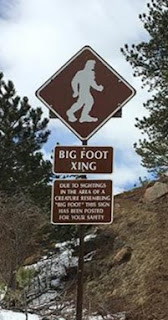
I've never been to any Bigfoot-themed event. I think of the Big Guy as a myth, although I want to be wrong. (I have, in fact, put up a $1000 reward to the person who finds the specimen leading to a description in a top peer-reviewed journal.)  But this event was pretty close to me, and I was curious, and I have book to push, I headed north from Colorado Springs to the Bigfoot Days event in Estes Park.  It was, to say the least, interesting, and I mean that in a good way despite my skepticism about our furry friend.  It was about a two-hour drive through fields, mountains, and evergreens - quintessential Colorado. I went through Boulder and a few small towns. (A pretty one called Lyons struck me as the only town I'd seen with more pot shops than Starbucks: a resident told me I wasn't wrong.) 

This was basically a fun event, not a gathering focused on evidence. Cliff Barackman  was the only serious person of note there: the other headliners were from Mountain Monsters, a show that, based on the one episode I saw, did not seem likely to discover a cryptid if it was confined to a broom closet. (My thanks to Cliff for answering a lot of questions in the course of three conversations.) 

Nothing changed my mind about Bigfoot, but I learned more about the people who are interested in it.  The people serious enough to seriously overpay for a Bigfoot BBQ Dinner the night of the 1st (I would have thought there was some Endangered Species Act rule about BBQing Bigfoot, but whatever), were a very friendly bunch with a family vibe.  They were also a reminder that Bigfoot aficionados can't be lumped together and characterized as being a few digits short of a password.  My table had, among other people, a geneticist trying to cure sickle cell, a biotechnology expert, a software engineer, and so on, and we talked about developments in gene therapy and data science and so on. Also, the non-Bigfoot BBQ was superb.  

The Bigfoot Days open-air festival on Saturday drew more aficionados and a lot of tourists (the season is well underway in this gorgeously-sited town). It was a gorgeous Colorado day in Bond Park, with an almost cloudless sky and a temperature in the 50s.  At 7,500 feet, that also makes it a good day for sun exposure, and I got a touch too much despite a hat and sunscreen.

Some 15 or 20 vendors sold everything from T-shirts and footprint casts to popcorn and (for some reason) cutlery. I should have gotten a table: I was really surprised by the absence of authors, with only my friend Lija Fisher there to sell her delightful middle-grade cryptid adventure novels. (Think Jonny Quest with a grumpy mentor and a basketful of cryptids.) There were numerous families with little kids and dogs: Estes Park makes a point of being a very dog-friendly town. 

I bought a cast from Barackman's table that was so unusual I loved it for the sheer oddity: the fingers, purportedly, of a sasquatch that probed into a bait jar of Nutella. The cast (below) showed fingers a bit larger than mine: I have very big hands, but this still wasn't out of the human range. There was also a Bigfoot calling contest. I assume someone invited Bigfoot to judge it, but he apparently declined.

The Park Theater hosted a couple of presentations. The theater is very interesting by itself, being 109 years old, so we writers are required by law to describe it as "the historic Park Theater." 

One was Cliff's "Bigfoot 101" lecture. I'll go over the points we discussed in the next entry. Not only do I get an extra blog post out of it that way, but I think anyone interested in Bigfoot will want to read it. I'd never met Cliff, have seen his show Finding Bigfoot only once, and haven't read anything by him.  So I'll be posting my immediate, spontaneous reactions and thoughts.

The other was the premiere of a documentary about aliens and Bigfoot in the Rocky Mountains, which I didn't attend for  obvious reasons. I think cryptozoology is for zoologists, however speculative, and aliens, apparitions, and so forth are for the parapsychologists.

I also hit a delightful 94-year-old bookstore whose proprietor described it as "haunted, in a good way." I gave them a signed copy of Books and Beasts to sell on my general principle of always supporting independent bookstores. I'd done the same with an equally cute place called The Book Worm on  my way up from Colorado Springs.  

So this wasn't a scientific conference, but it didn't pretend to be. It was focused on talking 'bout Bigfoot and family fun, and I relaxed and enjoyed it.  A final pleasure was that the live band, Shovelin Stone, was really good. (There was supposed to another band, called That Damn Sasquatch, but they unfortunately had to cancel due to illness.)  I didn't get to visit the Stanley Hotel this trip, but maybe next year!


Stay tuned for Part 2.


Matt Bille

www.mattbille.com

Author:

Of Books and Beasts (Hangar 1, 2021)

Rumors of Existence (Hancock, 1995)

Shadows of Existence (Hancock, 2006)


Sunday, March 27, 2022

Review: Karl Shuker's Mystery Cats of the World Revisited

Mystery Cats of the World Revisited: Blue Tigers, King Cheetahs, Black Cougars, Spotted Lions, and More 

Dr. Karl P. N. Shuker

Paperback, 2020 Anomalist Books, 414pp.


Dr. Karl Shuker’s well-researched Mystery Cats of the World (Robert Hale, 1989) instantly became the top reference (for many cases, the only one) for those interested in that topic. It's very hard to find now: I'm fortunate to have a copy.  

Shuker  adds a great deal of information and countless new illustrations in Revisited, so it's far more than just a revised edition. It's the NEW definitive reference for zoologists as well as cryptozoologists. Nothing, from the mysterious Iriomote wildcat to the strange-looking woolly cheetah to odd-looking cats in ancient art, is outside Shuker's interest. The cryptozoological mysteries are here, too.  What is a "water-leopard?" Could saber-tooth cats have survived?  Ahd what do we know of my favorite mystery, the Queensland tiger-cat or yarri?  Shuker writes well, and his background as a trained zoologist shows in his analysis of the cats and their potential origins or plausibility. As usual for a Shuker book, the sources are well-cited (if uneven in their reliability) and a ton of reference material is there for the more dedicated student of pussycat puzzles to pursue. 

Bill Rebsamen, as always, provides some great artwork. The very thin paper makes some of the photo-illustrations less impactful than they might be.   If I haven't mentioned it enough already, this is the best book ever published on such cats, and is unlikely to be dethroned in the coming decades. 

Thursday, March 24, 2022

Wernher von Braun's 110th Birthday

March 23 is the 110th birthday of Wernher von Braun.

In WW2, this talented engineer and manager headed the team that developed the V-2 rocket. (The V-1 was an unrelated Luftwaffe development.) After the war, he was imported with 117 others as part of Project Paperclip and worked with the Army Ballistic Missile Agency in Huntsville, where he developed short- and intermediate-range ballistic missiles and was instrumental in launching our first satellite, Explorer 1. He went on to NASA when that agency took over the ABMA team and was essential in the design, development, and execution of the the Saturn V program and other aspects of Apollo. He left NASA when the post-Apollo programs, especially sending people to Mars, vanished off the planning boards. He died in 1977. 

There is no denying the importance of his work for space exploration or his genuine, lifelong enthusiasm for those efforts. There's also no denying he lied about his actions during the war. While joining the Nazi Party and accepting an SS commission were largely forced on him, he continued his deadly work without protest (not, of course, that protest would have done him any good, but there is a Faustian theme that's unavoidable). He didn't create or supervise the slave-labor production program at the Mittelwerk, but he did see it in action. He argued to the SS commander on the utilitarian grounds that prisoners would produce better work if treated better, but when he was brushed off, he dropped it. When Germany disintegrated, he led his staff on a long, dangerous trek to hide key technology and tons of studies and design work until he could surrender to the Americans. The Project Paperclip staff and Army G-2 went light on the questioning in their urgency to get rocket engineers to the US. Ironically, the V-2's technical innovations had largely been matched by America's Robert Goddard, but Goddard couldn't get the funding to build missiles. 

Von Braun and staff helped test captured V-2s and went to work on American missiles. He fought hard for the Army team to get the assignment to launch America's first satellites, but a commission picked the Naval Research Laboratory's Project Vanguard. When Vanguard was compromised by technical problems and a famous failure, von Braun was given the green light to launch an American satellite to match Sputnik 1, and did so on January 31, 1958. The Army lobbied hard to keep the ABMA team, but it was transferred to NASA Marshall, and the rest is space exploration history. 

Von Braun might appear in the dictionary as the definition of "complicated." He believed his service his country in wartime was acceptable despite his disapproval of the war and the savagely evil conduct of his government. He enjoyed all the hedonistic delights of being a young baron, but once he married in 1947 he remained faithful for life. He had served Hitler and developed weapons but was a practicing Christian. (Interestingly, Hitler in hindsight should not have backed him: while the V-2 was deadly and frightening, the resources would have done more for the war if devoted to airplanes.) His V-2 staff worked clandestinely on space exploration ideas, and he was arrested at one point by the SS for allegedly slowing development of rocket weapons (this was, oddly a favorite charge in Stalin's purges). Von Braun pointed to this arrest as evidence of his lack of enthusiasm for war, although it was also a political ploy by SS leaders to take control of the program. The extent of his wartime activities and knowledge did not come out until the 1970s. 

Surprisingly for a German aristocrat, he adapted quickly to the American need to sell programs politically, emphasizing the wonders of space exploration and the terror of Soviet missiles to the right audiences. He believed strongly in a "Skunk Works" type of operation where everyone was together and he and other leaders walked the shop floor. He adapted his management style successfully to the needs of the enormous Saturn V program where a Skunk Works wasn't possible.

 Everyone who worked on space with van Braun liked him. Despite his aristocratic origins (he was, after all, Wernher Magnus Maximilian Freiherr von Braun), he was able to befriend and motivate everyone from sheet-metal workers to Presidents. He was outgoing, strong-willed, had a dozen side interests, and was a leader in encouraging the Germans transplanted to Huntsville to become part of the community to mitigate anti-German sentiment. His dynamism unquestionably moved American space exploration ahead by at least several years. 

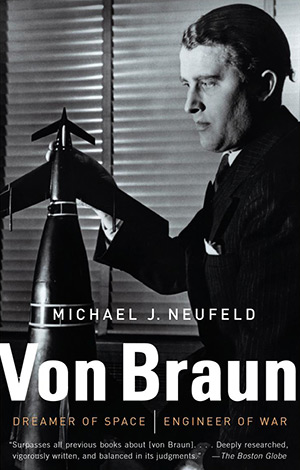
Von Braun died relatively young of cancer and did not write a memoir, although he left huge archives of plans and correspondence. To read his story very much as he would have written it himself, read Wernher vonBraun: Crusader for Space, by his friend and teammate Ernst Stuhlinger (who helped with my book The First Space Race) and Frederick Ordway. To read the definitive biography, add Michael Neufeld's Von Braun: Dreamer of Space Engineer of War. The former was attacked by Mittelwerk survivors, among others, for whitewashing him: the latter was attacked by von Braun relatives and friends for being unfair to him, but I think it's the most thorough examination we'll ever get.  

 No matter what your judgement of him, space history would have been very, very different with


out von Braun.


Friday, March 18, 2022

A unique Dunkleosteus sculpture

 From George Lafaye via Etsy comes this unique Dunk, a clay hand-sculpt over a wire armature. It's not the most accurate modeling job: among other things, the lower tail lobe is extended to be part of the stand.  That extra set of anal fins is problematical, and the surface detailing is minimal.  I'm not sure any fish ever had this color pattern.  On the other hand, it's altogether charming, the dorsal is in the right place, the tail is the right type, and did I mention it's cute? 


Thursday, March 17, 2022

64th Anniversary: Vanguard 1

The Vanguard satellite program, announced as the first (and then only) official U.S. satellite program in July 1955 for the 1957-58 International Geophysical Year, had a rough time.  The budget rocketed (I can't help writing that) from $20M to $110M; the technical hurdles on the all-new launch vehicle were seriously underestimated; after Sputnik's launch in October 1957 led to a hurried effort and a globally-publicized failure in December 1957, the Army's rival effort was green-lighted, and Explorer 1 was  launched on January 31 as America's first satellite. The ultimate authority, President Dwight Eisenhower, was incensed by Vanguard's budget problems but thought the program, once announced, had to be continued for national prestige. 

The Naval Research Laboratory (NRL) Vanguard engineers were a determined bunch, though, and after another failure they put Vanguard 1 up on March 17. (The program gave numbers only to successful satellites.)  Vanguard 1 was called the "grapefruit" satellites, as it was a 1.46 kg miniature of the 9.98kg satellite originally envisioned, and post-Vanguard 1 launches used this type. 

Roger Easton, one of primary contributors, and the NRL went on to create the first navigation satellites and contribute (opinion on credit is sharply divided, with the Air Force basically established in official histories as having all the credit and NRL objecting vociferously) to GPS.  The Vanguard program, while certainly troubled, was not a failure. Its launch technology was used in developing many subsequent vehicles including the workhorse Delta, and the satellite bus was likewise adopted for other projects. Important science was done, and the Minitrack satellite tracking system remained in use for many years. Vanguard 1 is still in orbit: Arthur C. Clarke wrote it would be undoubtedly collected for a museum, and that still may happen someday. 

You can see the protocols back then were not as strict as today: Roger Easton took the satellite home for some adjustments, and this is his son Richard (red jacket) posing with it!

Richard Easton's book on GPS is must reading.  
https://www.amazon.com/GPS-Declassified-Richard-D-Easton-ebook/dp/B00F51KIRO

Read the story of the race for the first satellite here: 
https://www.amazon.com/First-Space-Race-Satellites-Centennial/dp/1585443743


Thursday, March 10, 2022

Will We Ever See "De-Extinct" Mammals?

 Thanks to a $5M gift to the University of Melbourne (Australia), a lab is being established with the goal of bringing back the extinct thylacine (a.k.a. Tasmanian tiger or Tasmanian wolf) and developing genetic techniques that might help save rare species. Professor Andrew Pask will head the Thylacine Integrated Genetic Restoration Research (TIGRR) Lab. 

Pask said the lab will "work with stem cells, gene editing and surrogacy, to assist with breeding programs to prevent other marsupials from suffering the same fate as the Tassie tiger," which offers great benefits even if we never see a live thylacine again.  An interesting sidelight on this species is that sightings have continued since its presumed 1936 demise: it certainly lasted into the 1940s and maybe much longer, but it's hard to believe any are left after countless searches turned up nothing.) 

The last known thylacine in 1936 (Public domain

Bringing back extinct species is a very, very tough nut to crack. It's been around as an idea for a long time.

One way to do it is by back-breeding living animals that carry some of the extinct type's genes until you bring out the right characteristics. Serious attempts were made with the quagga, a version of the plains zebra; the aurochs, the ancient cattle painted on cave walls; and the tarpan, an extinct breed of wild horse. These have gained varying degrees of success.  I've seen reconstructed tarpans, known as Heck horses after the breeders,  in a zoo: indeed, the tarpan reconstruction effort has been carried out twice from different stock.  But is an animal that looks like an aurochs or a tarpan the real thing, or sort of a walking Xerox (for those old enough to know that I mean)?

Drawing of a Quagga, showing its brownish, incomplete striping. The Quagga Project, a back-breeding effort started in 1987 is getting closer to the right look. (picture in public domain)

Genetic engineering has opened new possibilities, even if they don't include bringing back dinosaurs.  We have DNA fragments from long-extinct animals, but the full genome only from those which died recently enough that we have well-preserved specimens. (In specimens preserved in formaldehyde, though, the chemical breaks down DNA.)  Assembling a full genome from creatures like the mylodon or giant ground sloth, from which hides thousands of years old have been found, is possible in theory, but one interested geneticist, Russell Higuchi, said when Jurassic Park came out that the problem was like reassembling, in the dark, a shredded encyclopedia written in a foreign language, all without using your hands. Technology like CRISPR is making it more practical, but how much more  remains to be seen. A Pyrenean ibex, or bucardo, was cloned  in 2003 with material from the last known member of its subspecies, which had been biopsied two years before its death in 2000. The mother was a closely related subspecies, of the Iberian ibex (a.k.a. wild goat), but the resulting animal died soon after birth. An endangered gaur (a.k.a. Indian wild ox) was cloned in 2001, although that calf died of dysentery two days after the apparently successful cloning. 

 A plan to bring back the woolly mammoth has garnered $75M from venture capitalists and  (really) Paris Hilton.  This has been proposed before. The approach that was long in vogue was to insert the genome of a mammoth from a frozen specimen into the egg of an Asian elephant (the closest living relative) and get a hybrid. Future generations would, following the same plan, become more and more mammoth until the result is almost a mammoth, assuming the line didn't die out to to inbreeding.


Woolly mammoth. The Woolly Mammoth Revival Project wants to bring the species back. (Public Domain)

Even if fertilization and implantation work, which may take countless tries (it took hundreds of attempts to get the unfortunate bucardo), one or two lost pregnancies could derail such a scheme. The logistics are especially difficult because Asian elephant pregnancies can take 22 months. The elephants are probably not big on the whole idea. Neither are animal rights activists or some scientists. The newest effort, by a Texas firm called Colossal Biosciences, plans to use artificial mammoth wombs, but first needs to invent and perfect this costly technology.  

The most famous fictional discussion of de-extinction by cloning/genetic engineering is in the Jurassic Park universe.  Another fictional take on the whole business appears in a well-researched thriller by Jonathan Maberry, The Dragon Factory. Rogue (of course) scientists trying to create better soldiers have brought the technology to such a level that, not only can extinct species be brought back (one man observes that dodo does not, in fact, taste like chicken) but can create a unicorn from a horse with a little messing around.  (See my review in my book Of Books and Beasts. You knew I was going to get that in somewhere.) 

Might we someday see a revised ancient (or modern) mammal? It may be impossible. Or it may take a long time and a lot of money.  Or we just might encounter so many obstacles that we call the whole thing off.  


Matt Bille

Matt Bille - SciWriter, LLC

www.mattbille.com

mattsciwriter@protonmail.com

Monday, February 28, 2022

Is Tyrannosaurus rex really 3 species?

 We've all grown up knowing a T. rex is a T. rex, and that's all there is to it.  A study published in the journal Evolutionary Biology suggests otherwise, According to the authors, there are three species.  Three times the Tyrannosaur goodness?  
After looking over the existing specimens of T. rex (there are only 38 in the world, according to one count) Paleontologist Gregory Paul and his coauthors believe they fall into three body types different enough from each other to be named species. He proposes we add T. imperator (emperor), and T. regina (queen), The world's most famous fossil skeleton, the Tyrannosaurus "Sue" in the Field Museum, is named as the type specimen for T. imperator. 
Some paleontologists were disappointed by the paper because there had been so much hype preceding it.  They expected a major discovery based on new fossils, not an argument for reclassification.  
This new royal family has sparked immediate controversy. We think of paleontologists as a serious lot, if not actually dull, but the debate in this case, while professional, is already getting fierce.  Dr. Steve Brusatte, author of the  superb popular book The Rise and Fall of the Dinosaurs (2018), thinks the differences cited are "...very minor and not indicative of meaningful biological separation of distinct species,,," PaleoTwitter, which is a VERY active community with a lot of calm professional discourse sprinkled with non-calm acrimonious discourse, is abuzz, and most of the buzz ia about how the paper is wrong.  But t
he storm of prehistoric dust is just starting. Many debates and studies lie ahead. Consensus may never come.  
NOTE: Dr. Alan Grant could not be reached for comment.
One vision of T. rex (public domain) 


Congratulations to Tetrapod Zoology

Congratulations to Dr. Darren Naish, whose blog Tetrapod Zoology marked its 16th birthday. Darren is a paleontologist who, among many other accomplishments, revolutionized our view of the largest pterosaurs. The blog offers posts about countless vertebrates, living or extinct, along a friendly skeptic's takes on the cryptozoological world.

Wednesday, February 09, 2022

What did Megalodon Look Like?

 New study conclusions

Body forms of extant lamniform sharks (Elasmobranchii: Lamniformes), and comments on the morphology of the extinct megatooth shark, Otodus megalodon, and the evolution of lamniform thermophysiology

Phillip C. Sternes, Jake J. Wood & Kenshu Shimada


One proposed comparison shape (marked "Free to Use and Share' on Creative Commons)


This is a really good example of what we can and can't know from incomplete fossils. Sharks, like my favorite fish
Dunkleosteus
, have a cartilaginous skeletons that rarely fossilize.  

Did they look like great whites? Did they look more like some other extant shark? 

We don't know. 

"...all previously proposed body forms for O. megalodon should be regarded as speculations (Figure 9) because there are no scientific means to decisively support or refute the accuracy of any of them. Any meaningful discussion on this specific topic would require the discovery of much better-preserved fossil specimens than what are presently known in the fossil record of O. megalodon."

Darn. 

Monday, February 07, 2022

Black History Month: the Astronauts

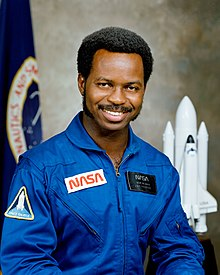
NASA's first three Black astronauts were picked in January 1978 as part of the first Shuttle program group of 35 astronauts. NASA had expanded the criteria for this group: all previous astronauts had to be test pilots, meaning the pool for Mercury through Apollo (which expanded the rule just a bit to allow scientists, with geologist Harrison Schmidt reaching the moon on Apollo 17), consisted almost entirely of white males.  The TFNG (Thirty-Five New Guys) also included the first American women. 

The first Black astronaut to fly was Air Force pilot Guion Bluford in 1983. (I met him 15 years later, when he was a VP at engineering services firm NYMA. He was a reserved fellow, the kind who didn't need to command attention as astronauts (and, by legend, all military pilots), sometimes do. Physicist Ron McNair first flew in 1984 and  died in the Challenger disaster in 1986. Air Force pilot Fred Gregory flew in 1985 and became become the first Black American to pilot, and later command, a space vehicle.  He became the NASA Deputy Administrator, at one point serving two months as the Acting Administrator.  A little-known fact is that he was the nephew of the famous physician, Dr. Charles Drew. Marine pilot Charles Bolden, selected in the next group in 1980, became the first permanent Black NASA Administrator.  One other Black astronaut has given his life for exploration: payload commander Michael Anderson, another Air Force officer, was on the shuttle Columbia on February 1, 2003.


Major Robert Lawrence, picked in 1967 by the Air Force for the to-be-canceled Manned Orbiting Laboratory (MOL), would likely have transferred to NASA and eventually flown the Shuttle had he not died in a crash a few months after his selection.


Captain Edward Dwight, Jr. was an Air Force pilot added as a candidate in 1963 from outside the usual process – JFK himself picked him to integrate the program - but he was still in the test pilot qualification program when selected, and he never did make the cut for selection by NASA.


The first person of African descent to reach space was Afro-Cuban cosmonaut Arnaldo Tamayo Mendez, who flew on Russia's Soyuz 38, orbiting on September 18, 1980.


Photographs (Dwight and Lawrence photos USAF, others NASA)


Bluford, McNair, and Gregory in 1978


Bluford

http://www.jsc.nasa.gov/Bios/htmlbios/bluford-gs.html


Anderson

http://www.jsc.nasa.gov/Bios/htmlbios/anderson.html

McNair
https://www.jsc.nasa.gov/Bios/htmlbios/mcnair.html

Lawrence

https://www.amfcse.org/robert-h-lawrence-jr

Bolden (as NASA Administrator, 2009)

https://www.jsc.nasa.gov/Bios/htmlbios/bolden-cf.html

Gregory (as NASA Acting Administrator in 2005)


https://www.jsc.nasa.gov/Bios/htmlbios/gregory-fd.html

Dwight

https://www.smithsonianmag.com/history/ed-dwight-first-african-american-space-until-wasnt-180974215/


.

Saturday, January 29, 2022

Book Review: The Cryptid Catcher

The Cryptid Catcher

Lija Fisher

Square Fish, 2018, 326 pp. + bonus material

Bigfoot hunter and educator Lija Fisher has written a wonderful adventure for middle-graders, Indeed, older kids and adults with an interest in cryptozoology will snork it up too.  Clivo Wren is the orphaned son of a cryptid-catcher who roamed the world looking for a cryptid with immortality-granting blood, which makes sense in the context of Fisher’s unique take on cryptids in general. Thirteen-year-old Clivo has an inherited contract with a mysterious man named Douglas who is not so much a mentor as a goad.  (Imagine Obi-wan throwing Luke a lightsaber and saying, “Good luck storming the Death Star. And I mean by tomorrow!”) 

Clivo will feel familiar to fans of Jonny Quest (from the original and ONLY series) and has a bit of Harry Potter in him, too. He meets a supportive cryptozoology club through, of course, the International Cryptozoology Museum. Soon, he’s off to Loch Ness and then Alaska, getting around via an unlimited credit card provided by Douglas, the outdoor and self-defense skills taught him by his dad, and innate cleverness.  Clivo has other problems, though, mainly people who are wiling to shoot him to find the cryptid that can help them use immortality to (what else?) take over the world.

This book, the first in a duology, is a funny, well-paced, globe-trotting tale of teenage derring-do. It’s stuffed with cryptozoology references both common and obscure, has a great supporting cast, and brims with originality. On to the sequel!

Saturday, January 22, 2022

Sasquatch: the Matt Bille Challenge

 We all love our buddy Bigfoot, despite his annoying habit of never leaving DNA, dead bodies, bones, fossils, partially eaten kills, or old copies of "The Smart Sasquatch: A Guide to Avoiding Humans." Even skeptics like myself HOPE the Bigfoot hunters finally find something.


So I posted the Matt Bille Challenge on a cryptozoology group.
I don't suppose it means much in the days of million-dollar book advances, but I'll write a personal check for $1,000 USD to the lead author of the paper in Nature, Science, or Journal of Mammalogy describing the creature known as Sasquatch.
I specified those three journals only because this would be earthshaking news: the peer review process would be extremely thorough there. Also, the authors would ONLY submit to the most prestigious journals. That paper is not going to Bubba's Journal of Mammalogy and Cheeseburger Recipes. (Which I would totally read.)
I'll add $1,000 to the person who finds the specimen used as the basis for the paper. Good hunting!

Monday, January 17, 2022

Book Review: Drunk Flies and Stoned Dolphins


Book reviews

Drunk Flies and Stoned Dolphins: A Trip Through the World of Animal Intoxication

Oné R. Pagán

BenBella Books, 2021. 320pp

Dr. Oné R. Pagán, a biologist, biochemist, and pharmacologist, has written a book that’s as much fun as the title indicates, with fascinating science as a bonus.  He explains the history of our research on naturally occurring pharmaceutically and psychedelically active substances and the many uses other animals, intentionally or unintentionally, put them to.  Did you know what happens to elephants on LSD (nothing good)? Have you ever heard the claim we evolved our brains because psychedelic plants expanded out consciousness? It’s called the Stoned Ape Theory, and an actual scientist was serious about it. This is not to be confused with the Drunken Monkey Hypothesis, which holds our ancestors found the ripest fruit by following their tastes for alcohol.  (One wonders at times what exactly the scientists consumed.)   


Pagán questions some popular stories. Elephants, it turns out, will greedily dive into liquor and can be very dangerous drunks, but the claim that they do this with fermented fruit is dubious. (Some smaller animals do get drunk that way.) The much-reported tale of dolphins passing around a puffer fish to get high is likewise unproven: they may just have been using it as an inflatable toy.  My favorite bit is that sea slugs apparently hallucinate on amphetamines. It’s not exactly useful knowledge, of course.

The author explains the chemistry of the subject in clear words and illustrations. He reviews the theories, adding a few of his own, about why intoxicating substances evolve and the way they have “unintended” effects (e.g., a plant may evolve an insecticide that’s an intoxicant to other animals). 

Pagán’s engagingly conversational style occasionally gets a little cutesy, but it succeeds in making the book a lively read that explains science without getting boring.  I came away knowing a lot more about biochemistry, animal behavior, and how to determine how drunk a fruit fly is. A unique book!


Sunday, January 16, 2022

Thanks to COSine 2022

I had a great time at COSine 2022. Thanks to the organizers, moderators, and panelists. I was on panels for Science Fiction predictions, appropriation, and the latest on dinosaurs. Thanks to Shannon Lawrence for this photo.  The organizers pulled it off despite COVID, the need to reshuffle presenters and work in remote presentations, and the conference hotel (I am not making this up) being sold for apartments two weeks before the conference!

Great photo by Shannon Lawrence.