On NASA's Day of Remembrance
Wednesday, January 27, 2021
On NASA's Day of Remembrance
Tuesday, January 19, 2021
Discoveries: A Dinosaur's Butt and an Orange Bat
There's always a lot going on, even if most of it is lost in the coverage of riots and disasters.
I love paleontologists, but maybe they should get out more, given the exitement over the first fossil showing a dinosaur's butthole. Granted, this is important in understanding the physiology of dinosaurs, but.. (hah)
Meanwhile, birds of paradise are among the planet's most amazing-looking creatures,and they are not just stylin' but do intricate mating dances. The Vogelkop superb bird-of-paradies (yes, that's the name) makes 44 species in the family Paradisaeidae. It's black,an almost indescribable black, absorbing almost all the light hitting it, but males reveal a bright blue "chest plate" and do a unique dance which, we suppose, is irresitable.
From Guinea, from the caves of the Nimba Mountains, comes a spectacular orange bat. It's so spectacular it's not clear why it was missed right now, but scientists working in the area knew when they spotted it it was something new. The linked article gives a good description of the process the discoverers went through to distinguish it from known species (color alone is not enough).
Thursday, January 07, 2021
Book Review: Owls of the Eastern Ice
Owls of the Eastern Ice: A Quest to Find and Save the World’s Largest Owl
Slaght, Johnathan.
(2020: Farrar, Straus, and Giroux. 348pp.)
Blackiston’s fish
owl is the world’s biggest and rarest owl. It has a wingspan approaching two
meters and a fluffy, shaggy appearance Slaght likens to a juvenile bear with
feathers glued on. It’s scattered in
pockets of Russia, China, and Japan, huddling in sections of old-growth forest
with large nesting trees and streams or rivers that don’t freeze over. The total population is perhaps 2,000.
In Russia, where the species was only found to exist in 1971, it clusters along the Pacific coast. That’s where Slaght, the son of diplomats and a good speaker of Russian, joined a Russian scientist to find the owls, document locations, and attach GPS tags to as many as possible.
This is a book
about five years of hard work in unforgiving terrain where humans keep an eye
out for the Amur tiger, the huge brown bear, and the armed and dangerous
poacher. Slaght works with a rotating cast including Sergey Surmach of the
Federal Scientific Center of the East Asian Terrestrial Biodiversity and Sergey
Avedeuk of the Amur-Ussuri Center for Avian Diversity (love the names). They set out using
snowmobiles and a massive ex-military four-wheel truck into areas where roads
don’t exist and a Western scientist is a sight rarer than the owl. Here in Russia’s Primorsky Krai (Maritime Territory),
they also face dangers from the land itself: fires in summer and freezing in the
infamous Russian winters. They have many
failures before devising a trap that works for the wily birds. Equipment fails
in the harsh conditions, and Slaght describes their efforts to fashion fixes
or alternatives.
He
writes, too, of the emotional heights and valleys inherent in chasing something
that may be vanishing. Slaght is an excellent writer, and people, owls, and the
terrain all come alive in his words.
Much
of the owl habitat is being logged, and regulations and enforcement are spotty
in this remote area. Deciding that a large wildlife preserve is politically difficult
and would affect many people’s livelihoods, Slaght focuses instead on
pinpointing the owls’ locations and habitat needs to pursue more focused
protection. He negotiates with companies and officials about leaving certain
trees and areas alone, and scores some successes. At the end of the book, he is
cautiously optimistic. Slaght, a man who
puts his life where his heart is, continues his work today with the Wildlife
Conservation Society’s Russia program.
Sunday, January 03, 2021
Book Review: Animal Treasure by Ivan T. Sanderson
Reaching way back in the bookshelf for this one.
AnimalTreasure: A Naturalist in Search of Strange Creatures
Sanderson, Ivan T. (1937: Viking Press, 325pp.)
The first book by Sanderson, who went on to become an
important and controversial figure in zoology and cryptozoology, is a delight for animal
lovers of all sorts. Sanderson was part of the generation of Western zoologists
that finally abandoned the “collect everything you can shoot” mentality to study
animals in situ. This book followed his first major expedition to British
Cameroon (now split between Nigeria and Cameroon). Everything here fascinates
Sanderson: he pays as much attention to ants as to antelopes. In vivid language,
he recounts adventures from being trapped and lost in a cave of bats to trying
to befriend a troop of baboons. The
animals pop off the page as if still alive.
His writing shows some 1930s condescension of Westerners toward the indigenous tribes, although he never says they aren’t his equals as people (in another book, he refers to an African elder as the wisest man he ever met.)
Two wildlife incidents are especially memorable. On one occasion, men
who wanted to show Sanderson they were better fishermen than a rival tribe
dragged ashore a stingray over 11 feet (3.4 m) long. Sanderson had no idea such
giants lived in African rivers. This is also Sanderson’s initial account of a
giant black bat that swooped toward him at head level. He describes it here as
the size of an eagle. [He wrote much later that he and fellow witness Gerald
Russell later compared their diaries and agreed it was 12 feet (3.6 m)
across.] He closes by saying he was
sorrowed by the destruction of the forest, a thought rare in 1937.
Sanderson became one of the first TV nature series hosts and wrote many more books.
Wednesday, December 30, 2020
Significant Events in Cryptozoology in 2020, as marked by Loren Coleman
End of Year Cryptozoology, as documented by Loren Coleman
Loren, founder and director of the International
Cryptozoology Museum, has taken on the very difficult job of trying to impose a
little structure on the controversial and sometimes chaotic world of
cryptozoology. While there’s no
governing body for this colorful group of scientists, amateurs, writers, and
assorted devotees, Loren is probably the best-known American cryptozoologist,
knows everyone, and tries to look over the global cryptozoology scene and pick
out the people and things cryptozoologists everywhere should know about. Loren and I have disagreements, with me
doubting most of the creatures he’s sure are out there, but he's one of the most dedicated cryptozoologists anywhere and is devoted to collecting and preserving
knowledge. His museum is a unique resource for cryptozoologists, zoologists, folklorists, and others, with countless thousands of items from all over the world.
First, Loren awards the Golden Yeti statue for Cryptozoologist of the Year and Lifetime Achievement. The top award this year went to Dr. (M.D.) Marie-Jeanne Koffmann of France. She spent decades recording sightings and gathering other evidence in the Caucasus concerning the humanlike cryptid called the almasty or almas, a mystery I don’t think has been definitely solved. Lifetime Yetis went to longtime Canadian Bigfoot researcher / writer / publisher / popularizer Christopher L. Murphy and Canadian sea creature expert Dr. Paul LeBlond (deceased in February, alas - he was a great guy and I’m glad we got to meet). One thing I remember about Paul was he was scientifically-minded enough (in a field where a lot of people aren’t at all) to admit there was room for interpretation of a sea creature drawing even though it was done under his direction from something he studied on film. Most people would be adamant that “that’s the real creature, exactly.”
Loren publishes a list of the Top Ten cryptozoology stories
of the year. These may include fieldwork
results, zoological discoveries, cryptozoology gatherings, and popular-culture
items. Examples this year include reports
of Vietnames “rock apes,” a possible new species of coelacanth, a new monkey, a
Loch Ness hoax, and a wave of new cryptid toys/models on the market.
He also publishes a detailed list of the Top 20 Cryptozoology Books every year (said the humble recipient of the top Historical Cryptozoology Book in 2006 for Shadows of Existence, still available on Amazon!).
Book of the Year went to The
Bigfooter’s Atlas by Zach Bales. Loren wrote, “This enjoyable, accessible,
well-written, nicely illustrated atlas of various Sasquatch-oriented locations
is the bright shining light for how 2020 needs to be remembered – as a roadmap
to future adventure.” There are books on specific creatures or categories: Bigfoot
of course, but also sea serpents, bunyips, etc., with Karl Shuker’s
superb, encyclopedic Mystery Cats of the Word Revisited: Blue Tigers, King
Cheetahs, Black Cougars, Spotted Lions, and More being my personal pick.
There are books on regional cryptozoology activity and on zoological discovery
(topped this year by Owls of the Eastern Ice: A Quest to Find and Save the
World’s Largest Owl by Jonathan C. Slaght).
Loren also provides a list of significant deaths among cryptozoologists:
this is a field with a lot of people working singly all over the world, and
such news is often missed. The most significant this year include Dr.
LeBlond, dedicated Florida cryptid-hunter Scott Marlowe, and Dr. Bryan Sykes,
who brought modern DNA analysis to bear on alleged cryptid-hominid hair samples (finding,
unfortunately, no unidentifiable ones).
Keep up with Loren's blog at http://www.cryptozoonews.com/
See the Museum at https://cryptozoologymuseum.com/
Tuesday, December 29, 2020
Farewell to a Leader of Space, Gil Moore
My friend R. Gilbert Moore has died. Gil Moore was an engineer of rockets and satellites and a relentless proponent of space education, from his first job as a rocket builder in 1947 to the microsatellites of today. He never ran out of ideas. He was key source for our book The First Space Race (and let me know it when I misread notes form an interview and made a mistake in the book). He was hatching new ideas for satellites and educational programs throughout his life. (I swear he had more energy at 90 than I did at 20.) He cofounded the Conference on Small Satellites, the premier conference in the world. His career spanned the history of small satellites from one of the first to launch (Vanguard 1, 1958) into the modern era where small satellites blanket the Earth providing imaging and communications. He lives on in the many satellites and programs he helped launch and in the thousands of students he inspired.
Monday, December 28, 2020
Propelling Dunkleosteus
THOUGHTS ON DUNKLEOSTEUS PROPULSION AND STEERING (TAILS AND
FINS)
By Matt Bille
This is one interested amateur’s view. I’m the creator of
the FaceBook Dunkleosteus terrelli site and author of the article “Dunkleosteus:
First King of the Ocean,” in the Summer 2018 Prehistoric Times (which,
ironically, had an editing error by me that swapped mentions of upper and lower
tail lobes). I have fiction and
nonfiction projects related to Dunk in progress, I’ve talked to a lot of
the experts, and I've looked at fossils and at models from toys to life-size museum exhibits.
The three tail options:
Eel-like tail:
Despite its presence in some illustrations and some scientific papers, I never liked it. I’ve never studied hydrodynamics, but I took a course in aerodynamics and have worked a bit with plane and missile designers. The main difference is that water is 830 times denser, and any propulsive movement that has to displace water is more difficult. That also means drag is worse.
If you look at big eels
like congers, the head isn’t much bigger than the body, and they’re not supporting
any big, heavy structure at the front end.
Wolf eels aren’t much different. I
think the eel body plan works for a larger creature than known eels (I’ve
suggested that an eel of 8 or 9 meters might cover some still-puzzling “sea
serpent” reports), but not something like a Dunk. You’re pushing a lot of water
to move that front end. This tail is common on some smaller placoderms, like Diandongpetalichthys
and the cool armor-plated Acanthothoraci, but nothing with the layout or mass
of a Dunk. I just don’t think that tail surface is big enough. I think there
are also stability and leverage problems stretching the body out well past the
center of mass: it might balance while static, but the front end is so much
more dense than the rear end that it’s hard for the latter to move the former.
Heterocercal tail with a large upper lobe and a small or nonextant lower one with a fin (I call this the scimitar tail):
The most common in scientific and popular works, and it may be correct. Still, you’re sweeping with a fin well aft of the body, and there’s a lot of water to push: for a predator that has to move fast (at least in spurts) and has maybe a ton of weight at the head, the surface and the musculature are both questionable. This one is so common because, with no impression fossils of Dunk to tell us what the tail looked like, the logical supposition is that it looks like a smaller placoderm of similar layout (Coccosteus cuspidatus) enlarged.
It’s a sensible approach: if you take a foot-long dogfish shark (Squalus acanthias) and blow it up the size of a whale shark, it’s still the same body plan and instantly recognizable as a shark. However: I don’t think our giant dogfish would move well, with the long, slender tail stock (peduncle) of the regular dogfish. That’s where I wonder about projections for the Dunk. It looks, generally, like Coccosteus, but Coccosteus is a foot long: blow it up to match a 20-foot Dunk and you have 20x20x20=800 times the mass. The body will not be identical.
It may be a reach, but what comes to mind is an anaology from aircraft and aerodynamics. You can look at a small jet, like a
two-place Air Force T-37 (29 feet long, 3,800 pounds), and the C-17 Globemaster
(174 feet, 500,000 lbs with moderate load).
The latter is about 6 times longer and 132 times heavier. You can see
they are both airplanes and both are designed to the same principles, but
they’re very different in layout, proportions, materials, etc. An enlarged T-37 wouldn’t work: the drag's too much, the propulsion's too weak, the structure won't hold up.
There are a lot of variations in the scimitar tail, of
course: I think the ones with the tail lobe rising at a more acute angle are
more likely to work.
It goes without saying that this stuff has been worked on
and modeled by icthyologists and paleoicthyologists with a zillion times my knowledge and
sophisticated tools, and I’m just spitballing, but if I had to bet I’d say that
tail is wrong.
The tail problem is also related to the reason I don’t like the fin “wrist”
joints outside the body: I don’t think the leverage is good. This configuration appears in some scientific
papers, and again I could be wrong, but the analogous modern fish in length and
bulk are big sharks like the great white, and the fins look quite different: the
joint is closer in to the pelvic girdle to reduce the “stroke length.” The pelvic fins are moving a lot of water .
Sharklike Tail:
So this is what I’ve thought for a long
time, and I was delighted to see real experts with real tools come out with
this in 2017:
https://peerj.com/articles/4081/
“Ecomorphological inferences in early vertebrates:
reconstructing Dunkleosteus terrelli (Arthrodira, Placodermi) caudal fin from
palaeoecological data”
Humberto G. Ferrón, Carlos MartÃnez-Pérez, Héctor Botella
Their modeling follows the shark analogy and concludes the
tail is sharklike. I think they’re
right. It takes major muscle mass to
move a fin quickly through water in a two-ton animal: I think convergent
evolution is going to work its magic here.
“…body design of fishes is determined, to a large extent, by their
swimming mode and feeding niche, making it possible to recognize different
morphological traits that have evolved several times in non-closely related
groups with similar lifestyles.” They produced logic similar to what I’d always
guessed about: “Our proposal suggests a caudal fin with a well-developed
ventral lobe, narrow peduncle and wide span, in contrast to classical
reconstructions founded on the phylogenetic proximity with much smaller
placoderms known from complete specimens.”
NOTE: I've looked for any response questioning this article and have not found one yet.
That’s why I think the Paleozoo model hits it on the head.
https://www.paleozoo.com.au/Dunkleosteus.php
There is, by the way, considerable debate on the skin covering of the Dunk and its close relatives. The Paleozoo model used denticles. The CollectA Dunk, one of my favorites, used more prominent denticles borrowed from the modern wolf fish. Predator fish today use denticles (sharks) or scales of varying sizes (easily visible on barracuda and tarpon, very small on tuna). The popular but problematic Scheich Dunk adds a row of huge scutes based on.. well, I don't know what. We many never be certain.
Sunday, December 27, 2020
Farewell to Barry Lopez
Barry Lopez, ascientist-poet who wrote memorably about humanity and nature, died yesterday of cancer. He was 75. Lopez' book Arctic Dreams is my favorite of his works. I never met him or heard him lecture: friends tell me I missed something special. God bless.
Wisdom:
“Everything is held together with stories. That is all that is holding us together, stories and compassion.”
“At the heart of this story, I think, is a simple, abiding belief: it is possible to live wisely on the land, and to live well. And in behaving respectfully toward all that the land contains, it is possible to imagine a stifling ignorance falling away from us.”
“How is one to live a moral and compassionate existence when one finds darkness not only in one's culture but in oneself? There are simply no answers to some of the great pressing questions. You continue to live them out, making your life a worthy expression of leaning into the light.”
“I lay there knowing something eerie ties us to the world of animals. Sometimes the animals pull you backward into it. You share hunger and fear with them like salt in blood.”
“Without intending to, they [human ancestors] separated themselves from the galaxy of African wildlife and emerged as something else, not yet the founders of civilization but no longer truly wild. These were the first creatures to shimmer with intentionality.”
A new (to me) Dunk model reviewed
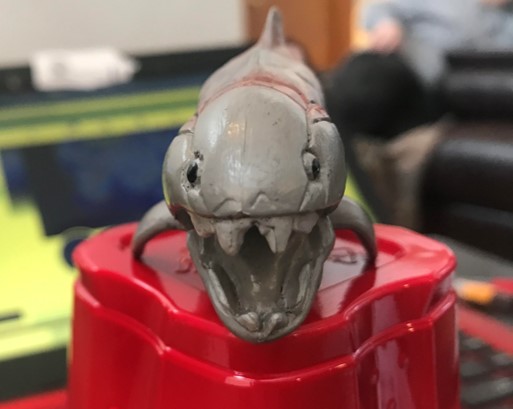
This is the latest Dunk model I've seen (I put up a hasty post with a rotten photo last night, sorry :)) Anyway, this one from Animal Paradise is a little under 6" (15cm). The coloration is clearly borrowed from the larger, popular Schleich Dunk. It's a toy and the sculptor didn't put in a lot of detail, but what's here isn't bad. It does have an odd, deep groove in each side of the body running back where the Schleich model has scutes, as if this were modeled by someone looking at an unclear picture of the latter. It's handsome nonetheless. I obtained mine from Amazon.
Saturday, December 26, 2020
A Dunkleosteus Christmas
Thanks to my family for understanding my fascination with this species. They had the sweatshirt and mug made up online and my daughter made the desk calendar.
Tuesday, December 08, 2020
New Whale Species! (bonus: a glowing sponge)
Three cetologists on a Sea Shepard Conservation Society expedition off the west coast of Mexico have spotted something amazing. We know of 23 species of the reclusive, deep-diving cetaceans called the beaked whales. The "23" is still approximate with such hard-to-study animals - some species might eventually be collapsed together, or new ones named. The biggest event in life sciences, though, is finding something new in the wild, and these folks may have done it.
Here are Markus Bühler's terrific illustrations of the new whale (above) and a comparison species, Mesoplodon perrini. Copyright 2020: reproduced by permission on this blog, no commercial re-use.
The actual photography (not shown here for copyright reasons, so see the link) and video is superb. Some experts are cautioning that it might be a known species, Mesoplodon perrini, but the scientists involved are sure it isn't. The placement of the two prominent teeth on the adult male (in almost all species) is a key differentiator between species, and the teeth on these were observed and noted to be in the wrong place for M. perrini.
It's taken scientists decades to untangle the beaked whales, and the job may not be done. The last new beaked whale (reported at sea by Japanese fishermen but never identified) washed ashore in Alaska only in 2016 and was formally described in 2019 as Berardius minimus. The people who found the newest whale were looking for a different whale whose unidentifiable "voice" had been picked up on hydrophones. This new species does not match that, so who knows what's down there?
“For
marine life, the age of discovery is not over.” –Jesse Ausubel, founding chair
of the Encyclopedia of Life
Free Bonus Sponge!
Until the 1990s, no one knew there were carnivorous sponges that didn't just sit there but used tendrils to snag food. Now we know there's one that glows. A submersible from the Monterey Bay Aquarium and Research Institute (MBARI) plucked the sample from the Pacific seafloor 4,000 meters down in 2017, but the description has just been published. Presumably it uses the light to draw in food. That's sometimes a low-percentage business on the seafloor, where a light can also signal, "Here I am, come eat me," but a sponge has to make a living, right?
NOTE Text was updated after the comments below from Markus.
Monday, December 07, 2020
Anniversary of a Still-Puzzling "Sea Serpent" Incident
Are there large and strange unclassified animals roaming the oceans of the world? The best eyewitness evidence of this possibility came 111 years ago today from two British men of science, Michael J. Nicoll and E.G.B. Meade-Waldo. In 1905, these witnesses observed a "sea monster" which has never been explained.
![]() |
| The original eyewitness drawing by Nicoll (out of copyright) |
Thursday, November 26, 2020
Book Review: Naming Nature
NamingNature: The Clash Between Instinct and Science
Carol Kaesuk Yoon (2009:
W.W. Norton & Co., 341pp.)
With the advent of increasingly sophisticated and quantitative approaches to taxonomy, we overlook the ways different
cultures label and group animals.
Biologist and top-flight science writer Carol Kaesuk Yoon set out to
write a book on the science of taxonomy and found a landscape much
more varied than she’d imagined. She embraces the concept of a near-universal
human way of perceiving nature, the umwelt, originating from our ancient
hunter-gatherer experience. The Linnean
approach is a bedrock technique for imposing order on the umwelt by deciding
what animal goes where, and she gives a lively history of the major figures
while foreshadowing the advent of cladistics.
This continues through Darwin and into the twentieth century, where
taxonomy became strictly the province of experts as the lumpers and splitters
continued their often-uncivil war.
(There were, at one point, 2,600 named genera of birds according to
lumpers, while splitters saw over 10,000 genera, more than the number of species
we accept today.) Darwin thought natural
selection would perfect taxonomy and end disputes: he couldn’t have been more
wrong. Evolutionary taxonomy was fully
as acrimonious as any other version. Other
conflicts, such as the worth of taxonomy itself, carried on, as did the never-ending
dispute over how to define a species. Ernst
Mayr’s Biological Species Concept held for several decades, but it was
challenged by Simpson’s revision of the evolutionary species concept and more
recently by the rise of DNA and then cladistics, both useful and widely used but
not yet dominant. [In October 2020, the American Museum of Natural History
reported new research, surprisingly not based on DNA but on morphology,
suggesting the 9,000-ish species of birds is far too low: the figure might be
double that. One for the splitters?]
In other cultures, Yoon reports, people tend to use Linnaeus’ binomial structure in their own way: there is a name
for a group and a name for each type.
Concerning the 137 known birds of paradise, not only do the locals of
Australia and New Guinea know and distinguish almost all, but their groupings
are very close to Mayr’s. Different
cultures classify things for different reasons – what mushrooms are edible,
what animals live within hunting distance, etc. – but the naming conventions,
based on the umwelt refined by accumulated practical knowledge, are not nearly
as dissonant as most of us would think.
We are, Yoon thinks, hard-wired to think about animals and nature a
great deal, even as small children, and notice types. A toddler who has seen
only a few dogs of very different breeds can still tell a newly-seen dog is dog
and not a cat. Where animals are lacking, imaginary ones or other things (like brand names) receive the benefit of this innate ability: her daughter's first word was "kiki," which she said while pointing at the Cookie Monster.
Animals, too, can distinguish between types of other animals:
witness the fact that monkeys have different cries to warn of different
predators. Even the simplest life forms have some faculty to distinguish
between their predators and their prey.
Yoon goes n to describe the new methods from Robert Sokal’s
computerized analysis of characteristics (species definition had long been a
matter of judgment, and in some ways still is), through the birth of molecular taxonomy
based on the chemistry of each organism, and then RNA and DNA, then to cladistics.
All of them, Yoon thinks, are valid, but also move us further from the umwelt
and into realms where comparing two animals visually becomes irrelevant. She
explains some of this very handily by assuming an ultra-simple animal, a blob, and
showing how some species diverge widely from the ancestor species and some
little, and how these developments can essentially be studied backwards to
analyze both evolution and relatedness.
The cladistics revolution began with Willi Hennig, a German fly specialist. The biggest impact of cladistics, to the lay reader, is the seemingly insane claim that there’s no such thing as “a fish,” only superficially similar tertrapods that may have had very different ancestries. The lungfish (her example) may be closer to the cow than the salmon. This technique not only supports now-common view that birds are dinosaurs, but suggests a reason to completely throw out existing taxonomy except where it aligns with cladistics.
The abandonment of the umwelt, Yoon writes, brings precision but loses the connection between humans and the natural world. She accepts the importance of continually improving the science of taxonomy but argues the now-dominant science of comparing molecules or DNA “has left us blind to our own view of the living world.” If animals are reduced to molecules and proteins, how much will we care to protect them? While taxonomy as practiced by societies historically living closer to nature is invariably local, with Aristotle a pioneer in trying to collect information from foriegn lands, there are reasons it continues to exist.
She discusses as an example the way people once thought of whales as fish [one need only consult
Melville for an example]. This view, while scientifically inaccurate, has
value in itself in understanding the umwelt and should not be forgotten. Yoon
also defends fish and considers that species are, to human senses, “the things
we cannot help but see.”
There’s much more in this book, from the loss of
ability to recognize living creatures in brain-damaged humans to various
thought experiments, and it adds up to a great deal to think about.
For my friends in cryptozoology, the book contributes to the longstanding debate about how well local cultures know their animal neighbors. There are published examples of indigenous groups, especially farming-centered as opposed to hunting-centered societies, whose members don’t know all the local fauna. Yoon offers numerous examples to the contrary, although she recognizes that need is a major driver of delineation. Indigenous cultures in Indonesia and the Philippines recognize 600 groups, which she considers equivalent to genera, of animals and plants. A striking example Yoon reports concerns the Tzeltal Mayans, among whom it's usual for four-year-olds to distinguish and name almost a hundred plants.
Many taxonomists, probably most (partitculary cladists, who Yoon more than once calls "rabid") will object to her phrasing of "science vs. the umwelt." I don't agree with it either, although I can also read her as not calling for the abandonment of science but for understanding that other concepts offer insights into animals and the people involved.
Yoon in this book does not just describe a science: she makes us think about what science is and how it affects us. It’s a very important work.
Friday, November 20, 2020
A Dunkleosteus-focused visit to Sea Monster Cove
I bought a trial membership in Meg author Steve Alten’s online venture, Sea Monster Cove (https://seamonstercove.com) to check it out. The basis is that there’s an island site where all the creatures from Alten’s fiction have been brought: there are tours, viewing opportunities, a trailer for a Web TV series, and even hotels with underwater views. I’m not going to review the science here, as my readers know (as Mr. Alten does) that I’ve critiqued him on that a lot. Today, though, I just wanted to see if there’s Dunk-related fun to be had.
Saturday, November 07, 2020
Progress on Cryptozoology Library book
For those interested, my project on a book of cryptozoology book reviews is humming. I intended to cap it at 200 books, but it'll be about 280. I've done all the acquiring / borrowing / etc. and "called a lid" as they say in politics. As it grew, my hope of having it out this year has faded: I'm shooting for January but might not make it. I'm still aiming for low cost as objective #1. Also, I WILL be having a book sale after this is done.
It looks like this:
Sunday, November 01, 2020
Tardigrades: Now Even Weirder!
I like tardigrades, the microscopic "water bears" that are most famous for being hard to kill. (You may recall some survived in a habitat stuck on the outside of the International Space Station. Vacuum, extreme temperatures, cosmic rays... yawn.) A newly discovered species glows blue in ultraviolet (UV) light. One of the effects of this is that UV light levels used to sterilize surfaces, able to wipe out bacteria, virus, nematode worms, etc.) don't kill it. It seems you're just giving it a spin in a tanning bed.