Friday, June 21, 2019

A Whale of a Hybrid

In my 2006 book Shadows of Existence, I wrote:

".. the skull from a whale killed in Greenland in 1986 or 1987 appears to be evidence of a hybrid between the two known monodonts, the beluga and the narwhal. The skull was spotted in 1990 by Mads P. Heide-Jorgensen of the Greenland Fisheries Research Institute.  It was sitting on the roof of a tool shed in the settlement of Kitsissuarsuit. The skull belonged to a hunter named Jens Larsen.  Larsen had who killed three identical whales, one of which produced the mystery skull.   He recalled that the animals seemed very strange to him.  They were a uniform gray color, showing neither the distinctive white of a beluga nor the mottled back of a narwhal.  Their tails looked like a narwhal's, with their distinctive fan-shaped flukes and convex trailing edges.  Their broad pectoral flippers, though,  resembled a beluga’s.  While these cetaceans had no horns, analysis of the skull indicated two teeth showed growth patterns resembling the spirals of a narwhal tusk.  These teeth may have protruded outside the mouth."
Now we know more - a lot more.  New techniques for imaging the skull and reconstructing the head, plus DNA evidence, have led to a complete picture of this enigmatic cetacean.  
UPDATE: Scientist and artist Markus Buhler has kindly given permission to add his reconstruction of the "narluga."   Below is the link to his post explaining how he did it.
Image may contain: sky and water

Narluga by Markus Buhler. Used by permission. No reuse unless cleared by the artist. 


The parents: Narwhal and Beluga. 
Illustration of Narwhal
Beluga whale illustration

The skull, as the New York Times' JoAnna Klein wrote, ""belonged to an adult, first generation son of a narwhal mother and beluga father. " As to those teeth: Dr. Eline Lorenzen said, “It’s like if you took 50-percent beluga and 50-percent narwhal and shoved their teeth in a blender, that’s what would come out.” 

So welcome the "narluga."

Thursday, June 20, 2019

Don't Miss the chance to see this Apollo 11 documentary

Passed along by NASA historian Mike Ciancone

....

Rare free opportunity to view the incredible new Apollo 11 documentary that was released earlier this year .. will be on CNN this coming Sunday, June 23, at 8pm CT / 9PM ET


APOLLO 11
Crafted from a newly-discovered trove of 70mm footage, and more than 11,000 hours of uncatalogued audio recordings, the CNN Film “Apollo 11” takes viewers straight to the heart of NASA’s most celebrated mission – the one that first put men on the Moon and forever made Neil Armstrong and Buzz Aldrin household names. Immersed in the perspectives of the astronauts, the team in Mission Control, and the millions of spectators on the ground, we vividly experience those momentous days and hours in 1969 when humankind took a giant leap into the future. Premieres 6/23 at 9P/ET on CNN.


Re-live this most astounding achievement and accomplishment in human history … from 50 years ago

Wednesday, June 12, 2019

Revisting Godzilla: King of the Monsters

Yep, he's still king.

Godzilla, King of the Monsters is here. As a lover of zoology and giant monster films, I had to weigh in.  Zoology and giant monsters, of course, don't really mix: Godzilla's first step would break his legs, topple him, and leave a giant puddle of dying green gunk on the ground.  But everyone agrees to believe: if you can't, you're at the wrong movie. 

My initial list of likes:
Amazing monster effects and action. Seriously amazing.  Think about how hard it is to make a giant three-headed dragon look like it's actually there, not as a video-game creature but with the seeming weight and movement of a real animal. (Three different motion-capture performers played the heads.)  
There were some good performances (Kyle Chandler, Ken Wantanabe). There were Easter eggs for cryptozoologists and some good one-liners. 
My initial dislikes: Unremittingly dark, thematically and visually, with none of the fun such movies should have, lots of errors about the military operations, and Vera Farmiga (a talented actress giving a bad performance in a hideously written role). 
Not rated: Logistics, physics, plot - you don't expect them to make any sense in a monster movie. (Although they REALLY pushed it with planes including short-ranged fighters flying fast and easily all over the planet.)
Special dislike: Naming a base Castle Bravo (after the nuclear test that poisoned Japanese fishermen and gave the original Godzilla its serious theme) is in stunningly bad taste, especially in an American film. I know that in these movies Castle Bravo was really an attempt to kill Godzilla, but that doesn't make it any better. 

Thinking back on it a day later, I found a few other things worth mentioning:
1. The best shot might have been Ghidorah frozen in ice: it offered a real sense of awe as the humans/cameras looked up at the monster.
2. Ken Wantanabe's last scene with Godzilla (the idea for which might have been swiped from The Abyss) was touching in a way you don't expect in a monster film. 
3. It's not clear why the two extra monsters that showed up near the end were fighting each other. 
4. The filmmakers seemed to throw in extra PG-13 cursing just because they could: Jesus is named more often in this film than he is in the Book of John. 
5. There's a clever homage to the Japanese version of Mothra and its two priestesses that I didn't even catch until I read a review. 

So, a mixed bag, but some fun to be had.  Grade B-.  Let's hope Godzilla v Kong next year keeps the great animation and adds a bit of humor - and daylight.

Sunday, June 09, 2019

World Oceans Day

OK, I'm a day late posting this, but the oceans need our help as much today as they did yesterday.  We're not doing enough. We're not doing enough to stop pollution or overfishing or climate change or acidification (reduction in the ocean's pH due to absorption of carbon dioxide from the air), which scares me even more than temperature changes: many marine animals have evolved to live only within a narrow range of pH values. 
This is where our lives began, and it 's where our species' existence will end  if we don't act faster. So make sure your seafood is sustainable, cut your plastic use, support marine protected areas and marine research... the list is endless, but start somewhere.  

"Ten percent of the big fish still remain. There are still some blue whales. There are still some krill in Antarctica. There are a few oysters in Chesapeake Bay. Half the coral reefs are still in pretty good shape, a jeweled belt around the middle of the planet. There's still time, but not a lot, to turn things around." - Dr. Sylvia Earle 

Ocean Acidification Illustration

Sunday, June 02, 2019

Thanks to Denver Pop Culture Con

Yes, it's a ComiCon, and Pluto is a planet, and I'm right, but there seems to be some legal stuff. I had a good time visiting the Denver PCC Friday. They have a great series of NASA panels on space topics, but I regret I missed them all in my short visit this year.  I didn't find any new Enemy Ace comic books, except one for $132, and my wife would have shot me down in flames.  Doesn't matter: it's always a great time, just seeing people and talking to them and watching the other humans. My Wizard Harry Dresden outfit got some photograph requests.  I wasn't on any panels this year, but I absolutely need to look for more opportunities and plan for more time next year. Thanks, volunteers, staff, and all!


Monday, May 27, 2019

Book Review: Chasing American Monsters

Chasing American Monsters
Jason Offutt
Llewellyn Publications, 2019 

  • 384pp.


America has some well-known cryptozoolgical puzzles, like Bigfoot, but it also has a rich folklore, still developing in the present day, of monsters, lake serpents, and just plain odd creatures reported anywhere from once to 3,000 times (Bigfoot again).  
To take a quick tour of this richness, we have Chasing American Monsters.


Jason Offutt clearly had a good time creating this tour of states and their monsters, and readers will happily come along.   All fifty state entries have some interesting nuggets, even for a well-informed cryptozoology fan who's read collections like this before. In my favorite spot, Alaska, he mentions some recent sightings of the Lake Iliamna monster I'd forgotten, although he's another writer who refers to early Russian reports without  details or sources.
On Stellers' sea ape, Offutt expresses a healthy skepticism that's too often absent here.  To get the nitpicks out of the way, Offutt repeats some falsehoods (e.g., that a monster photo appeared in a certain issue of the Tombstone Epitaph when it's long been disproved), and some misstatements like the wels catfish being a species from Spain, when the wels is not native  (it has been introduced) and has a far greater range. There are few primary sources here: almost everything is from media and online materials. Nothing wrong with that, but a bit more investigation is warranted before giving us, say, the supposed Loess not-quite-human skeletons.    Some creatures presented here are clearly just tales not meant to be taken seriously  (no one is expected to believe in fish-eyed Night People, complete with clothes and children) , but many are treated as animals, and it's not always certain which is which (to which the author would no doubt reply that's part of the fun.) 
All that said, this isn't meant to be a zoological text book,but it succeeds handsomely in being an enjoyable romp through monsters both familiar (lake monsters show up a lot) and obscure. Who knew a California woman had reported human-size roaches, or that a Georgia woman was shot as a werewolf, or that a lizard bigger than a Komodo dragon was once reported from Kentucky?  Who has heard of the giant amphibious ape that supposedly attacks cars near Dewey Lake, Michigan?  Oklahoma is home to more than just football and cows - it has a wolfman, an elkman, and a boarman! Vermont has a pigman, and West Virginia a big primate called the Stone Man. Getting to Wyoming, I never knew that anyone had claimed to see an actual live jackalope. 
You too, will have a great time reading through these tales.  Offutt comments at the end he thinks a few of the monsters are real,but you don't need to believe in any of them to enjoy this book. Wonderful illustrations add to the fun.

Monday, May 20, 2019

What if Sputnik 1 had failed? (my new article in QUEST)

The new issue of QUEST, the History of Spaceflight magazine (Vol 26 #2), offers 13 articles exploring "What if?" Mine is "What if Sputnik 1 had failed?" 
All my friends in the space history community are here, including Jim Vedda (alternate plans to go to the moon), Dwayne Day (events resulting from JFK's death), John Logsdon (if Apollo 8 had failed), and many more, including my First Space Race co-author, Erika Maurer, who looks at the Space Race as a poker player might. 
Thanks to publisher Scott Sacknoff and all the staff at QUEST. 

Saturday, May 18, 2019

Iliamna's freshwater seals are unique

Lake Iliamna, in Alaska, has a population of a few hundred harbor seals. hey constitute the only freshwater seal population in the Americas. But were these animals born here, and were they permanent residents or transients that came and went to Bristol Bay via the Kvichak River? Studying their teeth and the minerals deposited therein has given us the answer. This is their home and has been for many generations, and they stay year-round despite the fluctuations of the food supply caused by the summer salmon run. 

Tuesday, May 07, 2019

A real "monster" in Alaska's Lake Iliamna?

The Iliamna "giant fish" stories have always fascinated me. It's the only story about a large "lake monster" I think will prove to have something real and unusual in it.  The thousand-square-mile lake, so remote there are no roads to it (only a mountainous portage from Cook Inlet littered with debris from old trucks and the boats they were transporting), hosts the world's biggest salmon run.  It's at least 800 feet deep.  Jeremy Wade (River Monsters) suggests it's a kind of sleeper shark, while a more common theory is an undocumented population of sturgeon that runs larger than most.  The reports are pretty consistent about shape and features, with color and size varying, and it's certainly possible for a fish to adapt to seasonal variations in the food supply (there are trout, char, etc. that don't migrate in and out via the Kvichak River as salmon do). 
Enter marine ecologist Bruce Wright, who is sure there's something down there and intends to use a moored underwater camera to try for a picture of it (it, they, them, whatever: since stories go back before the first white people showed up a few centuries back, obviously there must be a population that's stable over time).  A retired military colonel named Mark Stigar thinks, so, too, since he tried fishing for it with a line of hooks on the bottom, and something dragged the anchor and damaged the gear.  I've written about it myself, though I've not yet been able to visit. 
Will they find anything? It would not surprise me.  What will they find? It might be something to surprise all of us. I hope it is.  

DNA proof of when people entered the Americas?

When people came to the Americas (and how) has always been a huge puzzle to which we do not have (and may never have) all the pieces. The idea that the Clovis people came over the Bering land bridge 10-12,000 years ago has been largely set aside -they were important but they were not first. Pre-Clovis data are claimed in several places across both American Continents.  Evidence from the Pacific Northwest has pushed the arrival date back to at least 14,000 years, and sites like Monte Verde in Chile may come to be accepted as proven , which would not only raise the question of when but how.  Did people first come to the Americas via boat or raft, or did they come by land but sail down the coast, planting populations much further south than migration by foot could have done? "Dusty" Crawford of the Blackfeet tribe has, according to CRI Genetics, DNA which is unusually unmixed that is, his ancestors intermarried very little with other groups) shows that, through 55 generations, his ancestors arrived (and stayed) beginning 17,000 years ago.  The group he belongs to genetically  apparently originated in the U.S. Southwest, meaning his ancestors might have come down via the ocean in a pre-land bridge migration. The ocean migration theory is hard to prove because so much of what used to be the Pacific Coast has long since vanished under water, but everything we learn seems to point to a more complex series of events than a few groups walking over from Siberia.  

Wednesday, May 01, 2019

More cool stuff on Dunkleosteus terrelli

Dunkleosteus terrelli is the biggest, nastiest, and coolest species from the Devonian, the "Age of Fishes." In my quest to learn and collect everything about it, I add the following:

First, we have a link to an MSN clip on the predator, with very nice animation, and my friend Lee Hall of the Cleveland Museum of Natural History.  The "Makes a Great White Look Like a Goldfish" and the text "Twice as long as a Great White" are silly: they were probably close to the same length, with Dunks probably longer  Not Lee Hall's fault, he isn't the one who wrote that, and he knows better).  The outliers among great whites cluster just short of 7m, while Dunks of 7-8m existed: the monster of the group is a Cleveland specimen that may have been close to 9m depending on the size and construction of the tail, about which we know little.

Also, some neat discoveries of Dunk stuff: a little green Dunk in a game I have no idea how to play, and a beautiful embroidered Dunk patch framed into a trading card from Upper Deck.


Wednesday, April 24, 2019

Birds in Indonesia: New Species and Supertramps

Way back in the 1970s, leading ornithologists like Dr. Ernst Mayr thought the discovery of bird species was almost complete.  In my 2006 book Shadows of Existence, though, I quoted a South African ornithology, Dr. Phil Hockey. He said, "Ten years or so ago, ornithologists were saying that by now all bird species would be known.  But today new species are popping up all over the place.” They still are.
Now we have two new species from Indonesia. Scientists from universities in Dublin and Sulawesi using "mitochondrial DNA, morphometric, song and plumage analyses" The Wakatobi white-eye and the Wangi-wangi white-eye  come from the Wakatobi Isalnds off the larger island of Sulawesi.  
The formal description includes a term I hadn't heard before: birds living on only one island have long been called "endemics," but the term "supertramps" is used for species that found homes all over the archipelago. I'd missed it: the term apparently dates back to 1974, when it was popularized by Dr. Jared Diamond (a fan of the band Supertramp as well as an ecologist describing a phenomenon)  to mean a generalized species with wide distribution - that is, one colonizes a large area but without specializing enough to form distinct species. (If you think about it, that describes humans very well.)  
Sulawesi is an oddity to begin with, a sort of demilitarized zone where creatures from both sides of the Wallace line separating placental mammals with roots in Asia from the marsupials mingle.   This makes it something of a zoological laboratory for hybrid and new species.  The Wakatobi white-eye is similar to other species on Sulawesi (indeed, it was mistaken for something else until now), while the Wangi-wangi white-eye is a loner, with the closest relative three thousand kilometers (something humans around the holidays can only wish for) And yet, they are allied, both in the genus Zosterops.  This poses both a puzzle and exciting new evidence for scientists trying to play the record revealed through modern species in reverse, so to speak, and understand how birds and other species radiated through this region from the nearest continents. 
The team leader, Dr. Nicola Marples, wrote, “To find two new species from the same genus of birds in the same island is remarkable." And yet here they are, and no one now doubts more birds await the eyes of science.

Friday, April 19, 2019

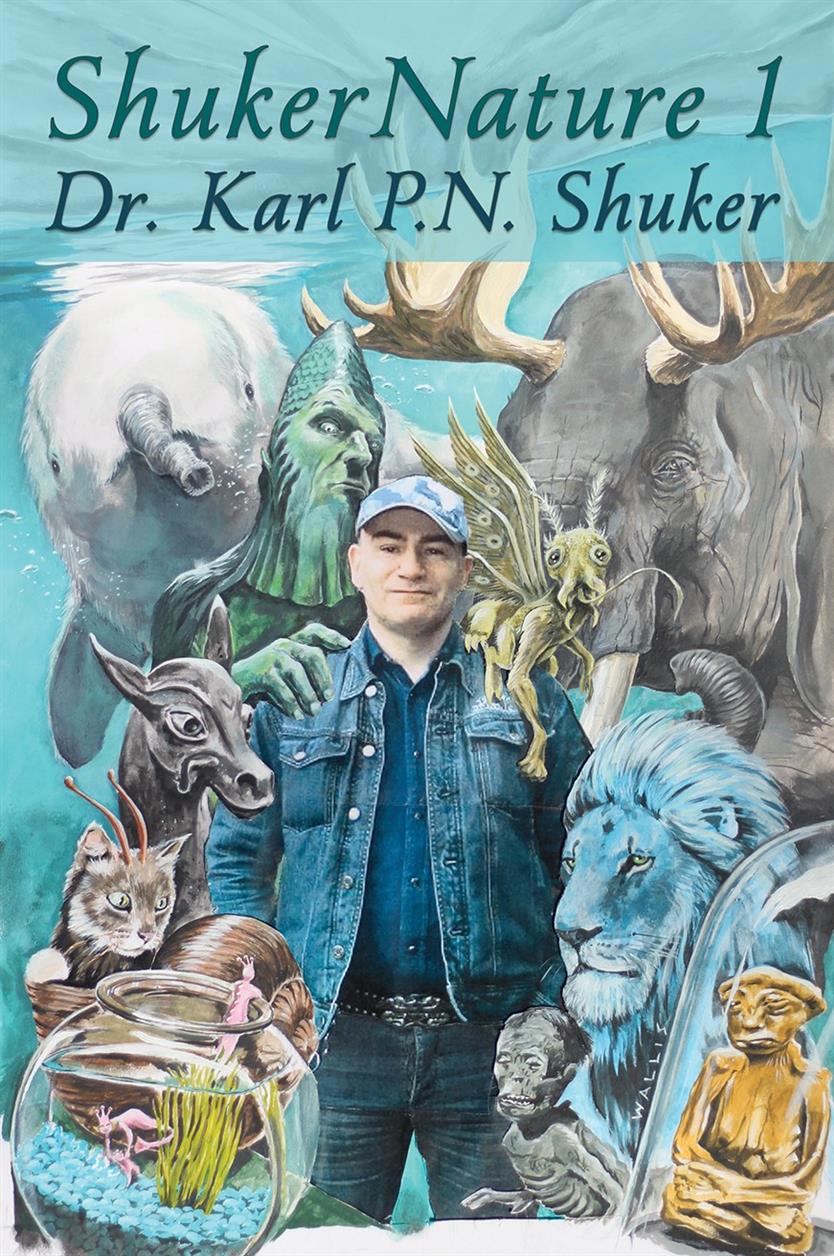
Book Review: ShukerNature 1, by Dr. Karl Shuker


ShukerNature Book 1Antlered Elephants, Locust Dragons, and other Cryptic Blog Beasts

Coachwhip Publications, 2019: 412pp.

Dr. Shuker’s curiosity about all things zoological is boundless.  In this volume, based on entries in his blog of the same name, the British zoologist plumbs the depth and breadth of of the animal world in fact, myth, and art.  Some topics will be familiar to most readers of cryptozoology, but what makes this such an enjoyable cabinet of curiosities is that many of them aren’t.  Shuker wonders about humans as much as beasts: why we put flying elephants in art, why monks put creatures half cat, half snail in the margins of illuminated manuscripts, and why stories of gigantic spiders drinking from whale-oil lamps popped up in cathedrals. We’ve all seen the silly postcards of a claimed half-man, half-alligator taxidermy fake (Karl loves “gaffs,” as these are called), but he’s uniquely identified how many of these were made (three) and how many he can locate (two).  Shuker explores his childhood fascination, Sea Monkeys™, tales of giant bunny rabbits, and Trunko, the bizarre “seagoing polar bear-elephant” that turned out, thanks largely to Shuker’s determined sleuthing, to be another dead whale.  And what was behind the poisonous “fury worm” classified first-hand by Linnaeus himself, but apparently nonexistent? 
Shuker also revisits the famous ape Oliver. While he agrees Oliver was just a chimp, he thinks the animal’s bipedal gait was too natural to be the result of training and there is still a bit of a mystery.  (I knew the man who gave Oliver sanctuary, Wallace Swett of Primarily Primates, and tried to help him out a bit, but I didn’t know Oliver had been cremated.) Concerning primates of another sort, the author explores legends and folklore about miniature humans from several Native American tribes and whether they are linked to Pedro, the mystery mummy from Wyoming, who has vanished despite serious attempts to track him down.   
Shuker closes with a mystery of his own, the dog-size, bounding mammal he met on a dark road in 2014.  He sifts through suspects and concludes this was likely a coypu, a species from South America that escaped captivity in Britain and bred its way to becoming a massively destructive pest and was supposedly wiped out by equally massive government campaigns. It seems to have slipped through the net. In one way or another, Shuker shows us, many creatures have. This is a book lovers of animals, odditites, and cryptids will wade into with gusto and finish anticipating an equally joyful experience when Book 2 appears. 


Toys R Us Dunkleosteus Review


Dunkleosteus Toy, Toys R Us™

Review by Matt Bille

I ordered this toy secondhand – it usually comes with a (modern day!) sea exploration playset. It is what you’d expect, a hard plastic toy with a lot of shortcomings in the realism department, but there are a couple of cool things about it anyway. 

It’s big, about 28cm.  It’s clearly modeled on the Schleich Dunk (shown below with it for comparison.)  It looks like a tank. The front armor is really impressive, like something Jaws’ Chief Brody could shoot at all day with his .357 without being more than a nuisance. There are armor plates (or platelike markings) all over the body, like a swimming ankylosaur. This certainly isn’t right, although this design would explain the Dunk’s disappearance from the fossil record: it couldn’t move. I assume the body armor is there just to keep the skin from looking flat and boring, There are scutes here and there, down the sides but also, weirdly, on the leading edges of the pectoral fins.     The choppers on the business end are appropriately scary-looking. The eyes are yellow with a small pupil (jaundice, or just the age of the toy?) The anal fin was not modeled, presumably to save a couple of cents in production.

Anyway, things I like.  I like the tail: the strong upper lobe indicates development in the direction of a full heteroceral tail, which I think is what they were, at the least, evolving toward. The coolest thing, though, is the action. The toy comes with the jaws wide open (of course), but if you press down on the dorsal fin, the cheek armor swings outward, creating a suction while the jaws close. We know the Dunk did feed this way, at least much of the time (some prey might have been too big), and kudos to the toymaker for including here.

So there we have it. It’s an interesting toy, not accurate but with some redeeming features. I would have LOVED this as a kid.  


Saturday, April 13, 2019

Oceanic oddities


It's 2019.  We've explored the world, right? Fear not, there is some fun to be had in poking under the sea.  
The common claim that 95% or so of the ocean is unexplored is a distortion. According to the blog Deepsea News, this is the percentage of the ocean floor not yet seen by humans or cameras. Still, in 1.39 billion cubic kilometers of ocean, a lot of things can be hiding.

Two British naturalists, Michael J. Nicoll and E.G.B. Meade-Waldo, might have had the weirdest encounter on record in December 1905. They were experienced scientists, best known for their work in ornithology but with the wide interests and expertise common for naturalists in those days. Both were Fellows of the Zoological Society of London.
The encounter came during a research cruise aboard the yacht Valhalla. At 10:15 AM, the yacht was off the coast of Brazil, fifteen miles east of the mouth of the Parahiba River. As the two naturalists looked out over the ocean, Nicoll saw something unusual. He asked Meade-Waldo, "Is that the fin of a great fish?"
Meade-Waldo looked and saw a fin he described as "dark seaweed-brown, somewhat crinkled at the edge." The visible part was rectangular, perhaps two feet high and six feet long. The distance between the fin and the observers was approximately a hundred yards.
Meade-Waldo trained “a powerful pair” binoculars on the strange object. As the two naturalists watched, there rose just ahead of the fin a small head on a long neck. Meade-Waldo described the neck as "about the thickness of a slight man's body, and from seven to eight feet was out of the water; head and neck were all about the same thickness ... The head had a very turtle-like appearance, as also the eye. It moved its head and neck from side to side in a peculiar manner: the color of the head and neck was dark brown above, and whitish below - almost white, I think."
Nicoll wrote, "Below the water we could indistinctly see a very large brownish-black patch, but could not make out the shape of the creature." Meade-Waldo recorded seeing a large body under water “behind the frill.”
The encounter lasted several minutes before the animal dropped astern of the Valhalla. Being under sail, the yacht could not come about. Meade-Waldo wrote later, "I shall never forget poor Nicoll's face of amazement when we looked at each other after we had passed out of sight of it ... "
Nicoll marveled, “This creature was an example, I consider, of what has been so often reported, for want of a better name, as the ‘great sea-serpent.’”
That was the only time the two men saw the creature. At 2:00 AM the next morning, though, three crewmembers reported spotting the same or a similar animal, almost entirely submerged.
The two men wrote up their encounter, and the Zoological Society's Proceedings carried their account of "a creature of most extraordinary form and proportions." Another version appears in Nicoll's 1908 book Three Voyages of A Naturalist.
There seems no reason to doubt the veracity or the powers of observation of these two men. A century after their encounter, the question remains: what was it that they saw?
Both were convinced it was an animal, but could not say what kind. The witnesses did not notice any diagnostic features such as hair, pectoral fins, gills, or nostrils.
While Nicoll admitted it was "impossible to be certain," he theorized the creature was a mammal. He wrote, "the general appearance of the creature, especially the soft, almost rubber-like fin, gave one this impression."
Dr. Bernard Heuvelmans wrote he’d seen conger eels rush about with head and forebody above water.  There are a few reports describing what the witnesses thought were giant eels. Four Irish fisherman claimed to have caught a nineteen-foot eel in 1915. Three years earlier, Captain Ruser of the German steamship Kaiserin Augusta Victoria had reported a giant eel off England. He described it as eighteen inches thick and twenty feet long. In 1971, English fisherman Stephen Smith was in the area of Ruser’s 1912 sighting when he claimed to have seen an eel more than twenty feet long. He described the head as resembling a conger eel’s but four times as large. Smith told an interviewer, “I have fished all over the world, but never have I seen something like this.”
There are also reports where the animal involved was not specifically called an eel but was described as eel-shaped. One such case occurred in 1947, when the Grace liner Santa Clara collided with a sea serpent. The ship’s officers described the animal as brown in color and perhaps sixty feet long.
What about Nicoll’s theory of a mammal? To begin with, there is no known mammal, living or extinct, which looks like the creature described in this incident. If we venture into the realm of possible unknown mammals, one option is a huge elongated seal. However, we have no fossil records indicating that a seal with a genuinely long neck ever existed, much less one with a dorsal fin.
Some cryptozoologists suggest sea serpents are surviving prehistoric snakelike whales, or archaeocetes, like those in the genus Basilosaurus. These, while elongated in form, did not have long necks. It’s possible a long-necked form evolved, but the available fossil record points the other way. Whale necks got progressively shorter, not longer, after the archaeocetes.
One group of animals that always come up in sea serpent discussions are the plesiosaurs. These Mesozoic reptiles (reptiles, not dinosaurs) make good sea serpent candidates in one respect: they had necks ranging from long to absurdly long. Will Cuppy, an American humorist, once wrote that plesiosaurs “might have a had a useful career as sea serpents, but they were before their time. There was nobody to scare except fish, and that was hardly worth while.” We know from fossils that plesiosaurs could not rear their necks high above the water, but the fairly low angle shown in a sketch in Nicoll’s book seems plausible.
Unfortunately, the fossil record for plesiosaurs and the other marine reptiles with similar body plans does not continue past the time of the K-T impact and the extinction of the dinosaurs. The famous case of the coelacanth has demonstrated that it’s possible for an animal to survive for a long time without leaving a fossil record, or, more precisely, without leaving one in places where humans have looked. A lot of land area remains unexplored by paleontologists, as does the entire sea floor. (Sasquatch proponents like to point out that, according to the fossil record, gorillas do not exist.)
Even if one assumes, though, that very large and widely distributed animals vanished from the fossil record while surviving in the flesh, the dorsal fin poses another problem. We have no fossils of plesiosaur-type beasts – and some of these are amazingly well preserved – which show any sort of dorsal fin. With their broad, turtle-like bodies, plesiosaurs did not need such fins for stability. It’s not impossible that a few species might have developed a fin for sexual display or some other purpose, but there is no evidence this took place.
Meade-Waldo, while he did not compare his animal to any known species, did refer back to the sea monster sighting made from the frigate HMS Daedalus in 1848. Witnesses in that incident described an animal sixty feet long or more, resembling "a large snake or eel."
Richard Ellis, whose 1994 book Monsters of the Sea is an excellent survey of the whole matter of marine cryptids, has offered a relatively conventional explanation for the Valhalla incident. Ellis, an expert on giant squid, theorized that a very large specimen swimming tentacles-first (which squid can do), could present a suitably strange appearance if it was holding one arm above the water. The description of the eye and mouth could result from misinterpretations of details on the arm or merely from imagination, since even expert observers can make errors when excited.
This explanation, as ingenious as it seems, is hard to picture in reality. First, Meade-Waldo must have made a much bigger mistake than just the details on the head, since he specifically described a large body aft of the fin. To offer the appearance Ellis suggests, the squid would have to swim on its side, keeping one fin partly exposed and one limb constantly above the surface. It must have held that unnatural and pointless position for several minutes. It might be possible for a squid to do this (or it might not – we know very little about them), but it seems impossible to explain why it would do so.
Can there be large seagoing animals still unknown to us? The answer, perhaps surprisingly, is a well-founded and scientific “yes.” Until recently, the Indopacific beaked whale (a.k.a. Longman’s beaked whale), Mesoplodon pacificus, was known from two weathered skulls found on beaches 73 years and thousands of miles apart. No one knew what the living animal looked like, or even if the species still existed, until one beached intact in Japan in 2002. Perrin’s beaked whale, Mesoplodon perrini, was described from stranded specimens in 2002. 
A new beaked whale was found in Alaska in 2016. new species of whale has been discovered based on a body, 7.3m long, that floated ashore on the Pribilof Islands.  This is just marvelous. I follow news of new and unidentified whales all the time, and I never heard a word about this, although it's apparently known to Japanese fishers, so it must have a range that spreads to the west.    This isn't a case where someone had it in hand and decided that its features or DNA warranted a split of a known species, as was the case with Balaenoptera omurai in 2003. This species was confirmed by DNA work, which resulted in reordering of its genus, but it began with a brand-new discovery from the field, when a biology teacher called in a seal researcher he knew who said, "This is weird," and then she called in a cetologist. Other previously collected (misidentified) skeletons have been located. 
The published abstract from Marine Mammal Science begins thus:
Philip A. Morin, et. al.There are two recognized species in the genus Berardius, Baird's and Arnoux's beaked whales. In Japan, whalers have traditionally recognized two forms of Baird's beaked whales, the common “slate-gray” form and a smaller, rare “black” form. Previous comparison of mtDNA control region sequences from three black specimens to gray specimens around Japan indicated that the two forms comprise different stocks and potentially different species...

Wilson's whale. Note the white underside in the top picture.(I believe the picture, copied from Heuvelmans here, to be out of copyright: if anyone knows differently, please tell me). 
File:Killer Whale Types.jpg
Type D (Wikimedia Commons)


The full description with  the full scientific name has not yet been published. 

The megamouth shark (Megachasma pelagios), up to sixteen feet long, was unknown until 1976, when one was snagged accidentally in a sea anchor. In this case, “unknown” means “completely unknown.’ Despite its size, its slow speed, and its distinctive appearance (the megamouth looks like a living blimp and resembles no other shark) there were no sighting reports, no strandings, nothing before that chance encounter.

Other sizable marine animals are apparently still at large. From my book Shadows of Existence (2006)
Two researchers who manned the submersible Deepstar 4000 on a 1966 probe of the eastern Pacific, for example, had an uncomfortably close encounter with an awesome denizen of the deep.  They were motoring along at a depth of 4,000 feet in the San Diego Trough when a dark-colored, mottled fish estimated to be thirty to forty feet long swam right up to the eighteen-foot sub.  The fish studied the craft with eyes "as big as dinner plates," then moved off, much to the relief of the startled aquanauts. 
Automatic cameras lowered into the same area took pictures of a large fish identified as a rare Pacific sleeper shark.  If this was what the Deepstar met, it would be, by far, the largest sleeper shark ever seen. 
The witnesses, pilot Joe Thompson and oceanographer Dr. Eugene LaFond, doubted their visitor was a shark.  Both men described a round tail like a grouper's rather than a sharklike tail.  Additionally, the eyes described were much too large for a sleeper shark.  
In the fascinating new book Harpoon: Into the Heart of Whaling (Da Capo Press, 2008) Andrew Darby chronicles the long and often bloody interactions between humans and whales. He also includes this item in his discussion of the now-closed whaling center on King George Sound in Albany, Western Australia. In the 1970s, when whalers like Captain George Cruikshank followed sperm whales with sonar, they often watched something they couldn’t identify in the 4000-meter-deep Albany Canyon.
"'The mystery bugger,' they called it...They would pick it up always at the same spot, and follow it by sonar as it cruised through the canyon, leaving a larger imprint on the screen than a whale. The creature would almost break the surface and then disappear. It was no air breather. It might have been a giant squid, or a giant shark. They never found out." (p.96)
Then we have Marvin. Off a Shell Oil rig near Santa Barbara,in 1966, a colonial invertebrate (that's the best guess) was filmed by an underwater camera. It was estimated at 15 feet long and moved by turning itself so its screw-like shape could pull it through the water. That sounds incredible, but here's the film (copyright unknown, fair use claimed) 


Now we come to one of my favorites, Wilson's whale.
Dr. Edward A. Wilson was a painter/naturalist on board the 1901-04 Discovery expedition to the Antarctic, led by Robert Falcon Scott. In 1902, Wilson painted an unknown whale with a high, slender dorsal fin and a solid black back, with no orca-type eyepatch observed. (One image does indicate a white underside.) I wrote in the chapter on mystery cetaceans in my 2006 book Shadows of Existence that the distinctive markings of an orca could not have been overlooked, and Richard Ellis and Dr. Darren Naish reviewed that chapter for me without objecting to that statement. Now I wonder. 
What made me wonder was the paper by Pitman, et. al., on an orca called Type D.  Type D, it seems, is a rarely observed but very distinctive orca that may be a separate species.  It's relatively small for an orca, and has  a tiny eyepatch and no gray dorsal "cape" marking.  In other words, it's not a perfect match to Wilson's whale - he'd have had to miss the eyepatch in his observations -  but it looks more like it than any creature yet documented.  

The dates of sighting are given as 28 and 29 January: Discovery stopped at Cape Crozier on 22 January and reached and named King Edward Land on 30 January, so my amateur reckoning puts them between 76 and 77 South. This creates a problem. The Type D has not definitely been identified below 60, and Robert Pitman told me in correspondence he can't imagine it goes below 65 or so - the water is just too cold for it. As for the visual match, Pitman writes, "Intriguing speculation but it would be difficult to say with any certainty - just not quite enough in the illustrations to be convincing."  He doesn't have an opinion on what Wilson's whale was, though he notes that, at the time, there was thought to be just one species of orca (heck, a hundred years after Wilson that's still what we thought) and it wasn't clear whether Wilson was saying his whale was not an orca (I have to get Wilson's book on the expedition).Anyway, Wilson's whale is a mystery. I thought for a bit there I'd solved it, but no.  If it was a Type D orca, it was way out of its range, and if it was some other orca, then Wilson could hardly have missed the markings.  So what was it? An odd orca of another type, one with minimal markings? An unknown type orca? Something else entirely?   


In 1998, employing a statistical technique used in biology to estimate the diversity of animal populations, Oxford University’s Dr. Charles Paxton calculated the likely number of marine animals measuring two meters (six and a half feet) or longer still awaiting classification. While Paxton admitted this technique is inexact, based as it is on the discovery rate and total number of such species found so far, his estimate of 47 species was an eye-opener.
Paxton thought the oceanic types still to be found included mainly whales and sharks, although he allowed for the possibility that some might be totally new types of animals. Meade-Waldo and Nicoll, were they here to speak to us, would no doubt agree on that point.
We must wait and see what answers the next hundred years will bring.

REFERENCES
Anonymous. 2003. “Whale species is new to science,” BBC News World Edition, http://news.bbc.co.uk, November 19.
Australian Museum. 2003. “Longman’s Beaked Whale,” Fact sheet.
Baker, Mary L. 1987. Whales, Dolphins, and Porpoises of the World. Garden City, New York: Doubleday and Co.
Carwardine, Mark. 1995. Whales, Dolphins and Porpoises. New York: Doring Kindersley.
Dalebout, Merel. 2003. Personal communication, October 28.
Dalebout, Merel, et. al. 2003. “Appearance, distribution, and genetic distinctiveness of Longman’s beaked whale, Indopacetus pacificus,” Marine Mammal Science 19:3, p.421.
Dalebout, Merel, et. al. 2002. “A new species of beaked whale Mesoplodon perrini sp. n. (Cetacea: Ziphiidae) discovered through phylogenetic analyses of mitochondrial DNA sequences,” Marine Mammal Science 18:3, p.577.
Ellis, Richard. 2003. Personal communication, November 22. Also 2000, March 10.
Ellis, Richard. 2003. Sea Dragons. Lawrence, Kansas: University Press of Kansas.
Ellis, Richard. 1998. The Search for the Giant Squid. New York: Lyons Press.
Ellis, Richard. 1994. Monsters of the Sea. New York: Knopf.
Gould, Rupert T. 1930. The Case for the Sea Serpent. London: Philip Allan.
Harrison, Paul. 2001. Sea Serpents and Lake Monsters of the British Isles. London: Robert Hale.
Heuvelmans, Bernard. 1968. In the Wake of the Sea Serpents. NY: Hill and Wang.
Meade-Waldo, E.G.B., and Nicoll, Michael J., 1906. "Description of an Unknown Animal Seen at Sea off the Coast of Brazil," Proceedings of the Zoological Society of London, p.719.
Nicoll, Michael J. 1908. Three Voyages of a Naturalist. London: Witherby and Co.
Molloy, R. 1915. “A Queer Tale of Flanagan and the Eel off Dalkey Sound,” publication title unknown, August 28. Available at http://www.clubi.ie/dalkeyhomepage/ee.html.
Pitman, Robert. 2003. Personal communication, October 27. Also 1997, April 3.
Pitman, Robert, 1999. “Sightings and Possible Identity of a Bottlenose Whale in the Tropical Indo-Pacific: Indopacetus pacificus?” Marine Mammal Science 15(2), p.531.
Pitman, Robert. 1987. “Observations of an Unidentified Beaked Whale (Mesoplodon Sp.) in the Eastern Tropical Pacific,” Marine Mammal Science 3(4), October, p.345.
Ralls, Katherine, and Robert L. Brownell, Jr. 1991. "A whale of a new species," Nature, April 18.
Taylor, L.R., Compagno, L.J.V., and Struhsaker, P.J. (1983). “Megamouth - a new species, genus, and family of lamnoid shark (Megachasma pelagios, family Megachasmidae) from the Hawaiian Islands,” Proceedings of the California Academy of Sciences, vol. 43, p.87.
Urban-Ramirez, Jose. 1992. “First Record of the Pygmy Beaked Whale Mesoplodon Peruvianus in the North Pacific,” Marine Mammal Science, October, p.420.
Wood, Gerald L.  Animal Facts and Feats.  Sterling Publishing Co., New York, 1977.
Yamada, Tadasu. 2002. “On an unidentified beaked whale found stranded in Kagoshima,” paper from the National Science Museum, Tokyo, December 25.


Thursday, April 11, 2019

A Beautiful New Dunkleosteus model from Mojo


Review: Mojo Dunkleosteus
By Matt Bille


As founder of the coolest site on FaceBook and a fanatical Dunkleosteus terrelli fan, I am pleased to report the newest Dunk on the market is a beautiful model.  At under 8 inches long, it’s about the same size as the Safari dunk but smaller (and less expensive) than the CollectA Dunk I consider the gold standard for mass-produced models.  It has no articulated parts but is done in a swimming pose that, added to careful detailing, gives it a lifelike appearance.  As with the CollectA fish, this is clearly an organic living creature, unlike some Dunk illustrations we’ve all seen that look like an armored head with the boring parts sort of stuck on. 
I need to start with the usual disclaimer: I’m not an ichthyologist, paleontologist, or (God knows) an artist. So my comments are thoughts and suggestions, not a hard-science critique. I have messaged the maker twice to ask questions and never heard back, so let’s go. 
The handsome green and yellow body with some countershading, a little reminiscent of a speckled trout, is plausible and looks great. It resembles Charles R. Knight’s classic painting of the critter.  As in most Dunk models, the artist set the rounded dorsal fin well back on the body.  The mouth is open, as is the law for all Dunk models (why make them if you don’t show off God’s own staple remover)?  The biting plates and head look great, although the sclerotic rings might have been set half-a-millimeter deeper.
There comes a point in any Dunk modeler’s life where he or she must make judgement calls, and some of the ones on display here are especially interesting.  The striations or folds on the body, indicating the allowance for movement by the skin, are carried considerably further back (all the way to the region of the anal fin), than in most Dunks. Indeed, most models either show these only at the cephalic joint (as with the with CollectA) or not at all.  No one has enough information to say “this is what Dunk skin looks like," so let's accept it as a maybe. The striations are sculpted, as every bit of this model (such as the fin rays) is, with precision. This Dunk has none of the pebbly-osteoderm-laden appearance of the CollectA or Schleich types, and no hint of the very large scutes on the Schleich model (the online information for a seller of that Dunk says, "authenticated model by the paleontologists of the Museum of Natural History," but I really would like to ask that artist about the scutes). 
The paired fins show the “wrists” reaching out further from the body than in all the other models I have.  There are illustrations of D. terrelli showing it this way, but they are definitely in the minority. However, we don’t have a Dunk fin, nor the cartiliginous skeleton of one, nor the outline of one, and some articles describe the pectoral fins as stenobasal (narrow based), so again the choice is reasonable. The pectoral fins are set a bit further back than the CollectA artist chose to place them.
On the tail, I do have strong opinions. I’ve never liked the symmetrical or almost-symmetrical eel-like tail idea: it just doesn’t seem to have enough surface area for the speed and maneuverability this heavily armored predator needed to catch prey like sharks. The most recent paper on this plumped for a more heteroceral tail, which I think more likely to be correct.  But we don’t KNOW this for sure, and some specialists still think this type of model is accurate. You could say the tail here is eel-like with just enough asymmetry to hint Dunk evolution might have started on the path to a more prominent upper lobe when the Frasnian-Famennian extinction event punched the arthrodires in their armored noses and the Hangenberg event left them on the bone heap of history.  I am also not a hydrodynamicist, but I know something of aerodynamics, so I’m big on control surfaces, given that the fins and tail had to propel/maneuver a head and forebody that by itself could weigh a ton.
The bottom line is that I don’t think anything, except perhaps the tail, is wrong with this Dunk, and again it’s just gorgeous.  Artists and scientists have many different interpretations of the species’ body plan and appearance, and unless we find impression fossils of something closer to the Dunk than its ubiquitously-cited little cousin Coccosteus, it’s going to stay that way. You might say it's now my favorite small model: the Safari Dunk is lovely, too, but this has more texture, and I think the dorsal armor on the Safari goes a little too far back, to where it might impede vertical movement.)  This is a great toy and display model, and, selling at only $11.95 on Amazon, a major addition to anyone’s lineup.


Photos by Matt Bille, Mojo and CollectA Dunkleosteus
(use of Steve Brusatte's superb book on dinosaurs is meant as a homage and is not an endorsement)


References: 


Lauren Cole Sallana and Michael I. Coatesa,”End-Devonian extinction and a bottleneck in the early evolution of modern jawed vertebrates,”  PNAS, https://www.pnas.org/content/107/22/10131

Neil Shubin, et. al., “The pectoral fin of Tiktaalik roseae and the origin of the tetrapod limb,” 2006, Nature volume 440, pages 764–771

Zerina Johanson, “Vascularization of the osteostracan and antiarch (Placodermi) pectoral fin: similarities, and implications for placoderm relationships,” Lethaia, 02 January 2007, https://doi.org/10.1111/j.1502-3931.2002.tb00077

"Dunkleosteus Schleich Dinosaur Scale Model," https://www.dinosaurcorporation.com/dunkleosteus2.html

G. C.Yioung, “The relationships of placoderm fishes,” September 1986, Zoological Journal of the Linnaean Society,  https://doi.org/10.1111/j.1096-3642.1986.tb00876 

Saturday, April 06, 2019

Can light go faster than light?

We all know the speed of light is universal.  You can slow it down a bit by passing light through selected materials in a lab, but you can't affect its velocity in free space. You can't make it speed up. And you certainly can't make it go backwards.  
The science gang at University of Central Florida says, "Yes, you can."  
We're far from knowing all the applications of this yet, but maybe that Star Trek faster-then-light "subspace" communication system? Wouldn't it be cool if we could do that in regular space, keeping contact with future starships traveling near light speed? 
(I know, getting to a significant fraction of light speed is a long way off. But I've been to the DARPA 100-year Starship conference and listened to very smart people who are sure it can be done, and in more ways than one.) 
In the meantime, this could bring breakthroughs in communications and a lot of other fields. Also, it's just cool.  

Wednesday, April 03, 2019

Hooray for Rocket Lab

The lack of an affordable small launcher has been a huge hindrance in development of small satellite and microsatellite capability.  While the 10cm CubeSats can be launched for as little as $100k thanks to companies like NanoRacks (which ships them to the International Space Station, where they are ejected overboard), larger microsats (defining those here as under 100kg) have fewer options, and almost always as a secondary payload. Secondaries launch when the primary payload is ready and go to a similar orbit. That's fine for basic experiments like radiation measurement, but it crimps the possible utility of satellites needing specific orbital altitudes and inclinations, and it prevents timely launch to add coverage for a natural disaster, a military crisis, etc.  Being the primary payload will often cost much more than the satellite: the innovative Pegasus, which in the 1990s gave us relatively affordable and very flexible aircraft-based launch, is still available, but rarely flies, in part because the Pegasus XL costs over $40M. Other small launchers have struggled: I think the count of failed proposals and ventures in the last two decades is likely to top 100. 
Now Electron, from Rocket Lab, has its first Defense Dept business, for $5.7M to launch three microsats. Hopefully this is a breakthrough. There is only room for a few of the many current ventures, and carrying U.S. military payloads successfully is a major mark of prestige and reliability for a new launcher. The Air Force, for the first time ever, requested money in the FY19 budget to fly payloads on small launchers. A recent attempt to build a small airlaunched vehicle by DARPA ended in disaster when the untried propellant exploded, but the agency has established the Small Launch Challenge, which will hopefully fly payloads on short notice this year.  (I never got the need for relying on a nasty new propellant: the Navy proved in 1958 you could do the same thing with solids.)
Whatever comes, the small launcher sector looks like it's finally on the way to being an established industry. Fingers crossed.