TV show criticized
Brian Regal has a bone to pick with sasquatch hunters, especially those on Finding Bigfoot. He complains the show and others like it elevate the amateur over the professional sceintist and the sensational over the provable.
He has a point, though his criticism of amateurs is overly harsh. If you follow news of new species discoveries, a lot of them still come in from amateur insect-hunters and herpetology hobbyists and the like. Just like "professor" does not automatically mean "ivory-tower irrelevant academic," "amateur" does not mean "scientifically useless." Ask the asteroid/comet hunters.
There's no reason a show on cryptozoology can't include rigorous science front and center, though, and Regal - who does not totally dismiss sasquatch - is right in saying that not nearly enough of them do.
Sunday, July 22, 2012


Friday, July 20, 2012
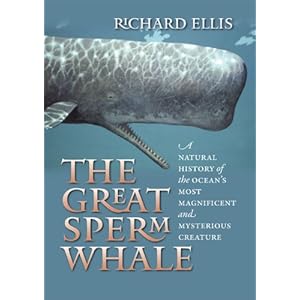
Book Review: The Great Sperm Whale
The Great Sperm Whale: A Natural History of the Ocean's Most Magnificent and Mysterious Creature
by Richard Ellis
U. of Kansas, 2011
Herman Melville said of the sperm whale, "Of all the great whales, his is an unwritten life." Not anymore.
I'm a longtime fan of Ellis' writing, so it was no surprise I loved this entry in his works on marine life. I'd read a great deal on this animal, including Ellis' own earlier books, but I had no idea just how bizarre Physeter macrocephalus really is. It has countless features (like the single forward spout) that don't appear in other whales, and a nose/spermaceti organ so remarkably weird it belongs on a creature from another planet. It wasn't until the last decade that scientists gave credence to the startling fact that sperm whales hunt squid in darkness by finding and then stunning them with sound. The sperm's evolution is very well traced, showing many transitional forms (including the fearsome Livyatan melvillei), but there is still a lot we don't know about how this animal came to be so unique.
As always with an Ellis book, this one is a mini-reference library, with a bibliography running 23 pages. Also as always, Ellis' own drawings and paintings bring the whale to life in a way the photographic record (which was sparse until remarkably recently) can't quite capture. (Ellis' postscript on how one paints a whale mural is a fascinating bit of "bonus footage" that comes with the book.)
Everyone is curious about how big the whale gets. Ellis rejects the idea that bull sperms were historically larger than the 62-foot modern record, but he admits that a pair of 11-inch teeth in a museum (8 inches is big) make one wonder just what the all-time record was. Ellis does not mention one oddity, the old reports of aberrant sperm whales with true dorsal fins - these may be in error, but I would have liked Ellis' analysis.
I gave this 4.5 stars on Amazon rather than 5 on a couple of minor flaws - the occcasional wrong word has slipped through editing, and there is some repetition. Another odd slip is that Ellis gives Charles Townsend's estimate of the casualties of New England Yankee whaling on page 238, but doesn't point out it's drastically wrong until page 291.
The sperm whale really is, as Ellis says, "The ocean's most magnificent and mysterious creature." Pick up this remarkable book and meet the monarch of the seas.
[...]
by Richard Ellis
U. of Kansas, 2011
Herman Melville said of the sperm whale, "Of all the great whales, his is an unwritten life." Not anymore.
I'm a longtime fan of Ellis' writing, so it was no surprise I loved this entry in his works on marine life. I'd read a great deal on this animal, including Ellis' own earlier books, but I had no idea just how bizarre Physeter macrocephalus really is. It has countless features (like the single forward spout) that don't appear in other whales, and a nose/spermaceti organ so remarkably weird it belongs on a creature from another planet. It wasn't until the last decade that scientists gave credence to the startling fact that sperm whales hunt squid in darkness by finding and then stunning them with sound. The sperm's evolution is very well traced, showing many transitional forms (including the fearsome Livyatan melvillei), but there is still a lot we don't know about how this animal came to be so unique.
As always with an Ellis book, this one is a mini-reference library, with a bibliography running 23 pages. Also as always, Ellis' own drawings and paintings bring the whale to life in a way the photographic record (which was sparse until remarkably recently) can't quite capture. (Ellis' postscript on how one paints a whale mural is a fascinating bit of "bonus footage" that comes with the book.)
Everyone is curious about how big the whale gets. Ellis rejects the idea that bull sperms were historically larger than the 62-foot modern record, but he admits that a pair of 11-inch teeth in a museum (8 inches is big) make one wonder just what the all-time record was. Ellis does not mention one oddity, the old reports of aberrant sperm whales with true dorsal fins - these may be in error, but I would have liked Ellis' analysis.
I gave this 4.5 stars on Amazon rather than 5 on a couple of minor flaws - the occcasional wrong word has slipped through editing, and there is some repetition. Another odd slip is that Ellis gives Charles Townsend's estimate of the casualties of New England Yankee whaling on page 238, but doesn't point out it's drastically wrong until page 291.
The sperm whale really is, as Ellis says, "The ocean's most magnificent and mysterious creature." Pick up this remarkable book and meet the monarch of the seas.
[...]
Thursday, July 19, 2012
Madagascar's lemurs - it's no DreamWorks film
As silly as the Madagascar films from DreamWorks are, they've made people more aware of Madagascar the real place. As Russell Mittermeir shows in this item, though, the island's many rare species of lemurs are becoming rarer as the environment degrades on what can only be called a fast track to hell. The northern sportive lemur population is 18. That's it. 18 in the world. So enjoy the film, but support conservation.
AeroAstro: Farewell to a Pioneer
Smallsat company closed down
Every revolution has its heralds, and Rick Fleeter was one of the key people behind the the microsatellite revolution - doing space missions with far smaller satellites in innovative ways. Fleeter's impact was lasting, but his pioneering company is taking its last breath. AeroAstro, which he founded in 1988, was acquired by Comtech. As of the last Conference on Small Satellites, Comtech AeroAstro was still an enthusiastic presence, even though Fleeter had sold all his interest long ago. But the company only had one funded satellite contract and the US Navy just unfunded it, so Comtech is shutting AeroAstro down. The revolution (though battered, bruised, reformulated, and dismissed many times) lives on, but those of us who see the value in it are sorry to see AeroAstro vanish from the ranks.
Every revolution has its heralds, and Rick Fleeter was one of the key people behind the the microsatellite revolution - doing space missions with far smaller satellites in innovative ways. Fleeter's impact was lasting, but his pioneering company is taking its last breath. AeroAstro, which he founded in 1988, was acquired by Comtech. As of the last Conference on Small Satellites, Comtech AeroAstro was still an enthusiastic presence, even though Fleeter had sold all his interest long ago. But the company only had one funded satellite contract and the US Navy just unfunded it, so Comtech is shutting AeroAstro down. The revolution (though battered, bruised, reformulated, and dismissed many times) lives on, but those of us who see the value in it are sorry to see AeroAstro vanish from the ranks.
Almost to Mars....
Rover approaches Red Planet
Less than three weeks from Mars, the rover Curiosity is attracting a big audience of the curious. Some are nervous about the "Skycrane" technology intended to lower the one-ton rover to the surface. Thanks to the gravity differentce, it wasn't even possible to completely test the system on Earth. If this doesn't work, a huge chunk of planetary probe budget will have been spent on nothing. No pressure....
Less than three weeks from Mars, the rover Curiosity is attracting a big audience of the curious. Some are nervous about the "Skycrane" technology intended to lower the one-ton rover to the surface. Thanks to the gravity differentce, it wasn't even possible to completely test the system on Earth. If this doesn't work, a huge chunk of planetary probe budget will have been spent on nothing. No pressure....
Why does the universe exist?
A review of a book that is definitely on my must-read list:
http://artsbeat.blogs.nytimes.com/2012/07/18/no-small-talk-jim-holt-on-why-the-world-exists/
We've all wondered. Someone in the comments said a brain formed of the "something" will never be able to explain why "something" exists. Maybe it's a problem we ought to set aside so we can deal with concrete realities? Naw, that would be no fun. Humans HAVE to wonder about this question: whether we approach it from science, secular philosophy, or religious philosophy, it is worth pondering because asking the question is what marks us as sentient beings. We can't lay it aside.
http://artsbeat.blogs.nytimes.com/2012/07/18/no-small-talk-jim-holt-on-why-the-world-exists/
We've all wondered. Someone in the comments said a brain formed of the "something" will never be able to explain why "something" exists. Maybe it's a problem we ought to set aside so we can deal with concrete realities? Naw, that would be no fun. Humans HAVE to wonder about this question: whether we approach it from science, secular philosophy, or religious philosophy, it is worth pondering because asking the question is what marks us as sentient beings. We can't lay it aside.
Saturday, July 14, 2012
A nasty new sea snake and other species
Sea Snake part of this collection of news
News of new species is collected on this page in a simple, accessible format. The star this week is Hydrophis donaldi, a sea snake which is not only venomous but has spines on its scales. It's a unique creature, and herpetologists still have a lot to learn about it.
News of new species is collected on this page in a simple, accessible format. The star this week is Hydrophis donaldi, a sea snake which is not only venomous but has spines on its scales. It's a unique creature, and herpetologists still have a lot to learn about it.
Friday, July 13, 2012
Lemurs on the brink
Primates in trouble from habitat loss
Lemurs are fascinating, a clutch of primates that exists in only one place - Madagascar - and includes species the size of mice up to an (extinct, or almost certainly extinct) type the size of a black bear. Additionally, we keep discovering new species, nearly every year.
The lemurs, though, are not doing well as a group. Their habitats are shrinking, to the degree that experts say 90 of the known 103 species belong on the Red List of threatened species. Poaching is widespread: national park boundaries are being ignored by loggers.
This belongs on any list of the world's top conservation priorities. Lemurs, due to an island home, can't flee destruction as some other animals can. If we lose them in Madagascar, we lose them forever.
Lemurs are fascinating, a clutch of primates that exists in only one place - Madagascar - and includes species the size of mice up to an (extinct, or almost certainly extinct) type the size of a black bear. Additionally, we keep discovering new species, nearly every year.
The lemurs, though, are not doing well as a group. Their habitats are shrinking, to the degree that experts say 90 of the known 103 species belong on the Red List of threatened species. Poaching is widespread: national park boundaries are being ignored by loggers.
This belongs on any list of the world's top conservation priorities. Lemurs, due to an island home, can't flee destruction as some other animals can. If we lose them in Madagascar, we lose them forever.
Wednesday, July 11, 2012
Arsenic and old life? No.
Science - science done right - allows for rebuttals, challenges, and overturning previous conclusions. Last year, NASA made a big deal out of the report that a microorganism had turned up which still reproduced even if highly toxic arsenic were substituted for phosphorous in its makeup.
Never mind.
Two new papers have been published that contradict the previous findings. One says the original team's samples were contaminated, screwing up results, the other saying the creatures don;t die with arsenic "installation," but they don't reproduce, either.
Despite all this, Dr. Felisa Wolfe-Simon of NASA’s Astrobiology Institute is sticking to her guns. She's convinced that further study will show the original finding was right.
Good science can be messy. This is a good example.
Never mind.
Two new papers have been published that contradict the previous findings. One says the original team's samples were contaminated, screwing up results, the other saying the creatures don;t die with arsenic "installation," but they don't reproduce, either.
Despite all this, Dr. Felisa Wolfe-Simon of NASA’s Astrobiology Institute is sticking to her guns. She's convinced that further study will show the original finding was right.
Good science can be messy. This is a good example.
New way to see nature: portraits of icebergs
I've never thought of icebergs as subjecta for a painting. But artist Camille Seaman has. “They are like humans in that each one reacts to its environment and its circumstances in its own way," she says. And these are stunning, absolutely stunning, visions of the great nature-made ships that roam the oceans. Anythign that helps us get a new slant on nature is a good thing,
Tuesday, July 10, 2012
Mystery solved, mystery created - Auroras do make sounds
Sound and light show
The claim that sounds accompanied the aurora borealis was long dismissed as folklore. But now we know. Microphones set up in an area of frequent auroral activity recorded a variety of "clapping" sounds along with pops and bangs and "sputtering."
How are sounds produced by the energetic particles creating the Northern Lights? Ah, that's the NEW mystery.
The claim that sounds accompanied the aurora borealis was long dismissed as folklore. But now we know. Microphones set up in an area of frequent auroral activity recorded a variety of "clapping" sounds along with pops and bangs and "sputtering."
How are sounds produced by the energetic particles creating the Northern Lights? Ah, that's the NEW mystery.
New species named for Bob Marley
Latest Carribean crustacean
Bring on the fresh crab - with reggae music. OK, not a crab, but a crustacean, albeit a tiny parasitic one. Its namesake: Reggae legend Bob Marley. Scientific name: Gnathia marleyi.
Scientists have to get creative in name species: we now have way more species than we have Greek or Latin words to apply to. So we have:
- A lichen named for President Obama
- A frog named for Prince Charles (frog, prince, get it?)
- Not one but two insects named for Steve Colbert
- A trilobite (ancient, get it?) named for Mick Jagger
- and a fly named for Beyonce.
If we ever find the Loch Ness monster, maybe we'll name it for longtime monster hunter Tim Dinsdale - or maybe for Vladimir Lenin (a dinosaur, get it?)
Bring on the fresh crab - with reggae music. OK, not a crab, but a crustacean, albeit a tiny parasitic one. Its namesake: Reggae legend Bob Marley. Scientific name: Gnathia marleyi.
Scientists have to get creative in name species: we now have way more species than we have Greek or Latin words to apply to. So we have:
- A lichen named for President Obama
- A frog named for Prince Charles (frog, prince, get it?)
- Not one but two insects named for Steve Colbert
- A trilobite (ancient, get it?) named for Mick Jagger
- and a fly named for Beyonce.
If we ever find the Loch Ness monster, maybe we'll name it for longtime monster hunter Tim Dinsdale - or maybe for Vladimir Lenin (a dinosaur, get it?)
Wednesday, July 04, 2012
Darren Naish takes on ReptileEvolution.com
Popular site is not good science
We all love dinosaurs. A site called ReptileEvolution.com has become the Web's top destination for dino info, but Dr. Darren Naish argues this is a very scary thing. The site features spectacular illustrations of creatures which, according to Naish, fly in the face of everything that virtually every paleontologist in the world believes. (Even to my amateur's eye, they are ridiculously impractical, festooned with ribbons and feathery growths that could only get in the way.) The site's author, a fellow named Peters who had a great career as an illustrator of (realistic) extinct creatures, relies on a photographic analysis technique (he does not examine actual fossils) by which he sees all kinds of soft tissue features no one else can discern.
So you have been warned. Because someone publishes material they have put a great deal of sincere effort into does not mean they are right, or even in the ballpark.
Here's a look at some of Peters' creatures. Can't swallow this....
http://www.reptileevolution.com/fenestrasauria.htm
And don't get me started on the vampire pterosaur
http://www.reptileevolution.com/jeholopterus.htm
Again, Naish is the expert here, but even to an amateur this looks bizarre.
To be complete, though, Peters is standing his ground in this blog.
http://pterosaurheresies.wordpress.com/
We all love dinosaurs. A site called ReptileEvolution.com has become the Web's top destination for dino info, but Dr. Darren Naish argues this is a very scary thing. The site features spectacular illustrations of creatures which, according to Naish, fly in the face of everything that virtually every paleontologist in the world believes. (Even to my amateur's eye, they are ridiculously impractical, festooned with ribbons and feathery growths that could only get in the way.) The site's author, a fellow named Peters who had a great career as an illustrator of (realistic) extinct creatures, relies on a photographic analysis technique (he does not examine actual fossils) by which he sees all kinds of soft tissue features no one else can discern.
So you have been warned. Because someone publishes material they have put a great deal of sincere effort into does not mean they are right, or even in the ballpark.
Here's a look at some of Peters' creatures. Can't swallow this....
http://www.reptileevolution.com/fenestrasauria.htm
And don't get me started on the vampire pterosaur
http://www.reptileevolution.com/jeholopterus.htm
Again, Naish is the expert here, but even to an amateur this looks bizarre.
To be complete, though, Peters is standing his ground in this blog.
http://pterosaurheresies.wordpress.com/
Tuesday, July 03, 2012
Government feels need to deny mermaids exist
Fallout from bad TV show
Well, I'm glad the government has no pressing business, like war and health care, and can focus on whether an Animal Planet TV show with bad CGI mermaids was real.
Mermaid beliefs go back a long way, with Columbus among other witnesses (although the Admiral of the Ocean Seas was quick to comment that they were not as comely as legend made them, which is accurate to a degree when you're looking at Carribean monk seals). Occasional seemingly sincere reports of something of this type have been laid to misinterpretations of marine mammals. The classic mermaid form makes no zoological sense, and most of those who delve into cryptozoology don't even think about them. (A few cryptozoologists suggest a primate adapted to an aquatic lifestyle, which might not be completely impossible but has no evidence behind it.) A spate of mermaid-like reports from New Guinea, concerning a creature locally called ri, was very properly investigated by cryptozoologists and identified as a population of dugongs. So mermaids will continue to populate the seas of legends, which is where they belong.
Well, I'm glad the government has no pressing business, like war and health care, and can focus on whether an Animal Planet TV show with bad CGI mermaids was real.
Mermaid beliefs go back a long way, with Columbus among other witnesses (although the Admiral of the Ocean Seas was quick to comment that they were not as comely as legend made them, which is accurate to a degree when you're looking at Carribean monk seals). Occasional seemingly sincere reports of something of this type have been laid to misinterpretations of marine mammals. The classic mermaid form makes no zoological sense, and most of those who delve into cryptozoology don't even think about them. (A few cryptozoologists suggest a primate adapted to an aquatic lifestyle, which might not be completely impossible but has no evidence behind it.) A spate of mermaid-like reports from New Guinea, concerning a creature locally called ri, was very properly investigated by cryptozoologists and identified as a population of dugongs. So mermaids will continue to populate the seas of legends, which is where they belong.
Monday, July 02, 2012
The God particle?
Welcome to the universe, Higgs boson
It's important for physics, but the Washington Post ran its dumbest headline of the year (that's an impression, I've not done a search) in saying the finding of the Higgs Boson "explains the universe." No. What this finding from CERN (which is described as the "footprint and shadow" of the boson rather than direct evidence) does is provide important evidence toward validation of the Standard Model of physics, which describes the building blocks of the universe. The Higgs is, in essence, the reason other particles have mass. Description is not quite the same as explanation. It is, however, a huge discovery. It's like knowing a city was made of concrete and brick: you can predict what kind of buildings can be created there, how long they'll last, and much else. Physicists now have a much more complete "toolbox" to apply to their problems. If I'm reaching for metaphors here, it's because this really is a big deal. Next year's Nobel Prize for Physics can probably be engraved now.
Sunday, July 01, 2012
More on Iliamna and sharks (wait, not really)
Shark in sort of general area proves what?
A while ago, someone suggested a Pacific sleeper shark (a slow-moving but pretty awesome species, which may get to be 8 m long) as a candidate for the Lake Iliamna monster, more often presumed to be a tall tale or (as I think) a white sturgeon. In King Cove Lagoon, a brackish sea-connected lake hundreds of kilometers away, a sleeper shark having some trouble with hte shallow waters was videotaped. It's an interesting story, but claims it validates this fish's presence in Iliamna don't seem valid to me.
Original article
By the way - thanks to Thomas Cook for sending me some information on Lake Iliamna I had not seen before, including his own correspondence with scientists and officials.
A while ago, someone suggested a Pacific sleeper shark (a slow-moving but pretty awesome species, which may get to be 8 m long) as a candidate for the Lake Iliamna monster, more often presumed to be a tall tale or (as I think) a white sturgeon. In King Cove Lagoon, a brackish sea-connected lake hundreds of kilometers away, a sleeper shark having some trouble with hte shallow waters was videotaped. It's an interesting story, but claims it validates this fish's presence in Iliamna don't seem valid to me.
Original article
By the way - thanks to Thomas Cook for sending me some information on Lake Iliamna I had not seen before, including his own correspondence with scientists and officials.
Pumas roam Kentucky?
Cougar on the Dark and Bloody Ground
I've always thought it likely the Eastern puma has, just barely, escaped its official extinction. Two sightings in the Ashland, Kentucky area have put authorities on alert.
As Doubtful News' Sharon Hill notes correctly, it's common to have puma/cougar/mountain lion sightings that turn out to be caused by smaller cats or by dogs seen under difficult conditions. And I'm not one of those cryptozoologists who insists "where there's lots of smoke, there must be some fire." But I think that's the case concerning this cat. There have been some very good sightings in KY, TN, and elsewhere, and the protection of habitat and explosion in the deer population bode well for puma survival. I don't know about the Ashland cat, but I don't automatically write off such encounters.
I've always thought it likely the Eastern puma has, just barely, escaped its official extinction. Two sightings in the Ashland, Kentucky area have put authorities on alert.
As Doubtful News' Sharon Hill notes correctly, it's common to have puma/cougar/mountain lion sightings that turn out to be caused by smaller cats or by dogs seen under difficult conditions. And I'm not one of those cryptozoologists who insists "where there's lots of smoke, there must be some fire." But I think that's the case concerning this cat. There have been some very good sightings in KY, TN, and elsewhere, and the protection of habitat and explosion in the deer population bode well for puma survival. I don't know about the Ashland cat, but I don't automatically write off such encounters.
Wednesday, June 27, 2012
Hot-blooded dinosaur fight, Round 217
Who you callin' cold-blooded?
Nothing, not even the status of Flores people, has consumed science the way three-plus decades of debate over whether dinosaurs were endothermic (warm-blooded) or ectothermic (cold-blooded) has. Evenr since Desmond and Bakker wrote the key popular books (The Hot-Blooded Dinosaurs and The Dinosaur Heresies, respectively), scientists have loosed volleys of facts and opinions at one another. There is general agreement that dinops were more mobile and active than we once thought, but is endothermy required for an active lifestyle in a big animal? The latest argument comes from a new direction, arguing that growth rings in the bones of dinosaurs look more like what we see in mammals (which grow more steadily than the start-and-stop development common in reptiles) and that, with the single exception of sauropods (so huge that normal rules might not apply to them in a sense: they may have been effectively warmed just by the movements of thse tons of muscles), dinosaurs show a common pattern consistent with behind warmblooded.
COMMENT: I've always liked the warm-blooded idea: these huge animals drifting through plain and swamp like ground-dwelling blimps never made much sense to me. Having read dinosaur books since the first grade, I naturally have formed some layman's opinions. Most of the dinos were warm-blooded, and by the way T. rex was an active predator, not some ridiculously over-armed scavenger!
Nothing, not even the status of Flores people, has consumed science the way three-plus decades of debate over whether dinosaurs were endothermic (warm-blooded) or ectothermic (cold-blooded) has. Evenr since Desmond and Bakker wrote the key popular books (The Hot-Blooded Dinosaurs and The Dinosaur Heresies, respectively), scientists have loosed volleys of facts and opinions at one another. There is general agreement that dinops were more mobile and active than we once thought, but is endothermy required for an active lifestyle in a big animal? The latest argument comes from a new direction, arguing that growth rings in the bones of dinosaurs look more like what we see in mammals (which grow more steadily than the start-and-stop development common in reptiles) and that, with the single exception of sauropods (so huge that normal rules might not apply to them in a sense: they may have been effectively warmed just by the movements of thse tons of muscles), dinosaurs show a common pattern consistent with behind warmblooded.
COMMENT: I've always liked the warm-blooded idea: these huge animals drifting through plain and swamp like ground-dwelling blimps never made much sense to me. Having read dinosaur books since the first grade, I naturally have formed some layman's opinions. Most of the dinos were warm-blooded, and by the way T. rex was an active predator, not some ridiculously over-armed scavenger!
Monday, June 25, 2012
Farewell, Lonesome George
The Pinta Island tortoise is extinct
George endured many lonely decades as, most herpetologists thought, the last of his kind. He held that unenviable position for 40 years (he was somewhere over 100 when he died).
George endured many lonely decades as, most herpetologists thought, the last of his kind. He held that unenviable position for 40 years (he was somewhere over 100 when he died).
Aliens and faith
Would ET affect our religion?
Humans are, overwhelmingly, religious (or at least spiritual) folks. I've read a fundamentalist magazine arguing that ET is not out there, because God would have told us through the Bible, or at least the Bible would not have implied that the universe was made for humanity alone.
I never saw that. The Bible didn't tell us a lot of things, even if you accept it as divinely inspired. If there are intelligent beings, great: we can have a fascinating discussion about spirituality (or lack thereof.)
Apparently there was a very interesting panel discussion on this at SETICon 2. Astronomer Seth Shostak noted, "We haven't been the center of the universe for a while now."
I like what a Baptist theologian (not on the panel) was quoted as saying: "If a couple has one child, and then they decide to have a second child. Is that second child any less special?" In other words, finding other intelligent species doesn't lessen us in a theological sense.
Maybe we can trade missionaries.
Humans are, overwhelmingly, religious (or at least spiritual) folks. I've read a fundamentalist magazine arguing that ET is not out there, because God would have told us through the Bible, or at least the Bible would not have implied that the universe was made for humanity alone.
I never saw that. The Bible didn't tell us a lot of things, even if you accept it as divinely inspired. If there are intelligent beings, great: we can have a fascinating discussion about spirituality (or lack thereof.)
Apparently there was a very interesting panel discussion on this at SETICon 2. Astronomer Seth Shostak noted, "We haven't been the center of the universe for a while now."
I like what a Baptist theologian (not on the panel) was quoted as saying: "If a couple has one child, and then they decide to have a second child. Is that second child any less special?" In other words, finding other intelligent species doesn't lessen us in a theological sense.
Maybe we can trade missionaries.
Cool - and weird - fish fossil
An intermediate form of flounder?
Flounders and other flatfish are bizarre enough: one eye migrates to the other side of the head. What's weirder is that no one knew how this started - there were no forms in the fossil record with one eye partially migrated. It's hard to swallow the such a mutation could have arisen in a single leap. Well, not we have an apparent intermediate form, found, as so many important fossils are, in a forgotten museum drawer. "The left eye of this single specimen, a 50-million-year-old fish called Heteronectes, has migrated toward the top of the skull, but not all the way over."
How weird is that? Still unclear - how useful an eye in that position would be.
Flounders and other flatfish are bizarre enough: one eye migrates to the other side of the head. What's weirder is that no one knew how this started - there were no forms in the fossil record with one eye partially migrated. It's hard to swallow the such a mutation could have arisen in a single leap. Well, not we have an apparent intermediate form, found, as so many important fossils are, in a forgotten museum drawer. "The left eye of this single specimen, a 50-million-year-old fish called Heteronectes, has migrated toward the top of the skull, but not all the way over."
How weird is that? Still unclear - how useful an eye in that position would be.
Saturday, June 23, 2012
Bigfoot and "Wild Man" myths
Ben Radford talks folklore and human belief
Ben Radford of SI is quoted and linked to in this article about the global "wild man" belief, a thread of our consciousness that's expressed in our desire to belive sasquatch and yeti and other creatures, perhaps early versions of ourselves, are still eluding civilization and living a freer existence. Everything said here is true, and it's important to remember. It's also true, though, that whether we are disposed to believe has little impact on the evidence - only how we interpret the evidence. If there were a very strong Wild Man myth or none at all, it makes no difference concerning whether the Big Guy is stomping the Pacific Northwest or not.
Ben Radford of SI is quoted and linked to in this article about the global "wild man" belief, a thread of our consciousness that's expressed in our desire to belive sasquatch and yeti and other creatures, perhaps early versions of ourselves, are still eluding civilization and living a freer existence. Everything said here is true, and it's important to remember. It's also true, though, that whether we are disposed to believe has little impact on the evidence - only how we interpret the evidence. If there were a very strong Wild Man myth or none at all, it makes no difference concerning whether the Big Guy is stomping the Pacific Northwest or not.
Hey swimmers, we found some more sharks!
Sharks more diverse than thought
A team of scientists have found there are many more species among sharks than we knew of. That on the one hand gives us more and better information to use in studying them. One the other hand, it meas some that we thought were doing ok are actually less numerous. After taking DNA from 4,283 specimens of sharks and rays, researchers found 574 species, vs the 495 they thought were represented by that sample and that 495 was only a chunk of the 1,400 or so thought to exist worldwide. (1,400 is a considerably higher number than we are used to reading, but there have been a lot of small types discovered and some significant species-splitting already in recent years.) An interesting note in this article is sounded by another scientists who thinks this team may be off using genetics alone to map the shark family tree. (As I have observed before, there is not universal agreement, or even a majority agreement, about precisely defining species based on differences in DNA.)
Meanwhile the sharks aer just going about their business, as they have for 400 million years.
A team of scientists have found there are many more species among sharks than we knew of. That on the one hand gives us more and better information to use in studying them. One the other hand, it meas some that we thought were doing ok are actually less numerous. After taking DNA from 4,283 specimens of sharks and rays, researchers found 574 species, vs the 495 they thought were represented by that sample and that 495 was only a chunk of the 1,400 or so thought to exist worldwide. (1,400 is a considerably higher number than we are used to reading, but there have been a lot of small types discovered and some significant species-splitting already in recent years.) An interesting note in this article is sounded by another scientists who thinks this team may be off using genetics alone to map the shark family tree. (As I have observed before, there is not universal agreement, or even a majority agreement, about precisely defining species based on differences in DNA.)
Meanwhile the sharks aer just going about their business, as they have for 400 million years.
Thursday, June 21, 2012
Book Review: Area 51
Area 51: An Uncensored History of America's Top Secret Military Base by Annie Jacobsen (2012)
As an aviation/space buff, I wanted to like this. As someone who has written aerospace history, I could only be dismayed by the way a ton of research was undone with careless misreporting (constantly referring to a Horten "flying disk" when it was a flying wing), exaggeration (no nuclear "Mars-bound" rocket was ever overheated, because nothing close to a space-going nuclear rocket, as opposed to a ground-bound reactor demo, was ever built), and the sheer incredulity of seeing a previously respected journalist discuss the a "Soviet/Mengele" Roswell crash theory as if it might be true. The section on atomic testing has been disputed, but I'm not an expert there, so I won't comment on it. (And is "escorted by destroyer battleships" a typo? One hopes so.
The author does better on the airplanes, with some interesting stories of Oxcart and the SR-71. Oddly, there is no mention of the reports from the past few years the might indicate really unusual test aircraft/UAVs.
I appreciated the thick bibliography and the many sources provided, but I couldn't get past the UFO stuff: if an author would report that as even possible fact, how does the reader know whether to trust anything else in the book?
The idea that Mengele created some kind of child-mutation for Stalin is absurdity layered on falsehood. Mengele never could have produced such prodigies because Mengele had no idea how to do science and there were no results from his barbaric wartime experimentation. The evidence of contact between Megele and high-level Soviets is zero. The chances Stalin had a flying disc with a totally unknown propulsion system, far beyond 2012 technology let alone 1947, is zero. The chances Stalin would have risked a superweapon that could have dropped a nuke on Washington on a demonstration of fake alien contact, where a malfunction would mean the US captured the craft and learned all its secrets, was zero. The chances the discredited Bob Lazar knew anything about real alien contact is zero. (I detect a trend here.) The Russians made a saucer to fake an alien spacecraft, sent it to the US, and left Russian writing on it in plain view? What happened to the author's instincts and practices as a journalist when presented with this tale?
It's one thing to relate that someone who claims he once worked in the area told her this story. It's another to refer to it throughout the book as a possibility, when it just isn't. Did she ask independent aerospace engineers and biomedical researchers to comment on the plausibility of the story? If not, why not? This book would have value if she'd left this story out or treated it as the fantasy it is: implying there is something to it ruined the rest of the book for me.
Matt Bille, lead author, The First Space Race (Texas A&M, 2004)
http://www.mattwriter.com/
(NOTE: As holder of a current DoD security clearance, I should add that I speak only from open sources: I've never seen classified material on these particular topics.)
As an aviation/space buff, I wanted to like this. As someone who has written aerospace history, I could only be dismayed by the way a ton of research was undone with careless misreporting (constantly referring to a Horten "flying disk" when it was a flying wing), exaggeration (no nuclear "Mars-bound" rocket was ever overheated, because nothing close to a space-going nuclear rocket, as opposed to a ground-bound reactor demo, was ever built), and the sheer incredulity of seeing a previously respected journalist discuss the a "Soviet/Mengele" Roswell crash theory as if it might be true. The section on atomic testing has been disputed, but I'm not an expert there, so I won't comment on it. (And is "escorted by destroyer battleships" a typo? One hopes so.
The author does better on the airplanes, with some interesting stories of Oxcart and the SR-71. Oddly, there is no mention of the reports from the past few years the might indicate really unusual test aircraft/UAVs.
I appreciated the thick bibliography and the many sources provided, but I couldn't get past the UFO stuff: if an author would report that as even possible fact, how does the reader know whether to trust anything else in the book?
The idea that Mengele created some kind of child-mutation for Stalin is absurdity layered on falsehood. Mengele never could have produced such prodigies because Mengele had no idea how to do science and there were no results from his barbaric wartime experimentation. The evidence of contact between Megele and high-level Soviets is zero. The chances Stalin had a flying disc with a totally unknown propulsion system, far beyond 2012 technology let alone 1947, is zero. The chances Stalin would have risked a superweapon that could have dropped a nuke on Washington on a demonstration of fake alien contact, where a malfunction would mean the US captured the craft and learned all its secrets, was zero. The chances the discredited Bob Lazar knew anything about real alien contact is zero. (I detect a trend here.) The Russians made a saucer to fake an alien spacecraft, sent it to the US, and left Russian writing on it in plain view? What happened to the author's instincts and practices as a journalist when presented with this tale?
It's one thing to relate that someone who claims he once worked in the area told her this story. It's another to refer to it throughout the book as a possibility, when it just isn't. Did she ask independent aerospace engineers and biomedical researchers to comment on the plausibility of the story? If not, why not? This book would have value if she'd left this story out or treated it as the fantasy it is: implying there is something to it ruined the rest of the book for me.
Matt Bille, lead author, The First Space Race (Texas A&M, 2004)
http://www.mattwriter.com/
(NOTE: As holder of a current DoD security clearance, I should add that I speak only from open sources: I've never seen classified material on these particular topics.)
Do you feel being shot in the head?
OK, thriller writers, this is for you. It's is a bizarre topic, but someone thought it worth research, and it points up that there's a lot we don't know about pain, consciousness, and neurological damage. There's sort of a consensus that a bullet to the head in a location causing quick death won't be felt, but about half of people shot in the head survive (obviously Gabby Giffords is a notable recent example) and some feel pain and some don't. The writer reports: "There is one rare effect, called the Krönlein shot, where a high powered shot messily opens the skull but neatly ejects the whole brain on the ground. " I felt no urge to find pictures. The good side of all this is how many people, like Congresswoman Giffords, survive wounds that would have been treated only with a shot of morphine a couple of decades back. The bad news is that we humans are still finding reasons - or, often, nonreasons - to make this field of study a medical neccessity.
Neat graphic: Space ships compared
How humans have left Earth
This cool graphic shows the silhouettes, to scale, of the vessels humans have used to climb to space: spaceplanes (including three canceled ones), space stations (though Mir and Skylab are missing), and capsules. The ISS, as you'd expect, dominates the field on sheer size. One many readers may not recognize is Skylon, a British proposal to build a Single Stage to Orbit (SSTO) spaceplane. The designers think they have an engine design that overcomes the problem all previous designs have run into: that you can't carry enough fuel in any size ship to get the ship and cargo direct to orbit and back. Sadly, I don;t expect success here: their technology is immature, and I don't think their math will hold up when you get into the real world, where you constantly tweak the structure of a huge vessel for various stresses and needs until your margin is gone. But good luck, chaps!
This cool graphic shows the silhouettes, to scale, of the vessels humans have used to climb to space: spaceplanes (including three canceled ones), space stations (though Mir and Skylab are missing), and capsules. The ISS, as you'd expect, dominates the field on sheer size. One many readers may not recognize is Skylon, a British proposal to build a Single Stage to Orbit (SSTO) spaceplane. The designers think they have an engine design that overcomes the problem all previous designs have run into: that you can't carry enough fuel in any size ship to get the ship and cargo direct to orbit and back. Sadly, I don;t expect success here: their technology is immature, and I don't think their math will hold up when you get into the real world, where you constantly tweak the structure of a huge vessel for various stresses and needs until your margin is gone. But good luck, chaps!
Tuesday, June 19, 2012
HAARPing on HAARP
Big Alaskan Antenna Attracts Suspicious Minds
Since I'm on fringe science today, let's think about the fringe that claims HAARP - High Frequency Active Auroral Research Program - is a secret mind control/weather control device. In fact, it was built under Air Force contract to "advance our knowledge of the physical and electrical properties of the Earth's ionosphere which can affect our military and civilian communication and navigation systems."
Those who see a dark hand in every unusual government project are not so easily mollified. It's weather control, it's mind control, etc. But the fact is, nothing about the facility is even classified. Anyone can go look at it (although tours are limited by availability of staff, there are Open House events for the public to visit.)
So as to its being a superweapon: in a word, nope. As big and science fictiony-looking (I can't think of a properly grammatical term) as this thing may be, the power is orders of magnitude lower than what you would need to make major changes to the ionosphere. It's a handy way for the USAF to do something very important: understand how radio communications propagate through the ionosphere and how disturbances in that layer (which it can create on a local ,temporary scale) affect those communications. Think about it: if we had a weapon that could change weather, human brainwave patterns, etc at a distance, don't you think the US would be doing rather better in its wars and other affairs? Wouldn't we be DOING something with it?
While I'm in the neighborhood, I think the same logic applies to those who think the government has all kinds of superweapons based on the work of the electrical genius Tesla. If some of his really nasty ideas, like death rays, were practical, why are we still building fighter planes and artillery? Because the man was a genius doesn't mean all his ideas were good ones.
Since I'm on fringe science today, let's think about the fringe that claims HAARP - High Frequency Active Auroral Research Program - is a secret mind control/weather control device. In fact, it was built under Air Force contract to "advance our knowledge of the physical and electrical properties of the Earth's ionosphere which can affect our military and civilian communication and navigation systems."
Those who see a dark hand in every unusual government project are not so easily mollified. It's weather control, it's mind control, etc. But the fact is, nothing about the facility is even classified. Anyone can go look at it (although tours are limited by availability of staff, there are Open House events for the public to visit.)
So as to its being a superweapon: in a word, nope. As big and science fictiony-looking (I can't think of a properly grammatical term) as this thing may be, the power is orders of magnitude lower than what you would need to make major changes to the ionosphere. It's a handy way for the USAF to do something very important: understand how radio communications propagate through the ionosphere and how disturbances in that layer (which it can create on a local ,temporary scale) affect those communications. Think about it: if we had a weapon that could change weather, human brainwave patterns, etc at a distance, don't you think the US would be doing rather better in its wars and other affairs? Wouldn't we be DOING something with it?
While I'm in the neighborhood, I think the same logic applies to those who think the government has all kinds of superweapons based on the work of the electrical genius Tesla. If some of his really nasty ideas, like death rays, were practical, why are we still building fighter planes and artillery? Because the man was a genius doesn't mean all his ideas were good ones.
Aquatic Apes? Not Us
Dr. Darren Naish takes on the Aquatic Ape Theory
The AAT has been swimming around the edges of the anthropological pool for a few decades now. It got a little publicity boost with the Animal Planet show on mermaids last month. It has its die-hard adherents, but, as Naish, explains here, it's basically crud. Humans are terribly maladapted for water, and the few arguments made from physiology are wrong, misused, or coincidental; they don't make up any coherent pattern of features you'd find in a swimming, diving ape. (The argument, for example, for hairlessness as an aquatic adaptation must seem pretty silly to seals: hairlessness occurs only in the completely waterborne mammals, like whales, not in the semi-aquatic ones.) Anyway, I'll let Darren take this the rest of the way, but the AAT, while fun to think about, isn't valid science. It really never was.
The AAT has been swimming around the edges of the anthropological pool for a few decades now. It got a little publicity boost with the Animal Planet show on mermaids last month. It has its die-hard adherents, but, as Naish, explains here, it's basically crud. Humans are terribly maladapted for water, and the few arguments made from physiology are wrong, misused, or coincidental; they don't make up any coherent pattern of features you'd find in a swimming, diving ape. (The argument, for example, for hairlessness as an aquatic adaptation must seem pretty silly to seals: hairlessness occurs only in the completely waterborne mammals, like whales, not in the semi-aquatic ones.) Anyway, I'll let Darren take this the rest of the way, but the AAT, while fun to think about, isn't valid science. It really never was.
Sunday, June 17, 2012
Shuker and the black lion
Dr. Karl Shuker writes a great blog, ShukerNature. His biggest-ever "hit" with readers wasn't about new species or lake monsters. It was about photos on the internet about a coal-black lion. A lot of people seem to have seen the photo but missed the description. Someone uploaded to the Net a photoshopped version of a real lion photograph.
Alas, no one has a black lion, or photographic evidence of one. Nonetheless, there are eyewitness claims that such a dramatic color variant exists. It wouldn't be surprising if melanism occurred on rare occasions. It does in several cat species. A raging debate exists over whether a truly black puma has ever existed, although there are a few photos of dark-looking examples, and my dad saw a black-looking one in Maine in the 1950s.
The most extreme example of an off-colored cat may be the blue tigers once reported from China. A blue has never ended up in a zoo or on film, but the color does, on extremely rare occasions, occur in lynx.
So people should keep an eye out for the legendary black lion. You know how sneaky cats can be....
Alas, no one has a black lion, or photographic evidence of one. Nonetheless, there are eyewitness claims that such a dramatic color variant exists. It wouldn't be surprising if melanism occurred on rare occasions. It does in several cat species. A raging debate exists over whether a truly black puma has ever existed, although there are a few photos of dark-looking examples, and my dad saw a black-looking one in Maine in the 1950s.
The most extreme example of an off-colored cat may be the blue tigers once reported from China. A blue has never ended up in a zoo or on film, but the color does, on extremely rare occasions, occur in lynx.
So people should keep an eye out for the legendary black lion. You know how sneaky cats can be....
Thoughts on the ivory-billed woodpecker
It was the king of woodpeckers, a majestic bird. Recent word is that we lost it twice: that the American and Cuban versions may have been different species. The Cuban is, without doubt, extinct. The American is...well, almost certainly extinct. It's sad to think we managed to screw up repeatedly. The Cuban was rediscovered in the 1980s, but too late to preserve enough habitat. The American was videotaped in 2004 in Arkansas, a huge effort was made to find and save it, and ... nothing.(I think the taped sighting was valid: the experts are split, so the amateurs get to weigh in, too :) ) Sightings in TX, LA, and FL and intriguing, but nothing solid backs them up.
I met a woman once who had hiked with her father as a young girl in the early 50s in Louisiana. Her dad shushed her and pointed to a magnificent bird sitting on a stump "That's an ivory-billed woodpecker," he whispered. "Take a good look, because you'll never see one again." This is where we all are now: take a good luck at the few seconds of video from the ivorybill's rediscovery, because I don't think we'll see it again.
Friday, June 15, 2012
New species: strange and beautiful sponge
A new species from 950 meters down, this sponge's silicon strucure makes it reminiscent of abstract scuplture in glass... but even more beautiful.

Oldest cave paintings - are they Neanderthal?
Secrets of a Spanish cave
Spanish cave paintings thought to be 25,000 years old and the work of Cro-Magnon humans have been dated much further back by a new technique - to over 40,000 years. A sphere and several handprints in red pigment, found in the El Castillo Cave, are now considered the oldest cave paintings ever found. While authorship can't be proven, some scientists think modern humans weren't in the area at the time - leaving Neanderthals as the likely culprit. We know some Neanderthals painted their bodies, but never before has a cave painting been attributed to them.
So many mysteries about those who came before us....

Spanish cave paintings thought to be 25,000 years old and the work of Cro-Magnon humans have been dated much further back by a new technique - to over 40,000 years. A sphere and several handprints in red pigment, found in the El Castillo Cave, are now considered the oldest cave paintings ever found. While authorship can't be proven, some scientists think modern humans weren't in the area at the time - leaving Neanderthals as the likely culprit. We know some Neanderthals painted their bodies, but never before has a cave painting been attributed to them.
So many mysteries about those who came before us....
Thursday, June 14, 2012
Space historian Roger Launius blog
From the NASM
I have known Roger since he was at NASA. We have disagreed, but he's been an invaluable resource to me as I took my first steps into space history. I didn't realize until now that he had a blog, though. In this entry, he discusses a panel he's moderating: "a discussion on Capitol Hill, Rayburn 2325, on Friday, June 15, 2012, 10 a.m. EDT, about “Commercialization of Space Travel and Human Participation in Space Exploration." Near and dear to my heart - if I was in Washington, I'd head on over.
He also has an interesting entry here: review of a new book on a very important force in space exploration (at least it used to be), Soviet robotic probes.
I have known Roger since he was at NASA. We have disagreed, but he's been an invaluable resource to me as I took my first steps into space history. I didn't realize until now that he had a blog, though. In this entry, he discusses a panel he's moderating: "a discussion on Capitol Hill, Rayburn 2325, on Friday, June 15, 2012, 10 a.m. EDT, about “Commercialization of Space Travel and Human Participation in Space Exploration." Near and dear to my heart - if I was in Washington, I'd head on over.
He also has an interesting entry here: review of a new book on a very important force in space exploration (at least it used to be), Soviet robotic probes.
Tuesday, June 12, 2012
How many cryptids are believable?
I put this one on some FaceBook crypto forums. It'll be interesting to follow the comments:
Update: Wow, did I draw a crowd of responses when I put this on Facebook. Loren Coleman, Chad Arment, and other well-known cryptozoologists chimed in. We discussed the validity of reports, the question of how big things can be missed, and so on, but I don't think any of us has worked out the answer to the core question yet. See: http://www.facebook.com/groups/261237557287228/
Monday, June 11, 2012
Bake sale for NASA
Scientists have tried everything else....
NASA gets less than a half of one percent of the federal budget. That's not too much for exploring the universe... except that public perception is that the budget is far larger, and in fact it's been savaged by cancellations and cutbacks. That's the reasoning behind the Planetary Exploration Car Wash and Bake Sale to be held by University of Central Florida and other institutions. Alan Stern of the Southwest Research Institute puts it this way: "This is being done to attract media attention and to help focus Congress on repairing the damage of the deep cuts planned to NASA's planetary science program," said Alan Stern, the institute's associate vice president for research and development. "It's important these cuts be repaired to maintain U.S. leadership in this area of science, to prevent mission cuts, and to prevent student and research job losses."
COMMENT: I wish he hadn't mentioned jobs: NASA does provide a lot of jobs, but jobs have become the sole criteria in Congress for shaping the agency (as in, "More jobs to the Center in my district.") But the idea of giving even half a cent to the one agency focused on the long-term future and the place of humanity in the cosmos would seem to be a no-brainer. Sigh.....
NASA gets less than a half of one percent of the federal budget. That's not too much for exploring the universe... except that public perception is that the budget is far larger, and in fact it's been savaged by cancellations and cutbacks. That's the reasoning behind the Planetary Exploration Car Wash and Bake Sale to be held by University of Central Florida and other institutions. Alan Stern of the Southwest Research Institute puts it this way: "This is being done to attract media attention and to help focus Congress on repairing the damage of the deep cuts planned to NASA's planetary science program," said Alan Stern, the institute's associate vice president for research and development. "It's important these cuts be repaired to maintain U.S. leadership in this area of science, to prevent mission cuts, and to prevent student and research job losses."
COMMENT: I wish he hadn't mentioned jobs: NASA does provide a lot of jobs, but jobs have become the sole criteria in Congress for shaping the agency (as in, "More jobs to the Center in my district.") But the idea of giving even half a cent to the one agency focused on the long-term future and the place of humanity in the cosmos would seem to be a no-brainer. Sigh.....
Sunday, June 10, 2012
Love those new species...
20 years of RAP team success
Conservation International's Rapid Assessment Program (RAP) teams have traveled to hotspots around the world, making rapid inventories of species whose environment is under threat. Everywhere they go, new species descriptions follow - 1,300 so far. Here is a slideshow of 20 top hits - the tube-nosed bat, the walking shark, and other spectacular finds.
COMMENT: The CI biologists' work is often arduous and rarely safe: two people drowned on one South American trip to a remote river area. These scientists and their support personnel are the SWAT teams of conservation, the smoke jumpers, the EMTs. They are heroes.
Conservation International's Rapid Assessment Program (RAP) teams have traveled to hotspots around the world, making rapid inventories of species whose environment is under threat. Everywhere they go, new species descriptions follow - 1,300 so far. Here is a slideshow of 20 top hits - the tube-nosed bat, the walking shark, and other spectacular finds.
COMMENT: The CI biologists' work is often arduous and rarely safe: two people drowned on one South American trip to a remote river area. These scientists and their support personnel are the SWAT teams of conservation, the smoke jumpers, the EMTs. They are heroes.
Space "visoneering"
Elon Musk of SpaceX
Interesting profile of SpaceX's Elon Musk, heir to past "visioneers" who sought to move the human species up - and out - through technology. To Musk and those who think like him, the author writer, "the present is only a prototype." SpaceX has proven its Falcon 9 medium booster with two flights and its Dragon capsule with two - they still have a lot of work to do, but they have gotten further towards transport of cargo and humans in reusable spacecraft than any company ever has.
Interesting profile of SpaceX's Elon Musk, heir to past "visioneers" who sought to move the human species up - and out - through technology. To Musk and those who think like him, the author writer, "the present is only a prototype." SpaceX has proven its Falcon 9 medium booster with two flights and its Dragon capsule with two - they still have a lot of work to do, but they have gotten further towards transport of cargo and humans in reusable spacecraft than any company ever has.
Saturday, June 09, 2012
Nope, no faster than light neutrinos here
Discovery was an error
The same scientists who announced they had observed a beam of neutrinos traveling slightly faster than light have a new finding: Never Mind. The discovery was due to a faulty element in the fiber-optic timing system, but the thing to remember is that science worked the way it should. Results were published and debated, other labs tried to replicate them, and repeated experiments by the original lab pinned down the anomaly. Science triumphs.
The same scientists who announced they had observed a beam of neutrinos traveling slightly faster than light have a new finding: Never Mind. The discovery was due to a faulty element in the fiber-optic timing system, but the thing to remember is that science worked the way it should. Results were published and debated, other labs tried to replicate them, and repeated experiments by the original lab pinned down the anomaly. Science triumphs.
Friday, June 08, 2012
Aquaman's Nightmare
Undersea "bug" is pretty destructive
Bathynomus is a creature from a science fiction film, a crustacean bigger than your foot that looks like it was designed specifically to give humans nightmares. It turns out those super-sharp mandibles aren't just for food: they also satisfy whatever impulse it is that makes the creatures gnaw on rubber-coated power cables. Scientists have caught these critters severing their connections to undersea camera experiments. Why? Well, it could be something about the taste of rubber. Or it could be they don't like us discovering their secret plan to rule the oceans...
Bathynomus is a creature from a science fiction film, a crustacean bigger than your foot that looks like it was designed specifically to give humans nightmares. It turns out those super-sharp mandibles aren't just for food: they also satisfy whatever impulse it is that makes the creatures gnaw on rubber-coated power cables. Scientists have caught these critters severing their connections to undersea camera experiments. Why? Well, it could be something about the taste of rubber. Or it could be they don't like us discovering their secret plan to rule the oceans...
Thursday, June 07, 2012
More bird species in trouble
Grim forecast
How many bird species are in trouble? BirdLife International says no fewer than 1,331. Brazil alone has over 100, mainly because of deforestation. Contrarians sometimes point out that most of the area marked deforested is not turned to concrete, but replanted with a crop or a cultured tree species, but the disruption even in these cases is huge, and birds don't take well to that. Ask the ivory-billed woodpecker, if you can find one: there were plenty of forested habitats remaining, but it apparently couldn't adapt well from old growth to secondary growth, and I think we lost it for good.
How many bird species are in trouble? BirdLife International says no fewer than 1,331. Brazil alone has over 100, mainly because of deforestation. Contrarians sometimes point out that most of the area marked deforested is not turned to concrete, but replanted with a crop or a cultured tree species, but the disruption even in these cases is huge, and birds don't take well to that. Ask the ivory-billed woodpecker, if you can find one: there were plenty of forested habitats remaining, but it apparently couldn't adapt well from old growth to secondary growth, and I think we lost it for good.
Wednesday, June 06, 2012
The business of space
The risks and rewards
This is a really good article looking at the business side of space. The writer notes that a lot of the commercial effort so far hasn't attracted public notice, but the SpaceX Dragon success is changing that. The article goes on to explain that space is potentially a high-reward arena of business, but we know it's high-risk, especially when human flight is involved. The entrepreneurs are moving ahead nonetheless.
(I think there is a typo in this sentence: "SpaceX founder Elon Musk, for example, has said he envisions developing aircraft to take people to Mars." Aircraft, really?)
Thanks to Kris Winkler for this item.
This is a really good article looking at the business side of space. The writer notes that a lot of the commercial effort so far hasn't attracted public notice, but the SpaceX Dragon success is changing that. The article goes on to explain that space is potentially a high-reward arena of business, but we know it's high-risk, especially when human flight is involved. The entrepreneurs are moving ahead nonetheless.
(I think there is a typo in this sentence: "SpaceX founder Elon Musk, for example, has said he envisions developing aircraft to take people to Mars." Aircraft, really?)
Thanks to Kris Winkler for this item.
Ray Bradbury: Farewell to an Original
Writer, poet, and visionary Ray Bradbury has died at 91. From Fahrenheit 451 to Something Wicked This Way Comes to his TV and film work and his touching poetry of the Space Age, Bradbury helped us all to see farther, imagine more, and never be afraid of the future. His countless accolades included the World Fantasy Award for Lifetime Achievement, the O. Henry Memorial Award, and the Grand Master Award from the Science Fiction and Fantasy Writers of America. I have an autographed copy of his poetry collection, a special thing to me even though he did not sign it to me. Alas, I never met him: I had the chance at Utah State U. some years ago but felt duty-bound to go to the Small Satellite Conference awards dinner isntead. Bad call on my part.
Tuesday, June 05, 2012
Belief in creation goes up
Gallup finds religious views rise
Despite changes in culture and new discoveries in science, the idea God created humans in their present form has ticked upwards 2% since 1982 to include 46% of Americans. 32 percent think God directed evolution to produce us, and 15% say no deity was involved.
COMMENT: I do think there is a divine intelligence that influenced us to evolve into spiritual beings who believe in such things as beauty, altruism, and philosophy as well as having the need to seek a divinity. I've read strictly mechanistic biological explanations for these things but have not been convinced. (That includes reading Dawkins, a brilliant man who created his own definition of what God was and then argued God as defined by Dawkins was irrational.) I wonder if it's a universal condition that any beings evolving anywhere to a human level of intelligence would develop spiritual awareness. Someday we'll drop on on the inhabitants of another planet and see if that's true: generalization from one species is certainly an iffy proposition.
(Thought experiment. Assume you are Moses and God has given you the understanding that creation was a 14-billion-year process of evolution. Are you going to try to explain this literally to a low-educated population? No, you'll write an allegory.)
Despite changes in culture and new discoveries in science, the idea God created humans in their present form has ticked upwards 2% since 1982 to include 46% of Americans. 32 percent think God directed evolution to produce us, and 15% say no deity was involved.
COMMENT: I do think there is a divine intelligence that influenced us to evolve into spiritual beings who believe in such things as beauty, altruism, and philosophy as well as having the need to seek a divinity. I've read strictly mechanistic biological explanations for these things but have not been convinced. (That includes reading Dawkins, a brilliant man who created his own definition of what God was and then argued God as defined by Dawkins was irrational.) I wonder if it's a universal condition that any beings evolving anywhere to a human level of intelligence would develop spiritual awareness. Someday we'll drop on on the inhabitants of another planet and see if that's true: generalization from one species is certainly an iffy proposition.
(Thought experiment. Assume you are Moses and God has given you the understanding that creation was a 14-billion-year process of evolution. Are you going to try to explain this literally to a low-educated population? No, you'll write an allegory.)
Monday, June 04, 2012
National Museum of Flight
I spent an interesting morning (interesting enough to make me miss my flight home) at the National Museum of Flight at the Boeing site in Seattle. A Concorde, a fomer Air Force One, an Apollo Block 1 capsule (a modified one used to test the new unified hatch after the Apollo 1 fire) and an Explorer 1 satellite model with the black-and-white-striped color scheme, which I discussed with Dr. Ron Hobbs, a friendly volunteer ambassador who promised to read my book mentioning why it's wrong. I was extremely impressed: it's the best space collection I've seen outside the National Air and Space Symposium.
Museum site: http://www.museumofflight.org/giving?gclid=CJyv4M31tLACFQlN4AodFG-ZTQ
From top: Original Boeing plant: Fokker Eindeckker: Explorer 1 and Sputnik 1: Me in front of lifesize image showing the size of the R-7 booster that launched the first Soviet spacecraft.


Museum site: http://www.museumofflight.org/giving?gclid=CJyv4M31tLACFQlN4AodFG-ZTQ
From top: Original Boeing plant: Fokker Eindeckker: Explorer 1 and Sputnik 1: Me in front of lifesize image showing the size of the R-7 booster that launched the first Soviet spacecraft.


The Space Industry's Prospects, 1959
FORTUNE magazine's view
Terrific article surveying the U.S. Space Industry and its prospects. I had read copiously on this era without coming across this article or the ARPA maneuverable manned spacecraft idea it mentions. Some projections were overly optimistic, but this is an excellent source for understanding the mindset of the day: the view from industry is oft overlooked in favor of government sources. (Although corporate sources can be hard to find: companies have a terrible record at keeping hold of their "old stuff." I called around Daimler-Chrysler in 2003-4 without finding anyone who even knew one of their divisions had built stages for Saturn V.)
Terrific article surveying the U.S. Space Industry and its prospects. I had read copiously on this era without coming across this article or the ARPA maneuverable manned spacecraft idea it mentions. Some projections were overly optimistic, but this is an excellent source for understanding the mindset of the day: the view from industry is oft overlooked in favor of government sources. (Although corporate sources can be hard to find: companies have a terrible record at keeping hold of their "old stuff." I called around Daimler-Chrysler in 2003-4 without finding anyone who even knew one of their divisions had built stages for Saturn V.)
Friday, June 01, 2012
Scary: people think mermaids show was real
Animal Planet was trying to entertain, but...
Yes, some people thought the mermaid mockumentary, cheap CGI, altered voices, long-discredited Aquatic Ape Hypothesis (come on, wouldn't we humans at least be decent swimmers if we'd once been merpeople?) and all, was real. Sigh.
Yes, some people thought the mermaid mockumentary, cheap CGI, altered voices, long-discredited Aquatic Ape Hypothesis (come on, wouldn't we humans at least be decent swimmers if we'd once been merpeople?) and all, was real. Sigh.
Star Wars: When Galaxies Collide
The sky in the far future
A mind blowing collision between the Milky Way and Andromesda will totally reshape the night sky. We're going to miss it by a few billion years, but NASA created these awesome images of what it it'll look like.

A mind blowing collision between the Milky Way and Andromesda will totally reshape the night sky. We're going to miss it by a few billion years, but NASA created these awesome images of what it it'll look like.
Thursday, May 31, 2012
SpaceX does it again
First private spacecraft from ISS splashes down
Another round of congratulations to Elon Musk and his team. One success in visiting the ISS doesn't prove long-term viability of this system for human transport, but it's a huge first step, great achievement, a feat previous unmanned capsules (which are discarded after one use) have never reached. I know SpaceX President Gwynne Shotwell slightly, and I sent her a congrats with the note that "It must be a unique experience to realize you'll be in every space history book written from now on."
Another round of congratulations to Elon Musk and his team. One success in visiting the ISS doesn't prove long-term viability of this system for human transport, but it's a huge first step, great achievement, a feat previous unmanned capsules (which are discarded after one use) have never reached. I know SpaceX President Gwynne Shotwell slightly, and I sent her a congrats with the note that "It must be a unique experience to realize you'll be in every space history book written from now on."
Wednesday, May 30, 2012
What's Batman doing under the sea?
Another mystery invertebrate
Comb jelly and ctenophore are the guesses... but it sure looks like Batman dropped in to visit Aquaman.
Comb jelly and ctenophore are the guesses... but it sure looks like Batman dropped in to visit Aquaman.
The fourlegged fish
Icthyostega
"Alive" after 360M years - at least on computer model - the long-extinct icthyostega shows how it became one of the first vertebrates to leave the sea and conquer the land.
Clumsily, as it turns out. It seems icthyostega didn't lumber along like a reptile or an amphibian. It was sort of a giant mudskipper, half-dragging itself in the new environment. Oh, well, Neil Armstrong didn't exactly look at home on the Moon, either....
"Alive" after 360M years - at least on computer model - the long-extinct icthyostega shows how it became one of the first vertebrates to leave the sea and conquer the land.
Clumsily, as it turns out. It seems icthyostega didn't lumber along like a reptile or an amphibian. It was sort of a giant mudskipper, half-dragging itself in the new environment. Oh, well, Neil Armstrong didn't exactly look at home on the Moon, either....
Tuesday, May 29, 2012
Journey to the (real) center of the Earth
Using seismic data to probe mysteries
We know the Earth's core is not the jungle realm of Edgar Rice Burroughs or the bizarre rockspace of The Core (an indescribably terrible movie that manages, among other crimes, to waste Hilary Swank.) But what is it? Why and how does the core rotate faster than the rest of the planet? How is it losing heat to the surrounding rocks at 2-3 times the rate we thought it was (and that fits with current geological theory)? It's extremely weird down there to begin with. At 35 million atmospheres of pressure, terms like "liquid iron" lose their meaning: as geologist Bruce Buffet puts it, “If you could put on your safety gloves and stick your hands into the outer core, it would run through your fingers like water." The core houses currents and even, in a sense, weather, all occurring in this spinning, Mars-sized sphere.
In other words, there are major scientific mysteries about our own planet, as well as the distant ones.
We know the Earth's core is not the jungle realm of Edgar Rice Burroughs or the bizarre rockspace of The Core (an indescribably terrible movie that manages, among other crimes, to waste Hilary Swank.) But what is it? Why and how does the core rotate faster than the rest of the planet? How is it losing heat to the surrounding rocks at 2-3 times the rate we thought it was (and that fits with current geological theory)? It's extremely weird down there to begin with. At 35 million atmospheres of pressure, terms like "liquid iron" lose their meaning: as geologist Bruce Buffet puts it, “If you could put on your safety gloves and stick your hands into the outer core, it would run through your fingers like water." The core houses currents and even, in a sense, weather, all occurring in this spinning, Mars-sized sphere.
In other words, there are major scientific mysteries about our own planet, as well as the distant ones.
Zoos: Who Makes it Onto the Ark?
Changing role, hard decisions
Zoos - the good ones, anyway - have moved to embrace their pivotal role in conservation and the breeding of endangered species and prioritize that over the old idea of having examples of as many species as possible. In my home of Colorado Springs, this means the Cheyenne Mountain Zoo keeps a breeding colony of black-footed ferrets and a family of Amur leopards, among other things. But for all zoos, it means making hard choices. Given that budgets have ceilings, zoos housing endangered species have to choose. Some species are not going to be chosen, and their captive populations will die out. Also, there is no getting around the fact that zoos have to attract the public, a point the St. Louis Zoo makes about keeping its non-endangered camels (who don't mind being outdoors and thus visible all year round) and spending $18M on a new pool for sea lions (not endangered in the wild, but wildly popular with visitors). I don't envy zookeepers who are trying to walk this tightrope.
Zoos - the good ones, anyway - have moved to embrace their pivotal role in conservation and the breeding of endangered species and prioritize that over the old idea of having examples of as many species as possible. In my home of Colorado Springs, this means the Cheyenne Mountain Zoo keeps a breeding colony of black-footed ferrets and a family of Amur leopards, among other things. But for all zoos, it means making hard choices. Given that budgets have ceilings, zoos housing endangered species have to choose. Some species are not going to be chosen, and their captive populations will die out. Also, there is no getting around the fact that zoos have to attract the public, a point the St. Louis Zoo makes about keeping its non-endangered camels (who don't mind being outdoors and thus visible all year round) and spending $18M on a new pool for sea lions (not endangered in the wild, but wildly popular with visitors). I don't envy zookeepers who are trying to walk this tightrope.
Sunday, May 27, 2012
More new species from New Zealand
What's down under in Fiorldland
I've reported on new species from New Zealand and it surrounding waters before - there's still an air of mystery around the land of Narnia and The Lord of the Rings. The latest story comes courtesy of a Remotely Operated Vehicle (ROV) probing an area called Fiordland. It found thriving fish populations (no word yet on whether any are new species), endangered red coral, and a host of invertebrates, some of which do look new to science. This is in an area just off shore, frequented by cruise ships, and yet never properly investigated. Environmental protections are being discussed.
COMMENT: Another example of two adages: 1) There's always more life than we knew, and 2) You can't protect something until you know it's there.
I've reported on new species from New Zealand and it surrounding waters before - there's still an air of mystery around the land of Narnia and The Lord of the Rings. The latest story comes courtesy of a Remotely Operated Vehicle (ROV) probing an area called Fiordland. It found thriving fish populations (no word yet on whether any are new species), endangered red coral, and a host of invertebrates, some of which do look new to science. This is in an area just off shore, frequented by cruise ships, and yet never properly investigated. Environmental protections are being discussed.
COMMENT: Another example of two adages: 1) There's always more life than we knew, and 2) You can't protect something until you know it's there.
Saturday, May 26, 2012
History: Radar Women of the RAF
Seeking operators of the Dowding System
One of the key technologies of WWII was radar. In the early days of the war, the Americans, Germans, Japanese, and others had radar projects, but the first nation to really put it to widespread use was Great Britain: and it was critical. The Dowding System, a net of radars, other sensors, and communications gear, gave the outnumbered RAF a vital edge over the Luftwaffe during the Battle of Britain. The Association of Royal Air Force Fighter Control Officers is now seeking the operators, largely women, who made all this work. Without them, England might well have lost the battle as fighters guided only by visual sightings chased German formations all over the country rather than so often being in the right place at the right time for an ambush.
One of the key technologies of WWII was radar. In the early days of the war, the Americans, Germans, Japanese, and others had radar projects, but the first nation to really put it to widespread use was Great Britain: and it was critical. The Dowding System, a net of radars, other sensors, and communications gear, gave the outnumbered RAF a vital edge over the Luftwaffe during the Battle of Britain. The Association of Royal Air Force Fighter Control Officers is now seeking the operators, largely women, who made all this work. Without them, England might well have lost the battle as fighters guided only by visual sightings chased German formations all over the country rather than so often being in the right place at the right time for an ambush.
Friday, May 25, 2012
"Yertle the Turtle was king of the pond...."
With apologies to Dr. Seuss, this turtle was definitely king of its pond
Largest freshwater turtle fossil
Researchers compare this exintct beast to a Smart Car in size... smaller than the great oceangoing Archelon, but still darn impressive.
Largest freshwater turtle fossil
Researchers compare this exintct beast to a Smart Car in size... smaller than the great oceangoing Archelon, but still darn impressive.
"We've got us a Dragon by the tail."
OK, that's not quite "One small step for man," but it's a very big step forward in the commercial use of space.
ISS Captures Dragon
Four hundred kilometers over Australia, the International Space Station's robot arm snagged SpaceX's Dragon capsule and brought it in to dock. After unloading 500kg of supplies, the astronauts on the 6-person ISS crew will load in experiments, trash, and other "downmass" and next Tuesday they will release the Dragon to reenter and spashdown.
Congratulations to Elon, Gwynne, and the crew at SpaceX. Welcome to the history books.
ISS Captures Dragon
Four hundred kilometers over Australia, the International Space Station's robot arm snagged SpaceX's Dragon capsule and brought it in to dock. After unloading 500kg of supplies, the astronauts on the 6-person ISS crew will load in experiments, trash, and other "downmass" and next Tuesday they will release the Dragon to reenter and spashdown.
Congratulations to Elon, Gwynne, and the crew at SpaceX. Welcome to the history books.
Thursday, May 24, 2012
Best short article ever for those wanting to publish books
I rarely diverge from sci/tech news in this blog, but I am a writer, and lots of people with an interest in this topic would like to publish their own thoughts. Herewith a great article demystifying pulishing of all types.
Wednesday, May 23, 2012
Mysteries in Lake Iliamna
Of seals and monsters
Lake Iliamna has a seal population estimated at 280. Where do they go when the lake freezes over? Alaska Natives think they must have a cave somewhere. Others think they swim out via the Kvichak River. This naturally leads to speculating about the lake's other large inhabitant - the "Lake Iliamna monster." Probably an undocumented species of sturgeon, but we don't know, and one man is even planning a deepwater camera experiment to find out whether it might be a sleeper shark instead (my opinion: No). If I had to bet money, though, I would say that some large fish exists here behind the monster legends and sightings.
Lake Iliamna has a seal population estimated at 280. Where do they go when the lake freezes over? Alaska Natives think they must have a cave somewhere. Others think they swim out via the Kvichak River. This naturally leads to speculating about the lake's other large inhabitant - the "Lake Iliamna monster." Probably an undocumented species of sturgeon, but we don't know, and one man is even planning a deepwater camera experiment to find out whether it might be a sleeper shark instead (my opinion: No). If I had to bet money, though, I would say that some large fish exists here behind the monster legends and sightings.
Tuesday, May 22, 2012
Oxford will test "yeti" DNA
This one is so unique I'll put the press release in here in its entirety. These folks are going to be deluged with tissue samples. Wil lthey find anything? They are testing hair from Sumatra's orang-pendek, which I think has a very good chance of being a real primate. But yeti? Sasquatch? It's a fascinating project. I hope they find something, but negative results would also be scientifically important... if not very exciting.
ADDED: Before we get to the press release, he're's some good background: Ben Radford's article on why unknown-primate DNA and hair samples have not panned out. Two lessons he hits on: some experts can be wrong; and "unidentified" does not necessarily mean "new species."
Radford on the evidence
Now, back to England
Oxford-Lausanne Collateral Hominid Project
As part of a larger enquiry into the genetic relationship between our own species Homo sapiens and other hominids, we invite submissions of organic material from formally undescribed species, or “cryptids”, for the purpose of their species identification by genetic means.
Timetable
The project is divided into three phases.
SAMPLE SUBMISSION PHASE May – September 2012
DNA ANALYSIS PHASE September – November 2012
PUBLICATION PHASE November – December 2012
SAMPLE SUBMISSION Sample submissions are invited from institutions and individuals. In the first instance, please send details of the material you would like to submit to one of the Principal Investigators. These should include:
· Your name, institutional affiliation (if any), postal and email addresses and other contact details.
· A physical description of the specimen: (Hair, tooth etc). Photographs welcome.
· Its provenance: A short account of the origin of the sample, when and where (with coordinates if known) it was collected and how it came to be in your possession.
· Identification: Your opinion of its likely species identification, and your reasons.
· Authority: A statement that you are entitled to send the specimen for analysis and that we have permission to publish the results.
In order to avoid misidentification of samples due to contamination, our preferred material is hair, although tissues will be considered.
After reviewing your submission, we will send you a sampling kit with instructions. Please do not send any materials without first hearing from us. They will not be analysed nor returned.
You may choose whether to be identified as the donor of the sample, or to remain anonymous.
DNA ANALYSIS
At the end of the submission phase, the most promising samples will be selected for DNA analysis. You will not be charged for the analysis. Unselected samples will be returned.
The process of DNA analysis is destructive. Any unused material from selected samples will be returned or, if you prefer, will be submitted for curation as part of the Bernard Heuvelmans Cryptozoology archive in Lausanne.
PUBLICATION PHASE
Results from DNA analysis will be prepared for publication in a peer-reviewed science journal. No results will be released until any embargoes on publication have passed.
PRINCIPAL INVESTIGATORS
Prof. Bryan Sykes
Professor of Human Genetics
Wolfson College
University of Oxford
Oxford OX2 6UD
United Kingdom
bryan.sykes@wolfson.ox.ac.uk
Dr. Michel Sartori
Directeur
Musee de Zoologie
Palais de Rumine
Place de Riponne 6
CH-1014 Lausanne
Switzerland
michel.sartori@vd.ch
ADDED: Before we get to the press release, he're's some good background: Ben Radford's article on why unknown-primate DNA and hair samples have not panned out. Two lessons he hits on: some experts can be wrong; and "unidentified" does not necessarily mean "new species."
Radford on the evidence
Now, back to England
Oxford-Lausanne Collateral Hominid Project
As part of a larger enquiry into the genetic relationship between our own species Homo sapiens and other hominids, we invite submissions of organic material from formally undescribed species, or “cryptids”, for the purpose of their species identification by genetic means.
Timetable
The project is divided into three phases.
SAMPLE SUBMISSION PHASE May – September 2012
DNA ANALYSIS PHASE September – November 2012
PUBLICATION PHASE November – December 2012
SAMPLE SUBMISSION Sample submissions are invited from institutions and individuals. In the first instance, please send details of the material you would like to submit to one of the Principal Investigators. These should include:
· Your name, institutional affiliation (if any), postal and email addresses and other contact details.
· A physical description of the specimen: (Hair, tooth etc). Photographs welcome.
· Its provenance: A short account of the origin of the sample, when and where (with coordinates if known) it was collected and how it came to be in your possession.
· Identification: Your opinion of its likely species identification, and your reasons.
· Authority: A statement that you are entitled to send the specimen for analysis and that we have permission to publish the results.
In order to avoid misidentification of samples due to contamination, our preferred material is hair, although tissues will be considered.
After reviewing your submission, we will send you a sampling kit with instructions. Please do not send any materials without first hearing from us. They will not be analysed nor returned.
You may choose whether to be identified as the donor of the sample, or to remain anonymous.
DNA ANALYSIS
At the end of the submission phase, the most promising samples will be selected for DNA analysis. You will not be charged for the analysis. Unselected samples will be returned.
The process of DNA analysis is destructive. Any unused material from selected samples will be returned or, if you prefer, will be submitted for curation as part of the Bernard Heuvelmans Cryptozoology archive in Lausanne.
PUBLICATION PHASE
Results from DNA analysis will be prepared for publication in a peer-reviewed science journal. No results will be released until any embargoes on publication have passed.
PRINCIPAL INVESTIGATORS
Prof. Bryan Sykes
Professor of Human Genetics
Wolfson College
University of Oxford
Oxford OX2 6UD
United Kingdom
bryan.sykes@wolfson.ox.ac.uk
Dr. Michel Sartori
Directeur
Musee de Zoologie
Palais de Rumine
Place de Riponne 6
CH-1014 Lausanne
Switzerland
michel.sartori@vd.ch

Saving the elusive Saola
A great discovery now on the edge
The most striking land mammal find since the 1930s was the 100kg saola - hard to classify (it needed a new genus) but very beautiful. The text of the WWF's latest (scary) report on it follows.
WWF: 20 Years After Its Discovery, Mysterious Mammal Continues to Elude Scientists PRWeb -
Critically endangered saola face extinction in Vietnam without increased protection
Two decades after the discovery of the saola – one of the most spectacular species discoveries of the 20th century – the rare large mammal remains as mysterious as ever. World Wildlife Fund (WWF) warns that the species, found in the mountains of Vietnam, faces extinction unless protection efforts are intensified. The saola is a primitive member of the Bovidae family, which includes antelopes, buffalo, bison, cattle, goats and sheep. The species is recognized by two parallel horns with sharp ends, which can reach 20 inches in length. They have striking white markings on the face and large maxillary glands on the muzzle that may be used to mark territory or attract mates. The greatest threat facing the saola comes from illegal hunting. Saola are caught in wire snares set by hunters to catch other animals, such as deer and civets, which are destined for the lucrative wildlife trade, largely for sale in urban restaurants. "We need to take urgent action to ensure that saola don’t vanish as the result of poaching,” said Dr. Barney Long, WWF’s Asian species expert.
The saola was discovered in 1992 by a joint team from Vietnam’s Ministry of Forestry and WWF surveying the forests near Vietnam's border with Laos.The team found a skull with long, straight horns in a hunter's home that they identified as a new species.The find proved to be the first large mammal discovery to science in more than 50 years, and one of the most spectacular zoological discoveries of the 20th century.
“Saola are incredibly elusive animals, and combined with their low number are nearly impossible to find,” added Dr. Long. “Even though we know the general area where they live, we’ve still never seen one in the wild – and the handful that have been caught by locals have not survived for any length of time.”
Twenty years later, little is still known about the saola’s ecology or behavior. In 2010, villagers in the central Laos province of Bolikhamxay captured a saola, but the animal died several days later. Prior to that, the last confirmed record of a saola in the wild was in 1999 from camera-trap photos in the same province. The difficulty in detecting the animal has prevented scientists from making a precise population estimate. “If things are good, there may be a couple of hundred saola out there,” said William Robichaud, Coordinator of the Saola Working Group of the IUCN Species Survival Commission. “If things are bad, the population could now be down in the tens.” Since the discovery of the saola, Vietnam and Laos have established a network of protected areas in the animal’s core range, and some reserves are pursuing innovative solutions to tackle rampant poaching, with support from WWF. A new approach involving community forest guards in the Saola Nature Reserve in Vietnam’s Thua Thien Hue Province is delivering positive results. Since February 2011, the newly established team of forest guards patrolling the reserve has removed more than 12,500 snares and close to 200 illegal hunting and logging camps. Efforts to save the saola have reached a greater level of urgency since another of Vietnam's iconic species, the Vietnamese Javan rhino, was confirmed extinct in 2011 due to poaching for its horn. “The lack of significant demand for saola in the wildlife trade gives great hope for its conservation,” said Robichaud. “But we still need to act. One of the rarest and most distinctive large animals in the world has been quietly slipping toward extinction through complacency.”
WWF is the world’s leading conservation organization, working in 100 countries for nearly half a century. With the support of almost 5 million members worldwide, WWF is dedicated to delivering science-based solutions to preserve the diversity and abundance of life on Earth, halt the degradation of the environment and combat climate change. Visit http://www.worldwildlife.org to learn more.
The most striking land mammal find since the 1930s was the 100kg saola - hard to classify (it needed a new genus) but very beautiful. The text of the WWF's latest (scary) report on it follows.
WWF: 20 Years After Its Discovery, Mysterious Mammal Continues to Elude Scientists PRWeb -
Critically endangered saola face extinction in Vietnam without increased protection
Two decades after the discovery of the saola – one of the most spectacular species discoveries of the 20th century – the rare large mammal remains as mysterious as ever. World Wildlife Fund (WWF) warns that the species, found in the mountains of Vietnam, faces extinction unless protection efforts are intensified. The saola is a primitive member of the Bovidae family, which includes antelopes, buffalo, bison, cattle, goats and sheep. The species is recognized by two parallel horns with sharp ends, which can reach 20 inches in length. They have striking white markings on the face and large maxillary glands on the muzzle that may be used to mark territory or attract mates. The greatest threat facing the saola comes from illegal hunting. Saola are caught in wire snares set by hunters to catch other animals, such as deer and civets, which are destined for the lucrative wildlife trade, largely for sale in urban restaurants. "We need to take urgent action to ensure that saola don’t vanish as the result of poaching,” said Dr. Barney Long, WWF’s Asian species expert.
The saola was discovered in 1992 by a joint team from Vietnam’s Ministry of Forestry and WWF surveying the forests near Vietnam's border with Laos.The team found a skull with long, straight horns in a hunter's home that they identified as a new species.The find proved to be the first large mammal discovery to science in more than 50 years, and one of the most spectacular zoological discoveries of the 20th century.
“Saola are incredibly elusive animals, and combined with their low number are nearly impossible to find,” added Dr. Long. “Even though we know the general area where they live, we’ve still never seen one in the wild – and the handful that have been caught by locals have not survived for any length of time.”
Twenty years later, little is still known about the saola’s ecology or behavior. In 2010, villagers in the central Laos province of Bolikhamxay captured a saola, but the animal died several days later. Prior to that, the last confirmed record of a saola in the wild was in 1999 from camera-trap photos in the same province. The difficulty in detecting the animal has prevented scientists from making a precise population estimate. “If things are good, there may be a couple of hundred saola out there,” said William Robichaud, Coordinator of the Saola Working Group of the IUCN Species Survival Commission. “If things are bad, the population could now be down in the tens.” Since the discovery of the saola, Vietnam and Laos have established a network of protected areas in the animal’s core range, and some reserves are pursuing innovative solutions to tackle rampant poaching, with support from WWF. A new approach involving community forest guards in the Saola Nature Reserve in Vietnam’s Thua Thien Hue Province is delivering positive results. Since February 2011, the newly established team of forest guards patrolling the reserve has removed more than 12,500 snares and close to 200 illegal hunting and logging camps. Efforts to save the saola have reached a greater level of urgency since another of Vietnam's iconic species, the Vietnamese Javan rhino, was confirmed extinct in 2011 due to poaching for its horn. “The lack of significant demand for saola in the wildlife trade gives great hope for its conservation,” said Robichaud. “But we still need to act. One of the rarest and most distinctive large animals in the world has been quietly slipping toward extinction through complacency.”
WWF is the world’s leading conservation organization, working in 100 countries for nearly half a century. With the support of almost 5 million members worldwide, WWF is dedicated to delivering science-based solutions to preserve the diversity and abundance of life on Earth, halt the degradation of the environment and combat climate change. Visit http://www.worldwildlife.org to learn more.
Dragons are Go!
Another page in space history was turned today. In the first private ISS mission, Falcon 9 rocket, with an unmanned Dragon resupply capsule for the International Spacre Station roared perfectly off its pad at Kennedy Space Center.
Oddly, at this writing, http://www.spacex.com/ doesn't have an update yet. Guess everyone is still waiting for the adrenalin to come down a bit.
Mission timeline from here:
Day 1/Launch Day: SpaceX's Falcon 9 rocket launches a Dragon spacecraft into orbit from the Cape Canaveral Air Force Station.
- Day 2: Dragon orbits Earth as it travels toward the International Space Station.
- Day 3: Dragon's sensors and flight systems are subject to a series of complicated tests to determine if the vehicle is ready to berth with the space station; these tests include maneuvers and systems checks that see the vehicle come within 1.5 miles of the station.
- Day 4: NASA decides if Dragon is allowed to attempt to berth with the station. If so, Dragon approaches; it is captured by station's robotic arm and attached to the station. This requires extreme precision even as both Dragon and station orbit the earth every 90 minutes.
- Day 5 - TBD: Astronauts open Dragon's hatch, unload supplies and fill Dragon with return cargo.
Nine days or so later, station will be inthe best location to give Dragon an accurate return trajectory, and off it will go - home to Earth.
Monday, May 21, 2012
Bacteria live long by slowing to a crawl
Barely alive, but doing well
We've learned in the last few decades that life can push into environments we thought impossible. But recent finds 30 m below the Pacific floor showed that we also have to think about time scale as an environment. The bacteria being studied now slow life down far more than we thought possible - as if they were "in suspended animation," as one scientists put it, except they live - just barely. The previous generation of scientists, with less sophisticated tests, might well have found these creatures and decided they were merely corpses. We have no idea how old the individual cells are - a thousand years, ten thousand, more? Endlessly fascinating.
We've learned in the last few decades that life can push into environments we thought impossible. But recent finds 30 m below the Pacific floor showed that we also have to think about time scale as an environment. The bacteria being studied now slow life down far more than we thought possible - as if they were "in suspended animation," as one scientists put it, except they live - just barely. The previous generation of scientists, with less sophisticated tests, might well have found these creatures and decided they were merely corpses. We have no idea how old the individual cells are - a thousand years, ten thousand, more? Endlessly fascinating.
Saturday, May 19, 2012
SpaceX almost makes it
SpaceX's Falcon 9, the first private rocket slated to take supplies to the ISS, has been delayed several times, mostly by software issues. Elon Musk and his people wanted to leave nothing to chance, to make sure failure was not an option.
They haven't failed, but they must feel a bit snake-bit after getting to within one-half of a second of launch before a sensor in one of nine first-stage engines reported an overpressure. The rocket was shut down. It will be May 22 before they can try again. (The Falcon 9 was designed to survive the loss of an engine - engine-out capability is one of its selling points - but this is an important flight and there was no wish to take risks. Also, an engine pressure being too high is particularly worrisome - if the engine actually explodes, shrapnel can take out other engines.)
So to Elon and Gwynn and the rest of the gang- hang in there. Make it work. I think you will.
They haven't failed, but they must feel a bit snake-bit after getting to within one-half of a second of launch before a sensor in one of nine first-stage engines reported an overpressure. The rocket was shut down. It will be May 22 before they can try again. (The Falcon 9 was designed to survive the loss of an engine - engine-out capability is one of its selling points - but this is an important flight and there was no wish to take risks. Also, an engine pressure being too high is particularly worrisome - if the engine actually explodes, shrapnel can take out other engines.)
So to Elon and Gwynn and the rest of the gang- hang in there. Make it work. I think you will.
Can a blow to the head change the brain in a good way?
Savants are not always born
I have no background in medicine, but it fascinates me as much as it does most people. This article is more interesting - and more baffling - than most. It cites examples of people who get hit on the head and then have talents they didn't have before. Are we tapping into some kind of genetic memory (which shouldn't be possible), or what is happening here? The weirdest case concerns a pianist who handles complex pieces beautifully (there's a clip here) with no training. Think how many years go into training that - keeping in mind it's not just knowledge, but physical skills, the ability of fingers to act in perfect coordination.
It makes no sense, really. But some things don't, despite all our advances.
I have no background in medicine, but it fascinates me as much as it does most people. This article is more interesting - and more baffling - than most. It cites examples of people who get hit on the head and then have talents they didn't have before. Are we tapping into some kind of genetic memory (which shouldn't be possible), or what is happening here? The weirdest case concerns a pianist who handles complex pieces beautifully (there's a clip here) with no training. Think how many years go into training that - keeping in mind it's not just knowledge, but physical skills, the ability of fingers to act in perfect coordination.
It makes no sense, really. But some things don't, despite all our advances.
Thursday, May 17, 2012
Phineas Gage: New light on a baffling injury case
Man survived iron rod through brain
In 1898, Phineas Gage was stuffing gunpowder into a drill hole with an iron rod to help blast rock clear for a railway. A premature explosion thrust the 6-kg rod clean through his skull and out the other side. Instant death, right? Well, no. Gage survived - but he was a different man, his personality changed from affable to irascible. Now a neuroscience team led by Jack Van Horn of UCLA has figured it out. The rod destroyed about 4% of the brain tissue but ten percent of the "white matter" that links the major lobes together. While it remains amazing - doctors at the time understandably called it a miracle - that Gage lived another 12 years, the case sheds some light on modern research about what damage in a given location does to the functioning of the whole brain - and being.
In 1898, Phineas Gage was stuffing gunpowder into a drill hole with an iron rod to help blast rock clear for a railway. A premature explosion thrust the 6-kg rod clean through his skull and out the other side. Instant death, right? Well, no. Gage survived - but he was a different man, his personality changed from affable to irascible. Now a neuroscience team led by Jack Van Horn of UCLA has figured it out. The rod destroyed about 4% of the brain tissue but ten percent of the "white matter" that links the major lobes together. While it remains amazing - doctors at the time understandably called it a miracle - that Gage lived another 12 years, the case sheds some light on modern research about what damage in a given location does to the functioning of the whole brain - and being.
Wednesday, May 16, 2012
Rare new monkey species spotted in China
New type of snub-nosed monkey
From the Nu river along the border between China and Myanmar comes a new report on the fifth known species of snub-nosed monkey. It's not "new new" - that is, the species Rhinopithecus strykeri was announced in late 2010 - but it represents a population of 50-100 animals previously unknown, a major boost to a species thought to number under 300 individuals. A Chinese primatologist, Dr. Long Yongcheng, hoped the find will lead to better cross-border cooperation in conservation. He argues the species must be protected, saying, "Any species extinction will affect the ecological balance and imbalance of a system, as well as impact all living organisms, including humans."
Amen, Doc.
From the Nu river along the border between China and Myanmar comes a new report on the fifth known species of snub-nosed monkey. It's not "new new" - that is, the species Rhinopithecus strykeri was announced in late 2010 - but it represents a population of 50-100 animals previously unknown, a major boost to a species thought to number under 300 individuals. A Chinese primatologist, Dr. Long Yongcheng, hoped the find will lead to better cross-border cooperation in conservation. He argues the species must be protected, saying, "Any species extinction will affect the ecological balance and imbalance of a system, as well as impact all living organisms, including humans."
Amen, Doc.
Monday, May 14, 2012
Biodiversity news - it's not good
The World Wildlife Fund (WWF) has issued its 2012 Living Planet Report, and it's bleak. The report is a broad one, but its biodiversity section says the the average Earth environment has lost 30 percent of its diversity of animals, plants, etc. The decline is acute in tropical species, with tropical biodiversity down by 60 percent since the 1970s. (As to the overall report, Jim Leape, WWF International director general, summed it up by saying, "We are living as if we have an extra planet at our disposal." ) Some 13 million hectares of forest are lost each year: much of this land is is still plant-covered, bu the diversity of any forest replace with agriculture or tree farms is clearly going to drop off a cliff.
COMMENT: This doesn't mean we've lost 30% of our species: it means the diversity in any given area is down, which is bad enough. Documented species extinctions average one species a year, although we're doubtless losing many more given the still-uncounted number of tropical insects occupying very small ranges. The WWF report recommends the usual - have rich countries reduce their footprints - but someone needs to take note of the fact that this has been recommended for decades, never adopted, and thus never going to be adopted, at least not as a stand-alone measure. There's not enough attention given here to the need for specific technologies that let people make the best use of the resources they have - Dean Kamen's combination Stirling-cycle heat engine/evaporator for producing electricity and water from cattle manure is an example. (I was at a speech a couple months ago where Kamen described how he's planting these in developing nations using the infrastructure developed by Coca-Cola bottlers. )
As C.P. Snow states in Two Cultures:
"The only weapon we have to oppose the bad effects of technology is technology itself. There is no other. We can't retreat into a nontechnological Eden which never existed... It is only by the rational use of technology -- to control and guide what technology is doing --that we can keep any hopes of a social life more desirable than our own; or in face of a social life which is not appalling to imagine." - C.P. Snow
Scientist films rare sight
Extreme weather has always been a human fascination. Even in the age of weather satellites, it's not completely predictable, and it's certainly untameable. NOAA scientist Tim Osbon caught a very rare sight off Louisiana when he filmed two waterspouts being born. One hopes he ducked for cover after that.... Speaking of Wild weather, I'm reading the book Halsey's Typhoon, but Bob Drury and Tom Clavin. Gripping stuff....Admiral Halsey thought his modern ships could ride out anything. In 1944, he was proven dead wrong.
Extreme weather has always been a human fascination. Even in the age of weather satellites, it's not completely predictable, and it's certainly untameable. NOAA scientist Tim Osbon caught a very rare sight off Louisiana when he filmed two waterspouts being born. One hopes he ducked for cover after that.... Speaking of Wild weather, I'm reading the book Halsey's Typhoon, but Bob Drury and Tom Clavin. Gripping stuff....Admiral Halsey thought his modern ships could ride out anything. In 1944, he was proven dead wrong.
Sunday, May 13, 2012
Review: Demon Fish, by Juliet Eilperin
Great book on the fish people love to hate
Demon Fish: Travels Through the Hidden World of Sharks
Pantheon; 2011
The human relationship with sharks is complex. Dangerous? Yes. At war with the human race? If so, it's a one-sided war, and we're wiping them out. Juliet Eilperin's book doesn't go deeply into the types and taxonomy of sharks. She's more interested in how humans relate to the 300+ species belonging to this enigmatic group. (She does relate that no fewer than 46 species have been proposed based on results of an 18-month DNA study.) From ecotourists to shark hunters, the species Homo sapiens is the focus here. There's a lot to learn here, and not all of it is bad. Sport fishermen are at least aware of the issues, scientists are pushing further in the quest to understand sharks, and tour guides have learned to make money while leaving the sharks alone. She also examines the seemingly mystical relationship of some Pacfic Islanders to their dangerous neighbors.
The good news, though, is still outweighed by the wholesale destruction of sharks worldwide. There are many accounts of the fishing - legal and illegal - for sharks, along with bizarre episodes such as members of the Unification Church poaching thousands of baby sharks from San Francisco Bay. Before I read this book, I knew about the trade in shark fins, but I had no idea how damned wasteful it is: only a single rod of cartilage from the fin is even used in shark fin soup. Her exploration of this trade, and how deeply it is ingrained in Asian cultures, is the most memorable feature of a superb, multi-faceted book that takes an original view of a long and problematic interspecies relationship.
Demon Fish: Travels Through the Hidden World of Sharks
Pantheon; 2011
The human relationship with sharks is complex. Dangerous? Yes. At war with the human race? If so, it's a one-sided war, and we're wiping them out. Juliet Eilperin's book doesn't go deeply into the types and taxonomy of sharks. She's more interested in how humans relate to the 300+ species belonging to this enigmatic group. (She does relate that no fewer than 46 species have been proposed based on results of an 18-month DNA study.) From ecotourists to shark hunters, the species Homo sapiens is the focus here. There's a lot to learn here, and not all of it is bad. Sport fishermen are at least aware of the issues, scientists are pushing further in the quest to understand sharks, and tour guides have learned to make money while leaving the sharks alone. She also examines the seemingly mystical relationship of some Pacfic Islanders to their dangerous neighbors.
The good news, though, is still outweighed by the wholesale destruction of sharks worldwide. There are many accounts of the fishing - legal and illegal - for sharks, along with bizarre episodes such as members of the Unification Church poaching thousands of baby sharks from San Francisco Bay. Before I read this book, I knew about the trade in shark fins, but I had no idea how damned wasteful it is: only a single rod of cartilage from the fin is even used in shark fin soup. Her exploration of this trade, and how deeply it is ingrained in Asian cultures, is the most memorable feature of a superb, multi-faceted book that takes an original view of a long and problematic interspecies relationship.
Saturday, May 12, 2012
Are there still big cats out there?
Naish's take in 2007
I came across this while while reading Dr. Darren Naish's blog on an African maneating lion of stunning proportions: the cat, now in Chicago's Field Museum, weighed an estimated 249kg. (A normal adult male averages around 180 kg). Since I've wandered onto that fascinating subject, see here.
Now, back to unknown big cats. I didn't reference Darren's 2007 column just because it cites me. I thought it a good jumping off point to mentioning that not much has happened in the big cat area of cryptozoology since then. We have some reclassifications, including debates on whether particular tigers are subspecies or full species, and the discussion of whether there are introduced American pumas living in Australia (I think there are) or surviving U.S. Eastern pumas (again, I think yes) has benefited from new reports and other evidence. But wholly new big cats might have reached a dead end with Peter Hocking's still-unresolved Peruvian cat skulls, which he reported came from new species but others have suggested came from oddball jaguars, perhaps with previously undocumented coat patterns.
Marc van Roosmalen's belief in a solid black, white-throated jaguar is interesting: I think it more likely than not that we'll get a specimen some day. But I fear the search for wholly new species of big cats may have petered out.
Hopefully, I'm wrong again.
I came across this while while reading Dr. Darren Naish's blog on an African maneating lion of stunning proportions: the cat, now in Chicago's Field Museum, weighed an estimated 249kg. (A normal adult male averages around 180 kg). Since I've wandered onto that fascinating subject, see here.
Now, back to unknown big cats. I didn't reference Darren's 2007 column just because it cites me. I thought it a good jumping off point to mentioning that not much has happened in the big cat area of cryptozoology since then. We have some reclassifications, including debates on whether particular tigers are subspecies or full species, and the discussion of whether there are introduced American pumas living in Australia (I think there are) or surviving U.S. Eastern pumas (again, I think yes) has benefited from new reports and other evidence. But wholly new big cats might have reached a dead end with Peter Hocking's still-unresolved Peruvian cat skulls, which he reported came from new species but others have suggested came from oddball jaguars, perhaps with previously undocumented coat patterns.
Marc van Roosmalen's belief in a solid black, white-throated jaguar is interesting: I think it more likely than not that we'll get a specimen some day. But I fear the search for wholly new species of big cats may have petered out.
Hopefully, I'm wrong again.
AIP Report: NASA legislation is not good news
Tight budgets ahead
The American Institute of Physics (AIP) produces reports on legislation affecting science and technology. They've now released a report on NASA legislation so far in the quest for an FY13 budget.
Overall, the Administration asked for a cut in the NASA topline to $17.1 billion (B). The House has recommended $17.6. The Senate recommended $19.4, although the apparent increase is caused by the transfer of weather satellite programs from NOAA to NASA. Looking across the budgets so far, Space Technology and Science do OK, while Education, Exploration, and Space Operations, and Aeronautics will likely be funded at or below the President's request in the upcoming conference committee.
One item of special interest is that the Senate bill "allows for the transfer of up to $14,500,000 to the Department of Energy to re-establish facilities capable of producing fuel needed to enable future missions" - in other words, plutonium oxide (not the form used in weapons) for radioisotope thermal generators (RTGs). Despite the controversy that attends anything labeled "nuclear," anything out past Mars inescapably requires an RTG: solar panels are just inadequate that far out, and the nation has almost none of it left.
NASA is being blasted by space scientists and advocates for cutting Mars missions. The Senate tries to mend this by adding $110M for Mars exploration. We'll see how this holds up. I hope it does.
The American Institute of Physics (AIP) produces reports on legislation affecting science and technology. They've now released a report on NASA legislation so far in the quest for an FY13 budget.
Overall, the Administration asked for a cut in the NASA topline to $17.1 billion (B). The House has recommended $17.6. The Senate recommended $19.4, although the apparent increase is caused by the transfer of weather satellite programs from NOAA to NASA. Looking across the budgets so far, Space Technology and Science do OK, while Education, Exploration, and Space Operations, and Aeronautics will likely be funded at or below the President's request in the upcoming conference committee.
One item of special interest is that the Senate bill "allows for the transfer of up to $14,500,000 to the Department of Energy to re-establish facilities capable of producing fuel needed to enable future missions" - in other words, plutonium oxide (not the form used in weapons) for radioisotope thermal generators (RTGs). Despite the controversy that attends anything labeled "nuclear," anything out past Mars inescapably requires an RTG: solar panels are just inadequate that far out, and the nation has almost none of it left.
NASA is being blasted by space scientists and advocates for cutting Mars missions. The Senate tries to mend this by adding $110M for Mars exploration. We'll see how this holds up. I hope it does.
Monsters of the Imagination
From the magical mind and ahead-of-his-time talents of Ray Harryhausen.... (Have to log in to Facebook to see this 4.5 minute assemply of classic clips, but it's worth the effort.)
Friday, May 11, 2012
In the desert, a ghostly piece of history
WWII P-40
I like history almost as much as science and technology, so this blog branches out on occasion... On this occasion, searchers came across a P-40 in plain sight but overlooked for 70 years. The hot, dry environment preserved the plane. Royal Air Force flight sergeant Dennis Copping landed successfully, created a shelter with his parachute... and vanished. Searchers have found no trace of him. The shifting desert sands have presumably hidden his body, and it's surprising they didn't hide the plane. New discoveries of relatively intact WWII aircraft are very rare today - not surprisingly after governments and amaturs have been looking for so long.
I like history almost as much as science and technology, so this blog branches out on occasion... On this occasion, searchers came across a P-40 in plain sight but overlooked for 70 years. The hot, dry environment preserved the plane. Royal Air Force flight sergeant Dennis Copping landed successfully, created a shelter with his parachute... and vanished. Searchers have found no trace of him. The shifting desert sands have presumably hidden his body, and it's surprising they didn't hide the plane. New discoveries of relatively intact WWII aircraft are very rare today - not surprisingly after governments and amaturs have been looking for so long.
Thursday, May 10, 2012
A real mystery creature filmed
What is this invertebrate?
Ben Radford did a good overview here, so we'll start with that. As he notes, marine biologists generally think this is Deeperstaria enigmatica, but it looks bigger than that weird creature's known 60cm size.
Here's the species
But how much bigger? Hard to tell. There is still some mystery about this beast, and it's a good reminder of how little we know about the depths.
Ben Radford did a good overview here, so we'll start with that. As he notes, marine biologists generally think this is Deeperstaria enigmatica, but it looks bigger than that weird creature's known 60cm size.
Here's the species
But how much bigger? Hard to tell. There is still some mystery about this beast, and it's a good reminder of how little we know about the depths.
Lobsters remind us of the wacky world of genetics
Blue, orange, and calico!
On extremely rare occasions, a lobster will turn out some color other than "bottom camouflage." This article shows us three: the blue lobster (a brilliant, lovely blue), the orange lobster (orange before being cooked!), and, one I definitely never heard of, the calico lobster with yellow and orange spots.
The genetic card deck is dealt out in very strange ways.....
On extremely rare occasions, a lobster will turn out some color other than "bottom camouflage." This article shows us three: the blue lobster (a brilliant, lovely blue), the orange lobster (orange before being cooked!), and, one I definitely never heard of, the calico lobster with yellow and orange spots.
The genetic card deck is dealt out in very strange ways.....
2500 Posts in the Sci/Tech Blog!
We passed 2,500 posts the other day. I know I don't have many followers, but I appreciate evey one of you. I hope I do a little bit to remind everyone how much of the universe, from Manhattan to Mars, remains for us to explore. Press on!
Wednesday, May 09, 2012
Gardner's Inivisible Gardener Thought Experiment
The late skeptical intellect Martin Gardner once posed this conundrum: one that, being a Christian, I ponder from time to time.
Essentially: "We find a lovely, organized garden in the woods. We can't see the gardener nor observe him in action. We employ every sensor, test, and alarm possible, and we still can't detect him. We can't see any action like weeds being pulling out of the ground by a visible or invisible force. How is such an insubstantial gardener different from no gardener at all?"
Gardner's preferred conclusion that there was no gardener, however, is based on the preconception that we should be able, in some way, to catch the gardener at work. There are actually two possible solutions:
1) a gardener who is so different from us no test can spot him or directly observe his work and
2) No gardener at all.
Possibility 1 is one we cannot test, but neither can we say as a fact that there is no such gardener. Possibility 2 is unsatisfying because we have not solved the problem: we still have to come up with an explanation for the garden, one that does not require a gardener. A) Maybe we can. B) Maybe there is one, but our science is not yet advanced enough to find it (possible but unprovable). C) Maybe we can't find it at all. In cases B or C we are still at a loss - we still have to explain the garden.
Martin's thought experiment is certainly thought-provoking. But the answer to it is not as simple as be believed.
Essentially: "We find a lovely, organized garden in the woods. We can't see the gardener nor observe him in action. We employ every sensor, test, and alarm possible, and we still can't detect him. We can't see any action like weeds being pulling out of the ground by a visible or invisible force. How is such an insubstantial gardener different from no gardener at all?"
Gardner's preferred conclusion that there was no gardener, however, is based on the preconception that we should be able, in some way, to catch the gardener at work. There are actually two possible solutions:
1) a gardener who is so different from us no test can spot him or directly observe his work and
2) No gardener at all.
Possibility 1 is one we cannot test, but neither can we say as a fact that there is no such gardener. Possibility 2 is unsatisfying because we have not solved the problem: we still have to come up with an explanation for the garden, one that does not require a gardener. A) Maybe we can. B) Maybe there is one, but our science is not yet advanced enough to find it (possible but unprovable). C) Maybe we can't find it at all. In cases B or C we are still at a loss - we still have to explain the garden.
Martin's thought experiment is certainly thought-provoking. But the answer to it is not as simple as be believed.
Sunday, May 06, 2012
Book review: Tracking the Man-Beasts
Joe Nickell's latest covers things that walk like men
Prometheus Books, 2011
Well-known skeptical investigator Nickell pokes into an interesting if loosely related collection of topics: sasquatch, yeti, vampires, werewolves, etc. (Nickell's bio says he's been referred to as "the real-life Scully." Sorry Joe, I've heard you're a great guy, but Scully was hot - a thinking man's babe. You, not so much.)
Naturally, my interest is in the cryptozoological stuff, although folklore of monsters and such is always fun. (Among other facts: the claim of a "real" zombie created with drugs isn't much better substantiated than the coming zombie apocalypse. I can't figure out the zombie craze, anyway. They are, almost by definition, the most boring of humanlike monsters, since they lack the pathos of a good vampire or the cunning of a werewolf.)
Nickell, not surprisingly, doesn't think much of any of the apelike or manlike cryptids of the world. While the relevant chapters in this book are too short to cover the subject in depth, I wasn't terribly impressed even on points where I agree with him. You can't spend a couple of days in the woods and expect it to contribute in any meaningful way to proving or disproving the existence of a particular species. Think how long it took Dian Fossey to find the gorillas, and she knew they were there. And investigators should apply the same standards to all claims, regardless of which side they agree with. Nickell tries to paper over the impossible gap between the two accounts of the Patterson-Gimlin film suit (commercial costume vs. homemade horse-hide), and his drawing of the figure points to things like "suit-glove" interface that I can't see on any blowup of the actual film - which he doesn't include. I happen to agree the film figure is likely a guy in an ape suit, but it's a darn good ape suit, and I don't think the mystery behind it has been solved.
Then we get to the "melted out" explanation for the Shipton Yeti track. Why, of all the people who have written about this track, am I the only one who has actually attempted to replicate it in snow? (Results: you can't. )
Joe has done a lot of good with his investigations of pseudoscience. This particular book just didn't make an impression on me.
Prometheus Books, 2011
Well-known skeptical investigator Nickell pokes into an interesting if loosely related collection of topics: sasquatch, yeti, vampires, werewolves, etc. (Nickell's bio says he's been referred to as "the real-life Scully." Sorry Joe, I've heard you're a great guy, but Scully was hot - a thinking man's babe. You, not so much.)
Naturally, my interest is in the cryptozoological stuff, although folklore of monsters and such is always fun. (Among other facts: the claim of a "real" zombie created with drugs isn't much better substantiated than the coming zombie apocalypse. I can't figure out the zombie craze, anyway. They are, almost by definition, the most boring of humanlike monsters, since they lack the pathos of a good vampire or the cunning of a werewolf.)
Nickell, not surprisingly, doesn't think much of any of the apelike or manlike cryptids of the world. While the relevant chapters in this book are too short to cover the subject in depth, I wasn't terribly impressed even on points where I agree with him. You can't spend a couple of days in the woods and expect it to contribute in any meaningful way to proving or disproving the existence of a particular species. Think how long it took Dian Fossey to find the gorillas, and she knew they were there. And investigators should apply the same standards to all claims, regardless of which side they agree with. Nickell tries to paper over the impossible gap between the two accounts of the Patterson-Gimlin film suit (commercial costume vs. homemade horse-hide), and his drawing of the figure points to things like "suit-glove" interface that I can't see on any blowup of the actual film - which he doesn't include. I happen to agree the film figure is likely a guy in an ape suit, but it's a darn good ape suit, and I don't think the mystery behind it has been solved.
Then we get to the "melted out" explanation for the Shipton Yeti track. Why, of all the people who have written about this track, am I the only one who has actually attempted to replicate it in snow? (Results: you can't. )
Joe has done a lot of good with his investigations of pseudoscience. This particular book just didn't make an impression on me.
Bigfoot, Nessie by the numbers
Doubtful News examines surveys
It's weird, in a way, to ask if people "believe" in a creature. The creature is either real or not, and it doesn't care how many people think it's out there. Neither, properly, does science: reality is independent of polls. But polls are taken, and are interesting to peruse. Here Doubtful News looks at recent polls on Bigfoot and Nessie. So, to quote a blog that quotes the surveys (Okay, I admit this is the lazy way to do it, but the facts are the same): "three-in-ten Americans (29%) and one-in-five Canadians (21%) think Bigfoot is “definitely” or “probably” real." and "17 per cent of Britons believe the Loch Ness Monster is “definitely” or “probably” real — 24 per cent in Scotland." Sharon Hill wonders to what extent the numbers are skewed by recent films, TV, etc. which of course they could be. (Someone should take a poll on mermaids before and after the upcoming Animal Planet science fiction show about a mermaid being found. ) She also asks if "real" necessarily refers to the physical creature, although I think most of those polled assume that's what they were being asked.
Grover Krantz once explained, "I don't believe or disbelieve. I have certain knowledge that causes me to conclude." Whether one agrees with the late Dr. Krantz on his conclusion, the fact that a large number of people believe these creatures exist is very interesting by itself. If you believe the surveys are real.
It's weird, in a way, to ask if people "believe" in a creature. The creature is either real or not, and it doesn't care how many people think it's out there. Neither, properly, does science: reality is independent of polls. But polls are taken, and are interesting to peruse. Here Doubtful News looks at recent polls on Bigfoot and Nessie. So, to quote a blog that quotes the surveys (Okay, I admit this is the lazy way to do it, but the facts are the same): "three-in-ten Americans (29%) and one-in-five Canadians (21%) think Bigfoot is “definitely” or “probably” real." and "17 per cent of Britons believe the Loch Ness Monster is “definitely” or “probably” real — 24 per cent in Scotland." Sharon Hill wonders to what extent the numbers are skewed by recent films, TV, etc. which of course they could be. (Someone should take a poll on mermaids before and after the upcoming Animal Planet science fiction show about a mermaid being found. ) She also asks if "real" necessarily refers to the physical creature, although I think most of those polled assume that's what they were being asked.
Grover Krantz once explained, "I don't believe or disbelieve. I have certain knowledge that causes me to conclude." Whether one agrees with the late Dr. Krantz on his conclusion, the fact that a large number of people believe these creatures exist is very interesting by itself. If you believe the surveys are real.
Of mermaids and aquatic apes
Animal Planet visits mermaids
Animal Planet on 5/27 is doing basically a science fiction program on the premise that we've found the body of a mermaid. It might be fun: I never saw their dragon show on the similar premise, but I know some people thought it was fun, while other thought it was real. This will no doubt get the same mixed reception.
The special also will present (uncritically, I suspect) the Aquatic Ape Theory that humans went through an aquatic phase of evolution. Now it's not totally out of the question that primates COULD have spawned an aquatic offshoot, and it's fun to speculate on. But presenting the AAT seriously as a scientific theory is... umm, I think the technical Latin word is "crap." Humans are terribly maladapted for aquatic existence: marine predators would have viewed us as a free buffet. To mention just one objection, the radically different salt excretion system proposed would have required a line of development unlike all other mammals - and then disappeared and saw us go back to normal kidneys. Right....
Animal Planet on 5/27 is doing basically a science fiction program on the premise that we've found the body of a mermaid. It might be fun: I never saw their dragon show on the similar premise, but I know some people thought it was fun, while other thought it was real. This will no doubt get the same mixed reception.
The special also will present (uncritically, I suspect) the Aquatic Ape Theory that humans went through an aquatic phase of evolution. Now it's not totally out of the question that primates COULD have spawned an aquatic offshoot, and it's fun to speculate on. But presenting the AAT seriously as a scientific theory is... umm, I think the technical Latin word is "crap." Humans are terribly maladapted for aquatic existence: marine predators would have viewed us as a free buffet. To mention just one objection, the radically different salt excretion system proposed would have required a line of development unlike all other mammals - and then disappeared and saw us go back to normal kidneys. Right....
Saturday, May 05, 2012
No croc - this critter was huge
Crocodylus thorbjarnarsoni
This newly identified species from East Africa might have been the largest of the "true crocodiles" - that is, the largest ever member of the genus Crocodylus. (The famous "supercroc" belonged in another genus.) Christopher Brochu, the describer, says, . “It may have exceeded 27 feet in length. By comparison, the largest recorded Nile crocodile was less than 21 feet, and most are much smaller. It lived alongside our ancestors, and it probably ate them." It wouldn't even have to chomp or tear a human up - it could have swallowed someone whole. Crocodiles love it when there's no mess after dinner...
This newly identified species from East Africa might have been the largest of the "true crocodiles" - that is, the largest ever member of the genus Crocodylus. (The famous "supercroc" belonged in another genus.) Christopher Brochu, the describer, says, . “It may have exceeded 27 feet in length. By comparison, the largest recorded Nile crocodile was less than 21 feet, and most are much smaller. It lived alongside our ancestors, and it probably ate them." It wouldn't even have to chomp or tear a human up - it could have swallowed someone whole. Crocodiles love it when there's no mess after dinner...
Killing Bigfoot?
Is the only good sasquatch a dead one?
A kerfluffle on the sasquatch websites lately concerns whether it's proper to kill a member of the species in order to prove its existence and get protection for the the rest of the population. A couple of people claim to have had the animals in their sights but couldn't shoot because the primates looked too human. Then there's the "Sierra Kills" claim by someone who says two specimens were shot in California but were, of course, covered up by the shooters. The story is ridiculous, but it does raise a real question about type specimens and whether you need a whole animal for a scientific description.
In the modern era, you can get away without shooting a specimen, but there are requirements that are perhaps harder to meet. A bird has been described and accepted when it was live-trapped, photographed close up, a blood sample was taken for DNA, and the bird released back into the wild. Close, repeated video surveillance would possibly work - but only if the surveillance produced images so clear that all possibility of fakery was removed, or if scientists with no perceived bias were brought in to join the observing team.
So if there is a North American ape - an unlikely but not impossible situation - it needn't be killed. But you'd better get alternate proof so solid it will convince everyone.
A kerfluffle on the sasquatch websites lately concerns whether it's proper to kill a member of the species in order to prove its existence and get protection for the the rest of the population. A couple of people claim to have had the animals in their sights but couldn't shoot because the primates looked too human. Then there's the "Sierra Kills" claim by someone who says two specimens were shot in California but were, of course, covered up by the shooters. The story is ridiculous, but it does raise a real question about type specimens and whether you need a whole animal for a scientific description.
In the modern era, you can get away without shooting a specimen, but there are requirements that are perhaps harder to meet. A bird has been described and accepted when it was live-trapped, photographed close up, a blood sample was taken for DNA, and the bird released back into the wild. Close, repeated video surveillance would possibly work - but only if the surveillance produced images so clear that all possibility of fakery was removed, or if scientists with no perceived bias were brought in to join the observing team.
So if there is a North American ape - an unlikely but not impossible situation - it needn't be killed. But you'd better get alternate proof so solid it will convince everyone.
Wednesday, May 02, 2012
As if dinosaurs didn't have enough problems...
Outsized fleas plagued biggest land animals
Dealing with asteroids, Tyrannosaurs, and shoving enough food in their mouths was bad enough, but the world's biggest-ever land animals also had to deal with fleas. Fleas ten times the size of modern ones, equipped with long claws to hold onto the edges of scales while their built-in hypodermicc needles poked the skin between to suck out blood.
COMMENT: My daughter Corey follows Buddhism and thinks all life is sacred. Well, perhaps it is sacred, but that doesn't mean it's all necessary. We modern creatures are perfectly happy to do without these mega-fleas.
Dealing with asteroids, Tyrannosaurs, and shoving enough food in their mouths was bad enough, but the world's biggest-ever land animals also had to deal with fleas. Fleas ten times the size of modern ones, equipped with long claws to hold onto the edges of scales while their built-in hypodermicc needles poked the skin between to suck out blood.
COMMENT: My daughter Corey follows Buddhism and thinks all life is sacred. Well, perhaps it is sacred, but that doesn't mean it's all necessary. We modern creatures are perfectly happy to do without these mega-fleas.
Subscribe to:
Posts (Atom)