Sunday, July 05, 2020
Jeremy Wade and the Kraken
I just caught an episode of Mysteries of the Deep with Jeremey Wade via Amazon. I picked this one because it concerns the legendary kraken, at least for about ten minutes. The other segments are forgettable to me, although the beluga inspecting ships in Norway is hyped rather relentlessly. Wade loves to draw people in with dramatic statements, and his deep, accented voice is perfect for that. He tells us of of an encounter by a racing sailboat that may have involved a 10 meter squid (interesting), shows a cool clip of diving with a Pacific giant octopus, and then shows the first two incidents where humans successfully captured giant squid on underwater video. We don't learn much about the kraken we sea-creature aficionados don't already know, but it's worth catching this episode for the video footage and scientists' comments on it.


Saturday, June 27, 2020
Interesting blogs: Bad UFOs
Robert Sheaffer has a long-running blog, Bad UFOs. taking a skeptical look at claims of UFOs and related stuff,or, as the subtitle puts it, "Reflections on UFOs, skepticism, and practically anything else by Robert Sheaffer, author of the book "Bad UFOs," plus the "Psychic Vibrations" column in The Skeptical Inquirer)."
I don't follow UFOs much any more, because the late Phil Klass' curse on UFO researchers, "You will never know any more about UFOs thank you do now," has basically been proven. We don't. We have curious incidents (the Navy videos, for which conventional explanations have been advanced but are still a little startling), but nothing new, just endless internet claims and images and just plain crud. No dead aliens, no live aliens, not a scrap of metal that can't be of Earth origin. Ho hum.
Sheaffer has never lost interest. He has the blog and also has the UFO Skeptic's Page. (He also houses papers by James Oberg here: Oberg has debunked all the"astronaut UFO sighting" claims.)
So if you get interested in a claim or report, you might want to pop over and check out his work. He doesn't cover all the reports - no one could - but the big oft-repeated claims of abductions and so forth are treated.
NOTE: None of this is to say there are no UFOs. There obviously are observations of things not yet identified and which may never be identified. But there is no good evidence any are alien spaceships, or that they are all technically "flying," or"objects." I suspect there are some electromagnetic or atmospheric phenomena hiding in the data, but we're unlikely to see it among the "spaceship" craze. .
I don't follow UFOs much any more, because the late Phil Klass' curse on UFO researchers, "You will never know any more about UFOs thank you do now," has basically been proven. We don't. We have curious incidents (the Navy videos, for which conventional explanations have been advanced but are still a little startling), but nothing new, just endless internet claims and images and just plain crud. No dead aliens, no live aliens, not a scrap of metal that can't be of Earth origin. Ho hum.
Sheaffer has never lost interest. He has the blog and also has the UFO Skeptic's Page. (He also houses papers by James Oberg here: Oberg has debunked all the"astronaut UFO sighting" claims.)
So if you get interested in a claim or report, you might want to pop over and check out his work. He doesn't cover all the reports - no one could - but the big oft-repeated claims of abductions and so forth are treated.
NOTE: None of this is to say there are no UFOs. There obviously are observations of things not yet identified and which may never be identified. But there is no good evidence any are alien spaceships, or that they are all technically "flying," or"objects." I suspect there are some electromagnetic or atmospheric phenomena hiding in the data, but we're unlikely to see it among the "spaceship" craze. .
Monday, June 22, 2020
BookReview: Cryptopedia
The Cryptopedia: A Dictionary of the Weird, Strange, and
Downright Bizarre
Jonathan Maberry and David F. Kramer, 2007. Citadel, 320pp.

This is a fun book and a good reference for those who like the
odd corners of the human experience and the things that dwell therein.
Hundreds of terms in fields from
cryptozoology to ghosts and UFOs are defined in entries ranging from a
sentence to a couple of paragraphs. The authors rarely dispute or support anything, sticking mainly to objective descriptions. Interspersed are short essays on foo
fighters (that one offers a fascinating first-hand report I've never read of), to
the best ghost movies, the effect of Tolkien’s writings on elf folklore,
superstitions about cats, etc., etc.
This is not an in-depth encyclopedia: there are few footnotes, few
endnotes, and few sources. So if you
want to write about, say, the voodoo pantheon, this is not the place to find details,
but it is a handy reference to tell you what terms and names fall in that area
and who Bakulu is (you may not want to know). Some seriously creepy illustrations are included. Mr. Kramer is a horror writer among other pursuits, and Mr. Maberry is a
prolific writer of horror and other fiction with a particular fondness for
cryptozoology. You’ll enjoy spending
time with this tome.
Friday, June 19, 2020
Visit from a giant squid
So, down in South Africa, a giant squid washed ashore, apparently very recently deceased and nearly intact. Teuthologists love this kind of rare event, because they rarely get a chance to examine intact giants. Until 2012, there was no film or video of a live one. When this one was spotted by beachgoers, the curator for marine invertebrates at Iziko Museums of South Africa hurried out and got it into a freezer for study. He estimated the animal was about 4 m long and weighed perhaps 330kg. That might not trigger everyone's definition of "giant," but the average weight of a human is 62kg, so imagine encountering this at sea. UPDATE: Rereading this, the estimate of 330kg is way too high - it did not come from the scientist but from the person who found it on the beach. Thanks to Markus Buhler for pointing this out.
Everyone asks how big Architeuthis dux gets. It's (probably) not the most massive squid in the sea: the colossal squid (Mesonychoteuthis hamiltoni, Latin for "What the hell is that?"), with its heavier build, takes that crown. Architeuthis is the longest squid but not the longest marine invertebrate, since we know of a sea worm - the bootlace worm, Lineus longissimus - of 55 meters. The lion's mane jelly can have tentacles trailing for 36 m, an a siphonophore drifting in a giant spiral through the ocean 600m down, spotted earlier this year off Australia, was guessed to be about 45 m.
A paper by Igner Winklemann et. al., published by the Royal Society, offers these estimates for the giant squid: "while claims have been made of individuals measuring up to 50 m in total length, a more realistic estimate is a maximum total length of 18 m for females, with males reaching slightly smaller sizes."
The 50 claim is sourced to Richard Ellis' book on the animal, which does not claim they get that big, only that it's been reported. (Ellis, 1 998,The Search for the Giant Squid, from The Lyons Press). Basically the source for 50m is one guy, a WWII sailor named A.J. Starkey. However, the late Peter Benchley wrote that a distinguished teuthologist once told him squid of 50 feet (46 m) were "highly probable," so that's intriguing.)
The 18 m is from a paper by Claude Roper, who spent a lifetime on this creature. (Roper CFE, Sweeney MJ; Nauen CE . 1984FAO species catalogue, vol. 3. "Cephalopods of the world. An annotated and illustrated catalogue of species of interest to fisheries." FAO Fish Synop. 3, 1–277.)
And that is where we leave our enigmatic friend for today.
Below: Squid Sculpture in Newfoundland (Pixabay, labeled as free for use, photographer unknown).
Newfoundland was the site of several famous squid strandings and encounters. in the late 19th century,

Below: the ultimate squid, the legendary kraken. (Pixabay, labeled as free for use, artist unknown)

Oh, and because it's mandated by law that all squid article must include this, here's Tennyson's take on the kraken. He manages to imbue it with even more dramatic imagery than the old Scandinavian sailors who clamed it could be mistaken for an island.
The Kraken
Below the thunders of the upper deep ;
Far, far beneath in the abysmal sea,
His ancient, dreamless, uninvaded sleep
The Kraken sleepeth : faintest sunlights fleeAbout his shadowy sides : above him swellHuge sponges of millennial growth and height;And far away into the sickly light,From many a wondrous grot and secret cellUnnumber’d and enormous polypiWinnow with giant arms the slumbering green.There hath he lain for ages and will lieBattening upon huge seaworms in his sleep,Until the latter fire shall heat the deep ;Then once by man and angels to be seen,In roaring he shall rise and on the surface die.
Everyone asks how big Architeuthis dux gets. It's (probably) not the most massive squid in the sea: the colossal squid (Mesonychoteuthis hamiltoni, Latin for "What the hell is that?"), with its heavier build, takes that crown. Architeuthis is the longest squid but not the longest marine invertebrate, since we know of a sea worm - the bootlace worm, Lineus longissimus - of 55 meters. The lion's mane jelly can have tentacles trailing for 36 m, an a siphonophore drifting in a giant spiral through the ocean 600m down, spotted earlier this year off Australia, was guessed to be about 45 m.
A paper by Igner Winklemann et. al., published by the Royal Society, offers these estimates for the giant squid: "while claims have been made of individuals measuring up to 50 m in total length, a more realistic estimate is a maximum total length of 18 m for females, with males reaching slightly smaller sizes."
The 50 claim is sourced to Richard Ellis' book on the animal, which does not claim they get that big, only that it's been reported. (
The 18 m is from a paper by Claude Roper, who spent a lifetime on this creature. (
And that is where we leave our enigmatic friend for today.
Below: Squid Sculpture in Newfoundland (Pixabay, labeled as free for use, photographer unknown).
Newfoundland was the site of several famous squid strandings and encounters. in the late 19th century,
Below: the ultimate squid, the legendary kraken. (Pixabay, labeled as free for use, artist unknown)
Oh, and because it's mandated by law that all squid article must include this, here's Tennyson's take on the kraken. He manages to imbue it with even more dramatic imagery than the old Scandinavian sailors who clamed it could be mistaken for an island.
The Kraken
Below the thunders of the upper deep ;
Far, far beneath in the abysmal sea,
His ancient, dreamless, uninvaded sleep
The Kraken sleepeth : faintest sunlights fleeAbout his shadowy sides : above him swellHuge sponges of millennial growth and height;And far away into the sickly light,From many a wondrous grot and secret cellUnnumber’d and enormous polypiWinnow with giant arms the slumbering green.There hath he lain for ages and will lieBattening upon huge seaworms in his sleep,Until the latter fire shall heat the deep ;Then once by man and angels to be seen,In roaring he shall rise and on the surface die.
Thursday, June 11, 2020
Modern Cryptozoology (and some reviews of yours truly)
Sharon Hill's Modern Cryptozoology blog is always worth reading. It's a collection of reviews and other information by a scientist who knows there are discoveries awaiting us but finds most claims (and many of the books she reviews) wanting.
She describes her topic as one that's not so much a branch of zoology as a study of folklore, natural history, and related fields: the belief is as interesting as the creatures.
She adds, "It also includes many paranormal or supernatural ideas even though much weight is placed on being scientifically-minded." That's true for many people interested in the topic. Readers will know that I'm not big on that: "If it's not zoology, it's not crytozoology." It is, though, part of the cryptozoology phenomenon.
She is the author of Scientifical Americans, a good book about the way we tend to believe things cloaked in scientific language even if they are less than scientific
Naturally, I appreciate that this blog gives some positive reviews to work by this writer.
Rumors of Existence is "a solid sourcebook" and "Straight up, easily understandable information about animal knowledge."
Shadows of Existence is "worthwhile for the cryptozoological-minded and far better written than the majority of crypto books – sound and solid."
I'll take it.
She also includes some snippets from my own reviews of books, as here on Karl Shuker's The Beasts That Hide From Man.
So it's not surprising we think well of each other's writing. Visit Modern Cryptozoology. If you like the topic, it's well worth your time.
She describes her topic as one that's not so much a branch of zoology as a study of folklore, natural history, and related fields: the belief is as interesting as the creatures.
She adds, "It also includes many paranormal or supernatural ideas even though much weight is placed on being scientifically-minded." That's true for many people interested in the topic. Readers will know that I'm not big on that: "If it's not zoology, it's not crytozoology." It is, though, part of the cryptozoology phenomenon.
She is the author of Scientifical Americans, a good book about the way we tend to believe things cloaked in scientific language even if they are less than scientific
Naturally, I appreciate that this blog gives some positive reviews to work by this writer.
Rumors of Existence is "a solid sourcebook" and "Straight up, easily understandable information about animal knowledge."
Shadows of Existence is "worthwhile for the cryptozoological-minded and far better written than the majority of crypto books – sound and solid."
I'll take it.
She also includes some snippets from my own reviews of books, as here on Karl Shuker's The Beasts That Hide From Man.
So it's not surprising we think well of each other's writing. Visit Modern Cryptozoology. If you like the topic, it's well worth your time.
Monday, June 08, 2020
Kathy Sullivan, from Shuttle Challenger to the Challenger Deep
Space travel is a great achievement for anyone, given the selection process and training that astronauts must excel in. Astronauts belong to a very exclusive club of explorers, but there's one club even more exclusive: ocean explorers who have gone to the greatest depth of the seas, to the bottom of the Challenger Deep. Until this week, there were only seven members in that club. It's been expanded now to eight, and Number 8 is a big deal.
Dr. Kathryn Sullivan has now become a member of both clubs. That puts her in a new club, with a memebership of exactly one person.
Sullivan spacewalked outside the space shuttle Challenger in 1984 on one of her three trips to orbit, becoming the first American woman to do an EVA. On STS-31 in 1990, she helped deploy the Hubble Space Telescope. Just another day at the office for Sullivan, who went on to be Payload Commander for STS-45, a Spacelab mission focused on Earth science.
She moved on to other achievements, including heading the National Oceanic and Atmospheric Administration (NOAA).
Now, in a submersible called the Limiting Factor, from a host ship named Pressure Drop (why should Elon Musk have all the fun with odd names?) as part of an exploration effort by a group called Caladan Ocean, she and pilot/submersible builder Victor Vescovo (who'd been there once before) touched the bottom of the sea.
Sullivan had pre-NASA submersible experience, having studied fault zones off California and the Mid-Atlantic Ridge among other targets, but had never been near this depth. She wrote on Facebook that the depth gauge read 10,915 meters or 38,810 feet. That's a fun number for me to think about because I used to run 10K races. It's hard to believe humans can go that far down, where pressure is over a thousand times what it is at sea level and very, very few creatures can live. It's a voyage so - well, challenging - that the first visit by a craft carrying humans was made in 1960 and there was no second trip until James Cameron did it in 2012.
One more bit of symmetry: the Challenger Deep is named for the British exploration vessel Challenger, which discovered it, and the shuttle was named after the ship.
It bears repeating that Sullivan, who was an oceanographer and geologist before she shifted gears to become an astronaut, is the only human being, man or woman, to have been to that height (~600 km) and that depth. While astronauts have trained in underwater facilities, and Scott Carpenter of the Mercury program became an aquanaut, Sullivan went "below and beyond" and will have this "first" forever.


Oh, and she has a new book! I'll review it soon.

I don't know what she will do to top this (go to Mars, perhaps?), but based on her life so far, she's likely to push more new frontiers.
Dr. Kathryn Sullivan has now become a member of both clubs. That puts her in a new club, with a memebership of exactly one person.
Sullivan spacewalked outside the space shuttle Challenger in 1984 on one of her three trips to orbit, becoming the first American woman to do an EVA. On STS-31 in 1990, she helped deploy the Hubble Space Telescope. Just another day at the office for Sullivan, who went on to be Payload Commander for STS-45, a Spacelab mission focused on Earth science.
She moved on to other achievements, including heading the National Oceanic and Atmospheric Administration (NOAA).
Now, in a submersible called the Limiting Factor, from a host ship named Pressure Drop (why should Elon Musk have all the fun with odd names?) as part of an exploration effort by a group called Caladan Ocean, she and pilot/submersible builder Victor Vescovo (who'd been there once before) touched the bottom of the sea.
Sullivan had pre-NASA submersible experience, having studied fault zones off California and the Mid-Atlantic Ridge among other targets, but had never been near this depth. She wrote on Facebook that the depth gauge read 10,915 meters or 38,810 feet. That's a fun number for me to think about because I used to run 10K races. It's hard to believe humans can go that far down, where pressure is over a thousand times what it is at sea level and very, very few creatures can live. It's a voyage so - well, challenging - that the first visit by a craft carrying humans was made in 1960 and there was no second trip until James Cameron did it in 2012.
One more bit of symmetry: the Challenger Deep is named for the British exploration vessel Challenger, which discovered it, and the shuttle was named after the ship.
It bears repeating that Sullivan, who was an oceanographer and geologist before she shifted gears to become an astronaut, is the only human being, man or woman, to have been to that height (~600 km) and that depth. While astronauts have trained in underwater facilities, and Scott Carpenter of the Mercury program became an aquanaut, Sullivan went "below and beyond" and will have this "first" forever.
Sullivan in her astronaut days (NASA)
Sullivan in one of her natural habitats, space, on STS-31 (NASA)
I don't know what she will do to top this (go to Mars, perhaps?), but based on her life so far, she's likely to push more new frontiers.
Monday, June 01, 2020
Review: Becoming Wild, by Carl Safina (Updated)
By Carl Safina
Henry Holt, 2020, 384 pp (hardcover)

Dr. Safina throws out a challenge to our thinking with just
the title: Animal cultures? Creating beauty? Achieving peace? They’re wild
animals!
Yes, they are, but they are far more complex than we used to
think, and the reader will learn a lot on these topics and others in this
fascinating follow-up to Beyond Words. The book tells of Safina’s travels
and observations of three species, with asides about many more, and offers
information and speculation on what ties their societies together.
At the core of Safina’s ideas is animal culture. We all know
that many animals learn by watching their parents. Safina documents that this
is not always a simple “monkey see, monkey do” process. Adults often spend a great deal of time
tutoring the young, and the sum of what goes on here, as each population passes
down (or changes) its ways over generations, is culture. Chimps in one territory
crack nuts a certain way: chimps a mile away do it differently, and both pass
down their own approaches. Chimps (the biggest section on specific animals is
devoted to chimps) have different social structures, too: in some the
aggression of the alpha male, his acolytes, and his rivals creates tension that
can explode into bloody fights and straight-up murder. In other populations, the female hierarchy is
more important, and internal fighting is less common. In all
populations, Safina learns to his own surprise, a lot of time is spent in
behavior that promotes peace and moving on from spats. Why do differences exist
within the same species, with the same genes, in adjoining territories?
Culture.
Culture requires a body of knowledge and behavior that must
be taught and the intelligence to teach/learn it. The sperm whales, chimps, and
scarlet macaws of this book display self-awareness, affection toward some
individuals and indifference/hostility to others, and do many “human” things (chimps
even have human-like wars, although that hasn’t driven the invention of complex
weapons, so good for them). As Cicero put it two thousand years ago, “What
an ugly beast is the ape, and how like us.”
Safina spends time with three examples.
Sperm whales: The most surprising item, for me, (and I’m
decently well-read on sperm whales) was the breadth and intricacy of sperm
whale society. Recent and rapidly-developing knowledge shows pods not related
by blood are connected by clan ties that span oceans and include different
behaviors than other clans. A “coda”
sent by a whale on interspecies acoustic transmissions is like the header on an
internet data packet, in this case identifying the sender’s “name” and clan. Sperm whales’ language is complex, evolving,
and makes it easy for whales and humans who’ve listened long enough to identify
individual voices. What, Safina wonders, did they say when whaling ships
arrived and started harpooning them?
Scarlet macaws: For anyone (like myself) who hasn’t been studying
birds, the richness of these South American birds’ individual lives and
personalities is startling. The differences extend to group matters such
as using particular salt-rich clay sources in different ways for no apparent
reason. Like whales and chimps, macaws have distinct dialects. While their “spoken”
communications are not as sophisticated as the whales’, they and the chimps can
gesture with bodies, limbs, and heads in ways whales can only do when they are
close together.
Safina makes his most interesting leap of all from watching these
birds. He thinks they don’t develop flashy colors just to be noticed by the
opposite sex: it goes deeper, to the point where they appreciate beauty much as
we do. Beauty, he believes, can drive
behavior and even speciation.
This takes some thought. It’s a fascinating idea, and I wish
he had explored a bit further (if sufficient knowledge yet exists to do that)
how far this idea of beauty reaches. Birds may find beauty in their own species
and in their elaborate dances, songs, and bowers, but are we the only ones
finding beauty in the rainforest dawn and the symphony of animal sounds, to
mention two examples Safina uses, or do, say, elephants notice it too? Ray Bradbury wrote a poem (yes, he was a poet,
at times a superb one) about how animals may notice or navigate by stars, but they
don’t see the beauty and promise “of
looking at those fires / our soul admires.” He
concludes “we’re first, the only ones / whom God has honored with his rise of
suns.” Too anthropocentric, or spot on? And can what animals may find beautiful really
differentiate them to the point of speciation? The answers are elusive, but
credit Safina for opening the door.
Third come the chimps.
One more note on them: they can take cultural teaching to a quite
unnerving level. Captive chimps teach
each other the wholly unnatural learned behavior of sign language. The original chimp champion of sign language,
Washoe, was seen teaching how to ask for a treat, not just by demonstrating,
but by grasping a younger chimp’s hand and moving his fingers into the correct
position, repeating this until she was satisfied he’d gotten it.
Safina closes, as he always does (and must, really), with
the point that a lot of this intelligent, cultural, learned behavior and the body
of knowledge involved is going to vanish along with the animals that knew
it. (To add a thought of my own, imagine
a future where signing is the primary chimp language because the only survivors
are captives.) We are still learning how much we affect the environment. While
people knew human-created noise could bother and hurt whales, for instance, we didn’t
know until recently what it did to their sound-dependent culture. Safina ends by mentioning one human distinction: only we can ask what’s ahead for the planet, and
only we can decide on the answers.
Safina’s written a beautiful and important book. I haven’t mentioned,
because the details are so interesting, how lively his language is: you don’t need
to be a biologist to appreciate the way macaws appear “like dancing flames.” The reader departs the book with, not only
knowledge, but impressions, the kind that linger in our brains and are harder
to create and convey that “Chimp A did X.”
I was left with two questions. One, described above, is
about beauty. The other is whether the author may be taking some speculation
too far, misinterpreting instinctive behavior (whatever that term really means)
for cultural learning. I sometimes felt
he was getting into fuzzy territory. Does a chimp teaching a juvenile how to crack nuts actually form the thought, "This is important and he needs this for survival, so I will do it," or does she do it with no conscious idea why?
Read this book. Give it to friends. Give it to your kids, if
they’re old enough. It’s that compelling.
If you want to know more or donate to The Safina Center, see
https://www.safinacenter.org/
UPDATE: I asked Dr. Safina about my question of whether animals were making conscious decisions to teach the young or just acting out of habit or instinct without thinking it over. His response: "The answer to the question about teaching is, when they show a youngster what to do (something they don't always do), no explanation fits except that they do it in the spirit of helping. I don't think they think "It's important to survival." Culture is the answer to the question: "How do we live here, where we happen to live?" It doesn't need to be more or less than that."
UPDATE: I asked Dr. Safina about my question of whether animals were making conscious decisions to teach the young or just acting out of habit or instinct without thinking it over. His response: "The answer to the question about teaching is, when they show a youngster what to do (something they don't always do), no explanation fits except that they do it in the spirit of helping. I don't think they think "It's important to survival." Culture is the answer to the question: "How do we live here, where we happen to live?" It doesn't need to be more or less than that."
Sunday, May 31, 2020
And we have a docking....Congratulations!!!!
Congratulations to SpaceX, NASA, and the crews of the Dragon capsule Endeavour and the ISS. In a horrible week, you gave us a reminder that thousands of people of all races, sexes, and nationalities can do something stupendous.
All images NASA

NASA this morning: "NASA astronauts Robert Behnken and Douglas Hurley aboard the SpaceX Dragon Endeavour have arrived at the International Space Station. The Crew Dragon arrived at the station’s Harmony port, docking at 10:16 a.m. EDT while the spacecraft were flying about 262 miles above the northern border of China and Mongolia."

Bob and Doug, in SpaceX's minimalist-looking but obviously effective suits, carried instrumentation, some small payloads, and a stuffed dragon named Ty to dock with the ISS.

Trivia: It was the first time a capsule on its first crewed launch carried no rookies. It is the first two-person mission where both astronauts are married to other astronauts. They launched from Pad 39A, where fifty years ago I was an eyewitness to Apollo 11's rise.
Wishing many more good missions to come.
All images NASA
NASA this morning: "NASA astronauts Robert Behnken and Douglas Hurley aboard the SpaceX Dragon Endeavour have arrived at the International Space Station. The Crew Dragon arrived at the station’s Harmony port, docking at 10:16 a.m. EDT while the spacecraft were flying about 262 miles above the northern border of China and Mongolia."
Bob and Doug, in SpaceX's minimalist-looking but obviously effective suits, carried instrumentation, some small payloads, and a stuffed dragon named Ty to dock with the ISS.
Trivia: It was the first time a capsule on its first crewed launch carried no rookies. It is the first two-person mission where both astronauts are married to other astronauts. They launched from Pad 39A, where fifty years ago I was an eyewitness to Apollo 11's rise.
Wishing many more good missions to come.
Thursday, May 14, 2020
The International Space Station - Something to Celebrate
Keith Cowing at NASAWatch spends a lot of time exploring what goes wrong at NASA, contractors, etc., but here he takes note of a success, and a big one.
The International Space Station is, many times over, the most complex, expensive thing ever built in space. What Keith points out is that it's not only a technical achievement, but an administrative, policy, and, above all, human achievement.

The ISS: like nothing else (NASA photo)
He writes, "Where is the one place where a multi-national program has operated - smoothly - as a real partnership - with no real problems between the partners? Answer: the International Space Station."
Nations that don't always like each other have partnered successfully and with minimal problems. While oddities crop up, like the absurd Russian claim of NASA sabotage, the crews invariably get along and get science done along with gathering knowledge about how to operate and maintain enormously complex structures in space. People can argue about the tradeoff between the ISS and other needs, in space or on Earth. The ISS program's cost ($100B+, with the + varying enormously depending on what you count) is enormous by any measure. What can't be argued is that the only way to learn what's needed to assemble and operate huge spacecraft is by doing it. Smaller-scale experiments and ground simulations, we have learned, did not prepare us for all that's involved with the ISS. From the microbe/mold problems to growing food in space to the amazing achievement of repairing a solar array never designed for spacewalking astronauts to repair, the ISS has taught us something new every day.

NASA's Chris Cassidy prepares a microsatellite deployment system in the Japanese-built Kibo module (photo NASA)
To return to Keith's point, those lessons extend beyond the hardware. On Earth, the U.S. is furnishing weapons to Ukraine to defend itself from Russian-backed separatist attacks. On the ISS? People are saying "Good morning" in three or four languages and sharing pudding snacks while they prepare for a future in space. The original space station program, a U.S.-led North American-Japanese-European affair, was expanded with the addition of former enemy Russia after the Cold War ended. There wre political and policy reasons, but it gave us all something in common, too. Decades after the USSR rejected President Kennedy's offer of a joint lunar program, here are astronauts from Iowa and Moscow looking together down at the Earth and out to the stars.
Obviously these people are carefully (if not infallibly) screened and prepared, and they have much in common before they ever launch. But it all works. If was can cooperate n the ISS, maybe there's a lesson for Spaceship Earth.
The International Space Station is, many times over, the most complex, expensive thing ever built in space. What Keith points out is that it's not only a technical achievement, but an administrative, policy, and, above all, human achievement.
The ISS: like nothing else (NASA photo)
He writes, "Where is the one place where a multi-national program has operated - smoothly - as a real partnership - with no real problems between the partners? Answer: the International Space Station."
Nations that don't always like each other have partnered successfully and with minimal problems. While oddities crop up, like the absurd Russian claim of NASA sabotage, the crews invariably get along and get science done along with gathering knowledge about how to operate and maintain enormously complex structures in space. People can argue about the tradeoff between the ISS and other needs, in space or on Earth. The ISS program's cost ($100B+, with the + varying enormously depending on what you count) is enormous by any measure. What can't be argued is that the only way to learn what's needed to assemble and operate huge spacecraft is by doing it. Smaller-scale experiments and ground simulations, we have learned, did not prepare us for all that's involved with the ISS. From the microbe/mold problems to growing food in space to the amazing achievement of repairing a solar array never designed for spacewalking astronauts to repair, the ISS has taught us something new every day.
NASA's Chris Cassidy prepares a microsatellite deployment system in the Japanese-built Kibo module (photo NASA)
To return to Keith's point, those lessons extend beyond the hardware. On Earth, the U.S. is furnishing weapons to Ukraine to defend itself from Russian-backed separatist attacks. On the ISS? People are saying "Good morning" in three or four languages and sharing pudding snacks while they prepare for a future in space. The original space station program, a U.S.-led North American-Japanese-European affair, was expanded with the addition of former enemy Russia after the Cold War ended. There wre political and policy reasons, but it gave us all something in common, too. Decades after the USSR rejected President Kennedy's offer of a joint lunar program, here are astronauts from Iowa and Moscow looking together down at the Earth and out to the stars.
Obviously these people are carefully (if not infallibly) screened and prepared, and they have much in common before they ever launch. But it all works. If was can cooperate n the ISS, maybe there's a lesson for Spaceship Earth.
Monday, May 11, 2020
In Bearable News...
I love bears. They're adaptable, smart, and really magnificent-looking. Indeed, bears have the largest and most complex brains of any large land mammal relative to their size, and their intelligence, while hard to test, probably overlaps that of the higher primates. Aa bear in California learned how to bounce on the roof of a Volkswagen Beetle and pop the doors open.
And they're big.
HOW BIG ARE BEARS?
A polar bear weighing a metric ton (2,200 pounds) is on record from Alaska, the biggest brown bears may hit 1,500 lbs, and 800-lb black bears are known. All of these are outliers, of course, but darned impressive nonetheless.
Bears in captivity may get even bigger if they are overfed or lack enough exercise. Take Samson, for example. Samson was a bear trapped alive by John "Grizzly" Adams and hauled to antebellum New York to be exhibited. He was a sensation. He was the biggest bear Adams had ever seen in many years of hunting grizzlies, and when put on a hay scale he weighed 1,503 lbs. (It's possible he had gained some "cage fat" by this point, but Adams' description of him as a "moving mountain" seems justified.) Here in my hometown of Colorado Springs, the Cheyenne Mountain Zoo reported in 1955 the death of a male Kodiak weighing 757kg (1,669 pounds)!
Earlier Post: More on Big Bears

Anyway, I hadn't written about bears in a while, so I thought I'd just dip a toe into recent and ongoing bear items.
Here in North America, we have black bears (Ursus americanus, which can be many colors including cinnamon and white), brown bears (Ursus arctos, with the grizzly and Kodiak bears being the local subspecies), and the totally awesome polar bears of the north. The polar bear is getting the most concern of late. Polars are not in danger of extinction - indeed, it's not clear their population is much below its historic highs - but their preferred range is squeezed as the pack ice is reduced and the occaional polar-grizzly cross has popped up. Grizzly range has been greatly reduced by hunting and so on - the grizzly on the Califonia state flag is the only one in the state outside of a zoo.
Here in Colroado, the last grizzlies were supposed to be gone in the 1950s, but a bowhunter killed one that attacked him in 1979, and this was a sow who had had cubs. A few other good modern sightings are on record. I wrote a paper once suggesting a few lingered in the San Juan mountains, although probably not a viable population.
And, of course, I once talked (brilliantly, I'm sure) about the largest brown bears in this little episode of must-see TV. MonsterQuest: Giant Bears. Alas, I can't find a still image of myself from it.
Chubby North Carolina bear compared to housebound humans...
This black bear looks like a balloon. A sceintist reports the 700-pound teddy found cornfields where it just ate, lay around, ate, went off to sleep, came back, and ate some more. Jokers compare it to people trapped by the pandemic with nothing to do but snack.

There's always controversy on bear conservation, for a number of reasons. One is that protecting bears means a lot of land: bears in North America are the biggest predators in every habitat, and they need space. Black bears, the males anyway, often wander 15 miles or so in pursuit of fodder and females, and sometimes go much further if the range is crowded or food is sparse. A male grizzly needs a range of 300-500 square miles, although such an area can support numerous bears. A grizz may defend a smaller home patch of ground, but won't try to police the whole range.
With protected areas like Yellowstone, the issue arises of what to do with park bears that go hunting outside the park.
BEARS AND HUMANS
Yellowstone like any area, has a carrying capacity, although there is often furious debate over what that number is and how to keep the population healthy. Advocates like those served by the Grizzly Times fear culling bears or delisting populations is a dangerous step when the animal has already been extirpated from much of its range. It gets more complicated because governments generally agree that problem bears, like repeat predators of livestock, can be killed, but of course the bears don't know the rules. And how far should the rules extend? This story out of Montana last month is an example of what bear advocates would call a borderline case at best. Bears don't view humans as their usual prey, but can be dangerous: this attack in Oregon occurred just this week, and here's a recent case from Alaska.
BEAR PROTECTION
The brown bear is a Threatened species in the Lower 48, while black bears, depending on locations/population/subspecies, may be protected or subject to hunting. That's another controversy altogether, with hunters arguing it's a smart, cheap way to control populations while supporting guiding and other occupations, and opponents arguing on conservation as well as moral grounds. (Brown bears may be hunted in limited numbers in Alaska.) The polar bear protected within the United States.
Here's the plan for the polars. Threats include poaching, habitat loss, climate change, and pollution, although just to remind us we CAN get good things done, here's a report of how accumulated toxins in polar bears are decreasing after a long rise.
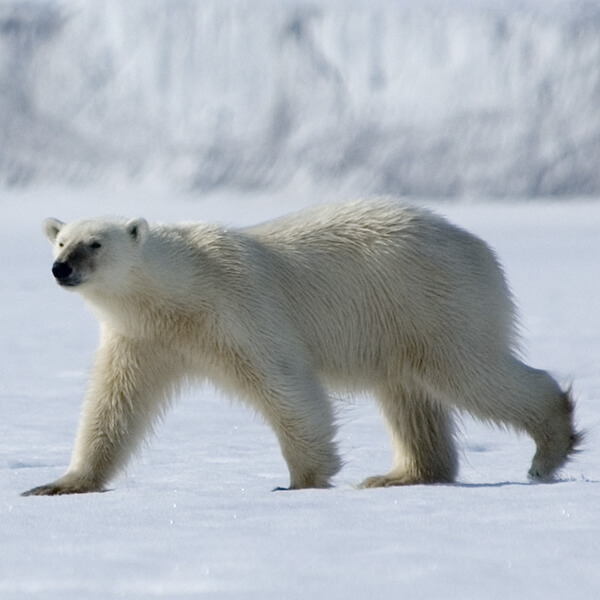
That's it for a roundup of bear stuff. No big new insights or conclusions, but bears are fascinating enough to just read about and think about every now and then.
A few bear references:
And they're big.
HOW BIG ARE BEARS?
A polar bear weighing a metric ton (2,200 pounds) is on record from Alaska, the biggest brown bears may hit 1,500 lbs, and 800-lb black bears are known. All of these are outliers, of course, but darned impressive nonetheless.
Bears in captivity may get even bigger if they are overfed or lack enough exercise. Take Samson, for example. Samson was a bear trapped alive by John "Grizzly" Adams and hauled to antebellum New York to be exhibited. He was a sensation. He was the biggest bear Adams had ever seen in many years of hunting grizzlies, and when put on a hay scale he weighed 1,503 lbs. (It's possible he had gained some "cage fat" by this point, but Adams' description of him as a "moving mountain" seems justified.) Here in my hometown of Colorado Springs, the Cheyenne Mountain Zoo reported in 1955 the death of a male Kodiak weighing 757kg (1,669 pounds)!
Earlier Post: More on Big Bears
Samson. Painting by Charles Nahl, 1855) this was the model for California's state flag. It is reported, although not certain, this paitning was the model for the California state flag another version is that a bear named Monarch deserves the honor.
Anyway, I hadn't written about bears in a while, so I thought I'd just dip a toe into recent and ongoing bear items.
Here in North America, we have black bears (Ursus americanus, which can be many colors including cinnamon and white), brown bears (Ursus arctos, with the grizzly and Kodiak bears being the local subspecies), and the totally awesome polar bears of the north. The polar bear is getting the most concern of late. Polars are not in danger of extinction - indeed, it's not clear their population is much below its historic highs - but their preferred range is squeezed as the pack ice is reduced and the occaional polar-grizzly cross has popped up. Grizzly range has been greatly reduced by hunting and so on - the grizzly on the Califonia state flag is the only one in the state outside of a zoo.
Here in Colroado, the last grizzlies were supposed to be gone in the 1950s, but a bowhunter killed one that attacked him in 1979, and this was a sow who had had cubs. A few other good modern sightings are on record. I wrote a paper once suggesting a few lingered in the San Juan mountains, although probably not a viable population.
And, of course, I once talked (brilliantly, I'm sure) about the largest brown bears in this little episode of must-see TV. MonsterQuest: Giant Bears. Alas, I can't find a still image of myself from it.
Chubby North Carolina bear compared to housebound humans...
This black bear looks like a balloon. A sceintist reports the 700-pound teddy found cornfields where it just ate, lay around, ate, went off to sleep, came back, and ate some more. Jokers compare it to people trapped by the pandemic with nothing to do but snack.
North Carolina's "chonk bear" (USFWS photo)
There's always controversy on bear conservation, for a number of reasons. One is that protecting bears means a lot of land: bears in North America are the biggest predators in every habitat, and they need space. Black bears, the males anyway, often wander 15 miles or so in pursuit of fodder and females, and sometimes go much further if the range is crowded or food is sparse. A male grizzly needs a range of 300-500 square miles, although such an area can support numerous bears. A grizz may defend a smaller home patch of ground, but won't try to police the whole range.
With protected areas like Yellowstone, the issue arises of what to do with park bears that go hunting outside the park.
BEARS AND HUMANS
Yellowstone like any area, has a carrying capacity, although there is often furious debate over what that number is and how to keep the population healthy. Advocates like those served by the Grizzly Times fear culling bears or delisting populations is a dangerous step when the animal has already been extirpated from much of its range. It gets more complicated because governments generally agree that problem bears, like repeat predators of livestock, can be killed, but of course the bears don't know the rules. And how far should the rules extend? This story out of Montana last month is an example of what bear advocates would call a borderline case at best. Bears don't view humans as their usual prey, but can be dangerous: this attack in Oregon occurred just this week, and here's a recent case from Alaska.
BEAR PROTECTION
The brown bear is a Threatened species in the Lower 48, while black bears, depending on locations/population/subspecies, may be protected or subject to hunting. That's another controversy altogether, with hunters arguing it's a smart, cheap way to control populations while supporting guiding and other occupations, and opponents arguing on conservation as well as moral grounds. (Brown bears may be hunted in limited numbers in Alaska.) The polar bear protected within the United States.
Here's the plan for the polars. Threats include poaching, habitat loss, climate change, and pollution, although just to remind us we CAN get good things done, here's a report of how accumulated toxins in polar bears are decreasing after a long rise.
Ursus maritimus (USFWS)
That's it for a roundup of bear stuff. No big new insights or conclusions, but bears are fascinating enough to just read about and think about every now and then.
A few bear references:
Day, David. 1990. The Doomsday Book of Animals. New York: Viking Press.
Domico, Terry. 1988. Bears of the World. New York: Facts on File.
Galbreath, Gary, et. al. 2008. "An Apparent Hybrid Bear From Cambodia." Ursus 19:85-86.
Goodwin, George. 1946. "Inopinatus the Unexpected," Natural History, November.
Halfpenny, James. 1996. “Tracking the Great Bear: Mystery Bears,” Bears, Spring.
Montgomery, Sy. 2003. Search for the Golden Moon Bear. New York: Simon and Schuster.
Wood, Gerald L. 1983. The Guinness Book of Animal Facts and Feats. Sterling Publishing Co.
Montgomery, Sy. 2003. Search for the Golden Moon Bear. New York: Simon and Schuster.
Wood, Gerald L. 1983. The Guinness Book of Animal Facts and Feats. Sterling Publishing Co.
Woolford, Riley. 2007. "White Black Bears and Blond Grizzlies: Alaska Bears Wear Coats of Many Colors," Alaska Fish & Wildlife News, September.
Discussion thread at http://shaggygod.proboards.com/thread/474/guinness-world-record-kodiak-bears
Discussion thread at http://shaggygod.proboards.com/thread/474/guinness-world-record-kodiak-bears
Thursday, April 30, 2020
Dino News: Spinosaurs and More
These days, there's not much to cheer about. Think about this, though: the pursuit of knowledge goes on. Science goes on. Not just in medical labs, but in every kind of endeavour humans engage in to learn more about the universe. It's a testament to our innate desire to learn, and what's more fun than to take some time out from COVID-19 to talk dinosaurs?
About unearthing dinosaurs. I've always wondered if some ancient traveler saw a Spinosaurus eroding out of a cliff and saw the sail as a pair of wings folded up. "So that's what a dragon looks like!"

First, remember our friend Spinosaurus from Jurassic Park 3? Easily the coolest creature in a very uneven creature feature, the onscreen predator was just as much at home swinning up on people submerged as it was fighting T. rex. Scientists have debated for a long time how aquatic Spinosaurus was. Did it swim, or was it just an occasional wader? The fragmentary nature of available skeletal material didn't answer that. Now we know: Spinosaurus apparently was equipped for a crocodile-like lifestyle, tethered to the land but hunting fish, reptiles, and other dinosaurs in the rivers and shallows, snatching animals in the water or perhaps ambushing them as they came down to drink (which must have been hard with that sail). We know this because we have good fossils of the tail now, and it's a crocodile-like tail, flattened side-to-side, suited for propulsion for an animal that also shared the crocodilian tendency toward short legs and (we think) webbed feet. It was the first true swimmer we know of among the dinosaurs. The key fossils came from Morocco and were unearthed in 2017-18.
Coverage here from Nat Geo


Spinosaurus at the George S. Eccles Dinosaur Park-Museum, Odgden, Utah Rea;;y cool, but we didn't know about the tail. Photo by Matt Bille, 2018.
About unearthing dinosaurs. I've always wondered if some ancient traveler saw a Spinosaurus eroding out of a cliff and saw the sail as a pair of wings folded up. "So that's what a dragon looks like!"
The biggest dinosaur search of all time, called Mission: Jurassic, is on in Northern Wyoming, near the famed Morrision Formation. Here's a fascinating story about the riches being uncovered and how one scientist has committed the next 20 years of his life to excavating the site.
Allosaurus, a common denizen of the Mission: Jurassic site and the Morrison Formation (photo origin unknown)
Thursday, April 23, 2020
Interview: Whales and the Marine Conservation Network
Kimberly Ray, cofounder of the Marine Conservation Network, did an interview with me a couple of weeks ago, focused on whale tracking and conservation. I'm no cetologist, but I hope there is some good stuff here for everyone. Thanks!

Wednesday, April 22, 2020
HAPPY EARTH DAY
On the 50th anniversary. there is room for both continued concern and aspirational hope. Here's an article I did about a small contribution to one aspect of conservation, improving the tracking of whales and other engendered species. Since I wrote this, NOAA has teamed with a French project called ANGELS to demonstrate successfully that smaller satellites can be part of the solution.
https://blueocean.net/saving-whales-with-satellites-3/?fbclid=IwAR1xP8oia-FkfwW1iY9eXsLu95-OQ6TsRn_0xXhu3WO1raG6__xUndu93oo
https://blueocean.net/saving-whales-with-satellites-3/?fbclid=IwAR1xP8oia-FkfwW1iY9eXsLu95-OQ6TsRn_0xXhu3WO1raG6__xUndu93oo
Friday, April 17, 2020
Dinosaurs, Dr. Naish, and General Coolness
Darren and the Dinosaurs
(sorry, Darren, I couldn’t resist that. Danny and the
Dinosaur was the first book I remember reading.)
I’ve talked about Dr. Darren Naish before. A paleozoologist and science writer with a specialty
in dinosaurs but interests everywhere, Darren’s blog Tetrapod Zoology is
reliable and fascinating reading on everything from sea serpents to orangutans
to every kind of zoological oddity.
The blog caught my attention this week for its headline about
sauropod dinosaurs and whether scientists are creating too many species. He notes some 50 “non-bird dinosaurs” are
described every year, and there’s a proliferation of North American longnecks
that some paleontologists think is overdone – there are 30+ species from just the Morrison
Formation (Upper Jurassic Period). One need
not understand the subtleties of classifying dinosaurs (I certainly don’t) to
wonder how complete the fossil record is and whether we know a few or most of
the dinos from a particular place and time.
His response is that there are gaps where we know almost none of the dinosaurs. Some caution is called for when we have only fragmentary
remains, but given the time scale we’re dealing with (remember T. rex is closer
in time to us than to most other dinosaurs we common folk have heard of) and the global spread of dinosaurs, there's a lot of room for discovery Indeed, we sometimes, in effect, don’t have enough
dinosaurs: an eternal war rages between those who think Nanotyrannus is a
young T. rex and those who think it’s a species. (The latest research is on the
T. rex side, leading me to brilliantly pun “sic semper nanotyrannus.”)
One estimate (not from this source) is that the average
lifetime of a species is 3 million years.
In the 140 million years of the Mesozoic, there’s room for a LOT of
dinosaurs. The known species include
cool mysteries like Amphicoelias fragillimus, now Maraapunisaurus,
described in 1878 from a single, now-lost vertebra so large it indicates a dinosaur
even bigger than the recently found South American giants. It might, given its resemblance to the famous
Diplodocus, be “a diplodocid diplodocoid, and probably a diplodocine
diplodocid diplodocoid.” Umm, ok.
OK, that’s all the dino-rambling for today. Buy Darren’sbook.
Monday, April 13, 2020
Review: Voices in the Ocean, by Susan Casey
By Susan Casey
Doubleday, NY, 2015, 320pp.

Casey, author of very interesting books on waves (her best
work) and great white sharks, here recounts her efforts to more about our
aquatic analogues, the dolphins. It is a
personal journey, and some sections are more compelling than others, but it’s a
trip worth taking.
Casey is enraptured with the animals, and that’s understandable.
She witnessed everything from hunting and captivity to the exhilaration of
open-ocean encounters off Hawaii, and there’s a very interesting closing
section on how dolphins were venerated and memorialized in art by the Minoans and
their neighbors. She talks to some
top-rank scientists like Robin Baird and Lori Marino, but she says her
curiosity could not be satisfied in labs and tanks, only in the ocean.
Casey tells us early on that it’s easy to “go down the
rabbit hole” with the mystical side of human-dolphin interaction, and down she
goes, offering a sympathetic portrait of the brilliant but bizarre John C.
Lilly (kudos to her for digging through his personal archives and not relying
just on secondary sources) and spending time in Hawaii with Joan Ocean, who
holds that dolphins are “multidimensional beings” with wisdom beyond our
imagination. The most fascinating bit,
scientifically, is her discussion of dolphin brains with Lori Marino. The
dolphin brain “design,” Dr. Marino explains, is very different from our own. It
prioritizes speedy processing and reactions as well as sensory inputs. The book includes numerous examples of
dolphin intelligence, some of them pretty startling. It also features tales of dolphins rescuing
people: as Casey notes, this implies animals, for some reason, sometimes see us
as kin.
There are heartbreaking chapters on the slaughter and
captivity of dolphins in the centers of the live-dolphin trade, Taiji Cove
(Japan) and the Solomons, where Casey, at some personal risk, meets the brave
and dedicated people trying to stop the carnage. (Her description of the “Whale Museum” in
Taiji is otherworldly, an example of how humans can warp their perceptions even
about things they’ve personally witnessed.)
She looks at some of the marine parks where mistreatment and tragedy
have occurred, including in Canada and the United States. She speaks to
ex-trainers, most famously Ric O’Barry,
whose dolphins I once saw perform as “Flipper.” She denounces the “swim with
dolphins” programs, which she shows include extreme confinement of the animals
to make sure they’re available. A welcome counterpoint is her visit to Dingle,
Ireland, to see Fungie, a bottlenose who has seemingly adopted the town and has
spent 30-plus years interacting with the people who venture out to see
him.
This is a personal journey and not a treatise, but a few
omissions seem odd. Casey never asks current dolphin trainers for their views -
I agree with her that captivity should be phased out, but castigating it
without those voices oversimplifies things.
She notes that dolphins are not all happy and gentle creatures, but
ignores the details. Bottlenose dolphin females are forced into sexual congress
by groups of males that ram them, bite them, and tail-bash them to make them
submit. Some newborn calves are batted through the air and rammed until they
die. Many other mammals do similar things, but there is a bit too much rosiness
in the portrait of dolphins. Casey doesn’t entirely embrace the more extreme
metaphysical beliefs, but there’s no skeptical counterpoint, either. Ancient
and modern indigenous people who honor or commune with dolphins are celebrated,
but the ones that killed and ate them go unmentioned.
Again, though, this comes back to being Casey’s own attempt
to learn more and connect more with dolphins and it helps that she’s a very
good observer and writer. Dolphins are
fascinating, and Casey shows us many of the reasons why. The book’s omissions
make me think she loves her subject too much, but that’s not the worst of
sins. If this is not the whole story of
humans and dolphins, it’s a compelling and often memorable chapter. There’s a good set of chapter notes
(neglected by many modern writers) and a bibliography.
Friday, March 27, 2020
Odds and Ends: Science and Survival
Odds and Ends March 27, 2020
By Matt Bille
It’s been such a crazy year so far, with the dominant threat
of coronavirus wrecking the whole world’s plans. (LISTEN TO THE EXPERTS!!!) But there are other things going on, some of them memorable.
SHOOTING FROM THE HIPPO
I posted on FaceBook the question of a little oddity that
turned up as I read Glynn Williams’ excellent book Naturalists at Sea
(full review coming). William Dampier
was a British naturalist, self-taught but brilliant, whose voyages took him
around the world three times. (Some of
that time was spent, incidentally, as history’s most inept pirate.) About 1700,
in Australia's Shark Bay, he was present when a shark was caught whose stomach
contained [his spellings] "the skull and boans of an hippopotamus."
He specifically mentioned the jaws, lips, and teeth as identifying features.
Dampier does not seem to have recorded the size or species of the shark. What
could a man who wrote many volumes of exhaustive and precise notes of plants
and animals all over the world have mistaken for a hippo?
German zoology expert Markus Bühler likely solved it when he
suggested the dugong. “For a naturalist from 1700, who has never seen a dugong
and who had likely also not exactly superior experience with hippos, it seems
really not too far stretched that he would consider that a dugong´s head
belonged to something hippo-like.” OK.
It was cool while it lasted.
SOCIAL DISTANCING FOR CRYPTOZOOLOGISTS
If you forget the required measurement for social
distancing, it’s four Bluff Creek sasquatch tracks or a little over one coelacanth.
LITTLE SURPRISE IN ANCIENT AMBER
According to the article in Science, the most prestigious
journal in America, by Gretchen Vogel, “This tiny head, 14 millimeters long
(including the beak), belongs to one of the smallest dinosaurs ever found. …” Oculudentavis khaungraae (eye-tooth bird) is an amazing find.
It’s one of the most controversial follis ever, though. The
scientific controversy is that not everyone agrees it’s a dinosaur. Some
suggest it’s an early true bird, some that it was a lizard. That will be argued
out in future papers. The tough one, though, is that many publications debated
covering it because it’s from Myanmar, where the province it was mined in. and
from which it was smuggled to China, is mired in a brutal separatist conflict and funds one side or the other depending on who's in control of that bit of ground at any given time.
Joshua Sokol reports on that here.
Read The Dinosaur Artist by Paige Williams for the big picture of
dinosaur smuggling and sales.
Want to read an old-but -great book in wilderness survival?
Try Cache Lake Country: Life in the North Woods, by John J. Rowlands and Henry
B. Kane (Norton, original edition 1947).

Rowlands recounts his North Woods adventures in a friendly campfire style
and along the way includes instructions, with drawings, on how to make everything
from a shelter to a water-cooled refrigerator, all with materials from the wild
and the kind of gear a camper could lay hands on way back in the 1940s, before
all the flashy modern stuff was even thought of. My dad had a copy of this when we were kids, and we loved it.
It vanished, but I turned up a used one. It’s on Amazon as paperback, Kindle, or FREE
audio book, although the hardback is now costly.
“There’s a Cache Lake for everyone, but it won’t be found by
a four-lane highway.” – John Rowlands.
In a year like this, I’m sorry I’m not up in Cache Lake
Country myself.
Tuesday, March 17, 2020
Anniversary: Vanguard 1 satellite
“Nothing ever built arose to touch the skies unless some man dreamed
that it should, some man believed that it could, and some man willed that it
must.” - Charles F. Kettering
It’s often forgotten that long before Sergei Korolev, Chief
Designer, launched Sputnik 1, an American satellite program was underway. This is a story Erika Maurer and I were
honored to chronicle in the NASA-sponsored publication of The First Space Race
(Texas A&M, 2004).

The Stewart Committee assembled in 1955 selected Project
Vanguard in what might be termed the ultimate Army-Navy game. Vanguard, to be run by the Naval Research
Laboratory, was to orbit a scientific satellite during the 1957-58 International
Geophysical Year (IGY). The Navy and the
Soviet Union pressed towards the goal of the first satellite (with the Stewart
Committee loser, the Army Ballistic Missile Agency, left, for the moment, on
the bench).
That competition has been second-guessed, then and now, and some
annoyingly persistent and unproven claims have been made about it. Since we have an opportunity here to mention
those, and it’s my blog and these irk me, there are three such claims:
- The Committee (in some versions, directed or pressured by President Eisenhower) picked Vanguard because it was the “more civilian” satellite, with the National Academy of Sciences being the official sponsor even though the program was hosted and carried out by NRL. The idea here (logical in itself) is that a civilian satellite would have more of a chance to establish a lasting principle of free overflight through space. But while the Stewart Committee was well aware of this logic, there’s no evidence they acted on it. There’s also no evidence Ike pressured the Committee in any way.
- That dislike of German engineers under the ABMA’s famous Dr. Wernher von Braun carried the day. Again, no evidence. Whether one or more people held an unconscious bias, or a conscious one never spoken of, is unknown and unknowable.
- That Ike wanted the U.S. program slowed down so the Russians would establish freedom of space. Again, the Committee, the National Security Council, and the President were aware of this thinking, but Ike more than once criticized Vanguard for being behind schedule. The “slow down” idea was disproved by Ike’s post-Sputnik action of calling his R&D chief, Donald Quarles, on the carpet and demanding to know how the Russians came in first.
On 4 October 1957, Korolev successfully placed a satellite
in Earth orbit. The spacecraft itself
was an unimpressive-looking sphere, not much bigger than a basketball. What it signified, though, was enormous. The first phase of the first space race was
over. The Soviets quickly followed up with
the far larger Sputnik 2.
Project Vanguard hustled to develop a response to the Soviet
Union – and a questioning American public.
Everyone knew Ike had approved Project Vanguard but also that he’d watched
with growing impatience as its timetable slipped and costs mushroomed. Vanguard never had an explicit directive to
be first, but it was widely assumed the Soviets were behind us in technology
and so the first satellite would be American.
On December 6, 1957, what had originally been meant as a
non-orbital Vanguard test vehicle but now fitted with a tiny satellite,
attempted a launch from Cape Canaveral in full television view of the entire
world. The result was an embarrassment: a massive explosion two seconds after
launch. Vanguard’s director, John P.
Hagen, was remarkably reserved in his response: “Nuts.” The satellite, built quickly
in a minor engineering miracle by a team led by Roger Easton, fell forlornly to
the sand. Easton carried it back to Washington, where it languished, seemingly
unwanted, in his house. (Years later, the Smithsonian put it on permanent
display.)

NRL newsletter article
The Army Ballistic Missile Agency’s Explorer 1 became the first
American satellite on January 31, 1958.
Vanguard did not give up. On March 17, 1958, on its third
try, the program put a satellite into orbit.
“I heard a tremendous roar, as if a fire had started. Suddenly, books, shoes, and other things flew
over the balcony down into the hangar.”
- Propulsion engineer Kurt Stehling on the Vanguard celebration at Cape
Canaveral
In October 1958, the
U.S. created the National Aeronautics and Space Administration (NASA) to run
civilian space programs. This
organization eventually absorbed the Army and Navy satellite programs. The NRL reconstituted a Satellites Techniques Branch
under Martin Votaw, and the Lab continues working on small satellites
today.
Vanguard has been categorized as a flop. It wasn’t. It went
over time, it went way over budget, and it had a launch failure at the worst
possible moment, but that shouldn’t obscure its contributions, which echo into
2020 and well into the future.
First, there was the rocket. The Vanguard launch vehicle, still
the smallest ever to successfully orbit a satellite, pushed technology hard. The margins were miniscule, and the rocket
met with success only after great effort (and considerable infighting) by the
Glenn L. Martin Company and the NRL team. The second and third stages, the Able
and Altair, mated to a Thor missile first stage, became integral components of the
longest-running and most successful American booster family, the Delta rockets.
Vanguard’s engineering DNA was still traceable in the last Delta II launcher,
flown in September 2018.
Vanguard’s satellite design packed a lot into a small space.
There were two designs: the full-sized satellite and the miniature one. Of the full-sized (24-lb) satellite that
would become Vanguard 2, Constance Milton Green and Milton Lomask wrote in
their book Vanguard: A History, that "Miniaturization, today a
commonplace of technology, was a novelty in 1955. The Laboratory's proposal,
however, hinged on it. satellite casing weighing eight pounds would carry
miniaturized instruments weighing ten pounds for accumulating scientific
data…Minitrack equipment weighing two pounds… and two pounds of telemetering
equipment."
There was a recognition even then that some power source
besides heavy, short-lived batteries was needed for spacecraft. The first
miniature Vanguard "grapefruit" satellite drastically shrunk the
original design. Weighing only 3.25 lbs, it carried six solar cells into space
and proved the utility of this brand-new technology. The satellite also had a
mercury battery, two radio transmitters, and a temperature sensor. The claim has been made that the NRL
originally didn’t want solar cells, but an Army researcher put pressure on
them. Roger Easton, discussing the satellite 50 years after launch, reported he
had checked into this (and of course, he was also THERE) and it was groundless. The occasional suggestion that Vanguard 1 was
essentially a rickety thing slapped together that somehow worked also irked
Easton and other program vets. The ingenious design of the satellite, using
every cubic inch of space, and its long active life transmitting from orbit (until
1964) stand as refutation to that idea.
Then there was the tracking system. Minitrack was another achievement led on the
design side by Easton, who deserves his own biography (although his son Richard
put a lot of the story into his book GPS Declassified, cited
below). Minitrack was a north-south line
of 14 stations, built by the Army Corps of Engineers and stretching all the way
down to Argentina. It was a predecessor to the Naval Space Surveillance System
(NAVPASUR), created for more accurate tracking of Soviet satellites. That
system (somewhat convolutedly) led to an Easton-led satellite project called Timation
and then the invention of GPS. Richard Easton says, “I think the most important
legacy of the Vanguard 1 satellite is the solar-powered transmitter. The second
was Minitrack, leading as it did to Space Surveillance and eventually to Roger
Easton’s Timation satellite and then onward to and GPS. But that was a long
process.”

NRL Minitrack Station at BlossomPoint, MD
(Side Note: Victory has a thousand fathers (and mothers),
and credit for GPS is a complex matter given the long gestation and many
contributions leading to the Air Force-deployed operational system that changed
the world. If one person and one program were absolutely essential, though,
they would be Easton and Timation.)
The Vanguard program would end with the 52.5-pound Vanguard 3,
launched on September 18, 1959.
The full-sized satellite had a second life: it lent its
structure, or bus, to NRL’s SolRad (Solar Radiation) satellites, along with its
telemetry equipment and other technology. SolRad is best remembered for having
a once-classified secondary mission as the first electronic intelligence
satellite, called GRAB (Galactic Radiation and Background), which studied
Soviet radar emissions, but it also did important science. SolRad was the first satellite built by the revived
Satellite Techniques branch. The series
opened with the launch of SolRad 1 on June 22, 1960 and put 11 satellites in
orbit.
Not bad for a “flop.”
Key References
Constance McLaughlin Green and Milton Lomask, 1969. Vanguard
- A History (Washington, DC: NASA
SP-4202, Smithsonian Institution Press, 1969).
Kurt Stehling, Project
Vanguard (Garden City, NY: Doubleday & Company, 1961).
Richard D. Easton and Eric F. Frazier, GPS Declassified:
From Smart Bombs to Smartphones (Potomac Books, 2013).
Richard Easton, online discussion, March 2020.
Subscribe to:
Posts (Atom)