Wednesday, April 28, 2021

R.I.P. Michael Collins, Astronaut, Explorer, and More

 Very sad news today. Michael Collins, Command Module Pilot of Apollo 11, has embarked on his last voyage of exploration.

Collins, who rose to the rank of Major General in the United States Air Force, was described by all who knew him as extraordinarily competent, yet a humble man with a sense of humor. When Apollo 18 and 19 were canceled, he knew he wouldn't get to walk on the Moon himself, but he was always proud of the role he'd played in putting his comrades and his country on the moon.


He was the first head of the National Air and Space Museum, a magnificent achievement that preserves aerospace history including many artifacts of the Apollo program.

His book Carrying the Fire is still the standard for astronaut autobiographies. In it readers will not only meet the man and understand his beliefs and motivations, but where he thinks the space program fits into the larger universe of human endeavor. As a bonus, Collins explains the technology involved in language all can understand. He conveys superbly what it was like to voyage in the cramped quarters of the Gemini and Apollo capsules through the harshest environment in the universe.

I never met Collins. I wanted to tell him, not only that I admired him, but I'd watched his launch to the moon. I was a 9-year-old watching from a plane my dad had rented from his employer, Piper Aircraft, in Vero Beach just down the coast from the Cape. (I wanted to meet them all, but I've only met Buzz Aldrin (who is well worth meeting!)

Michael Collins was 90 years old. From one Air Force veteran to another: a last salute. Ad Astra.

Thursday, April 22, 2021

Samson: Where's the Bear?

 Maybe readers can help solve this one. 

What happened to Samson the bear?

Samson was a California grizzly captured as an adult in 1854 by John "Grizzly" Adams. Adams had seen (and killed) many grizzlies, but Samson was the biggest bear he ever saw. Samson was shown in Adams' menagerie, established in San Francisco in 1856, where Charles Nahl painted him: he became the bear on the California state flag. Samson was moved with the other animals (Adams' close companion, the famous grizzly Ben Franklin, had just died) to New York in 1860. At this point, Samson, while he carried some "cage fat," nonetheless was a monster: he was weighed on a hay scale at 1,510 pounds, whereas an animal half that weight is now considered a very big bear. He was billed as the biggest bear ever captured in the United States, and he quite possibly was (noting the U.S. did not own Alaska back then.)

There are few photos of Adams, and I've found no  information about whether Samson was photographed. I'd think he probably was at some point.  


Photo of Adams with a smaller bear

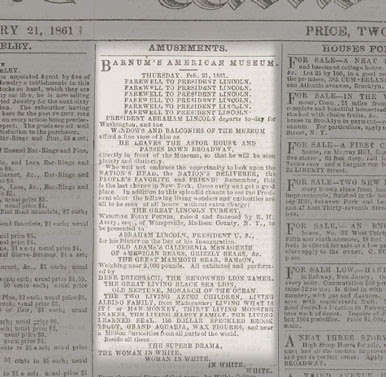
Adams sold the collection to P.T. Barnum in 1860 and was hired to show the animals. Adams, who had a terrible head wound from an old bear attack that could not be treated with 1860 medicine, died on October 25 of that year. Barnum's American Museum mention Samson as a live exhibit several times. Abraham Lincoln would have seen Samson when he brought his family there in 1863. Barnum, of course, couldn't resist boosting his star bear's size. An ad in the New York World (February 21, 1861) reads, "OLD ADAMS’S CALIFORNIA MENAGERIE OF AMERICAN BEARS, GRIZZLY BEARS, &c.THE GREAT MAMMOTH BEAR, SAMSON, Weighing near 2,000 pounds." 


The mystery: I've never found a source that said when Samson died or what happened to him.

One source says he had "been removed" just before the 1865 fire, and the New York Times expanded on this by saying he had been sold in New Orleans. I have so far found nothing later. Whenever he died, he was probably not stuffed for exhibit (or at least there are no accounts of it in online archives) but it seems strange the mammoth skeleton was not saved. Does it still exist? Is it in a museum? Or is Samson, like its species in California, gone for good?


Thursday, March 18, 2021

The endless weirdness of sharks

Back when I was a kid reading about sharks, there were "more than 200" living species. Then 300, then 350, and now it's over 500.  In addition to being numerous and of global distribution, the shark clan also boasts creatures so weird they could (and do) create nightmares.  Prehistoric sharks, were, if anything, stranger. 

In the oceans today swim the 15-meter whale shark, the 7-meter great white, the blimplike megamouth, and several species of the bizarre hammerhead. In the oceans of yesterday swam the 15-18m Megalodon, the bizarre "ironing board shark" Stethacanthus, and Helicopreon, which had a "wheel" of teeth" - it looks like it tried to swallow a (vertical) power saw blade.

Helicopreon (artist unknown, license marked "Free to Share and Use"  by Bing)


Stethacanthus  (artist unknown, license marked "Free to Share and Use"  by Bing) 

We have new species of present and past sharks, and they continue the weirdness.  

From the modern sea, far far below the Pacific near New Zealand, comes the 1.8m kitefin shark, the largest luminous vertebrate in the world. I always thought a glowing shark like the ones in the Meg novels wouldn't be able to find prey down there (it's like swimming around with a big neon sign saying "SHARK!").  Apparently, though, enough inhabitants of its realm are just too curious about light sources.   

From the past we have  Aquilolamna milarcae. Thanks to pectoral fins that rolled out like glider wings, its 1.8m "finspan" made it longer than it is wide.   This Cretaceous resident was more a drifter than a hunter-killer.  

The sharks... still full of surprises. 


Sunday, March 14, 2021

The Deadly Mantis

Yesterday I watched my favorite big-bug movie, "The Deadly Mantis" (with MST3K commentary). It's a decent story and well-acted, but I'd forgotten how slow it is. It's as if the model mantis (which has decent texture and movement, for the time/genre) had in its contract it only needed to appear 10 percent of the time, so 90 percent is people talking in offices. It opens with a LOT of footage from Air Force training films of the military's early warning radar nets watching the Arctic skies for Russian bombers. It also has the usual glitches of these movies: American planes shoot rockets at the mantis, but when the camera pans back to the planes the rockets are still there under the wings. The stock footage is pretty good throughout if you like 1957-era planes.


The scientist character from a natural history museum tries hard to make it all believable. Someone wrote some dialogue that at least sounds "sceincy." (OK, not the part where he suggests mammoths frozen in Siberia might have been ALIVE when unearthed.)

Still, one of my favorite movie monsters of all time. It ranks, for this era, with the giant ants in Them!

https://mst3k.fandom.com/wiki/MST3K_804_-_The_Deadly_Mantis

Trivia: An Eskimo village is Canada is found abandoned because the mantis attacked and everyone fled. The story is circulated endlessly in paranormal websites and literature as having been a real unexplained disappearance. I wrote once to the RCMP to nail it down, and they politely replied they'd searched their records many times and it hadn't happened.
Other trivia: the newspaper headline in the film (below) is a tribute to my hometown.

UNtil next time, visit me at MattBille.com

Friday, February 26, 2021

A Living Thylacine? Alas, No

 Well, there was a lot of hype, but in the end the much-heralded thylacine photos were not of the "Tasmanian tiger," but of a small kangaroo relative called a pademelon.  We talked about this last night on Untold Radio.  My best guess was we lost the thylacine around 1990.  I always hope I'm wrong about these things, but I'm not wrong often enough for my liking.  (OK, that sounds weird, but I hope it makes sense.)  By the way, did you know you could buy dog jackets that make Rover look like a thylacine? 

I do feel sorry for Neil Waters and his friends in the Thylacine Awareness Group of Australia. They've put years into this search.  Take a look at the initial announcement. He's so enthused about it that the result has to be an enormous letdown for him. 


Thursday, February 25, 2021

A Night on Untold Radio

 I had a great time chatting with Doug and Joel at Untold Radio.  My brain glitched a couple of times early on, but we had a good discussion of cryptozoology and books.  I even worked in Dunkleosteus. Thanks, guys! 

Episode 23 – Matt Bille – Author, Historian, and Science Writer – Untold Radio AM


Monday, February 15, 2021

New life discovered - past and present

First, the past. A coelacanth fossil discovered by accident turns out to be amazing.  The coelacanth may be five meters long, far larger than any prehistoric or modern coelacanth (1.5m is a normal adult specimen.)

Speaking of coelacanths, because the modern one looks very much like its ancestor (hence the rather problematic term "living fossil"), its genome has diverged quite a bit from prehistoric examples.  That doesn't make the modern one any less important, but it's very interesting. When the living animal's genome was sequenced in 2013, sceintists thoought it had changed very little.  


Modern coelacanth, Latimeria chalumnae (Smithsonian)


As for newly discovered life, news from Antarctica startled pretty much everybody.  Life has pushed into all kinds of unlikely and hostile environments, but no one thought life, especially multicellular life, would turn up at the bottom of a 900-meter hole drilled through the Antarctice ice sheet.  The animals are presumably chemosynthetic, but the details have everyone puzzled, and will until samples are obtained.  Which, of course, is no easy task.  

"Life finds a way." - Dr. Ian Malcom


Tuesday, February 09, 2021

Brooding over new Bryde's whale relative

A population of Bryde's whales (pronounced, approximately, Broodus) in the Gulf of Mexico has been determined to be a new species: amazing news. It has received the common name of Rice's whale and may be over 13m in length. 

NOAA's official account, based on a paper in Marine Mammal Science, reports Dr. Patricia Rosel was the key figure in identifying these whales as a new species. It was her examination of a skull, compared via hundreds of measurements to known Bryde's skulls, that provided the final proof of the new whale's uniqueness.  

This capped off more than a decade of work by Rosel and several other scientists.  It all began back in the 1990s with the first observations, by Dale Rice, of what was thought to be a population of Bryde's whales. This group was unusual in that its range appeared limited to the Gulf, which was odd given other populations of this whale (already split into two species, a pelagic and a coastal type) had much larger ranges.  Subsequent work included DNA studies as well as examining skull morphology.  (In one of those incongruities that pops up in the study of nature, the measured whale, the type specimen, is an oddball that wandered all the way up to North Carolina, where it died and drifted ashore.)

So now we have the species called, formally, Balaenoptera ricei.

Dr. Rosel examining the skeletal remains of the type specimen (NOAA)  

Rice's whale is the latest in an astonishing series of discoveries. It's common, and reasonable, to assume we know all the cetaceans. They are big, they must surface to breathe, and we've been "collecting" them for centuries.  

And yet we have ten new species in the current century.   

We know of 23 species of the reclusive, deep-diving cetaceans called the beaked whales. The "23" is still approximate with such hard-to-study animals - some species might eventually be collapsed together, or new ones named. As shown with Rice's whale, it can take a lot of time and work to establish definitively that two similar-looking species are indeed different.

In December 2012, three cetologists on a Sea Shepard Conservation Society described what they'd found on a research cruise off the west coast of Mexico.  They took clear, closeup video and film records of what appears to be a new beaked whale species.  Even more interesting, the scientists involved were there looking for a different whale whose unidentifiable "voice" had been picked up on hydrophones.  This new species does not match that, so who knows what else is down there? 

The last new beaked whale before that (reported at sea by Japanese fishermen but not scientifically identified) washed ashore in Alaska only in 2016. It was formally described in 2019  as Berardius minimus

Now the bad news for Rice's whale: there are perhaps 100 of them.  That's not too small a population to to sustain itself, but it makes the species very vulnerable.  Their habitat is troubled by the usual nemeses of whales: ship collisions, entangling fishing gear, and noise pollution that makes communication and thus family/pod cohesion difficult.  More details are in a good NPR article here.    

If we have, as it seems, three sizable whales announced in the last five years, that's a strong indication humans have not yet catalogued all these intelligent, social, and fascinating co-inhabitants of the Earth.

Hope for Mars

 It's traffic jam month on Mars.

"Hope," the first space probe built by the UAE entered Mars orbit today.  The journey of exploration goes on, and it's great every time a new participant succeeds.  In this case, it's especially interesting because the UAE program leaders didn't start by doing something relatively easier, like a lunar probe.  They went for broke to study a far more distant object, and the gamble paid off. You can find more details here.

The related news includes the first photograph of Mars by a Chinese probe, Tianwen-1, which was successfully inserted into Mars orbit. Next, coming up on February 18, we have the capper to this very busy month on and around the Red Planet.  At about 3:55 EST, the NASA rover Perseverance will touch down just north of the equator in Jezero Crater, formerly the site of a lake and a likely place to detect any signs of past microbial life.  

In the Apollo days, we thought human feet would touch Mars long before now. It's taking longer than we thought, but the robotic fingerprints of Earth ingenuity are all over Mars. Despite the previous orbiters and rovers, this is a big and complex world.  No one yet knows what we'll find as we keep going.  


Image: Perseverance detaching from the upper portion of the lander (NASA). This "skycrane" approach under power is necessary because parachutes can slow a probe only so much in the thin Martian air. Any human travelers will also have to land using rockets to slow the descent.


Endangered Species: A little good news today

From Mongabay.com:   "Researchers studying the impact of conservation actions since the landmark 1992 Rio Earth Summit say that at least 21 species of birds and seven mammals have been saved from extinction through direct human intervention."  

It's all much more complex than that, of course.  In the aftermath of a 1992 conservation conference called the Rio Earth Summit, which emphasized the need to prevent further loss of species, this story says human efforts have saved 21 birds and seven mammals from going extinct.  

There is much, much more to do. We are in the middle of what some scientists call the Sixth Great Extinction in Earth history. We lose documented species at a rate of about one a year, but we're also losing species of plants and animals before they can even be found and named. So every success is something to celebrate. 

Details here

Sunday, February 07, 2021

Book Review: Hope for Animals and Their World

 Hope forAnimals and Their World: How Endangered Species are Being Rescued from the Brink

Goodall, Jane, with Thane Maynard and Gail Hudson (2009: Grand Central, 392pp.)


In this book, Goodall and her co-authors tell the stories of animals (and a few plants) which might well have become extinct, but survive thanks to human dedication and ingenuity. Some of the stories, like the California condor (Gymnogyps californianus), are famous, and others obscure. I’d never read about one of the most fascinating episodes, the recovery of the black robin (Petroica traversi) whose survival came down to a captive breeding effort using the only fertile female left in the world.

Some of the stories include Goodall’s own travels around the world, where she saw such creatures as Pere David’s deer (Elaphurus davidianus), Australia’s Rufous Hare-Wallaby (Lagorchestes hirsutus), and the Formosan Landlocked Salmon (Oncorhynchus masou formosanus). She also visits her beloved chimps: a photo of an infant named Flint reaching out to touch her hand will bring tears to eyes of many readers.

Some of the stories concern people who took great risks to save the last of a species. Finding Dryococelus australis, the Lord Howe Island stick insect (by an expedition sent to verify its extinction!) involved great hazards including a seemingly insane climb up a steep, rocky slope in the dark to spot the huge nocturnal insects. 

Goodall doesn’t neglect modern discoveries and rediscoveries of animals. Her chapter on the Lazarus species includes Zino’s petrel (Pterodroma madeira) on the island of Madeira, named for and watched over by three generations of the Zino family.  There’s also the Caspian horse, an ancient breed of small, gentle horses, saved by one determined woman who discovered this forgotten ancestor to the Arabian pulling carts in a remote Iranian village. She looks at resurrections like the coelacanths (genus Latimeria) and the Wollemi pine tree (Wollemia nobilis) (and if you don’t think a story about a tree can be exciting, read it).   The new finds include the kipunji (Rungwecebus kipunji), a large and unique monkey (it looks intermediate between a mangabey and a baboon) from Tanzania. Co-discoverer Dr. Trevor Jones said of the find, “…one of our team suddenly grabbed me and pointed to a monkey in a tree a hundred meters away. I grabbed my binoculars and nearly fell over. It was a surreal moment.”

Goodall has much to say about the broader topic of conservation.  She is sad but blunt about the fact that saving island species, in particular, can require using guns and poison to kill off imported cats and rats when trapping is impossible due to funds or animal numbers. She also discusses the ethics of collecting, the need for a whole-body specimen (she doubts it), the importance of indigenous participation, and the many ways people can support conservation in general or a particular species. 

Don’t just read this book. Treasure it.

“…there is yet this feeling of hope. There are surely plants and animals living in the remote places, beyond our current knowledge. There are discoveries to be made.” – Jane Goodall

Friday, February 05, 2021

Book Review: Peter the Great

 Peter the Great: His Life and World

by Robert Massie

Reviewed edition: Knopf Reprint, hardcover, 2009 (original 1981)


Even very good biographies of complex, influential people sometimes leave you thinking you've watched the person in action, but you haven't met them. In this book, you will meet Peter the Great.

Words like "complex" and "dynamic" might have been invented for him. He was a tireless reformer of Russia, pulling in technology and expertise from around the world. After reading this book, I wondered if any one ruler has ever done what Peter did: essentially raise a backward, insular, agricultural nation to a modern power in in one lifetime.

Peter never lost most of the harsh ways Russian royalty thought were natural. He was capable of great kindness to an individual human being but great cruelty to anyone who might be an enemy. He apparently never thought of the lives of the serfs, changing them only by allowing some people to move from the land to manufacturing: they remained serfs. Building his great capital city of St. Petersburg in swampy land under terrible conditions would cost thousands of lives, and he knew it. He was a very devout church-goer who had no problem watching prisoners broken on the wheel and never rebuked a general who killed 7,000 men, women, and children in razing a village the enemy might use.  

In other ways, though, Peter was atypical from youth.  He escaped the rituals of court by playing soldier, but he played it with uniforms and real weapons, testing tactics, learning to be an artilleryman, and building fortresses. When he unexpectedly became tsar, he was already better at the military arts than some of the generals in Russia's third-rate army, and he reshaped it along European lines. He was a proud Russian but had no problem importing officers and experts from other nations to teach the Russian forces and often command them.

Massie tells us as well of the astonishing range of skills and technology Peter mastered, and how he demanded that his nation master them, too. Building a navy from nothing required, as Peter saw it, personally learning all the trades that went into shipbuilding. It's amusing to read of the agreed-upon fiction that went into pretending the towering (6 feet, 7 inches), well-known Peter was an ordinary workman of the Dutch East India Company shipyard while someone appropriately dressed for a tsar handled protocol. Russian naval cadets followed in Peter's footsteps, and the navy he created was a powerful regional force with modern ships and highly competent crews. 

He went all over Europe learning about the latest scientific and technical advances and buying everything from art collections to clocks to cannons to ship home. He created the first academies to teach military skills to young Russians, and he created centers of learning in a nation that had almost none. He created a professional civil service in a government where corruption was open and blood ties were formerly all that mattered.

He was, always, a man of contradictions.  He philandered, but dearly loved his wife Catherine, and it was for her sake he suffered through official rituals and functions she loved and he endured. Friends and retainers sought his jovial company but feared his violent temper. He loved Orthodox services but attended Quaker meetings when abroad.  He suffered from seizures but nonetheless lived every day with seemingly boundless energy and appetites.  When he died, he left the country far, far different than he found it. With art that is almost magical, Massie succeeds in presenting us with a living, breathing man who contained multitudes.

Massie doesn't quote it, but what came to my mind at the end of Peter's story was Hamlet's line, "I shall not look upon his like again." This book is a monumental work of both history and biography.


Thursday, January 28, 2021

Remembering Challenger

 35 years. Coming off a 24-hour stint in a Titan II ICBM solo. Hearing it on the car radio. Rushing home to turn the TV on with my wife. Watching the video/film replays. Pointing to a tongue of pink-orange flame at the lower SRB segment and saying over and over, "That shouldn't be there." Hypothesizing there was a defect in the solid-fuel casting making a crack, and flames had blasted through the casing. Never thinking of joint failure because I couldn't remember ever hearing of one on the solids I knew best. Praying. Watching Reagan quote High Flight. Crying for them all. A morning never to be forgotten. Ad Astra.

Wednesday, January 27, 2021

On NASA's Day of Remembrance

 On NASA's Day of Remembrance


The Explorers

Souls departing Earthbound life
Rise to heaven’s plane
Soldier, sailor, priest, or king
The destiny's the same
But in an even higher realm
With stars always in view
Meet those lost in exploration
Remembering how they flew

Komarov toasts to Grissom
While Resnik bonds with Clark
Ramon and Chalwa share a tale
As they look beyond the dark
Adams shares his glory days
With Husband and McNair
And always they watch
And urge us on
To rise above the air

Honor Mother Earth, they’d say
But look up to the stars
God gave us the vision
To cross the celestial bar
We gave our lives
(we don’t regret)
To push back the frontier
Remember us by challenging
And rising past your fears

Patseyev, Onizuka
Anderson and Brown
Salute each new endeavor
That lifts us from the ground
To every new thrust into space
They raise their glasses high
And remind us we were always meant
To reach beyond the sky.

- Matt Bille, space historian, 2014

Tuesday, January 19, 2021

Discoveries: A Dinosaur's Butt and an Orange Bat

There's always a lot going on, even if most of it is lost in the coverage of riots and disasters. 

I love paleontologists, but maybe they should get out more, given the exitement over the first fossil showing a dinosaur's butthole.  Granted, this is important in understanding the physiology of dinosaurs, but.. (hah)  

Meanwhile, birds of paradise are among the planet's most amazing-looking creatures,and they are not just stylin' but do intricate mating dances. The Vogelkop superb bird-of-paradies (yes, that's the name)  makes 44 species in the family Paradisaeidae. It's black,an almost indescribable black, absorbing almost all the light hitting it, but males reveal a bright blue "chest plate" and do a unique dance which, we suppose, is irresitable.

From Guinea, from the caves of the Nimba Mountains, comes a spectacular orange bat. It's so spectacular it's not clear why it was missed right now, but scientists working in the area knew when they spotted it it was something new.  The linked article gives a good description of the process the discoverers went through to distinguish it from known species (color alone is not enough).  


Thursday, January 07, 2021

Book Review: Owls of the Eastern Ice

 Owls of the Eastern Ice: A Quest to Find and Save the World’s Largest Owl

Slaght, Johnathan. (2020: Farrar, Straus, and Giroux. 348pp.)

Blackiston’s fish owl is the world’s biggest and rarest owl. It has a wingspan approaching two meters and a fluffy, shaggy appearance Slaght likens to a juvenile bear with feathers glued on.  It’s scattered in pockets of Russia, China, and Japan, huddling in sections of old-growth forest with large nesting trees and streams or rivers that don’t freeze over.  The total population is perhaps 2,000.


In Russia, where the species was only found to exist in 1971, it clusters along the Pacific coast.  That’s where Slaght, the son of diplomats and a good speaker of Russian, joined a Russian scientist to find the owls, document locations, and attach GPS tags to as many as possible.

This is a book about five years of hard work in unforgiving terrain where humans keep an eye out for the Amur tiger, the huge brown bear, and the armed and dangerous poacher. Slaght works with a rotating cast including Sergey Surmach of the Federal Scientific Center of the East Asian Terrestrial Biodiversity and Sergey Avedeuk of the Amur-Ussuri Center for Avian Diversity (love the names). They set out using snowmobiles and a massive ex-military four-wheel truck into areas where roads don’t exist and a Western scientist is a sight rarer than the owl.  Here in Russia’s Primorsky Krai (Maritime Territory), they also face dangers from the land itself: fires in summer and freezing in the infamous Russian winters.  They have many failures before devising a trap that works for the wily birds. Equipment fails in the harsh conditions, and Slaght describes their efforts to fashion fixes or alternatives.

He writes, too, of the emotional heights and valleys inherent in chasing something that may be vanishing. Slaght is an excellent writer, and people, owls, and the terrain all come alive in his words.

Much of the owl habitat is being logged, and regulations and enforcement are spotty in this remote area. Deciding that a large wildlife preserve is politically difficult and would affect many people’s livelihoods, Slaght focuses instead on pinpointing the owls’ locations and habitat needs to pursue more focused protection. He negotiates with companies and officials about leaving certain trees and areas alone, and scores some successes. At the end of the book, he is cautiously optimistic.  Slaght, a man who puts his life where his heart is, continues his work today with the Wildlife Conservation Society’s Russia program.

 Field work is often regular repetition of challenging or unpleasant activities, an application of persistent pressure to a question until the answer finally emerges. – John Slaght, Owls of the Eastern Ice

Sunday, January 03, 2021

Book Review: Animal Treasure by Ivan T. Sanderson

 Reaching way back in the bookshelf for this one.  

AnimalTreasure: A Naturalist in Search of Strange Creatures

Sanderson, Ivan T. (1937: Viking Press, 325pp.)


The first book by Sanderson, who went on to become an important and controversial figure in zoology and cryptozoology, is a delight for animal lovers of all sorts. Sanderson was part of the generation of Western zoologists that finally abandoned the “collect everything you can shoot” mentality to study animals in situ. This book followed his first major expedition to British Cameroon (now split between Nigeria and Cameroon). Everything here fascinates Sanderson: he pays as much attention to ants as to antelopes. In vivid language, he recounts adventures from being trapped and lost in a cave of bats to trying to befriend a troop of baboons.  The animals pop off the page as if still alive. 


His writing shows some 1930s condescension of Westerners toward the indigenous tribes, although he never says they aren’t his equals as people (in another book, he refers to an African elder as the wisest man he ever met.)   

Two wildlife incidents are especially memorable. On one occasion, men who wanted to show Sanderson they were better fishermen than a rival tribe dragged ashore a stingray over 11 feet (3.4 m) long. Sanderson had no idea such giants lived in African rivers. This is also Sanderson’s initial account of a giant black bat that swooped toward him at head level. He describes it here as the size of an eagle. [He wrote much later that he and fellow witness Gerald Russell later compared their diaries and agreed it was 12 feet (3.6 m) across.]  He closes by saying he was sorrowed by the destruction of the forest, a thought rare in 1937.


Sanderson became one of the first TV nature series hosts and wrote many more books.  


Wednesday, December 30, 2020

Significant Events in Cryptozoology in 2020, as marked by Loren Coleman

 End of Year Cryptozoology, as documented by Loren Coleman

Loren, founder and director of the International Cryptozoology Museum, has taken on the very difficult job of trying to impose a little structure on the controversial and sometimes chaotic world of cryptozoology.   While there’s no governing body for this colorful group of scientists, amateurs, writers, and assorted devotees, Loren is probably the best-known American cryptozoologist, knows everyone, and tries to look over the global cryptozoology scene and pick out the people and things cryptozoologists everywhere should know about.  Loren and I have disagreements, with me doubting most of the creatures he’s sure are out there, but  he's one of the most dedicated cryptozoologists anywhere and is devoted to collecting and preserving knowledge. His museum is a unique resource for cryptozoologists, zoologists, folklorists, and others, with countless thousands of items from all over the world.


First, Loren awards the Golden Yeti statue for Cryptozoologist of the Year and Lifetime Achievement. The top award this year went to Dr. (M.D.) Marie-Jeanne Koffmann of France. She spent decades recording sightings and gathering other evidence in the Caucasus concerning the humanlike cryptid called the almasty or almas, a mystery I don’t think has been definitely solved.   Lifetime Yetis went to longtime Canadian Bigfoot researcher / writer / publisher / popularizer Christopher L. Murphy and Canadian sea creature expert Dr. Paul LeBlond (deceased in February, alas - he was a great guy and I’m glad we got to meet). One thing I remember about Paul was he was scientifically-minded enough (in a field where a lot of people aren’t at all) to admit there was room for interpretation of a sea creature drawing even though it was done under his direction from something he studied on film. Most people would be adamant that “that’s the real creature, exactly.”

Loren publishes a list of the Top Ten cryptozoology stories of the year.  These may include fieldwork results, zoological discoveries, cryptozoology gatherings, and popular-culture items.  Examples this year include reports of Vietnames “rock apes,” a possible new species of coelacanth, a new monkey, a Loch Ness hoax, and a wave of new cryptid toys/models on the market.

He also publishes a detailed list of the Top 20 Cryptozoology Books every year (said the humble recipient of the top Historical Cryptozoology Book in 2006 for Shadows of Existence, still available on Amazon!).  

Book of the Year went to The Bigfooter’s Atlas by Zach Bales. Loren wrote, “This enjoyable, accessible, well-written, nicely illustrated atlas of various Sasquatch-oriented locations is the bright shining light for how 2020 needs to be remembered – as a roadmap to future adventure.” There are books on specific creatures or categories: Bigfoot of course, but also sea serpents, bunyips, etc., with Karl Shuker’s superb, encyclopedic Mystery Cats of the Word Revisited: Blue Tigers, King Cheetahs, Black Cougars, Spotted Lions, and More being my personal pick. There are books on regional cryptozoology activity and on zoological discovery (topped this year by Owls of the Eastern Ice: A Quest to Find and Save the World’s Largest Owl by Jonathan C. Slaght).

Loren also provides a list of significant deaths among cryptozoologists: this is a field with a lot of people working singly all over the world, and such news is often missed. The most significant this year include Dr. LeBlond, dedicated Florida cryptid-hunter Scott Marlowe, and Dr. Bryan Sykes, who brought modern DNA analysis to bear on alleged cryptid-hominid hair samples (finding, unfortunately, no unidentifiable ones).

Keep up with Loren's blog at http://www.cryptozoonews.com/

See the Museum at https://cryptozoologymuseum.com/

 Keep up the good work, my friend!


Tuesday, December 29, 2020

Farewell to a Leader of Space, Gil Moore

 My friend R. Gilbert Moore has died. Gil Moore was an engineer of rockets and satellites and a relentless proponent of space education, from his first job as a rocket builder in 1947 to the microsatellites of today. He never ran out of ideas. He was key source for our book The First Space Race (and let me know it when I misread notes form an interview and made a mistake in the book). He was hatching new ideas for satellites and educational programs throughout his life. (I swear he had more energy at 90 than I did at 20.) He cofounded the Conference on Small Satellites, the premier conference in the world. His career spanned the history of small satellites from one of the first to launch (Vanguard 1, 1958) into the modern era where small satellites blanket the Earth providing imaging and communications. He lives on in the many satellites and programs he helped launch and in the thousands of students he inspired.

Ad Astra, Gil. You were one of a kind.

Bob Pearlman at CollectSpace wrote this heartfelt obituary