That's my opinion. If Dr. Melba Ketchum thinks there is serious research to be done in the field of sasquatch, and that there may actually be an unknown North American primate, then she needs to improve the credibility of the field by accepting that something, somehow, went very wrong in her efforts, and make a retraction.
Consider two recent DNA stories, both announced outside the peer-reviewed journal system. (While I understand Dr. Ketchum's frustration with the exhausting process of scientific publication, her never-published, self-owned journal, carrying nothing but her own paper, does not impress.)
The other recent DNA-related story was the announcement, based on work carried out mainly by volunteer enthusiasts and announced in the press vs. a journal, on the finding of Richard III's remains. There are both similarities and differences in the two cases.
On the "difference" side, the announcement by Richard III researchers produced data that appeared reasonable on its face (that is, it matched with historical accounts and the appearance of the remains well enough to be plausible). It was an interesting finding, but, if true, would be nothing radical, whereas Ketchum's work (as well she knew) was going to be a major challenge to orthodoxy and thus needed to be near-flawless.
Similarities: the Richard III work has NOT been universally accepted, as other scientists cautioned about contamination and noted that matching mitochondrial DNA does not narrow the remains down to a particular individual or even, with certainty, a family. So the data and interpretations were critiqued along with the method of publication.
Dr. Ketchum's analysis of her own data initially indicated an evolutionarily implausible scenario, involving an ancestor related to no known primate that seemingly appeared one time and then disappeared. I've seen one outside scientist who thought it deserved examination vs. many who thought it absurd. Then came news that the unknown ancestor was related to lemurs, which moved her theory from implausible to impossible. No trace of lemurs exists in the New World or anywhere closer than Africa, and the finding guarantees no one will take her case seriously as anything but the results of contamination, despite her protests that all precautions were taken. A human and a large lemur-related primate are from different suborders, let alone families or genera. They have the same chance of producing a baby that a dog and a cat would - none whatsoever. She told an interviewer that the result doesn't fit with Darwin's theory of evolution. That's correct, and that means it will not be supported by any qualified scientist. (There's a huge difference between arguing we have the details of primate evolution wrong and arguing the entire concept of Darwinian evolution and the present concept of DNA development must be thrown out.)
I wanted Dr. Ketchum to be right. I think she is sincere, but right? I don't believe there is any chance that she is, and the scorn of outside scientists has convincing reasoning behind it, even if some of the language is intemperate.
Thanks to Terry Colvin for the email post that raised the question of comparing the two events.
Another piece of the puzzle here.
Monday, March 18, 2013


Sunday, March 17, 2013
Resurrection - maybe not so far off?
As this item reports, there's considerable theorizing, and even some serious lab work, directed at establishing the possibility of "de-extinction." DNA can be used as a tool to guide back-breeding of animals like the aurochs, which in the past had to be based on the looks of the animals, and the idea of reassembling a genome from whole or partial DNA samples and making a living mother able to carry a fetus to term is edging out of science fiction. It's being done first with a frog, which is fairly easy. There are many other candidates, but everyone's favorite is the mammoth.
Saturday, March 16, 2013
The artist who saw the future
Chesley Bonestell was proof that artists can not only envision the future, but help to shape it. The premier artist of space travel - in his lifetime or ever - was born in 1888 and lived to see Apollo and the Space Shuttle. His photorealistic art, especially in the pivotal years of the 1940s and 1950s, showed us space in such detail that his images were sometimes mistaken for photographs by people who didn't realize that there were no photographs of space yet. (One of his techniques, though, was to build extremely detailed models, photograph them, and then paint over the photos.) His most important work was for a series in Collier's magazine done with Werhner von Braun. If some of the technology shown didn't represent the directions we actually took (the giant wheel space station and von Braun's huge winged ships were never built) his evocative work helped generate public support for the space program. Bonestell learned space technology so well that he corrected concepts from von Braun, the actual engineer. (Prints of the amazing work displayed on this io9 site (link above) are still available here.) When Bonestell died at 98, there was a work in progress on his easel.
Third of marine species still unknown
How many species of plant and animal inhabit the oceans - and how many have we missed?
Bruce Robison of Monterey Bay Aquarium Research Institute said some years back that we were probably missing a third of the large animals in the ocean (he didn't define large) and added, "it could be half." Charles Paxton estimated by species discovery curves that around 47 species two meters long or more might remain to be found. Most of these may be sharks: we keep adding new species to the 350-plus we know of, and an interesting data point is that one reference published in 1986 listed fourteen species known from a single specimen each. This is significant if one remembers that the difference between one specimen and none is usually mere chance. Darren Naish and two co-authors in a 2009 paper in Historical Biology estimated three large, long-necked pinnipeds reported as "sea serpents" could be out there. When I was writing Shadows of Existence (2006), I corresponded with the leading researchers on beaked whales. They were unanimous in believing there were still undescribed species.
The Census of Marine Life tried to count everything - and also tried to estimate what was still being missed, of any size. Examining data including discovery rates and the number of species collected but undescribed in museum collections, the Census came up with 700,000 species known and a million or so total. You can look at the information at the World Register of Marine Species website.
Remember: “The reality is we know more about Mars than we know about the oceans” - Dr. Sylvia Earle
Bruce Robison of Monterey Bay Aquarium Research Institute said some years back that we were probably missing a third of the large animals in the ocean (he didn't define large) and added, "it could be half." Charles Paxton estimated by species discovery curves that around 47 species two meters long or more might remain to be found. Most of these may be sharks: we keep adding new species to the 350-plus we know of, and an interesting data point is that one reference published in 1986 listed fourteen species known from a single specimen each. This is significant if one remembers that the difference between one specimen and none is usually mere chance. Darren Naish and two co-authors in a 2009 paper in Historical Biology estimated three large, long-necked pinnipeds reported as "sea serpents" could be out there. When I was writing Shadows of Existence (2006), I corresponded with the leading researchers on beaked whales. They were unanimous in believing there were still undescribed species.
The Census of Marine Life tried to count everything - and also tried to estimate what was still being missed, of any size. Examining data including discovery rates and the number of species collected but undescribed in museum collections, the Census came up with 700,000 species known and a million or so total. You can look at the information at the World Register of Marine Species website.
Remember: “The reality is we know more about Mars than we know about the oceans” - Dr. Sylvia Earle
Wednesday, March 13, 2013
Saving the great white shark
The great white is in trouble, and scientists need to learn more about the species' habits. But this is a little hard to explain to a 900-kg shark, so how do you get its participation? You use the M/V OCEARCH, a research vessel from which one can hook a great white and then guide it onto a hydraulic platform that can bring the whole shark, as gently as possible, out of the water. This article describes the adventure of a 4-meter shark named Lydia, with a link to track her (the biggest great whites are always females).
Then you can use the Global Shark Tracker to keep tabs on her.

Great whites: there's a reason they impress us. (NOAA)
Then you can use the Global Shark Tracker to keep tabs on her.
Great whites: there's a reason they impress us. (NOAA)
Science gets it from both sides
The American media spend a lot of time claming (sometimes accurately) that the political/religious right is hostile to science. As this eSkeptic issue demonstrates in a review of an important book, the political left is just as guilty, only on different issues. .
Champ: Bringing Out the Big Puns
In e-Skeptic this week, an article on the lake monster "Champ" which will forever be remembered for a really painful title: "Weak are the Champ Puns." (And as a name, Champ is better than, say, Ogopogo.) The subject is Robert E. Bartholomew's book on the subject, a generally good effort which put the lake monster in context, not so much going deep into zoology as into such topics as the fracture lines within cryptozoology and the history of the Mansi photograph (which I think is a real photo, but most probably of a log.)
Monday, March 11, 2013
Extinct animal rebirth - can we and should we?
A good discussion here of the broader questions in bringing back extinct species (would they behave like their ancestors? Would they be able to survive?) and the techniques in genetic manipulation. The passenger pigeon has a better chance than the oft-talked-about thylacine, because the former has a much closer living relative. The author also talks about back-breeding Eurasia's ancient wild cattle, the aurochs - oddly, the writer seems completely unaware the Heck brothers already tried this.
Saturday, March 09, 2013
Dunkleosteus - biggest (non-shark) fish ever?
Where did my favorite predator, Dunkleosteus, rank among the largest fish ever?
Answer: it should make the top 5.
There’s some doubt here, because all we have of Dunkleosteus is the armored skull and forebody. The rest is conjectural. (I talked to a fossil seller once who said he’d seen a fossil slab with a whole baby Dunk on it, but he hadn’t bought it and didn’t know who had it.) If we assume the largest estimates are correct, the Dunk was up to 10m (33 feet) long and weighed about four tons.
The modern day record holder for largest fish is the whale shark, which reaches a confirmed length around 12.65m (41.5 feet). This specimen, from Pakistan in 1947, weighed a reported 21.5 metric tons, although it’s hard to believe it was actually weighed vs. being estimated. A 20m, 34mt shark was reportedly landed in Taiwan in 1987, and an extreme estimate of a 23m (75-foot) shark is given in Michael Bright’s book There are Giants in the Sea. Settling for the proven records, the whale shark reigns as the largest of all time,
The modern second place goes to the basking shark: a generally accepted record from Canada from 1851 12.27m (40.3 ft), and an estimated 19mt. Again, the claims go much larger. Third place goes to the great white shark, with a maximum length of about 7m (22feet). Then there are two prehistoric contenders. The extinct Carcharodon megalodon reached at least 15m: while claims of 30m and up are no longer taken seriously, 17-18m is possible. Then we have Leedsichthys problematicus, a filter feeder from the Jurassic period which was the subject of wild estimates up to 27m (approaching blue whale territory.) Dr. Darren Naish argues these were far too high, based on extrapolations of measurements from incomplete skeletons, and an average size of 9m was more likely. Still, we have to put an asterisk here when we class Dunkleosteus is the bigger fish.
So we have Dunkleosteus claiming to be the biggest non-shark fish (albeit from an extinct class, Placodermi) and Leedsichthys the largest bony fish (though from an extinct order, the Pachycormiformes, in the extant superclass Osteichthyes (yes, the proper rank and composition of this group here is debated, and no, I'm not qualified to pronounce on it)).
(There is an element of doubt among the sharks, because experts are debating a shark named Edestus giganteus from the Carboniferous period. Parahelicoprion mariosuarezi of the Permian times may also have been longer than the Dunk, though most reconstructions of the latter picture it as elongate, thus making it uncertain where it ranks in weight/mass. So we’re setting both of those aside for the moment.)
When we slot every fish that ever lived in a row, Dunkleosteus gets fourth place after the three biggest sharks, and second place among predatory fish. Not bad for an animal that appeared so early (380 MYA) and vanished too soon (for me, anyway).
Sources:
Richard Ellis, Aquagenesis: The Origin and Evolution of Life in the Sea, 2001.
Gerald Wood, The Guinness Book of Animal Facts and Feats, 1983.
Darren Naish, Tetrapod Zoology,
“Summary of Large Whale Shark Rhincodon typus Smith, 1828.”
 Dunkleosteus, as rendered by an expert artist for the Smithsonian and un-rendered by my own inexpert photography.
Answer: it should make the top 5.
There’s some doubt here, because all we have of Dunkleosteus is the armored skull and forebody. The rest is conjectural. (I talked to a fossil seller once who said he’d seen a fossil slab with a whole baby Dunk on it, but he hadn’t bought it and didn’t know who had it.) If we assume the largest estimates are correct, the Dunk was up to 10m (33 feet) long and weighed about four tons.
The modern day record holder for largest fish is the whale shark, which reaches a confirmed length around 12.65m (41.5 feet). This specimen, from Pakistan in 1947, weighed a reported 21.5 metric tons, although it’s hard to believe it was actually weighed vs. being estimated. A 20m, 34mt shark was reportedly landed in Taiwan in 1987, and an extreme estimate of a 23m (75-foot) shark is given in Michael Bright’s book There are Giants in the Sea. Settling for the proven records, the whale shark reigns as the largest of all time,
The modern second place goes to the basking shark: a generally accepted record from Canada from 1851 12.27m (40.3 ft), and an estimated 19mt. Again, the claims go much larger. Third place goes to the great white shark, with a maximum length of about 7m (22feet). Then there are two prehistoric contenders. The extinct Carcharodon megalodon reached at least 15m: while claims of 30m and up are no longer taken seriously, 17-18m is possible. Then we have Leedsichthys problematicus, a filter feeder from the Jurassic period which was the subject of wild estimates up to 27m (approaching blue whale territory.) Dr. Darren Naish argues these were far too high, based on extrapolations of measurements from incomplete skeletons, and an average size of 9m was more likely. Still, we have to put an asterisk here when we class Dunkleosteus is the bigger fish.
So we have Dunkleosteus claiming to be the biggest non-shark fish (albeit from an extinct class, Placodermi) and Leedsichthys the largest bony fish (though from an extinct order, the Pachycormiformes, in the extant superclass Osteichthyes (yes, the proper rank and composition of this group here is debated, and no, I'm not qualified to pronounce on it)).
(There is an element of doubt among the sharks, because experts are debating a shark named Edestus giganteus from the Carboniferous period. Parahelicoprion mariosuarezi of the Permian times may also have been longer than the Dunk, though most reconstructions of the latter picture it as elongate, thus making it uncertain where it ranks in weight/mass. So we’re setting both of those aside for the moment.)
When we slot every fish that ever lived in a row, Dunkleosteus gets fourth place after the three biggest sharks, and second place among predatory fish. Not bad for an animal that appeared so early (380 MYA) and vanished too soon (for me, anyway).
Sources:
Richard Ellis, Aquagenesis: The Origin and Evolution of Life in the Sea, 2001.
Gerald Wood, The Guinness Book of Animal Facts and Feats, 1983.
Darren Naish, Tetrapod Zoology,
“Summary of Large Whale Shark Rhincodon typus Smith, 1828.”

Starry, Starry Frog
The starry frog, named for the spots on its back, was found in Sri Lanka (then Ceylon) in 1853. Naturalist Edward Keleert took a specimen home to Europe and did the appropriate scientific writeup of Pseudophilautus stellatus. But then something funny - yet hardly unprecedented - happened. The frog disappeared. No one saw a starry frog for 160 years. Was it extinct? A reasonable assumption, especially given that, during a lot of this period, the IUCN rule to classify an animal extinct was that it hadn't been seen in 50 years. The newer rule, "When there is no reasonable doubt the last individual has died" - really didn't make the starry frog look in any better shape.
And yet, when conservationists probed the most inaccessible, rarely visited areas of the Peak Wilderness Sanctuary on the island nation and looked up, there in the canopy were frogs, A new species, they originally thought. No. As L.J. Mendis Wickramasinghe wrote in the formal paper reintroducing the frog to the world, “These quite stunning frogs were observed perched on leaves in the canopy. They were slow moving, we collected samples which we thought were new species. But after reviewing past work, [especially] extinct species, it was evident that this was Pseudophilautus stellatus."
One frog may not be a huge deal when we search for endangered and unknown amphibians. But it's not every day you hop back into the spotlight after a century and a half. And it's one more example of how determined scientists keep finding the rare, the unknown, and the missing when they probe the still-wild areas of the world.
And yet, when conservationists probed the most inaccessible, rarely visited areas of the Peak Wilderness Sanctuary on the island nation and looked up, there in the canopy were frogs, A new species, they originally thought. No. As L.J. Mendis Wickramasinghe wrote in the formal paper reintroducing the frog to the world, “These quite stunning frogs were observed perched on leaves in the canopy. They were slow moving, we collected samples which we thought were new species. But after reviewing past work, [especially] extinct species, it was evident that this was Pseudophilautus stellatus."
One frog may not be a huge deal when we search for endangered and unknown amphibians. But it's not every day you hop back into the spotlight after a century and a half. And it's one more example of how determined scientists keep finding the rare, the unknown, and the missing when they probe the still-wild areas of the world.
Friday, March 08, 2013
"Sea serpents" - just a few good sightings?
Thinking about "sea serpents" today. Bernard Heuvelmans may have come up with 358 reports, but how many would you be willing to introduce in, say, a court trial, with serious stakes involved (however that might happen)?
We all agree the gold standard for sea serpent reports is the Nicoll/Meade-Waldo sighting of 1905, but what else would you consider grade-A eyewitness evidence? The Daedalus, given the watch officer's sketch that makes the animal much smaller and further from the ship than the famous Illustrated London News picture, might have been a squid...
My top additional sightings? HMS Fly's encounter is pretty inexplicable, as is the SS Umfuli's. The French sightings off SE Asia around 1898 seem compelling, but all we have is Heuvelmans' description of them - to my knowledge, the original naval reports have never been translated into English. HMS Hilary (1917) and Stimson Beach (1983) qualify as unexplained. Mackintosh Bell's sighting of what seems like a giant long-necked seal is another one I'd consider positive evidence. Finally, the New England Sea Serpent of 1817-on is impressive by the sheer mass of the evidence: even the very cautious Richard Ellis thinks something peculiar was going on.
I believe there is at least one real creature behind "sea serpent" sightings, but I have a hard time filling out a Top 10 list of what I think are unexplainable sightings. None of the strandings, carcasses, or photos hold up as something not otherwise explainable. Carcasses that were not thoroughly examined don't count, only ones that were see by someone with scientific training and confirmed as an unknown species... and there have been no such incidents.
Do we have other nominations to go in a Top 10?
We all agree the gold standard for sea serpent reports is the Nicoll/Meade-Waldo sighting of 1905, but what else would you consider grade-A eyewitness evidence? The Daedalus, given the watch officer's sketch that makes the animal much smaller and further from the ship than the famous Illustrated London News picture, might have been a squid...
My top additional sightings? HMS Fly's encounter is pretty inexplicable, as is the SS Umfuli's. The French sightings off SE Asia around 1898 seem compelling, but all we have is Heuvelmans' description of them - to my knowledge, the original naval reports have never been translated into English. HMS Hilary (1917) and Stimson Beach (1983) qualify as unexplained. Mackintosh Bell's sighting of what seems like a giant long-necked seal is another one I'd consider positive evidence. Finally, the New England Sea Serpent of 1817-on is impressive by the sheer mass of the evidence: even the very cautious Richard Ellis thinks something peculiar was going on.
I believe there is at least one real creature behind "sea serpent" sightings, but I have a hard time filling out a Top 10 list of what I think are unexplainable sightings. None of the strandings, carcasses, or photos hold up as something not otherwise explainable. Carcasses that were not thoroughly examined don't count, only ones that were see by someone with scientific training and confirmed as an unknown species... and there have been no such incidents.
Do we have other nominations to go in a Top 10?
Thursday, March 07, 2013
Neanderthals: Back to the Future?
The initial furor over the Neanderthal cloning idea (in which the media displayed the common sense of primordial ooze, given that no project or even proposal ever existed) has died down, but here's a good overview of where we are concerning our knowledge of our ancient cousins and how we might learn more about them. Scientists are not thinking about re-creating whole Neanderthals (although here they indulge in some interesting speculation - would you let a Neanderthal kid play sports?) but about re-creating individual cells to study the differences in such things as our immune systems. We'll never lose our fascination with this ancient branch of the family tree, even if the speculative cryptozoologists who think they might have lingered into historical times - or into our time - are all wrong.
Wednesday, March 06, 2013
The Mystery of Megamouth
The Mystery of Megamouth
Marine biologists have rarely been stunned by a new species the way they were absolutely thrilled in 1976 when a Navy vessel cruising off Hawaii came up with a weird-looking and totally unknown fifteen-foot shark tangled in its sea anchor. Megachamsa pelagios proved to be not only a new species but the sole member (so far as we know) of a new family. The shark is a harmless filter feeder with an oversized head and a gaping mouth which turns down sharply at the corners, giving it a perpetual grimace. It's a chunky, slow-swimming, shy creature, hardly fitting the usual picture of a shark at all.
It was eight years before a second specimen was netted. Four more turned up through 1990, including one in Australia and two in Japan. The 1990 shark was was caught alive off California. The 1200-pound fish was measured (sixteen feet, three inches), photographed, and finally released with two miniature transmitters embedded under its skin. These revealed the animal is a vertical migrator, rising and falling every day in conjunction with its food, a layer of tiny animals called zooplankton, strained out by 236 rows of very small teeth. At night the shark remains at a relatively shallow depth of about 40 feet. At dawn, it descends to 500 feet or deeper and stays there all day. This behavior, unknown in any shark until now, undoubtedly played a role in the megamouth's avoiding human contact for so long. We are now up to 54 specimens, including a 2009 catch netted 200 meters down.
But that hasn’t solved the mysteries around this species. Where was it for so long? This fish wasn’t just unconfirmed. It was unguessed-at. There were no unexplained sightings, no accidental nettings, no identification of corpses found ashore. There were no stories or legends among Pacific islanders, even though the washed-up specimens found since 1976 show it does occur relatively close to coastlines. Why had it never encountered humanity, vertical migrator or not?
Logically, if there specimens washed ashore since 1976, they must have washed ashore before that, also. Presumably some were in remote localities, while others were just cut up for bait or otherwise disposed of. But it’s still weird. Several dozen have now been found or caught, dead or alive. And before 1976, nothing, not even fossils of possible ancestors.
The megamouth was the biggest wholly new marine animal (as opposed to the recent beaked whales and dolphins, of which we had some sightings or other clues) found in the last few decades. We've gone 37 years without a big animal that was quite as surprising. But its remarkable tale should make us all keep our eyes on the oceans.
Other big things may still be there….
Megamouth (photo NOAA)

Marine biologists have rarely been stunned by a new species the way they were absolutely thrilled in 1976 when a Navy vessel cruising off Hawaii came up with a weird-looking and totally unknown fifteen-foot shark tangled in its sea anchor. Megachamsa pelagios proved to be not only a new species but the sole member (so far as we know) of a new family. The shark is a harmless filter feeder with an oversized head and a gaping mouth which turns down sharply at the corners, giving it a perpetual grimace. It's a chunky, slow-swimming, shy creature, hardly fitting the usual picture of a shark at all.
It was eight years before a second specimen was netted. Four more turned up through 1990, including one in Australia and two in Japan. The 1990 shark was was caught alive off California. The 1200-pound fish was measured (sixteen feet, three inches), photographed, and finally released with two miniature transmitters embedded under its skin. These revealed the animal is a vertical migrator, rising and falling every day in conjunction with its food, a layer of tiny animals called zooplankton, strained out by 236 rows of very small teeth. At night the shark remains at a relatively shallow depth of about 40 feet. At dawn, it descends to 500 feet or deeper and stays there all day. This behavior, unknown in any shark until now, undoubtedly played a role in the megamouth's avoiding human contact for so long. We are now up to 54 specimens, including a 2009 catch netted 200 meters down.
But that hasn’t solved the mysteries around this species. Where was it for so long? This fish wasn’t just unconfirmed. It was unguessed-at. There were no unexplained sightings, no accidental nettings, no identification of corpses found ashore. There were no stories or legends among Pacific islanders, even though the washed-up specimens found since 1976 show it does occur relatively close to coastlines. Why had it never encountered humanity, vertical migrator or not?
Logically, if there specimens washed ashore since 1976, they must have washed ashore before that, also. Presumably some were in remote localities, while others were just cut up for bait or otherwise disposed of. But it’s still weird. Several dozen have now been found or caught, dead or alive. And before 1976, nothing, not even fossils of possible ancestors.
The megamouth was the biggest wholly new marine animal (as opposed to the recent beaked whales and dolphins, of which we had some sightings or other clues) found in the last few decades. We've gone 37 years without a big animal that was quite as surprising. But its remarkable tale should make us all keep our eyes on the oceans.
Other big things may still be there….
Megamouth (photo NOAA)
Sunday, March 03, 2013
How small can a lizard get?
Very small indeed.
These four new species of chamelon from Madagascar don't even look like reptiles.
These four new species of chamelon from Madagascar don't even look like reptiles.
Sunday Buffet: Zoological Finds
Top Ten lists:
From Arizona State University - Top 10 new species from 2012. Plants and animals, including a giant millipede and a blue tarantula. A little different from the usual mammal-centric lists.
From LiveScience.com, the Weirdest 10 Animal Discoveres of 2012. Bizarre ancient animals, a lmur practicing cannibalism, the awesome Pliosaurus funkei, a fish that carries ite penis on its head - C'mon, how much weirder could you want?
The Top 10 from Popular Science includes the weird-nosed "sneezing monkey" from Myanmar (Rhinopithecus strykeri was popular on Top 10 lists), and Tamoya ohboya
From Arizona State University - Top 10 new species from 2012. Plants and animals, including a giant millipede and a blue tarantula. A little different from the usual mammal-centric lists.
From LiveScience.com, the Weirdest 10 Animal Discoveres of 2012. Bizarre ancient animals, a lmur practicing cannibalism, the awesome Pliosaurus funkei, a fish that carries ite penis on its head - C'mon, how much weirder could you want?
The Top 10 from Popular Science includes the weird-nosed "sneezing monkey" from Myanmar (Rhinopithecus strykeri was popular on Top 10 lists), and Tamoya ohboya
Space Station, meet the Dragon
In another success for the Falcon 9 launcher and Dragon capsule, a second private resupply mission has docked to the International Space Station. After a day's delay caused by thruster problems (a stuck valve or blocked line kept the spacecraft from using all its maneuvering/positioning thrusters), the Dragon has made its docking. The mission was a triumph for the Falcon 9, which, on its last mission, had accomplished its main objective but had one of its 9 engines pretty much come apart. Congrats to SpaceX!
Dance of the Manta
Anything that promotes conservation and awareness is good, and in this case, conservationists concerned about the giant manta (being hunted, often illegally, for the Asian medicinal market) achieved their objective. Borrowing a technique from whale lovers, Blue Sphere Media sent a human model (obviously a talented diver/breath holder) down to film this dance.
We don't even have a complete scientific picture of this fish yet. A second species was described just a few years ago, and there may be others. The Kon-Tiki raft crew described passing mantas on the surface "the size of the floor of a room," and claims have been made for matas much larger than the 8m or so accepted as the maximum "wingspan."
We don't even have a complete scientific picture of this fish yet. A second species was described just a few years ago, and there may be others. The Kon-Tiki raft crew described passing mantas on the surface "the size of the floor of a room," and claims have been made for matas much larger than the 8m or so accepted as the maximum "wingspan."
Thursday, February 28, 2013
Nature's oddities: Dolores the hairless bear
There always seems to be a kerfluffle on the Internet about discoveries of hairless foxes, canids, and bears. It gets really silly, but I'll be honest - if I met Dolores in the woods at night, I would wonder what the hell she was, too. She apparently gets along just fine, but she looks like a werewolf in a sweatsuit.
Wednesday, February 27, 2013
The Iceman Cometh Back
No one in cryptozoology really expected to hear of the Minnesota Iceman again, ever. This carnival exhibit cause a major flap in the 1960s, when cryptozoologists Ivan Sanderson and Bernard Heuvelmans, both trained scientists, thought it was likely to be the real body of an unknown higher primate frozen in ice. After a few years on the carnival circuit, though, it vanished. People have been debating whether it was a well-made fake creature (a gaff, in carny talk) or a real body ever since. Some even think there was a real body that was replaced with a model. OMNI magazine reported the late Disney model-maker Howard Ball built it, modeling it on a Cro-Magnon concept, although the eyes with their semicircular orbits are distinctively Neanderthal-looking. Dr. John Napier in 1972 rejected it as having too many improbably-collected features from different primates.
There are at least five stories of the Iceman's origin, which is a red flag big enough to tent a carnival with, but it was, if nothing else, an impressive piece of work.
Now it turned up. For sale. And it was bought for a reported $19,000 by a known Bigfoot hoaxer. Darwin only knows what use he'll make of it. Loren Coleman is annoyed (rightfully) because it was apparently promised at a lower cost to his International Museum of Cryptozoology, which is where it belongs.
There are at least five stories of the Iceman's origin, which is a red flag big enough to tent a carnival with, but it was, if nothing else, an impressive piece of work.
Now it turned up. For sale. And it was bought for a reported $19,000 by a known Bigfoot hoaxer. Darwin only knows what use he'll make of it. Loren Coleman is annoyed (rightfully) because it was apparently promised at a lower cost to his International Museum of Cryptozoology, which is where it belongs.
DNA, cryptic species, and classification
DNA and identifying species has been a lot in the news lately. I found an interesting bit of science here on Deep Sea News about using DNA to identify cryptic species. Cryptic species are not related (not directly, anyway) to "cryptids" or cryptozoology. Cryptic species are those which are very, sometimes impossibly, difficult to distinguish from related species. Birders may grouse (get it?) about all the "little brown jobs," but the situation gets a lot worse when you get to the invertebrates.
As Dr. Holly Bik explains, "A species is a hypothesis." She then writes, "But that doesn’t mean DNA is a magic bullet. DNA provides a new type of evidence for making decisions about species, but that evidence still has to be robustly analyzed and interpreted in the context of historical knowledge (taxonomic classifications and anatomical features of specimens)." Her example here is a genus of sea slugs everyone had thought were pretty well described. Scientists applied "four independent methods of molecular based species delineation" and found that they no longer had two species in the genus: they had 12. There's a good overview here of the process used.
Dr. Bik concludes that the whole species thing is still devilishly hard to sort out (and remember, the species is the most well defined of traditional taxonomic units). It's no wonder people like Dr. Darren Naish advocate giving up on the Linnaen classification system altogether.
Bik closes: "Next time you hear a “global species estimate”, don’t say you believe it, please don’t say you believe it!"
As Dr. Holly Bik explains, "A species is a hypothesis." She then writes, "But that doesn’t mean DNA is a magic bullet. DNA provides a new type of evidence for making decisions about species, but that evidence still has to be robustly analyzed and interpreted in the context of historical knowledge (taxonomic classifications and anatomical features of specimens)." Her example here is a genus of sea slugs everyone had thought were pretty well described. Scientists applied "four independent methods of molecular based species delineation" and found that they no longer had two species in the genus: they had 12. There's a good overview here of the process used.
Dr. Bik concludes that the whole species thing is still devilishly hard to sort out (and remember, the species is the most well defined of traditional taxonomic units). It's no wonder people like Dr. Darren Naish advocate giving up on the Linnaen classification system altogether.
Bik closes: "Next time you hear a “global species estimate”, don’t say you believe it, please don’t say you believe it!"
Sunday, February 24, 2013
Slow loris slow to be found
One of the most interesting areas of cryptozoology is sleuthing the trail of creatures seen only once - but well documented. As Karl Shuker explains in his latest blog, the tailed slow loris is one of these cases. The lorises are cute little Asian primates with round heads, big eyes, and vestigial tails. Except for the specimens documented, with a photograph, in the Proceedings of the Zoological Society of London in 1908. Field reports and the photo and descriptions of two captive animals made it clear that, in one small area, the Lushai Hills of India's state of Assam, the lorises had bushy tails.
And that's it. The trail ends right there. Freaks, or a very distinctive new species?
And that's it. The trail ends right there. Freaks, or a very distinctive new species?
Wednesday, February 20, 2013
Footnote to Apollo: the lunar Bibles
Astronaut Ed Mitchell carried 300 microfilmed Bibles to the lunar service on Apollo 14 as a favor to friends in the Apollo Prayer League, a group of Christians at NASA who prayed for the success of the mission. A further 212 were carried on other missions. One that came up for auction fetched $56,000, and thereby hangs a dispute over this fascinating bit of history, when faith and high technology came together. The minister and his wife who spearheaded the project are elderly and under state care, but a freelance writer who says they authorized her to sell the four in her possession is in a legal dispute with the state and the couples' son. That part is sad, but the intersection between our spiritual aspirations and exploration is an interesting topic. Explorers have prayed for success as long as there have been explorers, and this continued into modern times, as when Pope Paul VI famously led Catholics in St. Peter's Square in prayers for the Apollo 13 astronauts, or in the prayer service led before human explorers embarked with the aliens in Spielberg's classic film Close Encounters of the Third Kind. As a Christian myself, I believe the exploration of the universe is almost a commandment. Whether we are or are not the only intelligent species in the cosmos, we are not here to hide on our little rock. We're supposed to seek, to find, to know, not only for science but also for spiritual growth, for perspective. And it will be fascinating when (as I think) we do contact aliens, although that's not likely to happen in my lifetime. Will they have a spiritual life? I strongly suspect they will. I think any species that evolves self-awareness will look up at the sky and wonder.
Monday, February 18, 2013
Four new whale species from California
Finding a new species in palentology, just like finding a new living animal, is painstaking stuff. In paleontology, first you have to find the remains, then you have to excavate them (which can take years), then you have to get them in the lab and prepare them (also possibly years), and then you have to do laborious comparisons with other species' remains to see if what you have is new. That's why it's so remarkable that, from the site of a single human activity in California (cutting through old rock to make a new road) we have four new species of whales. According to paleontologist Meredith Rivin of the John D. Cooper Archaeological and Paleontological Center in Fullerton, California, these are dated 17 to 19 million years ago (the Miocene epoch). These four species collectively represent the youngest known fossils of the toothed mysticetes - the animals that lost those teeth and developed into today's baleen whale. (I didn't know that fin whales still develop proto-teeth in the womb before reabsorbing them and growing their baleen!)
Friday, February 15, 2013
Yes, Amateurs Still Matter!
One of my favorite themes is the important of amateurs to science in this age of billion-dollar supercolliders and Mars missions.
That asteroid that just missed us? Found by an amateur - a Spanish dentist.
Countless species of new animals? Found by amateurs. This article gives us a retired mathematician with seven new beetles to his credit. The article reports that 6 of 10 new species from Europe are discovered by amateurs.
Even the famous can get in on the act: Japan's late Emperor Hirohito, an avid amateur marine biologist, found a new crab.
As I wrote in my Rumors of Existence, one of the important "living fossils," a kind of small house-building invertebrates called graptolites, was discovered by a London opthamologist, Noel Dilly, who became so well known that professional scientists sent him collections of sea floor animals to study.
That asteroid that just missed us? Found by an amateur - a Spanish dentist.
Countless species of new animals? Found by amateurs. This article gives us a retired mathematician with seven new beetles to his credit. The article reports that 6 of 10 new species from Europe are discovered by amateurs.
Even the famous can get in on the act: Japan's late Emperor Hirohito, an avid amateur marine biologist, found a new crab.
As I wrote in my Rumors of Existence, one of the important "living fossils," a kind of small house-building invertebrates called graptolites, was discovered by a London opthamologist, Noel Dilly, who became so well known that professional scientists sent him collections of sea floor animals to study.
Wednesday, February 13, 2013
Bigfoot DNA paper: I'm not impressed.
I WANTED to be impressed. I wanted Dr. Melba Ketchum's paper on Bigfoot DNA to be persuaive. It's not. It's just weird. A viable species sired by two parent species, one so unknown it has no known fossil ancestors or descendants? And then there is the journal - it has never published (it's Web-only, which isn't necessarily a problem - there are very legitimate Web journals - except that anyone can do it, so we have only the author's word that the paper was peer reviewed). Dr. Ketchum says she did not self-publish, she only acquired the journal and execised no influence. That's not an explanation. How does one acquire a journal that did not exist prior to this paper? And the video clip floating around of a sleeping sasquatch doesn't impress, either: you can't see any detail that would help to determine if it's a real animal or a person in a suit.
Granted, I am not a DNA expert. I can't critique the description of the genome. But everything else feels wrong.
Doubtful News has a good recap.
Granted, I am not a DNA expert. I can't critique the description of the genome. But everything else feels wrong.
Doubtful News has a good recap.
A Flock of Flying Squid
Seriously. These oceanic squid launch themselves with their water-jet propulsion, then spread out their fins and arms into gliding surfaces. They can fly over 30 meters in the air, presumably eaving their water-bound predators behind. The photo here is amazing. The behavior had been reported before, but never photographed or scientifically verified.
Sunday, February 10, 2013
When should we see sea serpents?
A thought experiment... I'm one person who suspects there is still, after all these years, a grain of truth behind the sea's most magnificent legend, that of an unknown creature misleadingly but universally called the "sea serpent." There are many hundreds (maybe thousands) of sightings, and, in the consideration of two experts writing decades apart, around 350 interesting ones.
Sea serpent reports have definitely dropped off in recent decades, to less than one per year. But how often should they be sighted, if there is a real animal involved?
I caution at the outset there are no good numbers for many of those figures, and I chose numbers that seemed reasonable and made the math simpler. So this is a simplification of a complex situation using arbitrary numbers, but one has to start with something, and the problem of how often humans might be expected to spot a possible sea serpent niggled at me until I had to try something.
Sea serpent reports have definitely dropped off in recent decades, to less than one per year. But how often should they be sighted, if there is a real animal involved?
I caution at the outset there are no good numbers for many of those figures, and I chose numbers that seemed reasonable and made the math simpler. So this is a simplification of a complex situation using arbitrary numbers, but one has to start with something, and the problem of how often humans might be expected to spot a possible sea serpent niggled at me until I had to try something.
The world’s oceans cover139,000,000 square miles (statue miles). A variety of Web sources give figures of 12,000 to 90,000 vessels on the oceans at any moment. Let’s use a high number, 50,000, which covers (we are presuming) everything large enough to have a lookout (small pleasure craft, for example, would be excluded for the moment). A lookout can see 1.17 times the square root of his or her eye height above the ocean, in nautical miles (note the diversion in units here: you'll see it's not enough to matter), so from an arbitrarily chosen 49-foot spot on a mast or bridge that’s 8.19 miles. An object rising above the water essentially raises the horizon: you could, in perfect conditions, spot the head/neck of an animal rearing 9 feet out of the ocean 8.19 + 3.51 miles away, or 12.7 nm.
In practice, no one can identify much of anything at that range, especially if sea serpents are sometimes wont to stick only the head or a small section of body or neck (if it has a neck) above water. Let’s say you can definitively identify a sea serpent (assuming there is such a thing) and rule out debris or known marine life at one half a statute mile. There’s no way to calculate the average eye height of the lookouts of all the ships at sea (and not every ship will have a lookout at all), not to mention who’s carrying what binoculars, so this business quickly gets rather silly, but if we assume, say, a ship can watch a circle of ocean a mile in diameter (area 3.14 miles) for sea serpents, and there are 50,000 ships with lookouts, then you get a figure of 157,000 square miles being observed. If there are 139 million square miles of ocean, then 1/874th (0.1129 percent) of the surface would be under observation, and a population of 1,000 sea serpents showing themselves for, say, five percent of their time at the surface (it could be far lower), 20 might be visible somewhere, and if they are identifiable in an area of 3.14 square miles, you get an area of 62.8 square miles, or 1/221338 the area of the sea (or 0.0005 %) showing sea serpents at any time, and if you try to calculate the likelihood of these areas intersecting the other the math goes from extremely hypothetical to absurd (any readers care to take a crack at it?). Actually, it’s worse than this: half the time it’s dark, a considerable percentage of the time there is a sea state that makes identification harder, or it’s raining, or it’s foggy, and the fact that lookouts on the open sea spend most of their time looking forwards… well, you get the picture. Or no one gets any pictures.
Comments and brickbats welcome.
Saturday, February 09, 2013
New fish from New Zealand
Every once in a while, it's important to remind ourselves we're still finding stuff. Take this eelpout. Please. A decent-sized fish by deepsea standards.
Dr. Alan Jamieson sent a press release that celebrated the find and added, "A voyage such as this is testament to how feasible scientific research in the deep sea has become. It is no longer the inaccessible, out of reach, part of the world it once was. The technological challenges of the past no longer exist.." it's hard to agree the challenges no longer exist. A world of complete darkness and crushing pressures is always going to be a challenge. But we're getting better.
Dr. Alan Jamieson sent a press release that celebrated the find and added, "A voyage such as this is testament to how feasible scientific research in the deep sea has become. It is no longer the inaccessible, out of reach, part of the world it once was. The technological challenges of the past no longer exist.." it's hard to agree the challenges no longer exist. A world of complete darkness and crushing pressures is always going to be a challenge. But we're getting better.
Thursday, February 07, 2013
African tragedy: Elephant poaching zooms again
A decade or so ago, conservation authorities thought a ban in trading ivory had helped them get a handle on African elephant poaching. Sadly, it didn't last. Concentrating on the forest elephants of Gabon, whose hard, pink-tinged ivory is in (mostly illegal) demand in Asian markets, poachers have killed 11,000 elephants in the last eight years. In the protected national park of Minkebe, 44 to 77 percent of the elephants have been wiped out. (Forrest elephants are hard to count precisely, being smaller than their savannah cousins and residing in, of course, forests.)
The World Wildlife Fund has asked people to sign this petition. I have always been unsure of the impact of such petitions, but it's worth a try. Scientists hope an upcoming CITES meeting will be persuaded to close loopholes allowing the ivory trade to ocntinue.
The World Wildlife Fund has asked people to sign this petition. I have always been unsure of the impact of such petitions, but it's worth a try. Scientists hope an upcoming CITES meeting will be persuaded to close loopholes allowing the ivory trade to ocntinue.
Monday, February 04, 2013
Loren Coleman's new online digs
Loren, perhaps the most prolific American writer of cryptozoology, has left the site www.cryptomundo.com and oepned a new blog here at CryptoZoo News. He has archived about four thousamd (!) posts from Cryptomundo and a variety of other forums. It's well worth your perusal!
Dinosaurs, Cryptozoology, and all that from Darren Naish
Dr. Naish is a major contributor on cryptozoology as well as the describer of several new species of dinosaurs and their relatives. Here he has gathered all his publications, most available online or as pdfs. If you like donosaurs, flying reptiles, icthyosaurs, or sea serpents, enjoy.
Thursday, January 31, 2013
New Study: Thylacine never had a chance
According to new research and mathematical modeling, Tasmania's marsupial "tiger" might hvae been on a path to extinction before it even met humans. But once the two species did meet, the ending was grimly predictable.
The thylacine was already set up for trouble in the long run by low genetic diversity. That itself is survivable: the cheetah has the same problem. But when humans put bounties on it, converted prime habitat to sheep farms, and wiped out its prey species (a factor not much taken into account by earlier studies - I'd never thought about it), the modeling shows it had nowhere to go but down. A distemper-like disease was suspected because of how fast the "tiger" slid into extinction, with the last definite specimen dying in a zoo in 1936. But apparently, we needed no help from microbes.
COMMENT: Cryptozoologists still look for this animal, and a trickle of sightings in Tasmania, on the Australian mainland, and in New Guinea give some reason to keep looking. But while the animal definitely survived past 1936 - I think the evidence is very solid on that - its current chances, while not zero, are tragically small.
The thylacine was already set up for trouble in the long run by low genetic diversity. That itself is survivable: the cheetah has the same problem. But when humans put bounties on it, converted prime habitat to sheep farms, and wiped out its prey species (a factor not much taken into account by earlier studies - I'd never thought about it), the modeling shows it had nowhere to go but down. A distemper-like disease was suspected because of how fast the "tiger" slid into extinction, with the last definite specimen dying in a zoo in 1936. But apparently, we needed no help from microbes.
COMMENT: Cryptozoologists still look for this animal, and a trickle of sightings in Tasmania, on the Australian mainland, and in New Guinea give some reason to keep looking. But while the animal definitely survived past 1936 - I think the evidence is very solid on that - its current chances, while not zero, are tragically small.
History: The family that time forgot
Or rather, they forgot time. Driven into the wilderness by the Communist purges of the 1930s, this family built a home 150 miles from the nearest village. They relied on faith and what they could harvest or scrape from the Siberian woods around them for decades, never seeing another human, improvising everything from shoes to cooking stoves with no source of metal, teaching their children to read and write from an old Bible. A remarkable story.
Tuesday, January 29, 2013
Monday, January 28, 2013
Discovery's show "Monster Squid"
Well, Monster Squid: The Giant Is Real does ramble a bit, including some peripheral material to stretch it out and build suspense before the big reveal - the first direct human observation and first video of Architeuthis. Edie Widder told an interesting story, with very clear video, of filming a six-foot (1.8m) squid off Monterrey Bay that she "couldn't even place in a scientific family." There are good comments from Clyde Roper and Steve O'Shea, who have been after this thing for decades, and Richard Ellis, among others. Then you get to the big video, and yes- it's everything you can want in a monster. Alien, big (over 8m if the long tentacles had been intact), rippling, flowing, not so much swimming as flying underwater. No creature created for the movies quite conveys the essence of this truly bizarre animal. (The promos for the new documentary Africa looked pretty good, too.) Amazing work!
Sunday, January 27, 2013
What Cryptids Should We Give Up On?
What Cryptids Should We Give Up On?
It might be the toughest, though rarely spoken, question in cryptozoology. Should cryptozoologists forget about some cases?
It’s a hard question for a number of reasons. First, no one has the authority to make a list and dictate to anyone what they should forget about. Second, the evidence for different cryptids can get better over time (or worse, if a hoax is revealed).
Finally, what standards do you apply? If the evidence doesn’t improve for 50 years, say, do you drop the case? A hundred years? A thousand?
I pulled the “50 year” example from the old IUCN standard that a species unreported for 50 years was considered extinct. They no longer use that – it’s now “When there is no reasonable doubt the last individual has died” – but that’s not a perfect standard either. Witness the extinction and subsequent evidence for Miss Waldron’s Red Colobus.)
Sometimes it’s not difficult to give up. If a cryptid fish or lizard or bird, for example, was reported from a restricted habitat, and the habitat has been drained or paved over, ok. But wait. Is even that an easy rule? What about the ivory-billed woodpecker? Almost everyone gave up after the last known habitat, the Singer Tract in Louisiana, was logged out. But the bird was rediscovered (briefly) in the form of a Cuban population written off after its habitat was destroyed, and then again in the U.S. in Arkansas. The bird had been extirpated from its known habitat but found another suitable patch, or it was there all along. (Yes, I think the rediscovery was genuine, but I realize that creates a whole additional layer of judgment/opinion.)
Let’s focus from here on out on the large animals. Draw a line for terrestrial or marine creatures at about 20kg, just because you have to draw a line somewhere. Insects, rodents, small fish, and birds often get around too easily to be sure about. Let’s also set aside reclassifications, when someone making a DNA study, for example, finds that a known group of dolphins should be divided into two species based on genetics. We’ll focus on sizable animals looked for by scientists (calling themselves cryptozoologists or not) in the field. As shown by van Roosemalen’s peccary, such discoveries do still happen, and I’m quite certain that more are coming.
So when can we be sure of abandoning a search? Well, some very small lakes in Ireland and Scotland reported to house sizable animals have been cleared with nets and/or dynamite. So I’d forget about those. But those are easy cases, or they should be.
Possible standards: Here are Seven Rules for When to Give Up. These are a bit messy and overlapping, and there are known exceptions to all of them, but we must start somewhere.
- No one has reported the animal in 25 years (somewhat arbitrary, but ½ of the old IUCN standard feels about right: the standard was written when travel and communications were much more limited)
- A large majority of the known or suspected habitat has been destroyed
- Scattered sightings have continued, but the quality of evidence hasn’t changed in 25 years – that is, all we have are a limited number of additional sightings, no hard evidence or good imagery
- The animal is very unlikely based on the habitat, food chain, etc. and there’s no hard evidence
- We have no fossil evidence of it or its recent ancestors in the region in question
- With presumed-extinct species, the opinion of authorities like government bodies, the WWF, and the IUCN is lined up solidly on the “extinct” side
- When the creature was reported once, or in a brief period, and there are no credible sightings since.
An animal meeting one or more of these standards is at risk unless the evidence is good. For example, the fossil rule is helpful but not by itself definitive: all the known chimp and gorilla fossils could go in my hat. We certainly don’t know all the fossil species even on well-trodden continents. But it’s a factor. Even an animal meeting three or more rules might reappear: the Bermuda petrel survived habitat destruction and three centuries without sightings – but it makes it so improbable the limited resources should go elsewhere.
So on to some practical cases. If there was a single global cryptozoological organization, and I was head of it, where would I stop expending resources?
Here are some I would give up on:
Champ. While some of the reports seem compelling, the lake freezes over. If you postulate a reptile or mammal evolved gills, you can argue that – stranger things have happened – but the further out on an evolutionary limb you have to go, the weaker that limb gets. The odds are just too long to make it worth the effort of looking, especially with no decent film/video evidence (the Mansi photo, I think, was of a floating log). Chad Arment pointed out to me the pattern of freezing should allow for significant amounts of air to be trapped beneath the ice, and some seals survive in similar situations, but I can’t see that as a long-term survival strategy: one unusually hard and fast freeze, and the whole species is dead at one blow..
This gets into the tricky business of evaluating eyewitness reports, especially for those of us who have not met the witnesses. But even the most ardent cryptozoologist has to admit that not all the large creatures around the world supported by apparently sincere eyewitness accounts are real. As Frederick the Great once said, “He who defends everything defends nothing.” Unless the world is swarming with large undiscovered species, you have to throw some of them out. Once you’re past that hurdle, what standard applies? You have to dismiss some animals despite what witnesses swear to, because there’s no other evidence and/or the environmental factors make it unlikely. The reports of sasquatch-like creatures in the British Isles are a good example: we have no evidence for any primate life on the islands ever, the wild habitat has steadily shrunk, the reports are rare and unsupported by any other type of evidence. Whatever people’s experiences, there is no physical giant primate involved.
Live dinosaurs as a group. Yes, the coelacanth proved a Mesozoic creature could exist despite a gap in the fossil record. However, every post-1938 discovery of an animal from that era has been tiny (neopilina, remipedes, graptolites, and so on.) Every one. At some point, you have to quit. No part of the terrestrial habitat went through the K-T event untouched, and no place has been static dino-suitable habitat continually for 60 million years. (See Jacobs’ Quest for the African Dinosaurs (sneering in tone, but scientifically persuasive) concerning the habitat for Mokele-Mbembe. There might still be something, like a big monitor lizard, at the heart of the Mokele-Mbembe tales, but no dinosaur.)
Nessie. Yep, Nessie. It hurts me to write off this beloved myth, but I think it is a myth, or, at best, a lone creature that found its way into the lake as a youngster and has since died. (I do believe there’s at least one elongated marine animal reported as a “sea serpent,” so I’m not contradicting myself here.) I don’t consider all the evidence explained (the Dinsdale film still doesn’t look like a boat to me, although I could be wrong), but there’s been nothing since the 1970s that made me really pay attention, and the ecosystem to support a standing colony or large predators isn’t there. There are few reports and no photographs of anything traversing the River Ness, and the water level rules out an underwater tunnel, so I don’t think we’re dealing with something that comes and goes.
A few years ago, I would have chucked Sasquatch into this Phantom Zone. Missing a huge primate in North America seemed absurd. Frankly, it still does. But a few of the 2000-and-later reports, plus Pyle’s ecological analysis, have moved the needle on my “Real or Imaginary” gauge just a bit. I don’t find any of the imagery to be definitive, not even the PG film, but I want the Big Guy to exist, and maybe, just maybe, he does.
We don’t have to dismiss all the large land animals. New populations of very large land animals have been found recently, and that’s not very different from finding new species. We have the mainland population of the Javan rhinoceros (soon re-exterminated by poachers), the distinctive-looking Asian elephants of Nepal’s Bardia National Park, and the spectacular discovery of an estimated 100,000 or more western lowland gorillas in 2007. It’s been a while since a new species of land animal over the 100kg threshold was found (Vu Quang ox, 1992), but there are quite a few examples since then of smaller but still substantial animals and the aforementioned new populations. So we don’t have to forget about all large cryptids on the basics that all large animals have been found. They may well not have. The orang-pendek and van Roosmalen’s jaguar (the latter likely being a subspecies) are examples of such animals likely to be confirmed soon.
Online Discussion Results
When I put this out on FaceBook pages, I got some interesting suggestions. First, Matt Wetzel pointed out that investigations of remote areas normally produce some useful scientific data even if no cryptid is found, or if it’s a known animal that was outside its known habitat or activities (the ri case comes to mind), and that’s true as far as it goes. Ian C. Thomas suggested this rule: “Definitely once an environment that purportedly supported the species is gone.”
Karianne Muckle on MonsterTalk offered a helpful response: “When your lack of evidence (and evolutionary evidence against) your subject is so overwhelming that it can no longer be ignored.”
Kyle German added a point I hadn’t thought of: “When it appears and disappears within a very short timeframe, say twenty-four to forty-eight hours. Think of the Dover Demon and the Enfield Horror. Both creatures that have yet to reappear.” I added that one to my Rules.
Skeptical writer Ben Radford felt that “if something hasn't been reported in decades (such as the thylacine), it's probably safe to assume that it's no longer alive, even if it was recently.” In fact there have been a few recent thylacine sightings, but the point is valid, and I already had a version of it in my rules.
Someone (I can’t find the post) suggested, “When your book about it no longer sells.” Oft in laughter is the ring of truth: when you can’t spark any interest outside the small circle of cryptozoologists, you may still be right, but it is cause for reflection. As someone said, “To claim the mantle of Galileo, you must not only be suffering ridicule: you must also be provably right.”
Now, what about recent extinctions? I’ve written separately about the fact that cryptozoologists must understand there may never be a solution to every mystery. The Queensland marsupial tiger or yarri is an example of an animal that may well have existed (there are fossils of thylacoleonids that might fit the bill) but might now be gone. The suggestion of “one and done” sightings of now extinct animals has been offered in other cases, such as Steller’s sea monkey and the predator photographed by Rilla Martin in Australia in 1964 (which might in fact be the yarri, though the match to descriptions of the living animal is problematical.) Discovering that an animal did recently exist (for example, finding thylacine remains from the late 20th century) can be a significant scientific find. So some searches are worth doing even if no one is sure a species is still breathing. I wonder if the yeti might turn out to belong in this category.
Some people will find this list too harsh, too skeptical. Others might think the opposite. But I repeat, these are indicators I'm offering. No one rule suffices to declare a species beyond the pale. But the fact is we do have limited resources, and that is true of any branch of science. No one, astronomer or zoologist, has all the resources he or she might desire. So hopefully, I'll start a worthwhile conversation.
There ARE new animals out there, and some will be spectacular. Keep exploring!
It might be the toughest, though rarely spoken, question in cryptozoology. Should cryptozoologists forget about some cases?
It’s a hard question for a number of reasons. First, no one has the authority to make a list and dictate to anyone what they should forget about. Second, the evidence for different cryptids can get better over time (or worse, if a hoax is revealed).
Finally, what standards do you apply? If the evidence doesn’t improve for 50 years, say, do you drop the case? A hundred years? A thousand?
I pulled the “50 year” example from the old IUCN standard that a species unreported for 50 years was considered extinct. They no longer use that – it’s now “When there is no reasonable doubt the last individual has died” – but that’s not a perfect standard either. Witness the extinction and subsequent evidence for Miss Waldron’s Red Colobus.)
Sometimes it’s not difficult to give up. If a cryptid fish or lizard or bird, for example, was reported from a restricted habitat, and the habitat has been drained or paved over, ok. But wait. Is even that an easy rule? What about the ivory-billed woodpecker? Almost everyone gave up after the last known habitat, the Singer Tract in Louisiana, was logged out. But the bird was rediscovered (briefly) in the form of a Cuban population written off after its habitat was destroyed, and then again in the U.S. in Arkansas. The bird had been extirpated from its known habitat but found another suitable patch, or it was there all along. (Yes, I think the rediscovery was genuine, but I realize that creates a whole additional layer of judgment/opinion.)
Let’s focus from here on out on the large animals. Draw a line for terrestrial or marine creatures at about 20kg, just because you have to draw a line somewhere. Insects, rodents, small fish, and birds often get around too easily to be sure about. Let’s also set aside reclassifications, when someone making a DNA study, for example, finds that a known group of dolphins should be divided into two species based on genetics. We’ll focus on sizable animals looked for by scientists (calling themselves cryptozoologists or not) in the field. As shown by van Roosemalen’s peccary, such discoveries do still happen, and I’m quite certain that more are coming.
So when can we be sure of abandoning a search? Well, some very small lakes in Ireland and Scotland reported to house sizable animals have been cleared with nets and/or dynamite. So I’d forget about those. But those are easy cases, or they should be.
Possible standards: Here are Seven Rules for When to Give Up. These are a bit messy and overlapping, and there are known exceptions to all of them, but we must start somewhere.
- No one has reported the animal in 25 years (somewhat arbitrary, but ½ of the old IUCN standard feels about right: the standard was written when travel and communications were much more limited)
- A large majority of the known or suspected habitat has been destroyed
- Scattered sightings have continued, but the quality of evidence hasn’t changed in 25 years – that is, all we have are a limited number of additional sightings, no hard evidence or good imagery
- The animal is very unlikely based on the habitat, food chain, etc. and there’s no hard evidence
- We have no fossil evidence of it or its recent ancestors in the region in question
- With presumed-extinct species, the opinion of authorities like government bodies, the WWF, and the IUCN is lined up solidly on the “extinct” side
- When the creature was reported once, or in a brief period, and there are no credible sightings since.
An animal meeting one or more of these standards is at risk unless the evidence is good. For example, the fossil rule is helpful but not by itself definitive: all the known chimp and gorilla fossils could go in my hat. We certainly don’t know all the fossil species even on well-trodden continents. But it’s a factor. Even an animal meeting three or more rules might reappear: the Bermuda petrel survived habitat destruction and three centuries without sightings – but it makes it so improbable the limited resources should go elsewhere.
So on to some practical cases. If there was a single global cryptozoological organization, and I was head of it, where would I stop expending resources?
Here are some I would give up on:
Champ. While some of the reports seem compelling, the lake freezes over. If you postulate a reptile or mammal evolved gills, you can argue that – stranger things have happened – but the further out on an evolutionary limb you have to go, the weaker that limb gets. The odds are just too long to make it worth the effort of looking, especially with no decent film/video evidence (the Mansi photo, I think, was of a floating log). Chad Arment pointed out to me the pattern of freezing should allow for significant amounts of air to be trapped beneath the ice, and some seals survive in similar situations, but I can’t see that as a long-term survival strategy: one unusually hard and fast freeze, and the whole species is dead at one blow..
This gets into the tricky business of evaluating eyewitness reports, especially for those of us who have not met the witnesses. But even the most ardent cryptozoologist has to admit that not all the large creatures around the world supported by apparently sincere eyewitness accounts are real. As Frederick the Great once said, “He who defends everything defends nothing.” Unless the world is swarming with large undiscovered species, you have to throw some of them out. Once you’re past that hurdle, what standard applies? You have to dismiss some animals despite what witnesses swear to, because there’s no other evidence and/or the environmental factors make it unlikely. The reports of sasquatch-like creatures in the British Isles are a good example: we have no evidence for any primate life on the islands ever, the wild habitat has steadily shrunk, the reports are rare and unsupported by any other type of evidence. Whatever people’s experiences, there is no physical giant primate involved.
Live dinosaurs as a group. Yes, the coelacanth proved a Mesozoic creature could exist despite a gap in the fossil record. However, every post-1938 discovery of an animal from that era has been tiny (neopilina, remipedes, graptolites, and so on.) Every one. At some point, you have to quit. No part of the terrestrial habitat went through the K-T event untouched, and no place has been static dino-suitable habitat continually for 60 million years. (See Jacobs’ Quest for the African Dinosaurs (sneering in tone, but scientifically persuasive) concerning the habitat for Mokele-Mbembe. There might still be something, like a big monitor lizard, at the heart of the Mokele-Mbembe tales, but no dinosaur.)
Nessie. Yep, Nessie. It hurts me to write off this beloved myth, but I think it is a myth, or, at best, a lone creature that found its way into the lake as a youngster and has since died. (I do believe there’s at least one elongated marine animal reported as a “sea serpent,” so I’m not contradicting myself here.) I don’t consider all the evidence explained (the Dinsdale film still doesn’t look like a boat to me, although I could be wrong), but there’s been nothing since the 1970s that made me really pay attention, and the ecosystem to support a standing colony or large predators isn’t there. There are few reports and no photographs of anything traversing the River Ness, and the water level rules out an underwater tunnel, so I don’t think we’re dealing with something that comes and goes.
A few years ago, I would have chucked Sasquatch into this Phantom Zone. Missing a huge primate in North America seemed absurd. Frankly, it still does. But a few of the 2000-and-later reports, plus Pyle’s ecological analysis, have moved the needle on my “Real or Imaginary” gauge just a bit. I don’t find any of the imagery to be definitive, not even the PG film, but I want the Big Guy to exist, and maybe, just maybe, he does.
We don’t have to dismiss all the large land animals. New populations of very large land animals have been found recently, and that’s not very different from finding new species. We have the mainland population of the Javan rhinoceros (soon re-exterminated by poachers), the distinctive-looking Asian elephants of Nepal’s Bardia National Park, and the spectacular discovery of an estimated 100,000 or more western lowland gorillas in 2007. It’s been a while since a new species of land animal over the 100kg threshold was found (Vu Quang ox, 1992), but there are quite a few examples since then of smaller but still substantial animals and the aforementioned new populations. So we don’t have to forget about all large cryptids on the basics that all large animals have been found. They may well not have. The orang-pendek and van Roosmalen’s jaguar (the latter likely being a subspecies) are examples of such animals likely to be confirmed soon.
Online Discussion Results
When I put this out on FaceBook pages, I got some interesting suggestions. First, Matt Wetzel pointed out that investigations of remote areas normally produce some useful scientific data even if no cryptid is found, or if it’s a known animal that was outside its known habitat or activities (the ri case comes to mind), and that’s true as far as it goes. Ian C. Thomas suggested this rule: “Definitely once an environment that purportedly supported the species is gone.”
Karianne Muckle on MonsterTalk offered a helpful response: “When your lack of evidence (and evolutionary evidence against) your subject is so overwhelming that it can no longer be ignored.”
Kyle German added a point I hadn’t thought of: “When it appears and disappears within a very short timeframe, say twenty-four to forty-eight hours. Think of the Dover Demon and the Enfield Horror. Both creatures that have yet to reappear.” I added that one to my Rules.
Skeptical writer Ben Radford felt that “if something hasn't been reported in decades (such as the thylacine), it's probably safe to assume that it's no longer alive, even if it was recently.” In fact there have been a few recent thylacine sightings, but the point is valid, and I already had a version of it in my rules.
Someone (I can’t find the post) suggested, “When your book about it no longer sells.” Oft in laughter is the ring of truth: when you can’t spark any interest outside the small circle of cryptozoologists, you may still be right, but it is cause for reflection. As someone said, “To claim the mantle of Galileo, you must not only be suffering ridicule: you must also be provably right.”
Now, what about recent extinctions? I’ve written separately about the fact that cryptozoologists must understand there may never be a solution to every mystery. The Queensland marsupial tiger or yarri is an example of an animal that may well have existed (there are fossils of thylacoleonids that might fit the bill) but might now be gone. The suggestion of “one and done” sightings of now extinct animals has been offered in other cases, such as Steller’s sea monkey and the predator photographed by Rilla Martin in Australia in 1964 (which might in fact be the yarri, though the match to descriptions of the living animal is problematical.) Discovering that an animal did recently exist (for example, finding thylacine remains from the late 20th century) can be a significant scientific find. So some searches are worth doing even if no one is sure a species is still breathing. I wonder if the yeti might turn out to belong in this category.
Some people will find this list too harsh, too skeptical. Others might think the opposite. But I repeat, these are indicators I'm offering. No one rule suffices to declare a species beyond the pale. But the fact is we do have limited resources, and that is true of any branch of science. No one, astronomer or zoologist, has all the resources he or she might desire. So hopefully, I'll start a worthwhile conversation.
There ARE new animals out there, and some will be spectacular. Keep exploring!
Top 10 lists - new species of 2012!
There are plenty of Top 10 lists of new species or of animal discoveries. A lovely box jelly, a monkey with an upturned nose, a millipede with 750 legs, a blue tarantula, a toothless rat... some of these actually reach back to 2011, but here's the lesson... never stop exploring!
Popular Science
International Institute for Species Exploration
National Geographic
The Week
TIME (one of those including fossil discoveries, like the "shield croc")
Have fun!
.
Popular Science
International Institute for Species Exploration
National Geographic
The Week
TIME (one of those including fossil discoveries, like the "shield croc")
Have fun!
.
Saturday, January 26, 2013
Cool Cats in Colorado
We are so worried about the state of so many species that's it's a refresher to take a moment and appreciate a conservation success, especially when it's this beautiful. Steve Chaney, a retired National Parks Service ranger, in the southwest of my home state of Colorado. Lynx were thought, 40 years ago, to be extirpated from the state (About that time, the same situation was declared for the Colorado grizzly bear population, although a trickle of evidence continues to suggest that might be wrong.) Anyway, in 1999 an aggressive reintroduction program began, eventually totaling some 200 animals. There have, through 2010, been at least 141 kittens born to this population. Tthis view of two lynx crossing a snowy road has gained impressive popularity, with thousands of views and Reddit upvotes, whatever those may be.
Thursday, January 24, 2013
"Neanderthal Cloning" = media ignorance of science
The guy who is widely reported to be looking for a mother for a cloned Neanderthal baby is doing nothing of the kind. George Church, a Harvard geneticist, was quoted accurately in the magazine Der Spiegel when he speculated about whether such a thing could be done. But this led immediately to global headlines saying he was going to do it and was looking for a suitably adventurous woman to carry the baby.
Thoughts:
There was a thread on the National Association of Science Writers group I belong to complaining scientists talk less to the media than they used to. Well, this episode illustrates why.
This item on LiveScience explains how hard this would actually be, and how unlikely it is with near-term technology. Because we have sequenced Neanderthal DNA doesn't mean we can jump from that to a clone. We can't, at present. And a really troubling point is that, even if we could, we'd have dozens of failures for every success. There's no ethical way to think about that.
Of course, if someone really WERE looking for a surrogate mother, in this age of people doing anything to be on reality TV, someone would do it. And it would be televised.
Finally, Isaac Asimov wrote a very touching story, The Ugly Little Boy, about a woman asked to be caretaker for a Neanderthal boy, albeit one brought back through a time-sampling device. It was later expanded into a collaborative novel.
Thoughts:
There was a thread on the National Association of Science Writers group I belong to complaining scientists talk less to the media than they used to. Well, this episode illustrates why.
This item on LiveScience explains how hard this would actually be, and how unlikely it is with near-term technology. Because we have sequenced Neanderthal DNA doesn't mean we can jump from that to a clone. We can't, at present. And a really troubling point is that, even if we could, we'd have dozens of failures for every success. There's no ethical way to think about that.
Of course, if someone really WERE looking for a surrogate mother, in this age of people doing anything to be on reality TV, someone would do it. And it would be televised.
Finally, Isaac Asimov wrote a very touching story, The Ugly Little Boy, about a woman asked to be caretaker for a Neanderthal boy, albeit one brought back through a time-sampling device. It was later expanded into a collaborative novel.
Monday, January 21, 2013
A thought on "living dinosaurs"
No one can resist dinosaurs. Even more than dragons (see post from a few days ago), dinosaurs hold our imagination because they were the real dragons - and European and Chinese chroniclers of dragonlore never invented anything more impressive.
Dinosaurs, it is almost universally thought, disappeared 60M years ago following the so-called K-T impact, when the world changed, the dust clouds and cold descended, the dinosaurs died off (not instantly, but pretty quickly in geological terms) and the way was cleared for the ascendancy of mammals and birds. Occasional claims of post K-T dinosaur fossils are written off as mislabeled or reworked from older deposits as land folds, rises, or recedes under the pressures of millions of years' worth of geological processes.
Dr. Karl Shuker, always worth reading on this subject, offered a Top Ten claims of surviving dinosaurs. Some are easy to dismiss: there's no evidence motorists in Chile in 2004 saw velociraptors, or that a "stegosaur" bas-relief carved in Cambodia shows anything except a boring old tapir in front of a bush. Stories from South America and Australia are, in general, sourced from one person, or someone claiming to quote indigenous people who are now long dead. Trying to overturn the dinos-are-dead paradigm with this material is like charging an elephant armed with a broom handle.
The one that pops up as relatively well-sourced is mokele-mbembe, known by several other names as well and described from various places in the Congo River basin in Africa. I say "relatively" because there are some 20th-century sighting reports, and there are some photographs and videos, taken (either unfortunately or expectedly, depending on your point of view) from too far away to show anything useful. Dr. Roy Mackal, who went on an arduous expedition but didn't see the creature, thought it could be a small sauropod or possibly a huge monitor lizard. He wrote an undeniably intriguing book on the subject.
And yet - many expeditions later, we don't have a good sighting by an outside scientist, a good image, any remains of an animal. Paleontologist Louis Jacobs, in the only book on African dinosaurs, ridiculed it, arguing this area is not a "lost world" unchanged since the Mesozoic.
My take? We're not going to find a dinosaur. Not in Africa, not anywhere. I think we are going to find more large land animals, but if we've already seen the best evidence, we haven't seen enough to support anything as science-shattering as living dinosaurs.
Unfortunately.
Dinosaurs, it is almost universally thought, disappeared 60M years ago following the so-called K-T impact, when the world changed, the dust clouds and cold descended, the dinosaurs died off (not instantly, but pretty quickly in geological terms) and the way was cleared for the ascendancy of mammals and birds. Occasional claims of post K-T dinosaur fossils are written off as mislabeled or reworked from older deposits as land folds, rises, or recedes under the pressures of millions of years' worth of geological processes.
Dr. Karl Shuker, always worth reading on this subject, offered a Top Ten claims of surviving dinosaurs. Some are easy to dismiss: there's no evidence motorists in Chile in 2004 saw velociraptors, or that a "stegosaur" bas-relief carved in Cambodia shows anything except a boring old tapir in front of a bush. Stories from South America and Australia are, in general, sourced from one person, or someone claiming to quote indigenous people who are now long dead. Trying to overturn the dinos-are-dead paradigm with this material is like charging an elephant armed with a broom handle.
The one that pops up as relatively well-sourced is mokele-mbembe, known by several other names as well and described from various places in the Congo River basin in Africa. I say "relatively" because there are some 20th-century sighting reports, and there are some photographs and videos, taken (either unfortunately or expectedly, depending on your point of view) from too far away to show anything useful. Dr. Roy Mackal, who went on an arduous expedition but didn't see the creature, thought it could be a small sauropod or possibly a huge monitor lizard. He wrote an undeniably intriguing book on the subject.
And yet - many expeditions later, we don't have a good sighting by an outside scientist, a good image, any remains of an animal. Paleontologist Louis Jacobs, in the only book on African dinosaurs, ridiculed it, arguing this area is not a "lost world" unchanged since the Mesozoic.
My take? We're not going to find a dinosaur. Not in Africa, not anywhere. I think we are going to find more large land animals, but if we've already seen the best evidence, we haven't seen enough to support anything as science-shattering as living dinosaurs.
Unfortunately.
Sunday, January 20, 2013
Manatee Nebula: A wonder in the cosmos
Officially, it's called W50. What's that, a lubricant? Boring. Fortunately, astronomers, like the rest of us, can be moved by the beauty, however coincidental, of a natural wonder. So here we have the Manatee Nebula. 18,000 light years from Earth, the remnants of a star that exploded 20,000 years ago have swirled into this picture - surrounding a black hole. So why can we appreciate beauty, anyway? There's no evolutionary advantage to it? Is it - dare I say it - a spiritual gift?
Saturday, January 19, 2013
Tigers of Korea and Sumatra
Wandering through the world of the tiger, the most magnificent cat that ever lived....
The tiger is believed extinct on the Korean peninsula, although there are occasional sighting reports. Now Korean scientists, while speaking of their nation's tiger in the past tense, report they have identified its proper classification and affiliation. Studies from tiger remains up to a century old indicate the Korean specimens were of the same subspecies as the Amur tiger, which is still hanging on (about 400 survive in the wild) in eastern Russia. Professor Lee Hang takes heart in this: "The fact that the Amur tiger and the Korean tiger are of the same bloodline means the Korean tiger is still alive."
There was an article linked to on FaceBook recently saying a Javan tiger had been caught in a camera trap, but I can't locate it now, and it was likely old or incorrect: that would have been worldwide news, as the Javan tiger is widely considered to have joined the Bali and Caspian tigers in the darkness of extinction in the 20th century. The Sumatran tiger isn't doing much better. it exists, but under extremely precarious conditions. So, as I wrote a few days ago, the global tiger population is up a bit, with some bright spots for subspecies like the Bengal tiger, but other populations (the aforementioned Amur, for example, and the South China tiger as well as the Sumatran) are still in deep trouble.
Everyone says William Blake's poem about the tiger was really about the Industrial Revolution or something, and Blake was a mystic who often melded themes, but has there ever been a better description? "Tiger, tiger burning bright / in the forests of the night / what immortal hand or eye / could frame thy fearful symmetry?"
This was the Caspian tiger, photographed on exhibit in Berlin in 1899.
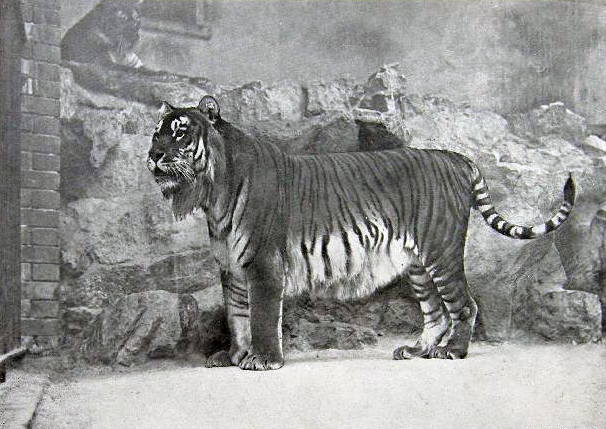
The tiger is believed extinct on the Korean peninsula, although there are occasional sighting reports. Now Korean scientists, while speaking of their nation's tiger in the past tense, report they have identified its proper classification and affiliation. Studies from tiger remains up to a century old indicate the Korean specimens were of the same subspecies as the Amur tiger, which is still hanging on (about 400 survive in the wild) in eastern Russia. Professor Lee Hang takes heart in this: "The fact that the Amur tiger and the Korean tiger are of the same bloodline means the Korean tiger is still alive."
There was an article linked to on FaceBook recently saying a Javan tiger had been caught in a camera trap, but I can't locate it now, and it was likely old or incorrect: that would have been worldwide news, as the Javan tiger is widely considered to have joined the Bali and Caspian tigers in the darkness of extinction in the 20th century. The Sumatran tiger isn't doing much better. it exists, but under extremely precarious conditions. So, as I wrote a few days ago, the global tiger population is up a bit, with some bright spots for subspecies like the Bengal tiger, but other populations (the aforementioned Amur, for example, and the South China tiger as well as the Sumatran) are still in deep trouble.
Everyone says William Blake's poem about the tiger was really about the Industrial Revolution or something, and Blake was a mystic who often melded themes, but has there ever been a better description? "Tiger, tiger burning bright / in the forests of the night / what immortal hand or eye / could frame thy fearful symmetry?"
This was the Caspian tiger, photographed on exhibit in Berlin in 1899.
Tuesday, January 15, 2013
Major Ferret Find!
The black-footed ferret was declared extinct at least twice before being rediscovered by a mixed-breed dog named Shep who dropped one on the porch of his house in Wyoming. Conservation biologists have put enormous effort into breeding them in captivity (there's a colony at the Cheyenne Mountain Zoo here in my hometown of Colorado Springs) and releasing them into the wild. A biologist from Columbus, Ohio has found something startling and potentially very important: a new wild population. Over fifty miles from any relocation site, Mike Gutzmer found three ferrets on the Standing Rock Indian Reservation in South Dakota. While the status of the ferrets is still being double-checked, the chance of introducing new genes into the population - all known ferrets are descended from 18 animals taken into captivity in a last-ditch effort to save the species - is exciting biologists. A "population bottleneck" is never a healthy thing, since the individuals bred from a small group will likely share some genetic weaknesses. Gutzmer may have made a giant step toward the permanent survival of the little black-masked outlaw of the prairies.
R.I.P., Ivan Mackerle
Anyone outside cryptozoology will likely be unfamiliar with this name. Ivan was a cryptozoologist, certainly the most eminent in the Czech Republic, but anyone can be "a cryptozoologist." What mattered, and why Macklerle mattered even though he never found a new species, is that he put his life where his mouth was. Over four decades, he traveled, paying out of his own pocket, to New Guinea, Australia, Brazil, Madagascar, and other far-flung places. He wanted to see everything for himself, look with his own eyes, follow up reports in person. Science depends on such people, be they amateur or Ph.D. Read Karl Shuker's tribute here.
Sunday, January 13, 2013
Cryptozoology is not Parapsychology
There's always been a little disturbance in the force known as cryptozoology, one that gives the field some of its difficulties in achieving scientific credibility. Some zoologists look askance at the whole endeavour because of the perceived focus on animals such as sasquatch which are perceived as highly unlikely, if not absurd. I have no problems here: as long as the chance of finding an animal is not zero, people can look without making the field scientifically invalid. In science, most long shots don't pay off, but some do. The key is whether searching is being done in a scientific manner, proceeding from the evidence to gather more evidence and meeting Popper's classic criteria of the falsifiable hypothesis. (There can be disagreement on how much negative evidence, or how strong a logical case, is needed to falsify a given hypothesis, but the point is that a hypothesis like "There is a large unknown primate in North America" is perfectly scientific. The means to search every possible chunk of forest habitat definitively are not available, but the reasoning is fine.)
Then we get into another problem: the allegedly paranormal/psychic/parapsychological nature proposed for some cases. I don't mean to pick on Nick Redfern, a very dedicated researcher, and a most enjoyable and often thought-provoking writer, but having just read his book Monster Diary, he is the example that comes to mind when thinking of people who class things that look like animals under cryptozoology, even if they are clearly not physical animals. I'm well aware that sane and sober people have reported apparitions, and I have no particular insight into what mix of causes is behind that phenomenon. It's not my field. But here's the part where I and Nick depart ways. He and other other like-thinking investigators argue that apparitions of animals are part of cryptozoolgy, and, as Nick puts it in his book, cryptozoologists in some cases will go on chasing sightings without results "unless the field of cryptozoology wakes up and and realizes that there needs to be a new approach to the subject."
I would flip that around. My position is that, if there is no physical animal, or no reasonable chance of one, the case no longer pertains to cryptozoology or any kind of zoology. If someone believes they saw a sabretooth tiger that disappeared into thin air, for example (and this happened, as Nick recounts) , then the fact that the apparition was in the form of an animal doesn't put the event under the heading of cryptozoology. It can be parapsychology or any other field one may think appropriate, but if it's not zoology, it's not cryptozoology. People who thing sasquatch is so elusive because it's not a material creature are welcome to hold that opinion, but they shouldn't call that topic part of cryptozoology. It's part of the whole business of apparitions and spirits and the paranormal. It also, critically, is not a falsifiable hypothesis (you can never prove such a belief to be wrong) and therefore is not part of the physical sciences. If a definitive search (in the cases where it's possible) fails to find an animal, then it's because the animal either did not exist in the area, has gone extinct, or has migrated elsewhere.
An animal is by definition a physical thing of flesh and blood. It's there or it's not. I don't dismiss the possibility of a nonmaterial reality: as a Christian, I believe strongly that the material universe is not all that exists. But an apparition is not an animal, any more than it can be a human being. It may be reported sincerely to look like one, or even act or sound like one, but that's not the same thing.
I wrote in my 2006 book Shadows of Existence that I was dismayed that a very good book by Healy and Cropper on Australian mystery animals spent a chapter on "zooform phenomena" after spending the rest of the book scientifically discussing unknown creatures. I feared that zoologists would dismiss the whole book because of this direction. I don't know how to take a survey on this, but I have no doubt I was right, and still am. Cryptozoology will never get the respect of zoology if paranormal entities are part of it.
And, if cryptozoology is the search for hidden ANIMALS, then they should not be. The experiences of people who see a big cat seemingly dive into the ground and vanish, or a small herd of camels appearing where none can be, are not beneath our notice. They are simply part of another field of study.
Then we get into another problem: the allegedly paranormal/psychic/parapsychological nature proposed for some cases. I don't mean to pick on Nick Redfern, a very dedicated researcher, and a most enjoyable and often thought-provoking writer, but having just read his book Monster Diary, he is the example that comes to mind when thinking of people who class things that look like animals under cryptozoology, even if they are clearly not physical animals. I'm well aware that sane and sober people have reported apparitions, and I have no particular insight into what mix of causes is behind that phenomenon. It's not my field. But here's the part where I and Nick depart ways. He and other other like-thinking investigators argue that apparitions of animals are part of cryptozoolgy, and, as Nick puts it in his book, cryptozoologists in some cases will go on chasing sightings without results "unless the field of cryptozoology wakes up and and realizes that there needs to be a new approach to the subject."
I would flip that around. My position is that, if there is no physical animal, or no reasonable chance of one, the case no longer pertains to cryptozoology or any kind of zoology. If someone believes they saw a sabretooth tiger that disappeared into thin air, for example (and this happened, as Nick recounts) , then the fact that the apparition was in the form of an animal doesn't put the event under the heading of cryptozoology. It can be parapsychology or any other field one may think appropriate, but if it's not zoology, it's not cryptozoology. People who thing sasquatch is so elusive because it's not a material creature are welcome to hold that opinion, but they shouldn't call that topic part of cryptozoology. It's part of the whole business of apparitions and spirits and the paranormal. It also, critically, is not a falsifiable hypothesis (you can never prove such a belief to be wrong) and therefore is not part of the physical sciences. If a definitive search (in the cases where it's possible) fails to find an animal, then it's because the animal either did not exist in the area, has gone extinct, or has migrated elsewhere.
An animal is by definition a physical thing of flesh and blood. It's there or it's not. I don't dismiss the possibility of a nonmaterial reality: as a Christian, I believe strongly that the material universe is not all that exists. But an apparition is not an animal, any more than it can be a human being. It may be reported sincerely to look like one, or even act or sound like one, but that's not the same thing.
I wrote in my 2006 book Shadows of Existence that I was dismayed that a very good book by Healy and Cropper on Australian mystery animals spent a chapter on "zooform phenomena" after spending the rest of the book scientifically discussing unknown creatures. I feared that zoologists would dismiss the whole book because of this direction. I don't know how to take a survey on this, but I have no doubt I was right, and still am. Cryptozoology will never get the respect of zoology if paranormal entities are part of it.
And, if cryptozoology is the search for hidden ANIMALS, then they should not be. The experiences of people who see a big cat seemingly dive into the ground and vanish, or a small herd of camels appearing where none can be, are not beneath our notice. They are simply part of another field of study.
Saturday, January 12, 2013
Death Star remains fiction: What about NASA?
The White House has responded to a petition by declaring it will not put a Death Star into the budget anytime soon. Paul Shawcross wrote that the government is not into blowing up planets and can't find room for the $850,000,000,000,000,000 necessary. Shawcross went on to point out there are some really interesting space hardware items already out there, including the ISS and the Mars rovers. "Even though the United States doesn't have anything that can do the Kessel Run in less than 12 parsecs, we've got two spacecraft leaving the Solar System and we're building a probe that will fly to the exterior layers of the Sun. We are discovering hundreds of new planets in other star systems and building a much more powerful successor to the Hubble Space Telescope that will see back to the early days of the universe."
Shawcross doesn't mention a lot of htings, though. Like the U.S. being dependent on Russia for human access to space for the next few years. Like the Administration's goal of eventually (long after it has left office) landing on an asteroid being rejected by nearly everyone in the space and science communities as a bizarre detour from an intelligent program to explore the Moon and Mars. Like the savage budget cutting of the planetary sciences program: the spacecraft now up there or now under contruction are essentially all there is. The Administration and Congress have determined that NASA's one half of one percent of hte Federal budget is some kind of indulgence rather than a future-oriented driver of technical and scientific progress with very real economic benefits. Darth Vader would find this lack of faith disturbing.
Shawcross doesn't mention a lot of htings, though. Like the U.S. being dependent on Russia for human access to space for the next few years. Like the Administration's goal of eventually (long after it has left office) landing on an asteroid being rejected by nearly everyone in the space and science communities as a bizarre detour from an intelligent program to explore the Moon and Mars. Like the savage budget cutting of the planetary sciences program: the spacecraft now up there or now under contruction are essentially all there is. The Administration and Congress have determined that NASA's one half of one percent of hte Federal budget is some kind of indulgence rather than a future-oriented driver of technical and scientific progress with very real economic benefits. Darth Vader would find this lack of faith disturbing.
Friday, January 11, 2013
Giving up on China's Wildman?
The buzz about a "wildman" (presumed to be an unknown upright primate) in the undeveloped regions of China has periodically made it into the popular, and even the sceintific, press, as hairs or body parts not immediately identified have been found and eyewitness reports collected. Now, though, an anthropologist who has followed the topic for half a century reports "...a Chinese Wildman of biological significance still has not been shown to exist, and simply may not exist." All the biological samples in Bejing anthropologist
Zhou Guoxing's collection have turned out to be from known creatures, and he classes the most detailed eyewitness accounts as fabrications. His disappointment is evident - he was once an enthusiastic field investogator of Wildman tales - but this is where the evidence has led him.
COMMENT: Darn. There were times when this case looked really intriguing.
COMMENT: Darn. There were times when this case looked really intriguing.
A better look at "hobbits"
Just over a meter tall, the "hobbits" of Flores weren't very impressive physically. They had longer arms than legs, and their sloping foreheads and chinlessness made them look less like us than we might picture. However, they were still, as further confirmed by new fossils, genuine humans, as in a species in the genus Homo. While their brains were the size of, or at least not much larger than, those of chimpanzees, those brains were developed enough to allow them stone tools and the use of fire. (Intelligence is correlated with brain size and brain-to-body-size ratio, but isn't directly equivalent - the structure of the brain matters more.) The tool-making is interesting, because their wrists and hands were more "primitive" (essentially, more apelike) than ours, but they managed. It seems too much to ask of "hobbits" that they should have oversized feet, but they actually did. So where did H. floresiensis come from? The popular theory is that they were an "island dwarfed" population of Homo erectus, although H. erectus fossils show some features more advanced. DNA studies on the bones haven't been done yet, and we still have only one complete cranium, so there's a lot more to learn.
Wednesday, January 09, 2013
The first great predatory reptile
What replaced the fearsome Dunkleosteus terrelli as top predator of the seas? The sharks survived the Permian extinction, but the large marine reptiles arose much more quickly than we previously thought. This 8-meter monster appeared at least 244 million years ago. It was shaped something like an oversized four-flippered dolphin, but the head is unmistakeably that of an apex predator. Thalattoarchon saurophagis ("lizard-eating ruler of the sea") was the first of the icthyosaurs, which would go on to produce giants three times this length - or more.
Giant Squid - coming on Discovery Channel!
Not many years ago, Richard Ellis, writing on the subject of giant squid being taken for "sea serpents," notes one problem was a lack of comparative observations: "No one has ever seen a healthy giant squid doing anything." While we now have video of a hooked squid and various other observations, what we still don't have is video of Architeuthis hunting in its natural habitat. Well, now we do, and it's coming to Discovery Channel on January 27. The squid was about three meters long and was videotaped at a depth of 640 meters. (It would be "more giant" than 3m, but it was missing its two long tentacles, presumably bitten off by a whale or shark.) A Japanese expedition got the footage by using a custom-designed camera that operated on a wavelength of light that squid can't see.
Here's the question we still don't have the answer to: how giant does the giant squid get? Confirmed lengths of 18-20 meters are probably not the uppermost end of the scale. There are several 25-30m claims, and one of nearly 55m (OK, I'm writing that one off.) But the appellation "giant" still fits in any case.
Tune in!
Here's the question we still don't have the answer to: how giant does the giant squid get? Confirmed lengths of 18-20 meters are probably not the uppermost end of the scale. There are several 25-30m claims, and one of nearly 55m (OK, I'm writing that one off.) But the appellation "giant" still fits in any case.
Tune in!
Sunday, January 06, 2013
Tigers: A little Good News
Tigers, as a whole, have taken it hard fro m humanity for the last two centuries. The Javan tiger is extinct; the Sumatran and South China tigers are on the edge; continued poaching and habitat destruction have ground down the remaining populations. So it's very nice to see this article. While the The Wildlife Conservation Society estimates there are only 3,200 tigers in the wild, that's actually an uptick. Years of all-out effort by the WCS, the government of India, and other conservation organizations have resulted in a surplus (from a total population of 600 or so) of tigers in the region containing the Nagarahole and Bandipur National Parks. Efforts in China, Russia, and Thailand are making progress, including rising or at least stable tiger populations thanks to increased arrests and stiffer punishments of poachers.
I was pessimistic in my 1995 book Rumors of Existence, quoting the IUCN's Peter Jackson (not the filmmaker) as saying, “It is my belief that the end of the tiger is in sight, probably within ten years." The situation is still critical, especially for the Sumatran subspecies (or species, depending on which authority one references), but we've shown that we can do some good for tigers in the wild. We need to keep it up.
I was pessimistic in my 1995 book Rumors of Existence, quoting the IUCN's Peter Jackson (not the filmmaker) as saying, “It is my belief that the end of the tiger is in sight, probably within ten years." The situation is still critical, especially for the Sumatran subspecies (or species, depending on which authority one references), but we've shown that we can do some good for tigers in the wild. We need to keep it up.
How big was the biggest bear?
How big do bears get - and how big did they use to get?
The 500-kg range seems about the upper limit for modern brown bears, with polars getting a little bigger. There are always stories of bigger ones (the best attested being a polar bear who weighed roughly a metric ton) and we have, of course, the prehistoric giants. My favorite, the short-faced bear, was longer and taller than any modern bear, although there is disagreement over whether he was heavier. Recent fossils from S. America, though, indicate he had still bigger relatives, bears that would make a huge modern Kodiak poop in his fur. This researcher has collected a lot of the accounts of outsized modern Kodiaks and polars. It's not all scientific data - skins are stretched, weights get exaggerated, and so on - but it's pretty darned eye-popping.
He leaves out Samson. Samson was a bear trapped alive by John (not James) "Grizzly" Adams and hauled to antebellum New York to be exhibited. He made a sensation. He was the biggest bear Adams had ever seen in many years of hunting grizzlies, and when put on a hay scale he weighed 1,503 lbs. (It's possible he had gained some "cage fat" by this point, but still, Adams' description of him as a "moving mountain" seems justified. I've never read what happened to his remains.
The 500-kg range seems about the upper limit for modern brown bears, with polars getting a little bigger. There are always stories of bigger ones (the best attested being a polar bear who weighed roughly a metric ton) and we have, of course, the prehistoric giants. My favorite, the short-faced bear, was longer and taller than any modern bear, although there is disagreement over whether he was heavier. Recent fossils from S. America, though, indicate he had still bigger relatives, bears that would make a huge modern Kodiak poop in his fur. This researcher has collected a lot of the accounts of outsized modern Kodiaks and polars. It's not all scientific data - skins are stretched, weights get exaggerated, and so on - but it's pretty darned eye-popping.
He leaves out Samson. Samson was a bear trapped alive by John (not James) "Grizzly" Adams and hauled to antebellum New York to be exhibited. He made a sensation. He was the biggest bear Adams had ever seen in many years of hunting grizzlies, and when put on a hay scale he weighed 1,503 lbs. (It's possible he had gained some "cage fat" by this point, but still, Adams' description of him as a "moving mountain" seems justified. I've never read what happened to his remains.
Saturday, January 05, 2013
Mapping Bigfoot
How do you map a creature not proven to exist? It's not easy. It inevitably involves subjective judgments about which sightings, footprints, etc. are considered credible enough to include.
But this fellow has put an enormous amount of effort into the attempt, and I salute him for that. The sightings he includes reflect human population in many areas, notably Florida and the Northeast. The Pacific Northwest has, as you'd expect, a cluster of sightings that exceeds what you'd see if sightings were strictly a reflection of human population density or numbers.
This map shows one of the problems with Bigfoot in general. It is impossible - not unlikely, impossible - that a large unknown mammal exists in nearly every US state and Canadian province. A range covering most of North America, including the most populous areas, argues against the chance such a species exists at all: the odds of it going undiscovered are too great.
IF Bigfoot turns out to be real, I'd expect a cluster of up to a few hundred in the Northwest, possibly with some small relict populations as geographical outliers, reflecting a wider distribution thousands of years ago. Despite the number of sightings and the dedicated efforts of searchers, I'd be stunned if anyone ever turned up solid proof of such an animal in the Northeastern or Southeastern US.
But this fellow has put an enormous amount of effort into the attempt, and I salute him for that. The sightings he includes reflect human population in many areas, notably Florida and the Northeast. The Pacific Northwest has, as you'd expect, a cluster of sightings that exceeds what you'd see if sightings were strictly a reflection of human population density or numbers.
This map shows one of the problems with Bigfoot in general. It is impossible - not unlikely, impossible - that a large unknown mammal exists in nearly every US state and Canadian province. A range covering most of North America, including the most populous areas, argues against the chance such a species exists at all: the odds of it going undiscovered are too great.
IF Bigfoot turns out to be real, I'd expect a cluster of up to a few hundred in the Northwest, possibly with some small relict populations as geographical outliers, reflecting a wider distribution thousands of years ago. Despite the number of sightings and the dedicated efforts of searchers, I'd be stunned if anyone ever turned up solid proof of such an animal in the Northeastern or Southeastern US.
Friday, January 04, 2013
Humans, Be Not Proud: Last Vietnamese rhino extinct
One of the startling large-mammal discoveries of the recent years was the finding that the critically endangered Javan rhinocerous, long presumed extinct on the Asian mainland, survived in Vietnam.
Well, not anymore.
The Vietnamese subspecies of the Javan rhino was down to one animal in Cat Tien National Park in 2009. Someone should have made the decision to take it into captivity: in April 2010, it was shot by a poacher and its horn stolen.
There are maybe three dozen Javan rhinos left in Indonesia.
Sometimes I want to resign from my species.
Well, not anymore.
The Vietnamese subspecies of the Javan rhino was down to one animal in Cat Tien National Park in 2009. Someone should have made the decision to take it into captivity: in April 2010, it was shot by a poacher and its horn stolen.
There are maybe three dozen Javan rhinos left in Indonesia.
Sometimes I want to resign from my species.
Physics: reaching impossible temperatures
It's sometimes said that the politics of the extreme right and the extreme left merge, creating a circle rather than a continuum. Could the same be true of temperatures?
Well, no. When all atomic motion is stopped, absolute zero (0 Kelvin) is reached, and you can't go any further.
Only you can.
It turns out that a situation can be created where atoms are impossibly cold. At the same time, they are impossibly hot. Negative temperatures - essentially temperatures for which the all-inclusive Kelvin scale does not exist - have been demonstrated in a lab. Atoms in this state attract each other. This state can only exist at negative pressure. It is, in other words, impossibly weird.
In theory, this could one day be put to use, with engines that are more than 100% efficient. Can's wrap your mind around that? Me neither. Such engines would not only absord energy from hotter regions, but colder ones as well. It's way off. But it's only the beginning of theorizing about a realm we thought could not exist.
Well, no. When all atomic motion is stopped, absolute zero (0 Kelvin) is reached, and you can't go any further.
Only you can.
It turns out that a situation can be created where atoms are impossibly cold. At the same time, they are impossibly hot. Negative temperatures - essentially temperatures for which the all-inclusive Kelvin scale does not exist - have been demonstrated in a lab. Atoms in this state attract each other. This state can only exist at negative pressure. It is, in other words, impossibly weird.
In theory, this could one day be put to use, with engines that are more than 100% efficient. Can's wrap your mind around that? Me neither. Such engines would not only absord energy from hotter regions, but colder ones as well. It's way off. But it's only the beginning of theorizing about a realm we thought could not exist.
Wednesday, January 02, 2013
Where be dragons?
Everyone loves dragons. Fictitious ones. As Ben Radford notes here, there are some bits of fact mixed with the fun. One comes from paleontology: bones of dinosaurs and giant prehistoric mammals were naturally ascribed to monsters, especially those already established in such sources as the Bible's Old Testament. Another source is the exaggeration of real creatures, such as crocodiles. Naming the world's largest lizard the Komodo dragon is a demonstration of the fascination we have with such creatures. (Douglas Adams wrote that his mind reeled when seeing one on display- "...ten feet long and a yard high is entirely the wrong size for a lizard to be.") In modern fiction, J.R.R. Tolkien gave us Smaug, plus occasional references to "worms" with names like Scatha and Ancalagon the Black. Anne McCaffery gave us the Dragonflight books, and dragons appear in countless other stories (to cite one of the more obvious examples, see the Dungeons and Dragons games and books). In Chinese folklore, dragons were wise and snakelike: in European tales, they had batlike wings and died out at the hands of Saint George and his kind. (The European dragon, incidentally, is almost always drawn with unrealistically small wings for any living creature, compared to the body size: when Chinese dragons fly, they do it by magic and dispense with the whole business of wings.)
Real modern dragons? Well, without dinosaurs in the world (with apologies to some fellow cryptozoologists, we're not going to find live dinos of any sort in Africa or anywhere else), crocodiles and Komodos are the best we have. And occasional "dragon photographs" circulated on the Net are beyond silly. The sirrush, that odd dragonlike creature on Babylon's Ishtar gate, is interesting, though there's no reason to suppose it real. Maybe it, too, was born of the imaginative interpretation of dinosaur bones. Modern studies of dinosaurs have given us creatures so fantastic that they outshine their make-believe counterparts.
So we had dragons. We just came along too late to see them.
P.S. In addition to a new book Ben mentions, Karl Shuker wrote a splendid dragon book.
Real modern dragons? Well, without dinosaurs in the world (with apologies to some fellow cryptozoologists, we're not going to find live dinos of any sort in Africa or anywhere else), crocodiles and Komodos are the best we have. And occasional "dragon photographs" circulated on the Net are beyond silly. The sirrush, that odd dragonlike creature on Babylon's Ishtar gate, is interesting, though there's no reason to suppose it real. Maybe it, too, was born of the imaginative interpretation of dinosaur bones. Modern studies of dinosaurs have given us creatures so fantastic that they outshine their make-believe counterparts.
So we had dragons. We just came along too late to see them.
P.S. In addition to a new book Ben mentions, Karl Shuker wrote a splendid dragon book.
Tuesday, January 01, 2013
The onza - a success for cryptozoology
The onza, the mysterious big cat of Mexico, is a cryptozoological success story.
That may sound funny, considering the only whole specimen examined was a definite member of the known species Puma concolor, the puma, panther, or cougar. But bear with me.
The
onza was generally consigned to folklore, despite reports from Americans such as Dale Lee. Lee, a professional hunting guide who had shot nearly 500 panthers, reported killing
an onza in 1938. He
wrote that the slender, long-eared animal "differs from any of the cat tribe I ever saw." J. B. Tinsley, in his 1987 book The Puma, reproduces photographs of this cat
and of a similar beast killed by a trapper named Ruggles in
1926.
The onza story languished until 1985, when Mexican rancher Andres Murillo shot a cat he didn't recognize. Fortunately, the man had heard of the legendary onza and was curious enough to contact an interested friend who knew American zoologist/cryptozoologist J. Richard Greenwell. Greenwell teamed up with a leading mammologist and puma expert, Auburn University's Dr. Troy Best, and the two brought the carcass in for study. They also tracked down two other onza skulls. One of these dates from 1938 (it is not from Lee's specimen, so it seems two onzas were killed that year) and the other from about 1975. The onza, from the specimen, looked like a panther, but with longer legs and
The onza story languished until 1985, when Mexican rancher Andres Murillo shot a cat he didn't recognize. Fortunately, the man had heard of the legendary onza and was curious enough to contact an interested friend who knew American zoologist/cryptozoologist J. Richard Greenwell. Greenwell teamed up with a leading mammologist and puma expert, Auburn University's Dr. Troy Best, and the two brought the carcass in for study. They also tracked down two other onza skulls. One of these dates from 1938 (it is not from Lee's specimen, so it seems two onzas were killed that year) and the other from about 1975. The onza, from the specimen, looked like a panther, but with longer legs and
a slimmer build.
The ears were long, and on the inside of the tawny cat's front legs were dark horizontal
stripes. The type specimen, a female about four years old, weighed
less than 60 pounds, considerably less than a normal panther its
size. The researchers wondered at first whether the specimen was
starving or diseased, but it proved to be healthy and well-fed.
As Dr. Best explained to me even before the studies were complete, one specimen and two skulls don't provide enough material for a conclusion about the onza's classification. I wrote in 1995 that "We may be dealing with a panther subspecies, a local variation, or even just a recurring abnormality born of normal panther parents. A complication is that there are few "normal" puma specimens from that region of Mexico to compare the onza with."
As Dr. Best explained to me even before the studies were complete, one specimen and two skulls don't provide enough material for a conclusion about the onza's classification. I wrote in 1995 that "We may be dealing with a panther subspecies, a local variation, or even just a recurring abnormality born of normal panther parents. A complication is that there are few "normal" puma specimens from that region of Mexico to compare the onza with."
Well, eventually a full analysis was done and published, and there was no longer any doubt about the puma identity. It wasn't even named as a new subspecies. It appears to be an oddball, born occasionally the way the strikingly marked "king " cheetah of Africa is, to normal-looking parents. We don't know how common an occurrence this is, but it certainly isn't frequent: no one has claimed a new onza specimen since.
So why was this a success? Because the animal was identified. A proper scientific investigation was done. And, most importantly, in the late 20th century on a relatively well-known continent, a strikingly different animal reported by witnesses recent and historical was confirmed to exist. That the appearance is essentially skin-deep, and the animal wasn't a new type, is secondary. Like the elephants of Bardia National Park (huge, dome-headed specimens of the Indian elephant), the most crucial thing is that witnesses who said they saw a weird-looking large mammal were right. Such witnesses are not always right, but they were this time. Mother Nature, it turned out, still had her secrets.
Bille, Matt. 1995. Rumors of Existence. Hancock House.
Best, Troy.
1993. Personal
communication, January 15.
James, Jamie.
"Bigfoot or Bust,"
1988. Discover, March.
Greenwell, J. Richard. 1992. Personal
communication, July 7.
Marshall, Robert E. 1961. The Onza. New York: Exposition Press.
Shuker, Karl. 2012. The Encyclopedia of New and Rediscovered Animals. Coachwhip Publications.
Marshall, Robert E. 1961. The Onza. New York: Exposition Press.
Shuker, Karl. 2012. The Encyclopedia of New and Rediscovered Animals. Coachwhip Publications.
Tinsley, Jim Bob. 1987. The Puma. El
Paso: Texas Western Press.
Is this life?
Lee Cronin of the University of Glasgow thinks it's close. He's developed iCHELLS, small bubbles based on "large polyoxometalates derived from a range of metal atoms, like tungsten" that duplicate some functions of life, like letting in "nourishment" and maybe, soon, evolution in response to their environment. Oh, and a kind of photosynthesis is in the early, but promising, stages.
COMMENT: Life? No. What he's created, to me, is more of a micro-robot that functions by aping some life processes. And evolution by itself is something many software programs have demonstrated. But that's not to knock the rather fascinating experiments going on here. I wonder if these bubble cells, tweaked for different environments, can be used in an adaptive swarm to explore or, eventually, terraform other bodies like asteroids.
COMMENT: Life? No. What he's created, to me, is more of a micro-robot that functions by aping some life processes. And evolution by itself is something many software programs have demonstrated. But that's not to knock the rather fascinating experiments going on here. I wonder if these bubble cells, tweaked for different environments, can be used in an adaptive swarm to explore or, eventually, terraform other bodies like asteroids.
Subscribe to:
Posts (Atom)