Sunday, October 21, 2012
Life in Lake Vostok? Nyet
Russan explorers drilled through kilometers of ice to a huge lake of liquid water beneath Antarctica, known as Lake Vostok. They hit the lake's surface in February, though pressure under the ice caused a 40m column of water - which, of course, immediately froze - in the borehole. So they augured out the ice and brought it to the surface. Evidence of ancient microscopic life? Disappointingly, the word so far is no. There are plans to sample other areas and greater depths.


Saturday, October 20, 2012
Big Bigfoot Photo Discussion
Readers will know I am skeptical of Bigfoot. While Robert Pyle's book Where Bigfoot Walks convinced me a large primate in N. America wasn't impossible from an ecological point of view, it still seemed unlikely that we have missed such a species, even if it's smart, wary, and rare. Since the Patterson/Gimlin film of 1967 (still hotly disputed) there have been countless fuzzy films and photos - Loren Coleman calls them "blobsquatches" - that I took one look at and dismissed.
But one from Washington is kind of interesting.
For one thing, I know one expedition member, Lori Simmons, who was a local addition to the cryptozoologists led by Adam Davies. The one thing I can testify to is that Lori is honest and this wasn't a hoax on her part.
They were camped at a public campground, with an infrared camera trap in place, and something walked through the frame, bent over the sleeping-bagged expedition members, and moved on. The shape is about five feet high. I'd class it as human except its brightness on the infrared is fairly even all over the body which tends to indicate the consistent surface temperature of a warm body, and I'd assume a human in a hoodie or parka would show at least a small change where the pants begin. I don't have the expertise to be definitve, though.
But one from Washington is kind of interesting.
For one thing, I know one expedition member, Lori Simmons, who was a local addition to the cryptozoologists led by Adam Davies. The one thing I can testify to is that Lori is honest and this wasn't a hoax on her part.
They were camped at a public campground, with an infrared camera trap in place, and something walked through the frame, bent over the sleeping-bagged expedition members, and moved on. The shape is about five feet high. I'd class it as human except its brightness on the infrared is fairly even all over the body which tends to indicate the consistent surface temperature of a warm body, and I'd assume a human in a hoodie or parka would show at least a small change where the pants begin. I don't have the expertise to be definitve, though.
The original links published with this post are no longer operative. The Bigfoot News post here dismisses the incident completely.
(EDITED 2021 with updated links and text)
Friday, October 19, 2012
Update on latest new primate species
First seen in 2007
This striking new monkey was found - as other species in Africa and South America have been - kept as a pet in a small village.
The headline from the UK Register is hard to top:
New monkey species with massive blue arse found in Africa
Possibly record-breaking buttocks stun boffinry world How do I top that? The discoverers warn: "The challenge for conservation now in Congo is to intervene before losses become definitive. Species with small ranges like the lesula can move from vulnerable to seriously endangered over the course of just a few years."
This striking new monkey was found - as other species in Africa and South America have been - kept as a pet in a small village.
The headline from the UK Register is hard to top:
New monkey species with massive blue arse found in Africa
Possibly record-breaking buttocks stun boffinry world How do I top that? The discoverers warn: "The challenge for conservation now in Congo is to intervene before losses become definitive. Species with small ranges like the lesula can move from vulnerable to seriously endangered over the course of just a few years."
Wednesday, October 17, 2012
One more bit on DNA
The first-ever podcast of Monster Talk, saved here in a transcript, includes a well-qualified scientist explaining what you do with possible sasquatch (or other cryptid) DNA and how you determine what it may be close to.
More on DNA testing project
Here's a site with some additional information, including a TODAY show interview with Dr. Bryan Sykes. If his project finds nothing, that will not prove the NON-existence of unknown primates, but I think it will lead to most scientists writing it off (even more than the number who write it off now.)
On the other hand....
Let's take an example: possible sasqutch hair sent in from North America.
The challenge in establishing that a hair sample is from sasquatch is that we don't have a proven sasquatch specimen to compare it to. And certainly it's not surprising that some hair could be mixed: if a bigfoot used an old bear den, for example.
But if Sykes comes back and says something like, "This is a clean, uncontaminated sample with good recoverable DNA, and the DNA is different from all known North American mammals," that will be a very big deal, I expect. At the least, it should create more interest and get more evidence gathered and tested.
I did a little logic exercise here where I tried to imagine what could be the cause if good DNA of an unknown animal was proven.
A ruling of "unknown" could mean only four things:
1. It's sasquatch.
2. The test was messed up. This is unlikely given Sykes' expertise and who he works for.
3. It's a sample from some little-known non-native animal, a South American monkey for example, that someone, for unknown reasons, went and planted way out in the woods. That would be pretty hard to believe, because unless the hoaxer knew exactly where and when a search was happening, any hair sample planted in the woods would be likely to blow away long before anyone found it. Very, very unlikely.
4. There is some OTHER unknown mammal in the area. That's very, very, VERY unlikely.
So I am waiting with everyone else :)
On the other hand....
Let's take an example: possible sasqutch hair sent in from North America.
The challenge in establishing that a hair sample is from sasquatch is that we don't have a proven sasquatch specimen to compare it to. And certainly it's not surprising that some hair could be mixed: if a bigfoot used an old bear den, for example.
But if Sykes comes back and says something like, "This is a clean, uncontaminated sample with good recoverable DNA, and the DNA is different from all known North American mammals," that will be a very big deal, I expect. At the least, it should create more interest and get more evidence gathered and tested.
I did a little logic exercise here where I tried to imagine what could be the cause if good DNA of an unknown animal was proven.
A ruling of "unknown" could mean only four things:
1. It's sasquatch.
2. The test was messed up. This is unlikely given Sykes' expertise and who he works for.
3. It's a sample from some little-known non-native animal, a South American monkey for example, that someone, for unknown reasons, went and planted way out in the woods. That would be pretty hard to believe, because unless the hoaxer knew exactly where and when a search was happening, any hair sample planted in the woods would be likely to blow away long before anyone found it. Very, very unlikely.
4. There is some OTHER unknown mammal in the area. That's very, very, VERY unlikely.
So I am waiting with everyone else :)
Seeking sasquatch in the lab
Even if unknown hominids exist and are wary or lucky enough to avoid having corpses found so far, you can't move through the forests without leaving evidence. Hair, saliva, feces, etc. can all provide DNA evidence if studied by a modern lab with the proper tools. And so the Oxford-Lausanne Collateral Hominid Project, the brainchild of researchers from Switzerland and the UK, is underway. Bryan Sykes of Oxford says, "It’s one of the claims by cryptozoologists that science does not take them seriously. Well, this is their chance. We are calling for people to send us their evidence, and we will test it through DNA analysis." So the evidence is on its way in - from Asia, from, from North America, from seemingly everywhere - as cryptid-hunters share their best evidence. We will watch and wait... and, even the most hardened skeptics, will agree, we'll all hope for something spectacular.
Nazis, Mengele, twins.... fiction
A National Geographic special probing the alleged role of Dr. Josef Mengele, ex-Nazi, in the birth of numerous sets of blond twins has come up with no link stronger than folklore. While one Brazilian town of 7,000 does have an anomalously high rate of twins (the blond part is not so surprising, since many Germans fled there), wild claims of Nazi experiments can now be dismissed.
COMMENT: Mengele had nothing to do with this for the same reason he had nothing to do with the fake aliens of Area 51 alleged in a recent book. Not only was the science required a generation (at least) ahead of his time, but he had no idea how to do science. His barbaric tortures were on the most primitive level (injecting dye into the eye to see if they changed color, for example). So we're down to environmental contaminants (possible) or the effects of one or two families with genes predisposing them to a high twin rate becoming established in the lightly-populated region around Cândido Godói and having a disproportionate influence on future births. We don't even know that Mengele was ever there, although some witness recollections indicate he may have visited.
COMMENT: Mengele had nothing to do with this for the same reason he had nothing to do with the fake aliens of Area 51 alleged in a recent book. Not only was the science required a generation (at least) ahead of his time, but he had no idea how to do science. His barbaric tortures were on the most primitive level (injecting dye into the eye to see if they changed color, for example). So we're down to environmental contaminants (possible) or the effects of one or two families with genes predisposing them to a high twin rate becoming established in the lightly-populated region around Cândido Godói and having a disproportionate influence on future births. We don't even know that Mengele was ever there, although some witness recollections indicate he may have visited.
Monday, October 15, 2012
Endangered primates: 25 too many
Newest list of 25 on the edge
The International Union for Conservation of Nature released its list of the 25 most endangered primates in the world. (Sadly, that's not all the endangered ones.) Six are lemurs: the attention brought to lemurs by the Madagascar films (although they have been beneficial) have not taken them off the endangered list. As one conservationist said, "Lemurs are now one of the world's most endangered groups of mammals, after more than three years of political crisis and a lack of effective enforcement in their home country, Madagascar." Asia, though, is first with nine species on the list. Dr. Russell Mittermeier adds, "Amazingly, we continue to discover new species every year since 2000."
The full report is here.
The International Union for Conservation of Nature released its list of the 25 most endangered primates in the world. (Sadly, that's not all the endangered ones.) Six are lemurs: the attention brought to lemurs by the Madagascar films (although they have been beneficial) have not taken them off the endangered list. As one conservationist said, "Lemurs are now one of the world's most endangered groups of mammals, after more than three years of political crisis and a lack of effective enforcement in their home country, Madagascar." Asia, though, is first with nine species on the list. Dr. Russell Mittermeier adds, "Amazingly, we continue to discover new species every year since 2000."
The full report is here.
Saturday, October 13, 2012
Can a chimp understand what a photograph is?
When a friend asked me this, my first thought was "no." I'd never read of it, and recognizing a photo requires some abstract thinking beyond what we usually ascribe to even the smartest nonhuman mammals. Well, it looks like I was wrong. Chimps have associated a photo with a human in studies that concluded "Results indicate that the chimpanzee is able to recognize individual humans from novel photographic representations." Other studies who chimps can recognize each other in photos. There is even IgNobel Prize-winning research (done in California - why does that not surprise me? ) that shows a chimp can recognize another chimp from a photo of its butt. It can also tell the sex of another chimp from a butt photo. I'm not sure what conclusions can be drawn from that. Maybe a chimp could tell me.
Thursday, October 11, 2012
Who knew? The vampire squid is boring
Any creature whose scientific name translates as "vampire squid from hell" is supposed to be lethal and scary, even if it's small. But it turns out our friend the vampire squid doesn't go for "lethal." Unlike practically every other creature in the whole octopus/squid group, it fishes little bits of detrius from the organic "snow" that falls through the oceans from the carnage of predators and prey above. What a waste. So to speak.
An interesting "sea serpent" tale
This is from the blog of cryptozoologist Malcolm Smith. He heard it from a single witness, though the man said he had a companion. It's unusual in that it was an underwater report, of which there are very few, of an elongated marine creature of unknown type. The witness, Mike Cleary, told Malcolm that he was diving in a bell at some 500 meters depth to look at oil-drilling sites in the early 1990s (This is a point I'll look up - I thought everyone used submersibles these days?) In any event, Mr. Cleary said a creature some 8m long, elongated, with a dorsal fin like an eel's swam into view. Well, I am one who is of the opinion there is a giant eel or eellike fish behind some "sea serpent" reports, but this report is odder than usual because the animal had two sets of limbs, vs. the single pair of all known eels, and - here's the really hard part - Cleary was insistent these were webbed limbs and not fins.
So there we have it. Was the witness making it up? Possibly, but it's the other possibility that is more interesting to contemplate - that Cleary saw a real animal. A very elongated pinniped? A freak giant eel with extra limbs? None of these is very likely, but the sea is a very big place even in the modern world.....
So there we have it. Was the witness making it up? Possibly, but it's the other possibility that is more interesting to contemplate - that Cleary saw a real animal. A very elongated pinniped? A freak giant eel with extra limbs? None of these is very likely, but the sea is a very big place even in the modern world.....
Wednesday, October 10, 2012
E.T., phone your publisher
On the 30th anniversary of Spielberg's marvelous film, io9.com reviews a commemorative book that contains all kinds of stuff I didn't know. Harrison Ford actually shot scenes (later cut) as the school principal? Melissa Mathison had to be begged and practically mugged into writing the screenplay? The new item I like best, though, is Spielberg's statement that he hoped to foster the desire to explore space: "If the government won't fund the space program, to allow people's imagination to soar, then all I can do is make movies that bring space down to earth and make it more accessible to the imagination."'
I met Spielberg once, or at least hung around him, when I was an extra on the film 1941. He's one of these rare people that seems to have this aura around him that makes the air crackle, telling you "This is THE BOSS MAN."
I met Spielberg once, or at least hung around him, when I was an extra on the film 1941. He's one of these rare people that seems to have this aura around him that makes the air crackle, telling you "This is THE BOSS MAN."
Tuesday, October 09, 2012
SpaceX, We've had a problem
I'm a big fan of SpaceX, the Apple Computer of the space launch world, the upstarts who are turning that industry on its head. Inevitably, though, there are glitches on the road to doing something this complicated. While the Dragon capsule is on its way to the ISS, a secondary mission, putting an Orbcomm 2 communications satellite in orbit, was compromised. It looks like when the Falcon 9 lost an engine, the second stage had to help correct the trajectory, and in so doing put the secondary payload, the Orbcomm, in an orbit much lower than planned. Much of the satellite's function can be saved, since it was a test model for a constellation to follow, but it's a reminder that space flight is still hard and even the most brilliant engineers are still human. SpaceX remains a big success story so far: they'll just have to try a little harder.
UPDATE: We have docking! Dragon has docked with the International Space Station. Good job, everyone!
UPDATE: We have docking! Dragon has docked with the International Space Station. Good job, everyone!
Farewell, Shuttle: 15 great photos
This is from 2011, but I missed it then, and I certainly don't care :) This collection of 15 stunning photographs of the Shuttle, from the crowds camped out at Edwards AFB to see the first return (I was there!) to awesome in-space photos to a poignant reminder of the risks of space flight, is wonderful. Only a couple have been widely circulated, which makes this collection worth perusing for any space buff.
Monday, October 08, 2012
Revisiting Air Force's flying saucer idea
Way back in the 1950s, the USAF looked at jet-powered saucers and initially thought they might work. Project 1794, though, was a complete fizzle: it produced nothing but a prototype called the AvroCar that was just an inefficient hovercraft. This story is being trumpeted as news, as here, but in fact it's been known since the early 60s at least. All that is new is declassification of a specific document. The Air Force's idea never went anywhere for the same reasons no one (Nazis included) ever made a flying saucer work: it's a terrible shape to control in the atmosphere, offering no advantage over conventional aircraft. While a saucer would work fine in space, where shape doesn't matter, that's no reason to build one. An interesting sidelight, though, is that a round, nearly flat shape works nicely for aerobraking in the transition to planetary atmospheres. That's why Apollo capsules were such broad cones and the Mars orbiter Curiosity looked very much like a flying saucer to an observer on Mars.
SpaceX Dragon makes orbit despite losing engine
The video is pretty dramatic.
One reason behind SpaceX's Falcon 9 launcher's being designed with 9 engines was to allow "engine-out capability." (Another was to allows mass production of small engines for the cost advantages.) This one is not just a shutdown, though - you can see substantial pieces of an engine bell (nozzle) flying off. NASA will no doubt want some more analysis and assurance despite the success. The other medium-lift rocket builders, Boeing and LockMart, have proven they can build superbly reliable rockets, although at very high prices. SpaceX is trying to prove it can build equally reliable rockets at much lower prices.
One reason behind SpaceX's Falcon 9 launcher's being designed with 9 engines was to allow "engine-out capability." (Another was to allows mass production of small engines for the cost advantages.) This one is not just a shutdown, though - you can see substantial pieces of an engine bell (nozzle) flying off. NASA will no doubt want some more analysis and assurance despite the success. The other medium-lift rocket builders, Boeing and LockMart, have proven they can build superbly reliable rockets, although at very high prices. SpaceX is trying to prove it can build equally reliable rockets at much lower prices.
Sunday, October 07, 2012
SpaceX heads for ISS again
SpaceX, the upstart company that presents the first serious challenge in many years to the US medium/heavy launch giants (Boeing and Lockheed Martin), has launched its second Dragon capsule bound for the space station. The first Dragon mission to the ISS was almost perfect. If NASA's experiment in private contracting pans out, private firms will take over "routine" launch of people and cargo to Low Earth Orbit (LEO) and NASA can concentrate on its planetary probes and (hopefully) astronaut missions beyond LEO.
Saturday, October 06, 2012
Also new: straight from Borneo
Want to see a spider that looks like it was invented to be englarged for a horror movie? That's just one of the striking creatures in this photographic collection of new discoveries.
Wednesday, October 03, 2012
Common ancestor of birds and mammals??!!?
There is no doubt birds descended from reptiles: we have good transitional fossils, a host of skeletal characteristics, and so on. Yet a few scientists have wondered: could we have it all wrong? Could some characteristics birds share with mammals (most notably the fully divided four-chambered heart) indicate the birds and mammals had a common ancestor?
As Dr. Darren Naish argues here in his marvelous Tetrapod Zoology blog, we certainly do not have it all wrong, but the idea of a bird-mammal clade (originally called Haematothermia by 19th-century naturalist Richard Owen, who seems to have originated the idea) isn't quite 100% dead. There have been some modern papers published on it. As Naish notes, you have to pretty much ignore all the fossils to support this conclusion. As I note, it does demonstrate that radical papers do get published in the peer-reviewed literature.
There's even a cool drawing here of what a bird-mammal ancestor might have looked like.
As Dr. Darren Naish argues here in his marvelous Tetrapod Zoology blog, we certainly do not have it all wrong, but the idea of a bird-mammal clade (originally called Haematothermia by 19th-century naturalist Richard Owen, who seems to have originated the idea) isn't quite 100% dead. There have been some modern papers published on it. As Naish notes, you have to pretty much ignore all the fossils to support this conclusion. As I note, it does demonstrate that radical papers do get published in the peer-reviewed literature.
There's even a cool drawing here of what a bird-mammal ancestor might have looked like.
Tuesday, October 02, 2012
Meanwhile, in Sulawesi....
If you don't know where Sulawesi is, that's understandable, but zoologists have the island high on their "hot spot" list for discovery of new species. A recent expedition funded by the funded by the Mohamed bin Zayed Species Conservation Fund, one of the few to visit the Mekongga mountains reserve since 1932, has turned up a new mammal - Margaretamys christinae, a rather cute rat with a white-tipped tail. The genus name makes it the fourth species in its group, and the species name - well, that's for the discoverer's girlfriend. Other recent finds from this area include Megalara garuda, a really big, mean-looking wasp. I'd pick the rat as a pet.
Sunday, September 30, 2012
Book review: Pink Boots and a Machete
Pink Boots and a Machete
Mireya Mayor
National Geographic (2011)
This is a terrific book, whether you want to read about a great scientist or about great adventures. A top primatologist and discoverer of a new species of lemur, Mayor tells gritty stories of her aventures around the world, leavened with humor and self-reflection. (I wrote about her in my 2006 book Shadows of Existence, although I accidentally called her a Rhodes scholar instead of a Fulbright scholar. Oops.) Most of this book is taken up with field expeditions, and the strongest message is that finding and conserving wildlife in remote regions of the world is still hard. As in "very hard," as in, "you can die," which she almost did on more than one occasion. Radios and modern gear and even rescue helicopters can't get you out of everything. Mayor includes in her gear a little black dress (social skills can be very handy in remote villages) and on one occasion resorts to blatant sex appeal when there's no other way to get something done. I don't think that demeans or diminishes her at all: it's just something extra in her toolkit, so to speak, for accomplishing work that's very important. Mayor is someone I'd very much like to meet, and the kind of role model I hope my daughters will look up to. Her book is superb.
Mireya Mayor
National Geographic (2011)
This is a terrific book, whether you want to read about a great scientist or about great adventures. A top primatologist and discoverer of a new species of lemur, Mayor tells gritty stories of her aventures around the world, leavened with humor and self-reflection. (I wrote about her in my 2006 book Shadows of Existence, although I accidentally called her a Rhodes scholar instead of a Fulbright scholar. Oops.) Most of this book is taken up with field expeditions, and the strongest message is that finding and conserving wildlife in remote regions of the world is still hard. As in "very hard," as in, "you can die," which she almost did on more than one occasion. Radios and modern gear and even rescue helicopters can't get you out of everything. Mayor includes in her gear a little black dress (social skills can be very handy in remote villages) and on one occasion resorts to blatant sex appeal when there's no other way to get something done. I don't think that demeans or diminishes her at all: it's just something extra in her toolkit, so to speak, for accomplishing work that's very important. Mayor is someone I'd very much like to meet, and the kind of role model I hope my daughters will look up to. Her book is superb.
Saturday, September 29, 2012
Deep Sea News
Great blog/news page. Ever knew how mantas give birth, why seemingly simple current flows are complex and full of eddies, why bivalves are such tough survivors, that there are lots of ocean-themed songs on a Spotify playlist or that one of the contributors, Dr. Kim Martini (really) says in her bio, “Quite simply, her goal in life is to throw expensive s**t into the ocean." Come see the sea as never before.
Friday, September 28, 2012
New fish "hooks up" with mates
A newly discovered freshwater fish seemingly doesn't know how to take "no" for an answer. It's equipped with - really - four barbed hooks on its genitals. Gambusia quadruncus, the llanos mosquitofish, diverged from its closest relative about a million years ago, and it's been off by itself evolving its mating equipment.
Hoax and Double-Hoax
Loren Coleman has a good column on Cryptomundo potining out an important consideration concerning claims a cryptozoological sighting, photo, or film is hoaxed. There are hoaxes, of course - I'm sick of blobby Sasquatch pictures and videos - but it's not automatic that the "whistleblower" is telling the truth. Coleman's cases are the deathbed confessions of hoaxing the "Surgeon's Photograph" of the Loch Ness Monster and the Patterson-Gimlin film. There are others...
Wednesday, September 26, 2012
What's a kangaroo doing in New Hampshire?
In 2008, a kangaroo was captured in Wisconsin. Some years earlier, two cops were slightly injured trying to capture a kangaroo in Chicago. (A version of that sighting made it onto an episode of ER.) Now two skeptics - and I mean Skeptic with a capital S, as they were members of the Granite State Skeptics Society - describe seeing what they jokingly called a chupacabra but what certainly looked like a kangaroo that hopped across the road in front of their car at night. The ears were oddly short for a kangaroo, but otherwise it fits and nothing else I - or they - can think of does. Unless it's a prop left over from a SyFy movie, someone has lost a big marsupial in a place no big marsupial should be.
Monday, September 24, 2012
An Air Force pilot trainer - for space!
The T-38 Talon is soldiering on in its fifth or sixth decade as the USAF's only supersonic trainer. There was a time, though, when Northrop Grumman suggested it could be much more - a suborbital Mach 3.2 trainer capable of hitting 250,000 feet, where its control surfaces would be useless and student pilots would control it with hydrogen peroxide thrusters. As often happened in the anything-is-possible 1960s, there were ideas for even more way-out versions. Amazing.
UPDATE: This one was so interesting I sent it to friends who were T-38 instructor pilots. Their responses:
Chas Ruth: "Would I want to fly it? Hell, yes! Do I think it would work? Probably not."
Elizabeth Knemeyer Ruth: "I'm not an engineer, so I don't know if they could make it work. But it would certainly be a blast to give it a try."
UPDATE: This one was so interesting I sent it to friends who were T-38 instructor pilots. Their responses:
Chas Ruth: "Would I want to fly it? Hell, yes! Do I think it would work? Probably not."
Elizabeth Knemeyer Ruth: "I'm not an engineer, so I don't know if they could make it work. But it would certainly be a blast to give it a try."
Sunday, September 23, 2012

Four new bats join the mammals
Yes, we are still finding new manmals - a lot of them. Latest evidence - four odd-looking bats All are members of the group called horseshoe bats, marked by weird-looking "leafy" noses. A single African species has turned out to be four. One clue: they echolocate on different frequencies.
A new kind of cloud?
Clouds have been around for billions of years. The modern classification system was completed in 1951. Or was it? It seems absurd we haven't properly classified all the cloud types, but maybe.... A very strange type called the agitated wave cloud - or undulatus asperatus - has been proposed as a new "species" deserving addition to the cloud "zoo." This dramatic swirly/wavy formation wasn't even photographed officially until 2006. See here for dramatic pictures
When my daughter was in third grade, she pointed out cumulus clouds to me and said, "I'm just telling you this because they probably didn't know it when you were in school." She may not have been entirely wrong.
When my daughter was in third grade, she pointed out cumulus clouds to me and said, "I'm just telling you this because they probably didn't know it when you were in school." She may not have been entirely wrong.
Next big step in private space
SpaceX is about to make its first regular resupply run to the ISS, following the success of their trial run. This time, their Dragon capsule will carry a full load of supplies up and carry used equipment back down. The date: October 7 (ONE DAY after my birthday - Elon, couldn't you speed it up a bit?)
SpaceX's press release:
OCTOBER 7 ANNOUNCED AS TARGET LAUNCH DATE FOR SPACE STATION MISSION
NASA and SpaceX have announced October 7, 2012 as the target launch date for SpaceX’s first resupply mission to the International Space Station (ISS). The launch of the Falcon 9 rocket and Dragon spacecraft is scheduled for 8:34 p.m. EDT from Cape Canaveral, Florida. October 8 is the backup date.
The launch represents the first of 12 SpaceX flights to the ISS under NASA’s Commercial Resupply Services (CRS) contract, and follows a successful demonstration mission in May when SpaceX became the first private company ever to attach to the ISS and return safely to Earth.
The SpaceX CRS-1 mission also represents restoration of American capability to deliver and return cargo to the ISS—a feat not achievable since the retirement of the space shuttle. SpaceX is also contracted to develop Dragon to send crew to the space station. SpaceX’s first manned flight is expected to take place in 2015.
SpaceX's press release:
OCTOBER 7 ANNOUNCED AS TARGET LAUNCH DATE FOR SPACE STATION MISSION
NASA and SpaceX have announced October 7, 2012 as the target launch date for SpaceX’s first resupply mission to the International Space Station (ISS). The launch of the Falcon 9 rocket and Dragon spacecraft is scheduled for 8:34 p.m. EDT from Cape Canaveral, Florida. October 8 is the backup date.
The launch represents the first of 12 SpaceX flights to the ISS under NASA’s Commercial Resupply Services (CRS) contract, and follows a successful demonstration mission in May when SpaceX became the first private company ever to attach to the ISS and return safely to Earth.
The SpaceX CRS-1 mission also represents restoration of American capability to deliver and return cargo to the ISS—a feat not achievable since the retirement of the space shuttle. SpaceX is also contracted to develop Dragon to send crew to the space station. SpaceX’s first manned flight is expected to take place in 2015.
Friday, September 21, 2012
The Ig Nobel prizes are out!
Ever wonder about the dynamics of coffee sloshing in a cup? About whether residual brain activity goes on in a dead fish? (Surprisingly, the answer is Yes.) About how to shut up an annoying speaker who drones on forever? Well, the Ig Nobel prizes, given for scientific work that cannot or should not be repeated, have been handed out (by real Nobel winners, incidentally). It's hard to top the dead-fish one, although for sheer uselessness the question of why the Eiffel Tower looks shorter if you lean to your left offered stiff competition. Who says science has no sense of humor?
Wednesday, September 19, 2012
Zoological oddity: Thomas Helm's sea creature
In spring 1943, radio broadcaster, naturalist, and nature writer Thomas Helm was cruising with his wife in a small sailboat off Florida's Gulf Coast. (Helm had been invalided out from the Navy after being severely wounded at Pearl Harbor). What he says he saw very clearly was a beast so odd he couldn't even suggest an identity. Helm was thoroughly familiar with seals, sea lions, and mustelids like otters: indeed, short of a degreed biological scientist, you couldn't have had a much better witness. A round head - like that of a tiger without visible ears - covered in chocolate brown fur and sitting atop a four-foot neck appeared in the water in front of him.. He had plenty of time for a good look, and altered course at one point to keep from coming too close (he originally saw it at 30-40 yeards, but does not say what his closest approach was.) Helm was insistent this was no known pinniped (seal or sea lion) - among other things, it had a relatively flat face with eyes looking forward, not on the sides, and this is what reminded him of a cat. Cryptozoologist Bernard Heuvelmans classified this as an example of his “Merhorse” type of sea serpent, although the head shape doesn't fit, while modern cryptozoologist Dale Drinnon writes it off as a normal pinniped. A pinniped, though, seems wrong to me. A seal or sea lion's head might give this appearance if the witnesses had had only a brief view straight on, but not when they had several minutes to watch it as they sailed by - they didn't see it from just one angle.
Helm's description and drawing of the face remind me a bit more of a manatee more than a pinniped, but it seems an impossible error to describe a nearly-neckless manatee as showing four feet of neck of smaller diameter than the head. There is no question this was a mammal - not only did it have fur, but definite whiskers. Helm thought the head was about the size of a basketball.
Helm insisted in his book Monsters of the Sea that, prior to the incident, he gave no thought to "sea serpents" of any kind. He asked local commercial fishermen if they'd seen anything like his animal, and they had not (though he noted almost all had their own tales to tell of odd sea creatures.) Neither they nor scientists he approached could tell him anything useful.
Well, there it is - and there it rests. We have a solid witness (accompanied by another adult) and a description not only impossible to reconcile with a known animal but with any of the "sea monster" sightings I can think of in which the head was described. Dr. Roy Mackal has suggested for some sea and lake monsters a kind of long-necked sirenian (a member of the group made up of the manatees and dugongs.) IF such an animal exists - and the evidence is scant - then Helm's animal could reasonably be placed in that category. As with so many cryptozoological sightings, this tale resides in a most unsatisfying limbo. It may be there forever.
Helm's description and drawing of the face remind me a bit more of a manatee more than a pinniped, but it seems an impossible error to describe a nearly-neckless manatee as showing four feet of neck of smaller diameter than the head. There is no question this was a mammal - not only did it have fur, but definite whiskers. Helm thought the head was about the size of a basketball.
Helm insisted in his book Monsters of the Sea that, prior to the incident, he gave no thought to "sea serpents" of any kind. He asked local commercial fishermen if they'd seen anything like his animal, and they had not (though he noted almost all had their own tales to tell of odd sea creatures.) Neither they nor scientists he approached could tell him anything useful.
Well, there it is - and there it rests. We have a solid witness (accompanied by another adult) and a description not only impossible to reconcile with a known animal but with any of the "sea monster" sightings I can think of in which the head was described. Dr. Roy Mackal has suggested for some sea and lake monsters a kind of long-necked sirenian (a member of the group made up of the manatees and dugongs.) IF such an animal exists - and the evidence is scant - then Helm's animal could reasonably be placed in that category. As with so many cryptozoological sightings, this tale resides in a most unsatisfying limbo. It may be there forever.
Tuesday, September 18, 2012
Who flew first?
Wrights are challenged again.
It's not news that there are other claimants to the title "first in flight." Some people, like Maxim, certainly achieved short hops. The Wrights, though, were first in controlled, practical flight. They were the first to develop, methodically, the aerodynamics behind their craft, test wing shapes in a wind tunnel. and reshape the wing to control flight. Gustave Whitehead no doubt did some hops (maybe even some impressively long ones), but I think the Wrights stand supreme in the invention of controlled flight.
It's not news that there are other claimants to the title "first in flight." Some people, like Maxim, certainly achieved short hops. The Wrights, though, were first in controlled, practical flight. They were the first to develop, methodically, the aerodynamics behind their craft, test wing shapes in a wind tunnel. and reshape the wing to control flight. Gustave Whitehead no doubt did some hops (maybe even some impressively long ones), but I think the Wrights stand supreme in the invention of controlled flight.
Monday, September 17, 2012
John McCain on Neil Armstrong's walk
I thought I had finished my tribute to Armstrong, but this is a unique coda to his story. Senator John McCain, in 1969, had no idea Armstrong had landed on the Moon. How he found out, and what it meant to him and his fellow POWs, is a very moving story.
Friday, September 14, 2012
Farewell, Neil
Neil Armstrong, per his wishes, was buried at sea. The former Navy pilot's remains were consigned to the deep with proper honors from the U.S.S. Philippine Sea.
We had heroes once / and we will again / why shouldn't we? - Mary Chapin Carpenter
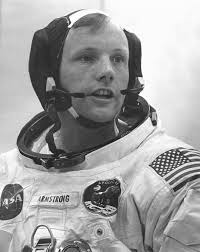
We had heroes once / and we will again / why shouldn't we? - Mary Chapin Carpenter
Looking askance at weird news
I have my conflicts with CSICOP and sometimes disagree with Sharon Hill, but she's one of the livelier writers on science and skepticism, and what she says here about teaching kids to think critically is well-phrased and important. She recounts helping them pick apart a "giant owl" photograph that made the rounds of the Internet even though you could see there was something not right about it. (Speaking of a class with Lawrence Krauss (author of The Physics of Star Trek, a great read), she also highlights one of my favorite themes: kids can still be fascinated by science if it's done right.) In her Doubtful News, this week she corrects some media hype about "living cells" being found in a frozen mammoth (they were no such thing, only well-preserved.) She's always worth a read.
Thursday, September 13, 2012
Latest new primate looks like... well, us
New monkey from Congo
The newest priamte is colorful and downright fascinating. It looks like a long-nosed old professor. The lesula, Cercopithecus lomamiensis, "looks right back at its beholder, calm and pensive, examining you as you examine it," a human observer noted. Check out the photo in the attached article.
And it is, of course, yet another reminder that we don't know all the animals, not even all the primates, in this still-big world of ours.
The newest priamte is colorful and downright fascinating. It looks like a long-nosed old professor. The lesula, Cercopithecus lomamiensis, "looks right back at its beholder, calm and pensive, examining you as you examine it," a human observer noted. Check out the photo in the attached article.
And it is, of course, yet another reminder that we don't know all the animals, not even all the primates, in this still-big world of ours.
Wednesday, September 12, 2012
JFK and the Moon: 50 Years ago today
President Kennedy gave his Moon speech (which included other goals, such as telecommunications satellites) 50 years ago today. "A man on the Moon in this decade" was an audacious goal to set: there was no certainty, even in NASA (Wernher von Braun probably excepted: love or hate the man, he never lacked confidence), that it could be done before 1970.
NASA's celebration
View entire speech
Indeed, JFK wondered about it even after he set the goal. He had a continuing interest in desalinating the oceans, and probably would have made that our top technical goal if it had been more feasible. But he stuck by Apollo, and Johnson and Nixon did so after him, and we made it.
"We choose to go to the moon. We choose to go to the moon in this decade and do the other things, not because they are easy, but because they are hard, because that goal will serve to organize and measure the best of our energies and skills, because that challenge is one that we are willing to accept, one we are unwilling to postpone, and one which we intend to win, and the others, too."
Amen.
NASA's celebration
View entire speech
Indeed, JFK wondered about it even after he set the goal. He had a continuing interest in desalinating the oceans, and probably would have made that our top technical goal if it had been more feasible. But he stuck by Apollo, and Johnson and Nixon did so after him, and we made it.
"We choose to go to the moon. We choose to go to the moon in this decade and do the other things, not because they are easy, but because they are hard, because that goal will serve to organize and measure the best of our energies and skills, because that challenge is one that we are willing to accept, one we are unwilling to postpone, and one which we intend to win, and the others, too."
Amen.
Tuesday, September 11, 2012
Annual article post: 9/11 and science
Demolition? No.
Good article on why the "truthers," sincere though they may be, are wrong on every claim about the physics involved in demolition claims concerning 9/11. Remember also that any complex event, especially one that has never happened before, will produce oddities, both material and in human perceptions. Believe the science. Honor the heroes based on the real events.
Good article on why the "truthers," sincere though they may be, are wrong on every claim about the physics involved in demolition claims concerning 9/11. Remember also that any complex event, especially one that has never happened before, will produce oddities, both material and in human perceptions. Believe the science. Honor the heroes based on the real events.
Friday, September 07, 2012
Expert comment on my book Shadows of Existence
Dr. Marcus van Roosmalen, whose new adventure travel idea I discussed below, also had the time to read my 2006 book Shadows of Existence: Discoveries and Speculations in Zoology. His take:
"Yur book is excellent and trustworthy - considering the fact that you depicted and described the white-throated black jaguar so realistically. No sensationalism."
Dr. Van Roosmalen is certain the white-throated jaguar exists and is not just a melanistic specimen like the black jaguars you can see at your zoo. The cat reported from Brazil is a solid black (with none of the hidden rosettes you can spot in your zoo janguar when the lighting is right - with a white underside and throat. Why is he so sure? Well, he has seen it.
""I just read Matt Bille's 2006 Shadows of Existence. I was flabbergasted to see the 'onca-cangucu' or white-throated black jaguar, the pictorial evidence I am after already for more than 15 years, so accurately depicted on page 65 - exactly the beast that I was so fortunate to get a glimpse of in the wild, not long ago."
Credit for the stunning illustration goes to the highly talented Bill Rebsamen, premier artist of cryptozoology.
"Yur book is excellent and trustworthy - considering the fact that you depicted and described the white-throated black jaguar so realistically. No sensationalism."
Dr. Van Roosmalen is certain the white-throated jaguar exists and is not just a melanistic specimen like the black jaguars you can see at your zoo. The cat reported from Brazil is a solid black (with none of the hidden rosettes you can spot in your zoo janguar when the lighting is right - with a white underside and throat. Why is he so sure? Well, he has seen it.
""I just read Matt Bille's 2006 Shadows of Existence. I was flabbergasted to see the 'onca-cangucu' or white-throated black jaguar, the pictorial evidence I am after already for more than 15 years, so accurately depicted on page 65 - exactly the beast that I was so fortunate to get a glimpse of in the wild, not long ago."
Credit for the stunning illustration goes to the highly talented Bill Rebsamen, premier artist of cryptozoology.
Update: Hunting New Mammals with Marc van Roosmalen
Dr. van Roosmalen has created a poster showcasing his proposed trips in search of "cryptid" mammals (so far undocumented species.) This is a topic Marc knows better than anyone else in the world, and this kind of trip offers a chance at scientific immortality: being part of the discovery of new speices. It's a new spin on adventure travel.


NY City has created its own ant species
I don't know if the newest species of ants use their chemical signals and antennas to say, "Hey, I'm WALKING here!" but they are denizens of New York City. In fact, they have a very restricted range reported as "traffic medians on Broadway between 63rd and 76th streets." Aside from the burning question of whether these creatures are Giants or Jets fans, it appears to be an example of adapting to a very specific environment. Insect species endemic to tiny environments, such a single tree, may be common in Brazil, but they don't normally emerge from US cityscapes. Or maybe they are normal, and we just haven't looked enough.
Tuesday, September 04, 2012
New species: a wild (and impressive) insect
This is the world's newest stick insect - not the biggest, although still impressive. Definitely the most visually arresting, though, and strikingly unlike most stick insects. This one is multicolored, built relatively low to the ground, and wingless. It needed a new genus to classify it. Oh, and it sprays an offensive liquid like a skunk when threatened. Fresh from the Phillipine island of Mindoro, welcome Conlephasma enigma.
Monday, September 03, 2012
Why some groups have more species than others
Why are there hundreds of thousands (if not millions) of species of beetles but only 23 known crocodilians? these scientists have found it has nothing to do with how old a lineage is. Instead, there are ecological limits - "adaptive zones" in time and physical habitat - where space, resources, and competition dictate how a given type of animal is more or less likely to move into new niches, which are likely to encourage the development of new species. Essentially, it doesn't take much habitat, or many individuals, to sustain a beetle species. Beetles in a place like Brazil can speciate all they want without having to have some other species vacate a habitat. Crocodiles may not have the opportunity unless an existing species dies out. This, Michael Alfaro explains, means, "If adaptive zones control biodiversity at the broadest scales, then the rate of species growth will be a good explanation of species richness only right after a lineage has entered into a new adaptive zone. Once the adaptive zone has filled up, then, no matter how much time goes by, the number of species will not change much...Most of the groups that we studied have hit their limits."
What's the implication for discovery of new species? Well, it's not a particularly earth-shaking finding that we are more likely to describe new mosquitoes than new crocodiles or mammals. It's harder to apply it to any specific habitat. There are oddities, overlaps, and evolutionary changes that create exceptions to the rules. But this is a step toward understanding why evolution has come out the way it has.
What's the implication for discovery of new species? Well, it's not a particularly earth-shaking finding that we are more likely to describe new mosquitoes than new crocodiles or mammals. It's harder to apply it to any specific habitat. There are oddities, overlaps, and evolutionary changes that create exceptions to the rules. But this is a step toward understanding why evolution has come out the way it has.
Aviation history - the Vulcan
As an aviation history buff, I appreciate the planes that took aerospace engineering in a new direction. The Royal Air Force's Vulcan's creation in 1952 is one of the unique moments, when a nation in search of a nuclear deterrent commissioned a radical new bomber. The four-engined Avro/Hawker Siddeley Vulcan was to soldier on, first in strategic and then tactical roles, until its retirement after service in the Falklands War. Today an enthusiats' club on shoestring financing keeps one Vulcan flying. I saw one at an air show in the mid-70s when the RAF was still flying it, and I remember the giant delta-wing was amazingly maneuverable for its size. It was also suprisingly quiet while it was approaching you - but it made a heck of a roar when it passed. Its only surviving contemporary is the USAF's B-52, which may soldier on until the airframe has 100 years on it, like like some sailing warship of the 18th century. (Britain, alas, no longer has the capability to build any type of warplane indigenously: the US can build a new bomber, but it keeps losing budget dogfights before it can even reach the design stage.) . Here's to a great old bird.

In whale news - a little GOOD news
Whales are among my favorite creatures. They were, perhaps, the first truly intelligent mammals to emerge on this planet - we primates took far longer to come up with big brains. The whales inhabit their own kingdom, one humans originally invaded with only malicious intent, but now try to understand. We drove several of the largest species to near-extinction, and one of the smallest is now extinct (Yangtze River dolphin) and one on the brink (vaquita porpoise.)
So, all good news is welcome. The mangnificent and unique humpback has several favorite mating grounds, one of them off the coast of Brazil. In 1996, there were only a thousand of these whales left. In 2002, the Humpback Whaling Institute counted 3,000 in the region. The estimate 10 years later is nearly 10,000. That doesn't approach the historical numbers of this species in the pre-whaling days, but it's a big nonetheless. All victories in whale conservation matter, and this is a victory.
Meanwhile, in my old home state of Florida, a lot of effort by experts and volunteers going into rescuing stranded whales. We still don't understand the causes of stranding well, and often the animals can't be refloated: they just beach themselves again. Recently, 22 pilot whales beached themselves. Seventeen could not be saved, but in a small but heartening example of interspecies cooperation, five were brought to Florida Atlantic University's Harbor Branch Institute for rehabilitation. This took the efforts of hundreds of volunteers to get them off the beach, a large staff at the Institute, and veterinary help from Sea World. The wales are doing better, and researchers hope they can be released soon. Bravo, rescuers!
So, all good news is welcome. The mangnificent and unique humpback has several favorite mating grounds, one of them off the coast of Brazil. In 1996, there were only a thousand of these whales left. In 2002, the Humpback Whaling Institute counted 3,000 in the region. The estimate 10 years later is nearly 10,000. That doesn't approach the historical numbers of this species in the pre-whaling days, but it's a big nonetheless. All victories in whale conservation matter, and this is a victory.
Meanwhile, in my old home state of Florida, a lot of effort by experts and volunteers going into rescuing stranded whales. We still don't understand the causes of stranding well, and often the animals can't be refloated: they just beach themselves again. Recently, 22 pilot whales beached themselves. Seventeen could not be saved, but in a small but heartening example of interspecies cooperation, five were brought to Florida Atlantic University's Harbor Branch Institute for rehabilitation. This took the efforts of hundreds of volunteers to get them off the beach, a large staff at the Institute, and veterinary help from Sea World. The wales are doing better, and researchers hope they can be released soon. Bravo, rescuers!
Saturday, September 01, 2012
Crypto-Expeditions with Marc van Roosmalen
Dr. Marcus van Roosmalen, one of the world’s best-known primatologists and its most prolific discoverer of mammals, has a new idea to get cryptozoologists involved up close and personal in his discoveries while also funding further work. As he explained it to me in an online conversation on 8/31/2012, his notion is to offer the cryptozoologist community organized boat expeditions he would into the 'Lost World' of the Amazon. He’d take 2-6 cryptozoologists paying for it (at, notionally, about 5,000 Euro each) on 2-3 week trips to capture on digital photo/video one or more of the cryptomammals he’s seen in the wild. He asked, “With digital scouting cameras to be placed along a freshly cut trail through the matrix high forest I think it must be feasible to capture images of the black white-throated jaguar - the onca-cangussu. Wouldn't that be something for any cryptozoologist?” (By the way, he honored me by praising my book Shadows of Existence, and he thought Bill Rebsamen had done a very good job of capturing the onca-cangussu in his illustration).
Van Roosmalen is as busy as ever. He says, “I hope to publish more novelties (e.g., dwarf manatee, fair brocket, giant paca, another peccary, four big monkeys) in the peer-reviewed Annals of the Brazilian Academy of Science.” He added, “I have been on a riverboat trip up the Rio Negro, Branco and Demeni/Araca with ten undergraduates from SUNY universities and upstate NY Colleges during the last two weeks. Unexpectedly, I discovered a new species of tamarin!”
He told me, “I might go on organizing these expeditions for many years, as it will be fun, but also productive." Since his legal troubles (allegations of biopiracy), despite his exoneration by Brazil's Supreme Court, he can't get the proper license to take a type specimen from the wild to establish any of the 40(!) mammals on his discovery list, and he is afraid of being jailed if he transports any holotype material, dead or alive, to accomplish the DNA testing needed to describe new species in the peer reviewed literature. He hopes these expeditions will result in more video and sighting evidence to pass along to government agencies and other scientists who can help him protect endangered habitat and collect the needed holotypes to properly describe more animals. .
He would appreciate feedback (email him through Facebook at http://facebook.com/marcus.vanroosmalen or go to his website at www.marcvanroosmalenconsulting.com) about how many cryptozoologists might be interested in this kind of work. I can’t do it in the short term (back problems and family obligations), but he describes it as a relatively comfortable trip made mainly on his well-equipped riverboat.
Who’s on board? Let Marc know if this interests you, even hypothetically.
Van Roosmalen is as busy as ever. He says, “I hope to publish more novelties (e.g., dwarf manatee, fair brocket, giant paca, another peccary, four big monkeys) in the peer-reviewed Annals of the Brazilian Academy of Science.” He added, “I have been on a riverboat trip up the Rio Negro, Branco and Demeni/Araca with ten undergraduates from SUNY universities and upstate NY Colleges during the last two weeks. Unexpectedly, I discovered a new species of tamarin!”
He told me, “I might go on organizing these expeditions for many years, as it will be fun, but also productive." Since his legal troubles (allegations of biopiracy), despite his exoneration by Brazil's Supreme Court, he can't get the proper license to take a type specimen from the wild to establish any of the 40(!) mammals on his discovery list, and he is afraid of being jailed if he transports any holotype material, dead or alive, to accomplish the DNA testing needed to describe new species in the peer reviewed literature. He hopes these expeditions will result in more video and sighting evidence to pass along to government agencies and other scientists who can help him protect endangered habitat and collect the needed holotypes to properly describe more animals. .
He would appreciate feedback (email him through Facebook at http://facebook.com/marcus.vanroosmalen or go to his website at www.marcvanroosmalenconsulting.com) about how many cryptozoologists might be interested in this kind of work. I can’t do it in the short term (back problems and family obligations), but he describes it as a relatively comfortable trip made mainly on his well-equipped riverboat.
Who’s on board? Let Marc know if this interests you, even hypothetically.
The Invaders: New Bee Species are Parasitic
Five new species of bees have been reported - and all are strange. They are parasites, stealing into other bees' nests and depositing their own eggs in the nurseries. Jakub Straka of Charles University (Prague) and Michael S. Engel of the University of Kansas reported the bees from the islands of Cape Verde. The invades (or "cuckoo bees") choose times when most of the target colony is out foraging and it's easier to slip in unnoticed. Their fast-incubating eggs hatch, and the larvae wipe out the unhatched eggs around them. Fiendish!
Friday, August 31, 2012
Bringing back extinct species
In this article in The Atlantic, Rebecca J. Rosen muses on the possibilities of bringing back extinct species, whether we should, and something I hadn't thought of before: if we bring them back via genetic manipulation, should we try to tweak their nature a bit for our preferences or our current environmental conditions?
The example she uses isn't the best - the California grizzly bear is not an extinct species, just an extirpated population, and we could bring it back any time we wanted just by moving Grizzlies in from other states. Still, her question of bringing back a predator with a genetic modification that makes them detest human flesh - if such an adjustment is possible - is a good one. Do we bring an animal back just as it was (my heart says yes, my brain is unsure) or do we try to give evolution a hand and adapt it to a different climate or the presence of humans or whatever else has changed?
Good questions, ones that might really matter in the near future.
The example she uses isn't the best - the California grizzly bear is not an extinct species, just an extirpated population, and we could bring it back any time we wanted just by moving Grizzlies in from other states. Still, her question of bringing back a predator with a genetic modification that makes them detest human flesh - if such an adjustment is possible - is a good one. Do we bring an animal back just as it was (my heart says yes, my brain is unsure) or do we try to give evolution a hand and adapt it to a different climate or the presence of humans or whatever else has changed?
Good questions, ones that might really matter in the near future.
Thursday, August 30, 2012
Are disc-shaped aircraft behind UFO sightings?
This is a reasonable question, one asked again in a recent post on The Cryptozoologist. After all, experimental aircraft have taken on a lot of odd shapes over the past 70 years or so, since the science of aerodynamics became less guesswork and more engineering in the years before World War II. You can find plenty of Internet claims and speculation about German disc-shaped aircraft, and all the other major powers had their experimental planes too, some of them very weird. But to stand in for "flying saucers" in the postwar world requires high performance as well as striking appearance, and I don't think it happened.
The reasons I discount disc-shaped aircraft, beyond the occasional experimental vehicle, is that the aerodynamics stink. They're hard to control. As with a flying wing, you are spreading the aerodynamic effects over this huge surface, much of it far away (relatively) from the ailerons and other control surfaces that give it direction. I don't believe for a moment the Nazis or anyone else developed a high-performance disc in the 1940s-1990s. That said, the sophisticated digital controls and other advances in the B-2 era might, I think, allow you to develop a high-performance disc today, but it would be a big investment for no real return unless getting the disc shape was the entire purpose of the project: payload would still be minimal. The exception would be if you got away from the jet propulsion system into some kind of propulsion that delivered thrust evenly around the disc (you can do that with jets, but the complexity and weight penalties will kill you, and the Coanda effect mentioned by some of the Nazi buffs is real but even less efficient.) "Revelations" by "insiders" about German or American disc aircraft never try to explain the engineering of the thing.
For those who are curious, I did try to come up with a practical disc in fiction: Send me an email if you'd like to read my story "The Old-Fashioned Way."
The reasons I discount disc-shaped aircraft, beyond the occasional experimental vehicle, is that the aerodynamics stink. They're hard to control. As with a flying wing, you are spreading the aerodynamic effects over this huge surface, much of it far away (relatively) from the ailerons and other control surfaces that give it direction. I don't believe for a moment the Nazis or anyone else developed a high-performance disc in the 1940s-1990s. That said, the sophisticated digital controls and other advances in the B-2 era might, I think, allow you to develop a high-performance disc today, but it would be a big investment for no real return unless getting the disc shape was the entire purpose of the project: payload would still be minimal. The exception would be if you got away from the jet propulsion system into some kind of propulsion that delivered thrust evenly around the disc (you can do that with jets, but the complexity and weight penalties will kill you, and the Coanda effect mentioned by some of the Nazi buffs is real but even less efficient.) "Revelations" by "insiders" about German or American disc aircraft never try to explain the engineering of the thing.
For those who are curious, I did try to come up with a practical disc in fiction: Send me an email if you'd like to read my story "The Old-Fashioned Way."
Tuesday, August 28, 2012
The CubeSats are coming
Cubesats at 10cm on a side, and they are the next big tiny thing in satellites.
See in New Scientist (registration required)
See in New Scientist (registration required)
Spontaneous Human Combustion solved?
I try to take a properly skeptical approach to ofddities, but the riddle of SHC has always seemed to me to need a better explanation that than the brush-off it gets in sources like Skeptical Inquirer. How can a human body burn to ashes with only its own fat for fuel? A "wick effect" - a human candle - sounds theoretically possible, but hasn't been duplicated in practice. This researcher thinks the answer lies in body chemistry: that the right circumstances can permeate the body with highly flammable acetone.
See it in New Scientist (registration required)
See it in New Scientist (registration required)
Monday, August 27, 2012
Had to happen: Bigfoot hoaxer killed
A man trying to create a Bigfoot hoax instead created a deadly accident - meaning, he occasioned his own death. I always figured this would be a headline about someone shot by a hunter who thought he'd bagged fame and fortune, but instead it was a terrible tragedy involving two teenage drivers who will never be the same.
Sunday, August 26, 2012
The "Anternet" - nature's internet works like ours
Ants, it seems, behave in response to the amount of food the same way the Internet handles packets of data. If there's less food (think of it as bandwidth), fewer gatherers (packets) leave the nest. If the net is broken by researchers preventing gatherers from returning to the nest, the nest, after a delay, stops sending out new ants. Ants can transmit only very limited amounts of information, but the way they operate, like the Internet, allows them to circumvent that limit and forage and gather with great efficiency.
COMMENT: Cool.
COMMENT: Cool.
Winner: Best Neil Armstrong Cartoon
Well, it's my contest, I get to pick the most touching memorial to the man I call America's Captain Cook. I thought it was this item, published in the Bangor Daily News.
(I can't amke out the cartoonists's name. No copyright violation intended: notify if problematic)

(I can't amke out the cartoonists's name. No copyright violation intended: notify if problematic)

Saturday, August 25, 2012
Ad Astra, Neil Armstrong
"The important achievement of Apollo was demonstrating that humanity is not forever chained to this planet and our visions go rather further than that and our opportunities are unlimited." - Armstrong
I wrote Neil Armstrong's bio for an encyclopedia once. I couldn't speak to the man himself, but a close associate relayed messages. Ever modest, Armstrong asked that he not appear in the book Notable 20th-Century Scientists at all (a wish I couldn't grant.) He did say he thought his pioneering work with fly-by-wire control systems, not being the moonwalker, was his most important achievement.
He will always be one of my heroes.
In 1969, songwriter John Stewart watched the moonwalk and marveled at the way it drew the whole world together, despite all our troubles:
The rivers are getting dirty
The wind is getting bad
War and hate are killing off
The only earth we have
But the world all stopped to watch it
On that July afternoon
To watch a man named Armstrong
Walk upon the moon
I wrote Neil Armstrong's bio for an encyclopedia once. I couldn't speak to the man himself, but a close associate relayed messages. Ever modest, Armstrong asked that he not appear in the book Notable 20th-Century Scientists at all (a wish I couldn't grant.) He did say he thought his pioneering work with fly-by-wire control systems, not being the moonwalker, was his most important achievement.
He will always be one of my heroes.
In 1969, songwriter John Stewart watched the moonwalk and marveled at the way it drew the whole world together, despite all our troubles:
The rivers are getting dirty
The wind is getting bad
War and hate are killing off
The only earth we have
But the world all stopped to watch it
On that July afternoon
To watch a man named Armstrong
Walk upon the moon
The last film of the last thylacine?
Interesting historical discussion of the film taken of the last zoo-kept thylacine, often thought to be the last individual of his species. The species almost certainly survived past the death of this animal in 1936, but for how long? No one knows.
An episode in the life of Nessie
Has any creature, real or mythical, attracted quite the attention the Loch Ness monster has? Arguments over reality, appeals to mysticism, witches and biologists, they've all been featured in the 1400 years or so that monster tales have circulated. Filmmakers, of course, have not been idle. This article recounts a singular moment, when famed eccentric director Walter Herzog took his turn at the mysteries of the Loch.
A one-species ecosytem? Yes it exists
This microbe is the only species in its ecosystem. The implication for finding life in ever more unlikely places - including far deeper locales and even on other planets - are major. Almost three kilometers down in a gold mine, Desulforudis audaxviator runs its own little chemical factory in total darkness and isolation. "Life finds a way."
Friday, August 24, 2012
Sputnik: The Human Story (Part 4 of 4)
We conclude our stody after the launch of Explorer 1. I hope you've enjoyed it!
The instrumentation aboard that first American satellite was the brainchild of Dr. James Van Allen, then head of the Department of Physics and Astronomy at the University of Iowa. Beginning with a childhood filled with crystal radio sets and electric motors, Van Allen had earned a doctorate in nuclear physics in 1939. Since then he’d been a naval gunnery officer, a developer of proximity fuses, head of the Upper Atmosphere Rocket Research Panel, and the drafter of specifications for the Aerobee sounding rocket. Before Explorer, Van Allen was best known for his work studying the physics of the upper atmosphere using “rockoons.” He proposed a particle detection experiment for Project Vanguard, but kept it small enough so it would likely be useful in the event Vanguard was supplemented by von Braun’s proposed Army satellite. The result of this foresight was the discovery of the radiation belts around Earth – the Van Allen belts.
Physicist Len Cormier, who personally made up one-half of the National Academy of Sciences’ tiny IGY satellites office, recalled, “About a month before the announcement of the radiation belts – over pizza at Luigi’s – Van Allen remarked that they had been unable to decipher the data from Explorer.” Soon after that, though, Van Allen did decipher it. The strange “dropout” periods reported by his Geiger-Mueller counters in Explorers 1 and 3 were not caused by the absence of radiation, but by being swamped with reading far higher than expected.
In May 1958, Project Vanguard, on its third try, put a satellite into orbit.
“I heard a tremendous roar, as if a fire had started. Suddenly, books, shoes, and other things flew over the balcony down into the hangar.”- Propulsion engineer Kurt Stehling on the Vanguard celebration at Cape Canaveral
Several thousand miles west of Huntsville, in the Mojave Desert of California, a group of maverick physicists and engineers at the Naval Ordnance Test Station (NOTS) in China Lake took matters into their own hands, and unofficially jumped into the satellite race in late 1957. Without authorization or official funding, the NOTS team attempted to leapfrog the larger programs with a five-stage rocket launched from a fighter plane. On a shoestring budget, largely “borrowed” from other programs, the satellite was pulled together in the NOTS workshops with not much more than the proverbial “chewing gum and baling wire.” But morale was high; after Commander William West, USN, a World War II hero then flying test aircraft at NOTS, watched a ground-test version of the rocket explode, he remarked with typical test-pilot swagger: “Don’t worry. It won’t do that when I’m carrying it.” On the second of the six launch attempts, the rocket did, in fact, explode - just far enough away from West’s F4D-1 Skyray for pilot and plane to survive. The NOTS program most likely produced only one short-lived satellite, but it deserves to be remembered for its sheer audacity.
And so the world had two space powers, and the story unfolded from there – a complex tale of engineering, Cold War politics, and human dreams. Sputnik 1 set in motion events Sergey Korolev could never have predicted.
“I must say, if I think about it from the viewpoint of history, I suspect that the whole space program is better because the Russians went up first. It shook up the complacency of the West…it was a challenge for us to do better than they were. The result was that the space programs got a lot of support from this country…In fact, the whole formation of NASA might not have happened if we had gone first.”
- William Pickering, JPL Director in the Sputnik era, in 1989
In October 1958, the U.S. created the National Aeronautics and Space Administration to run civilian space programs. This organization eventually absorbed JPL, the Vanguard program, and Wernher von Braun and most of his Army team.
The people of the early Space Age live on in their achievements and the organizations they created. Korolev’s government design bureau is now the giant Russian space firm RSC Energia. The Jet Propulsion Laboratory, the Naval Research Laboratory, Marshall Space Flight Center, and other American organizations with “space roots” in the Sputnik era, continue to develop space probes, satellites, and launch systems.
Of the three great theorists of the early 20th century, only Hermann Oberth lived to see the launch of satellites and men into space. Oberth had the satisfaction of seeing humans land on the moon using the lunar-orbit rendezvous approach – something he had conceived in the 1920s. He died in 1989 at the age of 95.
Sergey Korolev went on to launch many more satellites and space probes, put the first human into space, and lead the Soviet drive for a lunar program. He died on January 14, 1966, the result of a botched medical operation. Only after that was his identity revealed to the world.
Wernher von Braun had his great triumph with the landing of men on the moon using the Saturn booster his organization – now NASA’s Marshall Space Flight Center – developed. He hoped to follow it with a greater triumph, a voyage to Mars, but the money and political will did not exist. Von Braun died in 1977.
James Van Allen led the team that developed the world’s first student-built satellite and continued work with NASA space probes. For almost five decades after Sputnik, he kept studying, teaching, and writing on space science. When the authors of this article approached him about the book which became The First Space Race, he was happy to discuss his activities in 1957-58, which he remembered with astonishing clarity, spend a day taping interviews in his office in the University of Iowa’s Van Allen Building, and contribute a Foreword for the book.
The last word on the legacy of the Sputnik era goes to a man who never lived to see it.
"There can be no thought of finishing, for 'aiming at the stars,' both literally and figuratively, is a problem to occupy generations, so that no matter how much progress one makes, there is always the thrill of just beginning."
- Robert Goddard, 1932
A Personal Note
As authors, we have been pursuing this story since 1998, carrying it through the 2004 publication of our book and subsequently through the articles and papers we’ve been writing ever since. We had the great fortune to speak or correspond with many of the greats of this era, some of whom are no longer with us. We cherish our memories of time spent with them, and we’d like to take this opportunity to thank all those who assisted us – as everyone we contacted, without exception, enthusiastically did. We are honored to have contributed to the preservation of knowledge about the birth of the Space Age.
Matt Bille and Erika Lishock
August 2007
Suggested reading
The stories of the Sputnik era and the people who lived it are scattered in countless places. For those seeking worthwhile books on the subject, we have some suggestions for a “starter list.” See:
William E. Burrows, This New Ocean: The Story of the First Space Age (New York: Random House, 1998).
Boris Chertok, Rockets and People (Washington, DC: NASA SP20054110, 2005).
Paul Dickson. Sputnik: Shock of the Century. (New York: Walker & Co., 2001).
Roger Launius, John Logsdon, and Robert Smith (eds.) Reconsidering Sputnik: Forty Years Since the Soviet Satellite (Amsterdam: Harwood Academic Publishers, 2000).
James Harford. Korolev: How One Man Masterminded the Soviet Drive to Beat America to the Moon (New York: John Wiley & Sons, 1997).
Clayton R. Koppes, JPL and the American Space Program (New Haven: Yale University Press, 1982.)
Walter A. McDougall. …the Heavens and the Earth: A Political History of the Space Age (New York: Basic Books, 1985).
Constance McLaughlin Green and Milton Lomask, 1969. Vanguard - A History (Washington, DC: NASA SP-4202, Smithsonian Institution Press, 1969).
Asif Siddiqi, Challenge to Apollo: The Soviet Union and the Space Race, 1945-1974 (Washington, DC: NASA SP-2000-4408, 2000).
Kurt Stehling, Project Vanguard (Garden City, NY: Doubleday & Company, 1961).
Ernst Stuhlinger, with Frederick Ordway III, Wernher von Braun: Crusader for Space (Malabar, FL: Krieger Publishing Co. 1994).
James Van Allen, Origins of Magnetospheric Physics (Washington, DC: Smithsonian Institution Press, 1983).
The instrumentation aboard that first American satellite was the brainchild of Dr. James Van Allen, then head of the Department of Physics and Astronomy at the University of Iowa. Beginning with a childhood filled with crystal radio sets and electric motors, Van Allen had earned a doctorate in nuclear physics in 1939. Since then he’d been a naval gunnery officer, a developer of proximity fuses, head of the Upper Atmosphere Rocket Research Panel, and the drafter of specifications for the Aerobee sounding rocket. Before Explorer, Van Allen was best known for his work studying the physics of the upper atmosphere using “rockoons.” He proposed a particle detection experiment for Project Vanguard, but kept it small enough so it would likely be useful in the event Vanguard was supplemented by von Braun’s proposed Army satellite. The result of this foresight was the discovery of the radiation belts around Earth – the Van Allen belts.
Physicist Len Cormier, who personally made up one-half of the National Academy of Sciences’ tiny IGY satellites office, recalled, “About a month before the announcement of the radiation belts – over pizza at Luigi’s – Van Allen remarked that they had been unable to decipher the data from Explorer.” Soon after that, though, Van Allen did decipher it. The strange “dropout” periods reported by his Geiger-Mueller counters in Explorers 1 and 3 were not caused by the absence of radiation, but by being swamped with reading far higher than expected.
In May 1958, Project Vanguard, on its third try, put a satellite into orbit.
“I heard a tremendous roar, as if a fire had started. Suddenly, books, shoes, and other things flew over the balcony down into the hangar.”- Propulsion engineer Kurt Stehling on the Vanguard celebration at Cape Canaveral
Several thousand miles west of Huntsville, in the Mojave Desert of California, a group of maverick physicists and engineers at the Naval Ordnance Test Station (NOTS) in China Lake took matters into their own hands, and unofficially jumped into the satellite race in late 1957. Without authorization or official funding, the NOTS team attempted to leapfrog the larger programs with a five-stage rocket launched from a fighter plane. On a shoestring budget, largely “borrowed” from other programs, the satellite was pulled together in the NOTS workshops with not much more than the proverbial “chewing gum and baling wire.” But morale was high; after Commander William West, USN, a World War II hero then flying test aircraft at NOTS, watched a ground-test version of the rocket explode, he remarked with typical test-pilot swagger: “Don’t worry. It won’t do that when I’m carrying it.” On the second of the six launch attempts, the rocket did, in fact, explode - just far enough away from West’s F4D-1 Skyray for pilot and plane to survive. The NOTS program most likely produced only one short-lived satellite, but it deserves to be remembered for its sheer audacity.
And so the world had two space powers, and the story unfolded from there – a complex tale of engineering, Cold War politics, and human dreams. Sputnik 1 set in motion events Sergey Korolev could never have predicted.
“I must say, if I think about it from the viewpoint of history, I suspect that the whole space program is better because the Russians went up first. It shook up the complacency of the West…it was a challenge for us to do better than they were. The result was that the space programs got a lot of support from this country…In fact, the whole formation of NASA might not have happened if we had gone first.”
- William Pickering, JPL Director in the Sputnik era, in 1989
In October 1958, the U.S. created the National Aeronautics and Space Administration to run civilian space programs. This organization eventually absorbed JPL, the Vanguard program, and Wernher von Braun and most of his Army team.
The people of the early Space Age live on in their achievements and the organizations they created. Korolev’s government design bureau is now the giant Russian space firm RSC Energia. The Jet Propulsion Laboratory, the Naval Research Laboratory, Marshall Space Flight Center, and other American organizations with “space roots” in the Sputnik era, continue to develop space probes, satellites, and launch systems.
Of the three great theorists of the early 20th century, only Hermann Oberth lived to see the launch of satellites and men into space. Oberth had the satisfaction of seeing humans land on the moon using the lunar-orbit rendezvous approach – something he had conceived in the 1920s. He died in 1989 at the age of 95.
Sergey Korolev went on to launch many more satellites and space probes, put the first human into space, and lead the Soviet drive for a lunar program. He died on January 14, 1966, the result of a botched medical operation. Only after that was his identity revealed to the world.
Wernher von Braun had his great triumph with the landing of men on the moon using the Saturn booster his organization – now NASA’s Marshall Space Flight Center – developed. He hoped to follow it with a greater triumph, a voyage to Mars, but the money and political will did not exist. Von Braun died in 1977.
James Van Allen led the team that developed the world’s first student-built satellite and continued work with NASA space probes. For almost five decades after Sputnik, he kept studying, teaching, and writing on space science. When the authors of this article approached him about the book which became The First Space Race, he was happy to discuss his activities in 1957-58, which he remembered with astonishing clarity, spend a day taping interviews in his office in the University of Iowa’s Van Allen Building, and contribute a Foreword for the book.
The last word on the legacy of the Sputnik era goes to a man who never lived to see it.
"There can be no thought of finishing, for 'aiming at the stars,' both literally and figuratively, is a problem to occupy generations, so that no matter how much progress one makes, there is always the thrill of just beginning."
- Robert Goddard, 1932
A Personal Note
As authors, we have been pursuing this story since 1998, carrying it through the 2004 publication of our book and subsequently through the articles and papers we’ve been writing ever since. We had the great fortune to speak or correspond with many of the greats of this era, some of whom are no longer with us. We cherish our memories of time spent with them, and we’d like to take this opportunity to thank all those who assisted us – as everyone we contacted, without exception, enthusiastically did. We are honored to have contributed to the preservation of knowledge about the birth of the Space Age.
Matt Bille and Erika Lishock
August 2007
Suggested reading
The stories of the Sputnik era and the people who lived it are scattered in countless places. For those seeking worthwhile books on the subject, we have some suggestions for a “starter list.” See:
William E. Burrows, This New Ocean: The Story of the First Space Age (New York: Random House, 1998).
Boris Chertok, Rockets and People (Washington, DC: NASA SP20054110, 2005).
Paul Dickson. Sputnik: Shock of the Century. (New York: Walker & Co., 2001).
Roger Launius, John Logsdon, and Robert Smith (eds.) Reconsidering Sputnik: Forty Years Since the Soviet Satellite (Amsterdam: Harwood Academic Publishers, 2000).
James Harford. Korolev: How One Man Masterminded the Soviet Drive to Beat America to the Moon (New York: John Wiley & Sons, 1997).
Clayton R. Koppes, JPL and the American Space Program (New Haven: Yale University Press, 1982.)
Walter A. McDougall. …the Heavens and the Earth: A Political History of the Space Age (New York: Basic Books, 1985).
Constance McLaughlin Green and Milton Lomask, 1969. Vanguard - A History (Washington, DC: NASA SP-4202, Smithsonian Institution Press, 1969).
Asif Siddiqi, Challenge to Apollo: The Soviet Union and the Space Race, 1945-1974 (Washington, DC: NASA SP-2000-4408, 2000).
Kurt Stehling, Project Vanguard (Garden City, NY: Doubleday & Company, 1961).
Ernst Stuhlinger, with Frederick Ordway III, Wernher von Braun: Crusader for Space (Malabar, FL: Krieger Publishing Co. 1994).
James Van Allen, Origins of Magnetospheric Physics (Washington, DC: Smithsonian Institution Press, 1983).
The loneliest whale in the world?
What if no other creature on Earth spoke your language? This whale sings alone, and there is no one to answer. Of unknown species, this whale sings a song at more than twice the 15-to-25 HZ frequency of other whales. Not only is the species unknown, but its calls, first picked up by the US Navy in 1989, indicate it's not following the migration route of any known species. I can't help but think of the theme song from an old Bigfoot movie The Legend of Boggy Creek (whether you like or hate the movie, the song is haunting):
Perhaps he dimly wonders why
Is there no other such as I
To love to touch before I die
No one to hear my lonely cry
Is the whale a freak, a hybrid, or even - just possibly - the last of a vanishing species?
Perhaps he dimly wonders why
Is there no other such as I
To love to touch before I die
No one to hear my lonely cry
Is the whale a freak, a hybrid, or even - just possibly - the last of a vanishing species?
Thursday, August 23, 2012
Sputnik: The Human Story (Part 3 of 4)
Then, on 4 October 1957, Sergey Korolev successfully placed a satellite in Earth orbit. The spacecraft itself was an unimpressive-looking sphere, not much bigger than a basketball. What it signified, though, was enormous. The first space race was over.
“It was a complete shock. I had not anticipated it in the least. But I knew it would change the modern world.” - Arthur C. Clarke
“Those damn bastards.” - General John Medaris (after Sputnik 1)
Korolev was not allowed to rest on the laurels of Sputnik 1, nor did he wish to. His brain and his files bulged with ideas for lunar probes and piloted spacecraft, but nothing beyond the first Sputnik had been approved until he had that first great success. Korolev and his team, including rocket designer Mikhail Tikhonravov and propulsion engineer Valentin P. Glushko, immediately set to work.
“We never thought that you would launch a Sputnik before the Americans. But you did it. Now please launch something new in space for the next anniversary of our revolution.”
- Soviet Premier Nikita Khrushchev, immediately after Sputnik 1
Korolev answered the Premier’s demand with Sputnik 2, which captured the world’s imagination by virtue of its size (over half a ton) as well as its passenger – the dog Laika, the first living creature in orbit. Laika’s name and likeness were everywhere, including on a brand of Russian cigarettes. The man who launched her, though, was a cipher. The world, including most of the Soviet Union, had no idea who Korolev was. He was only “the Chief Designer,” and his name was a state secret.
Back in the United States, Project Vanguard hustled to develop a response to the Soviet Union – or perhaps even more to a questioning American public. U.S. President Dwight Eisenhower had approved Project Vanguard in 1955, then watched with growing impatience as its timetable slipped and costs mushroomed. When Sputnik succeeded, he called the Deputy Secretary of Defense, Donald Quarles, on the carpet. The President’s words to the public were stoic: “Our satellite program has never been conducted as a race with other nations.” To his aides, he confessed, “I can’t understand why the American people have got so worked up over this thing. It’s certainly not going to drop on their heads.” Quarles’ response was to note that the Administration’s policy had never been to launch the first satellite, only to launch a successful one. But perhaps he was one of the first to see what many came to believe was a silver lining to the whole affair: “…the Russians have done us a good turn, unintentionally, in establishing the concept of freedom of international space.”
On December 6, 1957, what had originally been meant as a non-orbital Vanguard test vehicle, now fitted with a tiny satellite, attempted a launch from Cape Canaveral in full television view of the entire world. The result was an embarrassment that for many years tainted the Vanguard name: a massive explosion two seconds after launch. Vanguard’s director, John P; Hagen, was in Washington, connected by telephone to the launch team under his deputy, J. Paul Walsh. Their conversation was brief and to the point. Walsh: “Explosion!” Hagen: “Nuts.”
In the end, it was von Braun’s Jupiter-C rocket, a modification of the Redstone missile born from V-2 technology, which answered Korolev’s challenge in space. After the shock of the Soviet triumph, Wernher von Braun received what he and General Medaris had long sought: permission to attempt a satellite launch. Moreover, their directive was to do it as quickly as possible. In von Braun’s words to the incoming Secretary of Defense, Neil McElroy: “We knew they were going to do it. Vanguard will never make it! We have the hardware on the shelf. For God’s sake, turn us loose and let us do something! We can put up a satellite in 60 days, Mr. McElroy. Just give us a green light and 60 days!” On January 31, 1958, he fulfilled his promise. Wernher von Braun’s Jupiter-C (renamed Juno 1 to make it sound more civilian) was thrust into the night sky over Cape Canaveral with its American payload, Explorer 1.
"It [space travel] will free man from the remaining chains, the chains of gravity which still tie him to this planet. It will open to him the gates of heaven."
-- Von Braun after succeeding in the launch of the first American satellite
One of the colorful personalities who witnessed the launch was JPL mathematician and head of the Research and Analysis Section, Al Hibbs. Hibbs had previously achieved some degree of fame when LIFE magazine reported his profitable success in discovering and exploiting a flaw in the “random” pattern of a casino’s roulette wheel. After the launch, he sat in the blockhouse at the Cape making calculations based on telemetry from the launch vehicle. With General Medaris hovering over him, he concluded “with 95 percent confidence there’s a 60 percent chance that it’s in orbit.” The General snapped, “Don’t give me that crap, Hibbs! Is it up?”
“It’s up.”
Apparently the President was more cautious. His initial response after being told of a successful launch was, “Let’s not make too great a hullabaloo about this.” However, after it was confirmed the satellite was in orbit, he added, “That’s wonderful. I sure feel a lot better now.”
The instrumentation aboard that first American satellite was the brainchild of Dr. James Van Allen, then head of the Department of Physics and Astronomy at the University of Iowa. Beginning with a childhood filled with crystal radio sets and electric motors, Van Allen had earned a doctorate in nuclear physics in 1939. Since then he’d been a naval gunnery officer, a developer of proximity fuses, head of the Upper Atmosphere Rocket Research Panel, and the drafter of specifications for the Aerobee sounding rocket. Before Explorer, Van Allen was best known for his work studying the physics of the upper atmosphere using “rockoons.” He proposed a particle detection experiment for Project Vanguard, but kept it small enough so it would likely be useful in the event Vanguard was supplemented by von Braun’s proposed Army satellite. The result of this foresight was the discovery of the radiation belts around Earth – the Van Allen belts.
“It was a complete shock. I had not anticipated it in the least. But I knew it would change the modern world.” - Arthur C. Clarke
“Those damn bastards.” - General John Medaris (after Sputnik 1)
Korolev was not allowed to rest on the laurels of Sputnik 1, nor did he wish to. His brain and his files bulged with ideas for lunar probes and piloted spacecraft, but nothing beyond the first Sputnik had been approved until he had that first great success. Korolev and his team, including rocket designer Mikhail Tikhonravov and propulsion engineer Valentin P. Glushko, immediately set to work.
“We never thought that you would launch a Sputnik before the Americans. But you did it. Now please launch something new in space for the next anniversary of our revolution.”
- Soviet Premier Nikita Khrushchev, immediately after Sputnik 1
Korolev answered the Premier’s demand with Sputnik 2, which captured the world’s imagination by virtue of its size (over half a ton) as well as its passenger – the dog Laika, the first living creature in orbit. Laika’s name and likeness were everywhere, including on a brand of Russian cigarettes. The man who launched her, though, was a cipher. The world, including most of the Soviet Union, had no idea who Korolev was. He was only “the Chief Designer,” and his name was a state secret.
Back in the United States, Project Vanguard hustled to develop a response to the Soviet Union – or perhaps even more to a questioning American public. U.S. President Dwight Eisenhower had approved Project Vanguard in 1955, then watched with growing impatience as its timetable slipped and costs mushroomed. When Sputnik succeeded, he called the Deputy Secretary of Defense, Donald Quarles, on the carpet. The President’s words to the public were stoic: “Our satellite program has never been conducted as a race with other nations.” To his aides, he confessed, “I can’t understand why the American people have got so worked up over this thing. It’s certainly not going to drop on their heads.” Quarles’ response was to note that the Administration’s policy had never been to launch the first satellite, only to launch a successful one. But perhaps he was one of the first to see what many came to believe was a silver lining to the whole affair: “…the Russians have done us a good turn, unintentionally, in establishing the concept of freedom of international space.”
On December 6, 1957, what had originally been meant as a non-orbital Vanguard test vehicle, now fitted with a tiny satellite, attempted a launch from Cape Canaveral in full television view of the entire world. The result was an embarrassment that for many years tainted the Vanguard name: a massive explosion two seconds after launch. Vanguard’s director, John P; Hagen, was in Washington, connected by telephone to the launch team under his deputy, J. Paul Walsh. Their conversation was brief and to the point. Walsh: “Explosion!” Hagen: “Nuts.”
In the end, it was von Braun’s Jupiter-C rocket, a modification of the Redstone missile born from V-2 technology, which answered Korolev’s challenge in space. After the shock of the Soviet triumph, Wernher von Braun received what he and General Medaris had long sought: permission to attempt a satellite launch. Moreover, their directive was to do it as quickly as possible. In von Braun’s words to the incoming Secretary of Defense, Neil McElroy: “We knew they were going to do it. Vanguard will never make it! We have the hardware on the shelf. For God’s sake, turn us loose and let us do something! We can put up a satellite in 60 days, Mr. McElroy. Just give us a green light and 60 days!” On January 31, 1958, he fulfilled his promise. Wernher von Braun’s Jupiter-C (renamed Juno 1 to make it sound more civilian) was thrust into the night sky over Cape Canaveral with its American payload, Explorer 1.
"It [space travel] will free man from the remaining chains, the chains of gravity which still tie him to this planet. It will open to him the gates of heaven."
-- Von Braun after succeeding in the launch of the first American satellite
One of the colorful personalities who witnessed the launch was JPL mathematician and head of the Research and Analysis Section, Al Hibbs. Hibbs had previously achieved some degree of fame when LIFE magazine reported his profitable success in discovering and exploiting a flaw in the “random” pattern of a casino’s roulette wheel. After the launch, he sat in the blockhouse at the Cape making calculations based on telemetry from the launch vehicle. With General Medaris hovering over him, he concluded “with 95 percent confidence there’s a 60 percent chance that it’s in orbit.” The General snapped, “Don’t give me that crap, Hibbs! Is it up?”
“It’s up.”
Apparently the President was more cautious. His initial response after being told of a successful launch was, “Let’s not make too great a hullabaloo about this.” However, after it was confirmed the satellite was in orbit, he added, “That’s wonderful. I sure feel a lot better now.”
The instrumentation aboard that first American satellite was the brainchild of Dr. James Van Allen, then head of the Department of Physics and Astronomy at the University of Iowa. Beginning with a childhood filled with crystal radio sets and electric motors, Van Allen had earned a doctorate in nuclear physics in 1939. Since then he’d been a naval gunnery officer, a developer of proximity fuses, head of the Upper Atmosphere Rocket Research Panel, and the drafter of specifications for the Aerobee sounding rocket. Before Explorer, Van Allen was best known for his work studying the physics of the upper atmosphere using “rockoons.” He proposed a particle detection experiment for Project Vanguard, but kept it small enough so it would likely be useful in the event Vanguard was supplemented by von Braun’s proposed Army satellite. The result of this foresight was the discovery of the radiation belts around Earth – the Van Allen belts.
Newest mammal - weird rat can't gnaw
The whole point of existence for a rodent is to gnaw everything in sight. but this rat can't. Nor can it chew. It has 2 teeth! The new Indonesian species, Paucidentomys vermidax, has a name that can be loosely translated as "worm-eating mouse with few teeth." The codiscoverer says that, compared to all the 2,200 known rodent species, this one is bizarre: "In having lost all teeth except a pair of unusually shaped incisors that are incapable of gnawing, this new rat is unique among rodents."
COMMENT: We are not only still finding new species. We are finding one that teach us there are evolutionary pathways we didn't know had ever been followed.
COMMENT: We are not only still finding new species. We are finding one that teach us there are evolutionary pathways we didn't know had ever been followed.
Wednesday, August 22, 2012
Sputnik - The Human Story (part 2 of 4)
In Part 1, we saw how rocetry and spaceflight were ancient dreams. Today we see how they were made real. Today also bring on scene Dr. James Van Allen, the father of modern atmospheric physics, who was wonderfully helpful in our book, contributing a Foreword and spending a full day with Erika taping interviews.
“No sane nation would make such a fantastically expensive piece of precision machinery (think of the cost of the turbine engine) to drop a ton of explosives on England. But what a break for astronautics!” - Arthur C. Clarke on the V-2
“This is what cannot be.”
-Russian engineer Viktor Bolkhovitinov, viewing the captured V-2’s engine
Von Braun’s American counterpart in the prewar years was physicist Robert Hutchings Goddard (1882-1945). Goddard, writer of two seminal papers on the technology and uses of rocketry, launched the world’s first liquid-fuel rocket on March 16, 1926. In developing rocket theory and design, Goddard and the handful of associates who worked with him were ahead of their German and Russian counterparts. What Goddard never had, though, was the money and materiel to develop a rocket as powerful as the V-2. He was unable to gain the interest of the War Department, who could not grasp the possible military applications of rockets. This must have brought back his memory of being mocked in a 1920 article in the New York Times for daring to suggest that a rocket could function in the vacuum of space. On the physicist’s dismay at learning of the V-2, and thinking what he could have done for the United States with military backing, a colleague remarked, “I don’t think he ever got over the V-2.”
“In my opinion, such a thing is impossible and will be impossible for many years.”
- Dr. Vannever Bush, head of the Pentagon’s Research and Development Board, speaking in 1945 on long-range ballistic missiles
“Every vision is a joke, until someone accomplishes it. Once realized, it becomes commonplace.”
– Robert H. Goddard
On 5 April 1950, American physicist James Van Allen (1914-2006) hosted a gathering of scientists at his home in Silver Spring, Maryland, to discuss international cooperation in scientific research. The guest of honor was one of the world’s leading geophysicists, Dr. Sidney Chapman of Great Britain. In the course of the discussion, American physicist and engineer Lloyd V. Berkner asked Chapman, “Sydney, isn’t it about time we had another International Polar Year?” in reference to an international, collaborative polar research effort first conducted in 1882 and again in 1932. The idea of a Third International Polar Year excited the group, and they immediately went to work contacting educational and research leaders. Broadened in scope and renamed the International Geophysical Year, the IGY, which ran from July 1957 to December 1958, spurred the U.S. and the Soviet Union onward towards a new goal: the successful placement of a man-made satellite into Earth orbit. Officially or not, the first space race had begun.
“The race into space may be said to have started in Van Allen’s living room that evening in 1950.” -TIME magazine, 1959
In June 1954, Commander George Hoover of the Office of Naval Research arranged a meeting in Washington which included some of the leading minds in space science and technology. These included Fred Durant, president of the International Astronautical Federation; Professor S. Fred Singer of the University of Maryland; and Smithsonian astronomer Dr. Fred L. Whipple, in addition to von Braun. Out of that meeting came an Army-Navy-civilian proposal called Project Orbiter. Orbiter was never launched, but it became the blueprint for the Army program which eventually launched the first American satellite, Explorer 1.
“Everybody talks about satellites, then nobody does anything. So maybe we should put to use the hardware we already have.” - George Hoover at the famous meeting of 25 June 1954
The U.S. Department of Defense in 1955 selected Project Vanguard, under the auspices of the Naval Research Laboratory, to attempt to orbit a scientific satellite during the 1957-58 IGY. The U.S. National Committee (USNC) created a Technical Panel on Rocketry, which appointed a subcommittee to study “a long-playing rocket.” As Dr. William H. Pickering, director of the Jet Propulsion Laboratory put it, “...this is about the time the long-playing records came out, 33 rpm. We had the long-playing rocket which would go up and round and round and round.”
Directing the Army Ballistic Missile Agency, whose proposal for a satellite lost out to the Project Vanguard, was Major General John B. Medaris. He was a hard-charging, no-nonsense solider who, perhaps surprisingly, bonded very well with the outgoing Wernher von Braun and his German colleagues. After Vanguard was selected as the official program, he continued to pester his superiors about the need for an Army program as a backup. As he later observed, “In various languages, our fingers were slapped, and we were told to mind our own business.”
“You know how complicated it is to launch a satellite. Those people (the Soviets) will never do it.” - General John Medaris (before Sputnik 1)
And so the stage was set, and the two competitors, the United States Navy and the Soviet Union, pressed towards the goal, with the Army still waiting on the bench. With the world as audience, both sides reached higher and higher towards space, sometimes coming close, sometimes engulfing the launch pad in a fiery spectacle. Then, on 4 October 1957, Sergey Korolev successfully placed a satellite in Earth orbit. The spacecraft itself was an unimpressive-looking sphere, not much bigger than a basketball. What it signified, though, was enormous. The first space race was over.
“No sane nation would make such a fantastically expensive piece of precision machinery (think of the cost of the turbine engine) to drop a ton of explosives on England. But what a break for astronautics!” - Arthur C. Clarke on the V-2
“This is what cannot be.”
-Russian engineer Viktor Bolkhovitinov, viewing the captured V-2’s engine
Von Braun’s American counterpart in the prewar years was physicist Robert Hutchings Goddard (1882-1945). Goddard, writer of two seminal papers on the technology and uses of rocketry, launched the world’s first liquid-fuel rocket on March 16, 1926. In developing rocket theory and design, Goddard and the handful of associates who worked with him were ahead of their German and Russian counterparts. What Goddard never had, though, was the money and materiel to develop a rocket as powerful as the V-2. He was unable to gain the interest of the War Department, who could not grasp the possible military applications of rockets. This must have brought back his memory of being mocked in a 1920 article in the New York Times for daring to suggest that a rocket could function in the vacuum of space. On the physicist’s dismay at learning of the V-2, and thinking what he could have done for the United States with military backing, a colleague remarked, “I don’t think he ever got over the V-2.”
“In my opinion, such a thing is impossible and will be impossible for many years.”
- Dr. Vannever Bush, head of the Pentagon’s Research and Development Board, speaking in 1945 on long-range ballistic missiles
“Every vision is a joke, until someone accomplishes it. Once realized, it becomes commonplace.”
– Robert H. Goddard
On 5 April 1950, American physicist James Van Allen (1914-2006) hosted a gathering of scientists at his home in Silver Spring, Maryland, to discuss international cooperation in scientific research. The guest of honor was one of the world’s leading geophysicists, Dr. Sidney Chapman of Great Britain. In the course of the discussion, American physicist and engineer Lloyd V. Berkner asked Chapman, “Sydney, isn’t it about time we had another International Polar Year?” in reference to an international, collaborative polar research effort first conducted in 1882 and again in 1932. The idea of a Third International Polar Year excited the group, and they immediately went to work contacting educational and research leaders. Broadened in scope and renamed the International Geophysical Year, the IGY, which ran from July 1957 to December 1958, spurred the U.S. and the Soviet Union onward towards a new goal: the successful placement of a man-made satellite into Earth orbit. Officially or not, the first space race had begun.
“The race into space may be said to have started in Van Allen’s living room that evening in 1950.” -TIME magazine, 1959
In June 1954, Commander George Hoover of the Office of Naval Research arranged a meeting in Washington which included some of the leading minds in space science and technology. These included Fred Durant, president of the International Astronautical Federation; Professor S. Fred Singer of the University of Maryland; and Smithsonian astronomer Dr. Fred L. Whipple, in addition to von Braun. Out of that meeting came an Army-Navy-civilian proposal called Project Orbiter. Orbiter was never launched, but it became the blueprint for the Army program which eventually launched the first American satellite, Explorer 1.
“Everybody talks about satellites, then nobody does anything. So maybe we should put to use the hardware we already have.” - George Hoover at the famous meeting of 25 June 1954
The U.S. Department of Defense in 1955 selected Project Vanguard, under the auspices of the Naval Research Laboratory, to attempt to orbit a scientific satellite during the 1957-58 IGY. The U.S. National Committee (USNC) created a Technical Panel on Rocketry, which appointed a subcommittee to study “a long-playing rocket.” As Dr. William H. Pickering, director of the Jet Propulsion Laboratory put it, “...this is about the time the long-playing records came out, 33 rpm. We had the long-playing rocket which would go up and round and round and round.”
Directing the Army Ballistic Missile Agency, whose proposal for a satellite lost out to the Project Vanguard, was Major General John B. Medaris. He was a hard-charging, no-nonsense solider who, perhaps surprisingly, bonded very well with the outgoing Wernher von Braun and his German colleagues. After Vanguard was selected as the official program, he continued to pester his superiors about the need for an Army program as a backup. As he later observed, “In various languages, our fingers were slapped, and we were told to mind our own business.”
“You know how complicated it is to launch a satellite. Those people (the Soviets) will never do it.” - General John Medaris (before Sputnik 1)
And so the stage was set, and the two competitors, the United States Navy and the Soviet Union, pressed towards the goal, with the Army still waiting on the bench. With the world as audience, both sides reached higher and higher towards space, sometimes coming close, sometimes engulfing the launch pad in a fiery spectacle. Then, on 4 October 1957, Sergey Korolev successfully placed a satellite in Earth orbit. The spacecraft itself was an unimpressive-looking sphere, not much bigger than a basketball. What it signified, though, was enormous. The first space race was over.
Tuesday, August 21, 2012
Sputnik - The Human Story (Part 1 of 4)
As we struggle with decisions on the future of space, I decided it was a good time to offer a look back. Here, in four parts (one posted per day), is the human story behind the first satellites, as written by myself and Erika Lishock for QUEST magazine.
SPUTNIK: THE HUMAN STORY (PART ONE OF FOUR)
“Nothing ever built arose to touch the skies unless some man dreamed that it should, some man believed that it could, and some man willed that it must.” - Charles F. Kettering
Any engineer can tell you that the paradigm-shaking events that launched the Space Age 50 years ago involved a significant number of technological breakthroughs. But how did the Space Age really start? Was it the fervor of a nationalistic movement, or an educational institution, or a military-funded program that gave it birth and heralded its first faltering steps? Or did it start long before 1957 – in the minds and hearts of those who dreamed, and believed, and eventually willed it into reality? In this article, we’ll take a brief look at the human side of the timeline up to and through the pivotal first months of the new era.
The beginnings of the Sputnik story lie too far back to be traced, to the first humans who looked at the sky and wondered what lay high above them and whether they might someday reach it. As civilizations arose, the pieces of modern cosmology and physics began to form, divined by those who, in J.R.R. Tolkien’s phrase, “in high cold towers asked questions of the stars.”
In the 15th through 18th centuries emerged the great celestial mathematicians and physicists; Copernicus, Galileo, Kepler, and Newton, who, through entire lifetimes of observation and unimaginably laborious hand calculations, turned speculation into theories, and numbers, and formulae: if an object reached an altitude of x above most of the atmosphere, and attained a velocity y parallel to the Earth’s surface, it would continue to “fall” around the earth; the result would be an artificial moon. By the nineteenth century, it was all possible in theory. In the twentieth, it became fact.
“When ships to sail the void between the stars have been built, there will step forth men to sail these ships.” - Johannes Kepler
And so we come to Konstantin Edvardovich Tsiolkovsky (1857-1935). Space visionary and pioneer of cosmonautics, the poor math teacher in rural Russia had been rendered totally deaf by scarlet fever at the age of 10, and because of this, never received any formal education. Inspired by the novels of Jules Verne, and driven by imagination and a will to prove himself despite his disability, Tsiolkovsky stayed up long nights working out the details of travel beyond the atmosphere. He created the rocket equation and calculated the velocities required for payloads and orbits. He came up with the idea of a large multistage rocket, a “rocket train,” the notion of a space station, and the use of hydrogen and liquid oxygen as booster fuel and oxidizer.
“Earth is the cradle of humanity, but we cannot live in the cradle forever.”
- Konstantin Tsiolkovsky
Tsiolkovsky’s most famous pupil (though it’s not certain they ever met) was Sergey Pavlovich Korolev (1907- 1966). As a young aircraft engineer in his twenties, Sergey joined an amateur rocket enthusiast society led by the equally visionary Frederich A. Tsander. Korolev worked on rockets until 1938, when he became a victim of Stalin’s political purges, was unjustly accused of suspected political unreliability, and sentenced to imprisonment in a Soviet Gulag – a nightmare of cold, hunger, and death for most. His story would likely have ended there had he not been transferred two years later to a sharaga, a slightly less torturous work camp for political undesirables whose skills were nonetheless needed by the war effort. After the war, he took a lead role in developing missiles for the government that had imprisoned him. He built for the USSR the first intercontinental ballistic missile (ICBM), the R-7, which was later modified and eventually placed the first satellite into Earth orbit on October 4, 1957.
"I've been waiting all my life for this day!"
– Sergey Korolev at the launch of Sputnik 1
Further to the west, Hermann Oberth (1894 -1989) was born in what was then Austria-Hungary. He too, was inspired by the works of Jules Verne, and at age 14 was busily constructing model rockets. After serving on the Eastern Front during World War I, he began studies in physics. His 1922 thesis submitted to the University of Heidelberg was rejected because the topic - the use of rockets for space travel - was deemed impractical and outlandish. Undaunted, Oberth turned the thesis into a book, The Rocket Into Interplanetary Space. This work sparked widespread discussion of rocketry by academics and scientists who had previously ignored this immature field of technology. In 1930, Oberth fired the first test model of his own design for a liquid-fueled rocket engine. Working with him were some students from the Technical University of Berlin. One of them was named Wernher von Braun.
"This is the goal: To make available for life every place where life is possible. To make inhabitable all worlds as yet uninhabitable and all life purposeful." - Hermann Oberth
Wernher von Braun (1912 - 1977) was 18 at the time of Oberth’s test firing. The handsome young man with an aristocratic pedigree had already shown himself as both a promising engineer and a natural leader. In 1931, he helped Germany’s amateur rocket society, the Verein fur Raumschiffahrt (VfR), launch its first liquid-fuel rocket. Three years later, the VfR was effectively absorbed by a branch of the Army Weapons Office, with von Braun and several other VfR alumni becoming civilian Army employees. Von Braun was the critical integrator, the first man who succeeded in wrapping the efforts of Oberth and Tsiolkovsky in steel on a scale large enough to make spaceflight truly viable. Always controversial as the lead inventor of the A-4 (or V-2), the first ballistic missile, mass-manufactured by concentration camp prisoners under horrific conditions, he came to the United States after the war. There he eventually became technical director of a crucial branch of American rocketry, the Army Ballistic Missile Agency. As a note of interest, after Von Braun left Peenemunde for the United States, invading Soviet troops found a German edition of one of Konstantin Tsiolkovsky's books on rocketry and space travel. It had been annotated throughout by Wernher von Braun.
SPUTNIK: THE HUMAN STORY (PART ONE OF FOUR)
“Nothing ever built arose to touch the skies unless some man dreamed that it should, some man believed that it could, and some man willed that it must.” - Charles F. Kettering
Any engineer can tell you that the paradigm-shaking events that launched the Space Age 50 years ago involved a significant number of technological breakthroughs. But how did the Space Age really start? Was it the fervor of a nationalistic movement, or an educational institution, or a military-funded program that gave it birth and heralded its first faltering steps? Or did it start long before 1957 – in the minds and hearts of those who dreamed, and believed, and eventually willed it into reality? In this article, we’ll take a brief look at the human side of the timeline up to and through the pivotal first months of the new era.
The beginnings of the Sputnik story lie too far back to be traced, to the first humans who looked at the sky and wondered what lay high above them and whether they might someday reach it. As civilizations arose, the pieces of modern cosmology and physics began to form, divined by those who, in J.R.R. Tolkien’s phrase, “in high cold towers asked questions of the stars.”
In the 15th through 18th centuries emerged the great celestial mathematicians and physicists; Copernicus, Galileo, Kepler, and Newton, who, through entire lifetimes of observation and unimaginably laborious hand calculations, turned speculation into theories, and numbers, and formulae: if an object reached an altitude of x above most of the atmosphere, and attained a velocity y parallel to the Earth’s surface, it would continue to “fall” around the earth; the result would be an artificial moon. By the nineteenth century, it was all possible in theory. In the twentieth, it became fact.
“When ships to sail the void between the stars have been built, there will step forth men to sail these ships.” - Johannes Kepler
And so we come to Konstantin Edvardovich Tsiolkovsky (1857-1935). Space visionary and pioneer of cosmonautics, the poor math teacher in rural Russia had been rendered totally deaf by scarlet fever at the age of 10, and because of this, never received any formal education. Inspired by the novels of Jules Verne, and driven by imagination and a will to prove himself despite his disability, Tsiolkovsky stayed up long nights working out the details of travel beyond the atmosphere. He created the rocket equation and calculated the velocities required for payloads and orbits. He came up with the idea of a large multistage rocket, a “rocket train,” the notion of a space station, and the use of hydrogen and liquid oxygen as booster fuel and oxidizer.
“Earth is the cradle of humanity, but we cannot live in the cradle forever.”
- Konstantin Tsiolkovsky
Tsiolkovsky’s most famous pupil (though it’s not certain they ever met) was Sergey Pavlovich Korolev (1907- 1966). As a young aircraft engineer in his twenties, Sergey joined an amateur rocket enthusiast society led by the equally visionary Frederich A. Tsander. Korolev worked on rockets until 1938, when he became a victim of Stalin’s political purges, was unjustly accused of suspected political unreliability, and sentenced to imprisonment in a Soviet Gulag – a nightmare of cold, hunger, and death for most. His story would likely have ended there had he not been transferred two years later to a sharaga, a slightly less torturous work camp for political undesirables whose skills were nonetheless needed by the war effort. After the war, he took a lead role in developing missiles for the government that had imprisoned him. He built for the USSR the first intercontinental ballistic missile (ICBM), the R-7, which was later modified and eventually placed the first satellite into Earth orbit on October 4, 1957.
"I've been waiting all my life for this day!"
– Sergey Korolev at the launch of Sputnik 1
Further to the west, Hermann Oberth (1894 -1989) was born in what was then Austria-Hungary. He too, was inspired by the works of Jules Verne, and at age 14 was busily constructing model rockets. After serving on the Eastern Front during World War I, he began studies in physics. His 1922 thesis submitted to the University of Heidelberg was rejected because the topic - the use of rockets for space travel - was deemed impractical and outlandish. Undaunted, Oberth turned the thesis into a book, The Rocket Into Interplanetary Space. This work sparked widespread discussion of rocketry by academics and scientists who had previously ignored this immature field of technology. In 1930, Oberth fired the first test model of his own design for a liquid-fueled rocket engine. Working with him were some students from the Technical University of Berlin. One of them was named Wernher von Braun.
"This is the goal: To make available for life every place where life is possible. To make inhabitable all worlds as yet uninhabitable and all life purposeful." - Hermann Oberth
Wernher von Braun (1912 - 1977) was 18 at the time of Oberth’s test firing. The handsome young man with an aristocratic pedigree had already shown himself as both a promising engineer and a natural leader. In 1931, he helped Germany’s amateur rocket society, the Verein fur Raumschiffahrt (VfR), launch its first liquid-fuel rocket. Three years later, the VfR was effectively absorbed by a branch of the Army Weapons Office, with von Braun and several other VfR alumni becoming civilian Army employees. Von Braun was the critical integrator, the first man who succeeded in wrapping the efforts of Oberth and Tsiolkovsky in steel on a scale large enough to make spaceflight truly viable. Always controversial as the lead inventor of the A-4 (or V-2), the first ballistic missile, mass-manufactured by concentration camp prisoners under horrific conditions, he came to the United States after the war. There he eventually became technical director of a crucial branch of American rocketry, the Army Ballistic Missile Agency. As a note of interest, after Von Braun left Peenemunde for the United States, invading Soviet troops found a German edition of one of Konstantin Tsiolkovsky's books on rocketry and space travel. It had been annotated throughout by Wernher von Braun.
Monday, August 20, 2012
Impossibly Cool - helicarrier from The Avengers flies
OK, we all know the helicarrier in the movie The Avengers was imaginary. Someone figured out each rotor would have to have been larger than the entire ship to make it work. But this hobbyist hasn't let reality stop him from making a flying model. Watch this thing move across the water and rise into the air, and the unbelievable is no longer crazy....
Sunday, August 19, 2012
Who's that owl? Oh, it's TWO owls!
New bird finds are rare, just a few a year, but now we have four announced in the last month. The most recent two are from the Philippines. US ornithologist Pamela Rasmussen, who is one of the really prominent figures in new bird discovery (and rediscovery) said, "More than 15 years ago, we realized that new subspecies of Ninox hawk-owls existed in the Philippines. But it wasn't until last year that we obtained enough recordings that we could confirm that they were not just subspecies, but two new species of owls." She explains that the songs are not learned but are unique to species. Welcome to the Camiguin Hawk-owl (noted for singing "a long solo song" at night) and the Cebu Hawk-owl!
New family in Oregon (spiders, that is)
In a cave in southern Oregon, the first new family of spiders found in North America since 1890 has seen the light of science A population so distinct it requires not just a species name and not just a genus name but a family name is rare anywhere: this is the first family of spiders anywhere in the world in 22 years. Charles Griswold of the California Academy of Sciences described the spider, 7.5 cm across, as "biggish," but adds, "When you're in a cave and it's dark and there's only the beam of your head lamp, they look much bigger. It's quite astonishing to see them hanging from a few threads." The distinctive hook-legged creature (Robert Kiehn, on a Facebook board, compared it to the Face-hugger in the Alien movies), is tagged Trogloraptor marchingtoni.
Friday, August 17, 2012
OK, not hypersonic...
This really stinks. We had the Air Force all ready to test their hypersonic scramjet X-51 WaveRider, and they drop it from the B-52, and a tail fin fails before they can even ignite the motor. I hope Boeing puts more care into their airliners than they did into building four of these things. I mean, seriously, you have a multimillion-dollar breakthrough X-vehicle, and you can't put a decent tailfin on it? (Or someone dropped or bumbed it hard and somehow no one noticed, which isn't very flattering either.) I hope we got a warranty.
Monday, August 13, 2012
Trying for hypersonic
X-51A WaveRider test set
This week, a B-52 will drop an experimental unmanned aircraft that will - hopefully - operate for a record 5 minutes on the power of a scramjet engine. The Supersonic Combustion Ramjet is intended to allow for missiles and aircraft to travel at X-15 type speeds of 3,600 mph in the atmosphere, at altitudes up to 70,000 feet. Most jet engines, even on supersonic aircraft, keep the airstream flowing through the combustion chamber subsonic. Trying to sustain combustion in a supersonic airstream is a goal engineers have pursued for over 50 years. Today, flight by flight, albeit with plenty of failures along the way, they are getting closer.
This week, a B-52 will drop an experimental unmanned aircraft that will - hopefully - operate for a record 5 minutes on the power of a scramjet engine. The Supersonic Combustion Ramjet is intended to allow for missiles and aircraft to travel at X-15 type speeds of 3,600 mph in the atmosphere, at altitudes up to 70,000 feet. Most jet engines, even on supersonic aircraft, keep the airstream flowing through the combustion chamber subsonic. Trying to sustain combustion in a supersonic airstream is a goal engineers have pursued for over 50 years. Today, flight by flight, albeit with plenty of failures along the way, they are getting closer.
Saturday, August 11, 2012
In honor of Mars, look back in TIME
TIME magazine has covered space since before Sputnik, giving the topic numerous cover stories. Here's a sequence of those covers, from a concept for an unwieldy robot explorer through the Moon landing, the loss of the two Shuttles, and our triumphs on Mars. Very cool. Thanks to Dwayne Day for pointing this out on Facebook.
Wednesday, August 08, 2012
New bird from the cloud forest
Two new birds in a week! Here's the latest: the Sira Barbet. A colorful bird, red-breasted with a black mask, the species Capito fitzpatricki was nabbed in 2008, but it took the discoverers this long to complete the exhaustive process of confirming a new-species identity and writing a description. And the meaning of the name? It fit in the existing genus Capito, and the species name was chosen "in honor of Cornell Lab of Ornithology executive director John W. Fitzpatrick, who discovered and named seven new bird species in Peru during the 1970s and '80s."
Go, Ornithology!
Go, Ornithology!
Tuesday, August 07, 2012
IMPORTANT science - will Luke die in the Tauntaun?
Forget exploring Mars, what really would have happened to Luke in The Empire Strikes Back when Han cuts open a dead tauntaun and shoves Luke into it to keep him warm? "I always thought they smelled bad on the outside," Han wheezes.
Turns out Han didn't have much time. Luke was already dangerously cold, the tauntaun would have been cooling rapidly, and Han had only 17 to 47 minutes to get him into the "emergency shelter," which we need to assume had some kind of heater.
So Han was a fast shelter-builder. Whatever this great movie needed was worth it!
Turns out Han didn't have much time. Luke was already dangerously cold, the tauntaun would have been cooling rapidly, and Han had only 17 to 47 minutes to get him into the "emergency shelter," which we need to assume had some kind of heater.
So Han was a fast shelter-builder. Whatever this great movie needed was worth it!
Monday, August 06, 2012

Sunday, August 05, 2012
A lovely - if decidedly odd - woodpecker
White woodpecker recorded
A unique Pennsylvania woodpecker - a mostly white (leucistic) specimen of the Pileated Woodpecker Dryocopus pileatus.
A unique Pennsylvania woodpecker - a mostly white (leucistic) specimen of the Pileated Woodpecker Dryocopus pileatus.
"Frankenstein" hybrid fish?
What is it? Well, it's a fish, but... Mark Sawyer, editor for an angling publication, has never seen a fish like the one he recently caught, photographed, and released in Briatain's Magpie Lake. Neither has anyone else. As this article describes it, Sawyer thought it had "the head of a roach, the body and tail of a brown goldfish and the rear fin of a bream." [NOTE: By "roach" he presumably means the common small fish known to ichthyologists as Rutilus rutilus, though the name is hung on several other types in various locales.) He suggested it was a hybrid of two or even three species (which would mean it was the result of at least two generations of mixed breeding in the wild.) A curious thing is Nature....
Saturday, August 04, 2012
Newest bird species hails from India
Meet the Great Nicobar Crake
New birds are certainly not deluging science the way amphibians are (see previous post), but they still turn up. According to the Zoological Survey of India, the new crake, a quick runner but a poor flier, was spotted on India's Great Nicobar Island. The new-species opinion was confirmed by American ornithologist Pamela Rassmussen (I wrote about her in my 2006 Shadows of Existence: she's famous for rediscovering Jerdon's courser, an Indian bird long thought extinct). Now the bird awaits a scientific name.
New birds are certainly not deluging science the way amphibians are (see previous post), but they still turn up. According to the Zoological Survey of India, the new crake, a quick runner but a poor flier, was spotted on India's Great Nicobar Island. The new-species opinion was confirmed by American ornithologist Pamela Rassmussen (I wrote about her in my 2006 Shadows of Existence: she's famous for rediscovering Jerdon's courser, an Indian bird long thought extinct). Now the bird awaits a scientific name.
New amphibians - by the thousand!
3,000 species in 25 years
Yes, you read that right. Herpetologists have described an average of 120 new species a year for the last quarter-century. The total number of amphibians on the AmphibiaWeb project has passed 7,000. So we've gotten them all now? No where close. Given that 100 have been described so far in 2012, the species discovery curve is, if anything, trending UP. The news isn't all good - as many as 40% of the known species are threatened to some degree - but the sheer number is astonishing. We don't know all the inhabitants of this planet yet, not even the vertebrates. Not by a long shot.
Yes, you read that right. Herpetologists have described an average of 120 new species a year for the last quarter-century. The total number of amphibians on the AmphibiaWeb project has passed 7,000. So we've gotten them all now? No where close. Given that 100 have been described so far in 2012, the species discovery curve is, if anything, trending UP. The news isn't all good - as many as 40% of the known species are threatened to some degree - but the sheer number is astonishing. We don't know all the inhabitants of this planet yet, not even the vertebrates. Not by a long shot.
Friday, August 03, 2012
Intriguing photo - maybe - from Loch Ness
At first look, this photo was striking: it looked sizable and hard to explain.
Boat captain George Edwards claims he got Nessie on film, and some cryptozoologists (including myself) found it very interesting. A poster on the Monster Talk blog, though, has pointed out you can see the edge of a boat railing in the extreme lower left corner. That makes the object look closer and smaller than I thought (seal size, perhaps), though it's still not clear what the object is.
COMMENT: Darn. I don't think there's a "monster" in Loch Ness, but I WANT there to be.
Boat captain George Edwards claims he got Nessie on film, and some cryptozoologists (including myself) found it very interesting. A poster on the Monster Talk blog, though, has pointed out you can see the edge of a boat railing in the extreme lower left corner. That makes the object look closer and smaller than I thought (seal size, perhaps), though it's still not clear what the object is.
COMMENT: Darn. I don't think there's a "monster" in Loch Ness, but I WANT there to be.
Subscribe to:
Posts (Atom)