"They conceal information like that in books."
Remember that line from the movie Lake Placid, when someone asks how a crocodile could swim across the ocean? Well, that was in Maine, so no crocodile has (or would) swim there. But we now know the biggest crocodiles in the world swim long distances, and they are smart enough (ok, instinctive enough) to use the ocean currents.
Saltwater crocs (which can be monsters: a big one may weigh a metric ton) are spread over many islands of the southeastern (or southwestern, if you're looking from the United States and want to put it that way) Pacific ocean, plus the coasts of Australia, India, Malaysia, etc. They are, surprisingly, not great swimmers. But they have endurance: they can devote weeks to a sea voyage, according to satellite tracking,chomping fish or turtles along the way. One that ventured out to sea from Australia's Kennedy River stayed in the ocean for 25 days and traveled 590km, thanks to a boost from the currents.
So that's how they swim across the ocean.
Monday, September 03, 2018


Friday, August 31, 2018
A dove back from the dead
Brazil's Blue-eyed Ground Dove, Columbina cyanopis, seemingly vanished in 1941. It was a pretty olive/tawny, red, and blue bird (the blue appears in spots on the wings like a soldier's rank). It was detected again by its unique song in 2015.
Its rediscovery led to one of those momentous decisions that's inevitable when a species is found but has only a tiny population (about 12 in this case): what's the best thing to do? Protect its habitat and hope it survives? Capture it and hope it breeds in an aviary? There are never unlimited resources available, and there are hard choices - and a lot of finger-crossing and prayers - when the staff of organization with responsibility makes the call. In this case: the conservation organization SAVE Brasil bought the land where the bird still existed and created the Blue-eyed Ground-Dove Nature Reserve.
Fingers crossed.
Sunday, August 26, 2018
A giant collection of whale news (and the most curious of whales)
These folks have put together a huge and ongoing compilation of news on our friends the cetaceans.
Among other recent news is some good stuff: this item on B.C. humpbacks proves humans can get together and set rules that enable heavily whaled populations to rebound.
And speaking of humpbacks, don't forget out Australian friend Migaloo.
Humpbacks are something very unusual. They have a genus to themselves, Megaptera ("giant wing") after those huge, knobby pectoral fins. The fins are the can't-miss field mark of this species: no other whale, even the giant blue, has a fin that size. Despite their genetic separation from other whales, they can create hybrids: there is a documented hybrid with the much larger blue whale and a reported hybrid with a grey whale. So say hi to the humpbacks and cheer their comebacks, and don't forget to wave.

Humpback whale (NOAA)
Monday, August 20, 2018
Tree Kangaroo rediscovered by tourist
Cheers for the rediscovered kangaroo and for this reminder of the still-important role of observant amateurs in science.
Saturday, August 18, 2018
The Meg movie: Soggy science, decent fun
Review: The Meg
As a lover of monster movies and creature movies and
anything involving marine life, I have finally watched the Meg. It’s not great,
but I feared worse. It’s a good summer popcorn flick.
SPOILERS AHEAD
The differences between the film and Steve Alten’s novel are
so huge they make for two very different stories, but for the purposes of a
film, the decision to shrink the timeline down to about three days and keep all
the action in one patch of the Pacific works well. The pacing is very good and
the visuals are terrific throughout.
Having said I enjoy the film, I will now put on my science
writer hat and grumble about it.
First, the shark(s).
The shark looks a little odd, with the longitudinal strakes of a whale
shark and pronounced caudal keels, but it basically works. The CGI beast is good while it’s in the
water, but never looks right when the animal is jumping (why does a shark from
a deep trench cruise the surface so much, anyway)? Its appearance in the
ridiculous final Jonas-v-shark shot is terribly cartoony (as is the whole shot,
but the book’s way-out ending was probably unfilmable). They have, of course, opted for the largest
possible version of Meg, about 75 feet: most experts make it shorter these
days, but, again, it’s not enough of a problem to sink the film.
The underwater technology all looks cool as heck, but except
for one scene the aquanauts seem to operate submersibles in and out of the
Mariana Trench as though they are in much shallower waters. The idea the Meg can
destroy a nuclear missile submarine is pretty silly, and the idea the crew is
still alive at depths many times such a submarine’s crush depth really requires
you to turn off your brain. Nor can I
figure out why crushed submarines explode like they were filled with nitroglycerin: you
could say the big sub had torpedoes, but the entire length of the thing explodes. The premise about the chemical layer giving
the Trench a false bottom isn’t workable, but IS necessary for the story, so I’ll
give that a pass.
The reason the ecosystem
below 11,000 meters has schools of fish that look just like those in near-surface
waters is… what?
The actors all look like they are having fun in their roles,
which is what you want in a monster movie.
Jason Statham strikes the only false note: when he tries to be amused,
his face looks like it will break. I think he was trying to convey what Jonas
Taylor had been through, and how real mirth (as opposed to drunken banter) was a
thing he was just starting to rediscover, but Statham overdoes underacting, if
that’s possible. The cast all works
except the insanely precocious/cute child, whose presence feels forced in EVERY
scene she’s in – it’s not the actress’ fault, but few of the emotions or
actions in her scenes ring true for such a young child. The rest of the cast works, though, and
there’s fun to be had in the ensemble playing as egos and opinions bounce
around.
There’s no attempt to work in real science so the audience
goes away with some new knowledge. Granted, that’s not the purpose of the film,
but they could have done it. For
example, someone could have offered a theory of why and how a shallow-water
shark switched to living under tremendous pressure how it survived the abrupt
change to very slight pressure. The one
attempt at an environmental point (the evil of shark finning) is another thing
that feels forced in, and nowhere is it explained why the shark is attacking
random boats, which it doesn’t know have any food, and in practice the food
return is very limited for a predator this size (I commented on the trailer saying
the shark didn’t look the same size in all shots, but I stayed away from
reading reviews and didn’t realize I was looking at two sharks.)
The dialogue has some quippy one-liners: my favorite exchange
comes when someone says, “We should seek out non-lethal options” and the reply
is something like “For it or for us?” Taylor’s Finding Nemo joke is hilarious. But there are also endless cliché
lines about man and nature and some real clunkers: actor Page Kennedy is
saddled with stock “big black guy” lines that just HURT.
The tone is about right, but the horror moments are undercut
by the PG-13 minimization of the damage done to humans, sharks, and other
creatures. There’s a reason the greatest
shark movie ever (nodded to several times in this film) was an R. If you want to scare an adult audience with
sharks, they need to create the carnage real monster sharks would.
Now, you may be saying: “Wait, I thought you LIKED this
film!” I did. It’s fun to watch, the
cast is pretty good, the direction is good, and the shark has some great
moments. Just don’t use it in a marine
biology class and expect an A.
Friday, August 10, 2018
From the Conference on Small Satellites
The annual Conference on Small Satellites, my favorite event next to Denver ComiCon, is history.
I got a great reception for the paper on smallsat-enabled whale tracking. A lot of people just liked that it was different from the parade of engineers discussing the specifications of their multispectral sensors or whatever. The topic and the Booz Allen Hamilton OceanLens(TM) visualization software embedded in the presentation woke people up a bit even after the long lunch break. I asked for partnerships in making a better system worldwide, and a lot of people had ideas. We will see where it goes. Thanks to the great staff at Utah State University and the Space Dynamics Lab.
Here's the paper (this version has a couple editing mistakes I missed when uploading).
Here's the full program.
There were a lot of good presentations from government, military and civilian, all emphasizing how serious people are getting about making the most of the ever-increasing capabilities of small satellites. NASA is dedicating $100M in investment, DARPA has a $10M small-launcher challenge on, and everyone is talking (I hope seriously) about changing old cultures to emphasize speed and flexibility. (One of the things smallsats offer is that agencies can afford to refly a mission is the launcher or spacecraft fails.) There were plenty of industry participants, from large companies and small (or smaller companies bought by larger ones. The highly innovative Orbital Sciences is now part of Northrop Grumman.
The NG presenter on the state of the small launcher industry stunned even me by counting up over 100 launchers in development or proposed. Only a fraction of these will become operational, but for a while (after NASA retired the Scout and SpaceX moved on from the Falcon 1) there were only a few very expensive small launchers on the market. That's clearly in the past.
A record 2,800 people attended some part of the conference. The vibe is still there, though: the experimental, what-the-hell spirit that still exists alongside the corporate interest in hard numbers.
I can't wait for next year.

Tuesday, July 31, 2018
Cetacean hybrid a bit mixed up
It's an animal produced by parents, not only of different species, but different genera, but Dr. Robin Baird cautions the popular word "wholfin" for a hybrid cetacean spotted in the Pacific is not accurate. The animal, a cross between a melon-headed whale and a rough-toothed dolphin, is still a dolphin, because the "melon-headed whale" is also a dolphin, technically. "Calling it something like a wholphin doesn't make any sense." Also incorrect are articles calling this one animal (male, BTW), a new species: as Baird says, "There's no evidence to suggest it's leading toward anything like species formation."
This article says it's only the third confirmed hybrid between species in the family Delphinidae in the wild. That surprised me, but I looked up my own work on this, and it may be right, as I see this:
This article says it's only the third confirmed hybrid between species in the family Delphinidae in the wild. That surprised me, but I looked up my own work on this, and it may be right, as I see this:
Robin Baird wrote in 1998 that a fetus recovered from the corpse of a
Dall’s porpoise (Phocoenoides dalli) proved to have an unusual father: a harbor
porpoise (Phocoena phocoena). Baird
found this particularly intriguing because there are several other reports of
unusually pigmented cetaceans with the general size and form of Dall’s
porpoises. Although Dall’s porpoises are
notably variable in their pigmentation, Baird suggests some of these cases are due to ongoing
hybridization with harbor porpoises. Another intergeneric hybrid, this one
between the long-beaked dolphin (Delphinus capensis) and the dusky dolphin
(Lagenorhynchus obscurus) was nabbed off Peru.
In 2001, an apparent hybrid between a dusky dolphin and a southern
right whale dolphin, Lissodeplhis peronii, was photographed among a school of
duskies. This very unusual-looking
animal was about seven feet long, larger than normal for a dusky. It sported a solid black upper body and was
completely white underneath, lacking the intermediate shades normally present
on a dusky’s body. On the other hand (or
flipper), it had black pectoral fins, whereas the right whale dolphin’s are
white, and it had a small triangular dorsal fin. Right whale dolphins have no dorsal fin at
all.
Finally, three odd-looking dolphins which washed up on an Irish beach
in 1933 were identified by one expert as hybrids between the bottlenosed
dolphin and Risso's dolphin. While the
match between these two species was proven viable by the incident from
captivity described above, not all cetologists accept the hybrid interpretation
in this case.
A few of the sources I used:
Baird, Robin, et. al., 1998. “An
intergeneric hybrid in the family Phocoenidae,” Abstract, posted to MARMAM@UVM.UVIC.CA mailing list, March 12. Baird, Robin.
1997. Personal communication,
March 28. Carwardine, Mark. 1995.
Whales, Dolphins, and Porpoises.
London: Dorling Kindersley.
Ellis, Richard. 2000. Personal communication, March 10. Ellis, Richard. 1989.
Dolphins and Porpoises. New York:
Alfred A. Knopf.
Naish, Darren.
2001. Personal communication,
September 28
Saturday, July 28, 2018
Coming up on the Conference on Small Satellites
I've been to several space-related conferences, but Smallsat (August 6-9 for the main conference this year) is my first and favorite, my home base. While it's grown about 10-fold over the last 20 years, this is still a conference with a unifying theme - all the experts in the world, practically, on smallsats, microsatellites, and nanosatellites are in one place to talk about one thing, and that one thing has changed the world. From being looked at as toys or test vehicles, smallsats are now blanketing the planet with new capabilities in imaging, communications, weather monitoring, etc., etc. Since the introduction of the CubeSat, a standardized 10-cm cube that allows organizations and schools all over the world to have access to space at a launch cost as low as $100K, we are growing the biggest-ever generation of young minds with space experience.
This is the conference where you hear really amazing ideas, most of which are actually practical because smallsats have brought the cost and technology of space within reach and enabled affordable experimentation, including the ability to refly failed missions (try THAT with the Hubble Telescope). Because it's a single-track conference, everyone hears all the ideas, and the people at Utah State and its Space Dynamics Lab who put this on are amazing.
When I first went in the mid-90s, smallsats were a small pond. For a few years there, I knew everyone in the business. Little startup firms like the now-giant SpaceX and the now-absorbed Spectrum Astro showed up alongside the big outfits. This is still the place students and space nerds can go and ask questions of the best minds in the field, and where new ideas can be tested by presenting them to all those minds and seeing what feedback you get.
I'll be back this year after a lamentable absence, presenting innovative thinking on the tracking of whales and dolphins using small satellites. That's another nice thing about this meeting. Not every idea has to be worth a billion dollars. Some just make people think "We didn't know about this problem," or "That's innovative, could we help?"
So I hope you all make it, and don't miss the presentation on "Microsats and Moby Dick" on Tuesday afternoon. See you there.


A cool mini-doc on the placoderms
While we are on Placoderm Week (more fun than Shark Week!) here's a great episode from PBS' Eon series, exploring the development of life over, well, eons. This interesting program posits that placoderm armor was not just for defense, but provided a reservoir for calcium the body needed by the cartilage skeleton couldn't store. I'm not sure about this, given that sharks get along just fine without any bone, but it's an intriguing idea, and the whole show is very cool.
Friday, July 27, 2018
My article on Dunkleosteus is out
Here it is, folks! I just received my first copy of the Prehistoric Times with my Dunkleosteus article in it. Somehow I made an editing mistake swapping out mentions of the upper and lower tail lobes in placoderms (embarrassing! the upper was almost certainly the larger) but Mike Fredericks and company did a great job of fitting all my text in along with thanks and sources. I tried to work in all the latest science on this fascinating, fearsome predator.
(Get your very own at www.prehistorictimes.com)

(Get your very own at www.prehistorictimes.com)

Sunday, July 22, 2018
Sleek little shark species named for pioneer Eugenie Clark
Eugenie Clark, the Shark Lady, was a pioneer, not only for women in marine biology, but in her many discoveries concerning sharks. (she was, among other things, the first scientist to puncture the myth that all sharks need to keep swimming or they'll suffocate.) Now Clark (who died a few years ago at 92) has her name on a shark, a new dogfish with a sleek silver body and startlingly large eyes. I think the founder of the famous Mote Marine Laboratory would like that.
Sunday, July 15, 2018
A couple of blogs (Safina and Dino Toy: different but worthy!)
It's not true that this blog is so wonderful you don't need to read any others, especially since I'm not the best at posting frequent updates. But between the brilliant posts here, there are some other things to read.
For conservation, the Safina Center blog is one of the more authoritative spots ton which to alight. Dr. Carl Safina, author of Beyond Words, a book I absolutely loved, is one of the most important scientists on the planet when it comes to telling us all about the health of said planet. (Read my review here.)
For something completely different... the Dinosaur Toy Blog is a unique resource for all of us who love dinosaurs and their representations in models, toys, etc. It will bring out the kid in you even as it informs. The authors keep up on the science and critique the newest offerings of dinosaurs, prehistoric mammals, birds, fish, invertebrates, etc. with an expert eye.
Enjoy!
.
Wednesday, July 04, 2018
More smallsats for big science jobs
NASA is putting more of its bets on small satellites as it tries to do as much science as possible while (this part is unspoken) navigating around the budgetary gravity wells of the Space Launch System and James Webb Space Telescope. I'm not calling those programs bad ideas, but they are the financial centers of today's NASA universe: everything else has to fit around them.
Anyway, NASA leaders are betting that small satellites can be used for an increasing number of science missions and they can accept risk: a mission success rate of 85 percent is acceptable, whereas large missions simply can't fail. NASA went down a bit of a similar path in the 1990s with the Faster-Better-Cheaper paradigm, with mixed results, but the technology of very small spacecraft has advanced by generations, and the philosophy is more different than it might appear. Whereas FBC could be summed up as "take a conventional spacecraft and shrink it," the new paradigm is more about "what science can we do with technology that's already been shrunken?"
It's going to be an exciting future for the smallsats, microsats, and nanosats (many of them using the CubeSat technology that's revolutionized access to space), and it's not going to be a wave of interest this time: it's going to become part of the foundation of future space science and exploration.
See you at the Conference on Small Satellites!

Sunday, July 01, 2018
Book Review: Dinosaurs: How They Lived and Evolved
Darren Naish and Paul Barrett
Smithsonian, 2016: 224pp.Naish, a paleozoologist, and Barrett, a paleontologist, have given us an altogether splendid treatment of what, as of just a couple of years ago (this business changes fast, especially regarding feathers) we know about dinosaurs. This isn’t a competitor to Steve Brussate’s 2018 The Rise and Fall of the Dinosaurs, with which it will often be compared: rather, these books are complementary.
Where Brusatte presented a highly readable story, beginning to end, Naish and Barrett dig (literally) into the meat and bones of dinosaur evolution. Barrett’s book chronicles what happened, mixed with discovery stories and asides on the science: Naish and Barrett tell why and how it happened. Dinosaurs starts with an overview chapter, then goes into the complexities of the family trees, then chapters on anatomy and on biology, ecology, and behavior. They provide a fascinating chapter on the origin of birds and how they survived and thrived up to the present day, showing what we know of Mesozoic-era birds and what features survived into the birds of today. Birds also offer clues we can trace back to look at dinosaurs: those sluggish reptiles we saw in our childhood books can in part be blamed on an overreliance on modern reptiles as the models. These two scientists draw on both models, as appropriate, as they make clear how countless dinosaur features, from feathers to femurs, evolved and worked.
The book is sumptuously illustrated, drawing heavily for photos on the collection of the Natural History in London but including vivid artistic depictions. Clear line drawings explain the anatomical features and how researchers have figured them out (or, in some cases, why they are still puzzling.) Another valuable bit is the authors' ability to explain how we know so much from fossils, what kind of clues (like tooth wear demonstrating feeding habits) we can get through traditional and modern exam techniques.
American readers need not fear the British authors have slighted our favorite dinos: Triceratops and T. rex and the other North American denizens of the Mesozoic, especially the Cretaceous, get full treatment here. The authors close with a thorough examination of the extinction event and the aftermath.
The authors get just a little too dry in spots for this nonscientist dino aficionado, and the structure of the book lends itself to too many “we will look in detail at this later” statements. These are quibbles, though. If you hand this book and Brusatte’s to your favorite dino-lover, you’re not going to see that person again for a week.
Saturday, June 30, 2018
Birding in the South Pacific
The South Island of New Zealand, has long been home to a beautiful black and white cormorant with the cool name of Otago shag (Leucocarbo chalconotus). Birders and scientists wondered for a long time whether a mistake had been made in the 1800s when classifying the birds as one species: there were differences in plumage, skeleton, and more. In 2016, the record was straightened out by naming the Foveaux shag (Leucocarbo stewarti).
By some estimates, about two-thirds of new vertebrates come from museum drawers or reclassifications, rather than being newly identified in the field. That doesn't mean we are not still spotting new ones all over the place - just less often, in fewer places, than in the last century. The Australian snubfin dolphin and Omura's whale are recent reclassifications of large to VERY large animals, and orcas of course continue to drive cetologists to distraction: there may be ten valid "ecotypes," which may or may no be species or incipient species.
Speaking of new birds and wonderful names, the birds of paradise have captivated humans since earliest times (which included some later times when ladies wore them for hats, not a good deal at all for the birds). Anyway, over in New Guinea in 2018, a new species was identified by, among other things, having a different courtship dance than the bird it had been lumped in with. From the west end of the island, in an area known as the Vogelkop ("Birds Head") region, the Vogelkop Superb Bird-of-Paradise has been named. The original species, the Superb Bird-of-Paradise, also got an upgrade to make the names more distinct, to the Greater Superb Bird-of-Paradise. Those are pretty fancy labels to live up to. I hope the birds are polishing their dance steps.
Link above is on this bird is to Science Daily: The original journal article is
Edwin Scholes, Timothy G. Laman. Distinctive courtship phenotype of the Vogelkop Superb Bird-of-Paradise Lophorina niedda Mayr, 1930 confirms new species status. PeerJ, 2018; 6: e4621 DOI: 10.7717/peerj.4621
Saturday, June 23, 2018
Why ARE whales that big?
This fascinating bit from Dr. Nick Pyenson in the New York Times explores why whales, which have an earliest-known ancestor not much bigger than my dog (although probably less neurotic) became the giants they did. We're generally conditioned to think of giants as things of the past (e.g., dinosaurs), but whales are the biggest they've ever been. Dr. Pyenson believes whales exploded in size (cue joke about that exploding sperm whale in Taiwan) when the first Ice Ages changed the way their favorite prey was distributed, concentrating it in warming waters and essentially giving them such a buffet that limited food was never a factor. (See the study he and co-authors did on that here.)
So could they get bigger? He thinks not, citing studies indicating that the biggest blue whales are about as big as they can get and function physiologically. I think of airplanes as an analogue: you can design a 1,000-ton airplane, but the limits of materials, potential maximum engine efficiency, and so on mean you couldn't build a workable example.
Pyenson also notes whalers cropped the biggest giants for a long time, and modern species might be a BIT smaller than they might have been. While some big whales are doing ok, some are not (big animals are more likely to get hit by ships, caught in fishing gear, etc.) and smaller cetaceans are still in serious trouble: one example, the little porpoise called the vaquita, is facing extremely steep odds of survival after a captive breeding venture failed and the population has been estimated as low as 12. We can still save most species, if we choose to.
Tuesday, June 19, 2018
Smallsat Conference is coming
A highlight of the year for me (when I get there: I can't always make it) is the Conference on Small Satellites, held in August at Utah State University in Logan, UT. For over 25 years, this meeting has gathered the experts in smallsats, microsats, and nanosats from around the world.
Microsats (to lump everything under one name) were tiny scientific or amateur satellites until the 1980s and early 90s, when advancing technology and funding from DARPA sparked the first wave of new applications. The MacSat-2 that delivered logistics orders to and from a Marine force in Operation Desert Storm was an example. Today, there are applications for licensing for constellations totaling (this is not a misprint) 18,000 satellites. High schools around the world have build CubeSats, those endlessly useful 10cm-cubes. Continuing technical advances are behind this (ask any engineer in the 1990s if it was possible to get 3m imagery from a 5kg satellite: they would have laughed at you) and don' show any signs of hitting a wall.
So I'll be there this year, talking about the use of microsats as a possible solution for improving the tracking of whales. It will, I'm sure, be a lot of fun. It always is.
Army SMDC communications microsat (5 kg)
Saturday, June 09, 2018
Zanzibar leopard: Extinct or (maybe) alive?
The new TV show "Extinct or Alive" has apparently bagged its first big finding: that the Zanzibar leopard, presumed extinct, is still around. Here's a story with video clip. Host Forrest Galante thinks the small island leopard is what was filmed - a leopard imported from the African mainland would be bigger.
That puts "Extinct or Alive," in its first season, way ahead of "Finding Bigfoot' which taped 100 episodes without finding - well, anything. Every finding of a presumed-extinct species is a little bit of hope when we are living through Earth's sixth mass extinction. (Elizabeth Kolbert's superb book on the big picture of this ongoing catastrophe is here.)
That puts "Extinct or Alive," in its first season, way ahead of "Finding Bigfoot' which taped 100 episodes without finding - well, anything. Every finding of a presumed-extinct species is a little bit of hope when we are living through Earth's sixth mass extinction. (Elizabeth Kolbert's superb book on the big picture of this ongoing catastrophe is here.)
Friday, June 08, 2018
What's on Mars? not life - yet
We have not discovered life on Mars. But we've discovered a tantalizing mystery - or mysteries - that need solutions.
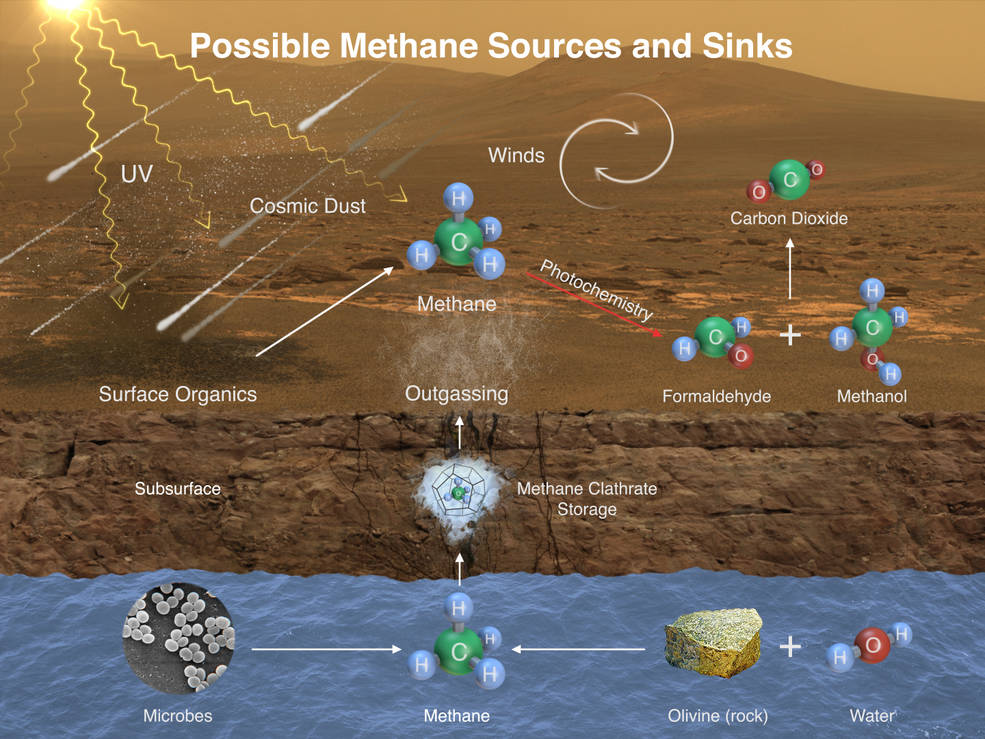
First, NASA has confirmed that Mars does have a methane cycle. On Earth, that's connected to the existence of of quintillions (or whatever) of living organisms, from microbes to roses to whales, doing their things as they respire, pass gas (yes, that definitely matters if you have enough life forms, which we do), dump waste, and die. The Martian cycle is far less robust, only a whisper of Earth's you might say. There are non-living processes that could be involved, but the LACK of a cycle would most likely mean there is no present life analogous to Earth-type life.
Second, Curiosity, the not-so-little rover that could (we tend to think of it as desk-size, but it is in fact the size of a small car and weighs 900kg), has drilled into the surface and uncovered complex organic molecules. Again, these are not by themselves proof of life, nor are they unquestionably endemic to Mars (they could be deposit from a meteorite or comet strike), but they are what we would find if microbial Martians had been - or still were - buzzing about under the surface. The source rocks, in the Gale Crater, are believes to be about 3 billion years old.
There were preliminary discoveries on both these topics made in 2014, but this, to scientists, is much stronger evidence, derived from different locations, and basically the exobiologists are partying hard. To them, the $2.5 billion dollars spent on this mission has been justified a dozen times over.
Fingers crossed.
Below: NASA images: Curiosity: Methane cycle with possible inorganic and organic sources.
Saturday, June 02, 2018
Denver ComiCon looks great this year
Yes, it's time for Denver ComiCon, 15-17 June at the Denver Convention Center.
I will be on two great panels
Letters Written from Hell - The Horror Writing Process — Friday 1:30pm - in Room 405 (DeAnna Knippling (MOD), Emily Godhand, Matt Bille, Shannon Lawrence)
Creating Believable Monsters — Saturday 12:30pm - in Room 405 (Veronica R. Calisto, DeAnna Knippling, Sue Mitchell, Emily Godhand, Matt Bille (MOD), Shannon Lawrence)
(PANELIST NAMES NOT FINAL)
NASA and other have science/education panels, with scientists and SF writers interacting in some. DCC is very education oriented, and there are educational programs and an award for Educator of the Year,
See you there!
Subscribe to:
Posts (Atom)