Sunday, June 27, 2021

New humans all over the place?

How many human species are there, anyway? New discoveries keeping adding more data and more  questions to the heap of possibilities. 

Scientists have known for a long time there was never a neat line of human evolution from apes to "cavemen" to us.  That old chart some of us still remember from in school had a very simplistic view of our ancestors (and also showed them as white guys).

Example of early evolution chart 
(copyright unfindable but presumably expired)

"Scientists have many more pieces of the human-origins puzzle than they once did, but the puzzle is now vastly bigger than it was previously understood to be. Many gaps remain, and some may never close. " - Kate Wong in Scientific American

A good start for the topic is this article on human evolution from the Smithsonian. What's notable about this is that it was published in March of 2021, and it's obsolete.

Just in the last few years:

In 2019, the new species Homo luzonensis was named form the Philippines. It's small with an unusual mix of features including fingers and toes adapted for climbing. The find was published in Nature. 

In 2021, we have Homo longi, "Dragon Man," a species from China, at least 146,000 years old. There's a lot of buzz about the size of the skull: it shows a brain the size of a modern humans, and that alone is a stunner to anthropologists. (The formal paper is here.)

And now we have the "Nesher Ramla Homo type" from Israel, some 20,000 years younger. The discoverers don't think it's a new species, but it's unique, with some Neanderthal traits. (Here's the paper in Science.)

Where is all this taking us? To greater knowledge, yet greater mystery. It's a fascinating topic we may have only begun to grasp.


Wednesday, June 23, 2021

My interviews on The Space Show

I haven't been on Dr. David Livingston's The Space Show in a little while, but I think of it very fondly. It's a long-running series in which David interviews administrators, astronauts, engineers, and the full spectrum of people involved in the national and global space community.  

Some of these interviews may interest you space nuts.

2019, Broadcast 3271: Tracking whales from satellites

2011, Broadcast 1614: The small-space revolution of microsatellites and CubeSats 

2007, Broadcast 802: With Erika Maurer (then Lishock) on the 50th anniversary of Sputnik 1

2007, Broadcast 650: With Kris Winkler on the role of microspacecraft in NASA exploration

2004, Broadcast 260: With Erika Maurer on our book The First Space Race: Launching the World's First Satellites

2003, Broadcast 149: On microsatellites, launch vehicles, and extraterrestrial life, among other things 

Thanks, David, for all the opportunities. See you again soon, I hope!


Monday, June 14, 2021

Review: A Fighter Pilot's Memories

World War II has always been one of my top historical interests.  It's hard for modern people to even understand what total war is. While I was born in 1959,and my father served after the war, I still read on it a great deal. A war of this magnitude is a grand-scale mix of the great and the small: the sweep of armies, the decisions of governments, and the actions and experiences of human beings. Having some background as a historian, I'm always interested in the little corners, the forgotten stories.   

One book that came to my attention is this slender memoir by a pilot who didn't do anything famous but was important nonetheless. His tale memorably demonstrates the human-experience dimension of the war.  

Brave and Funny Memories of WWII: by a P-38 Fighter Pilot 
by Lyndon Shubert


This is a terrific memoir, funny and honest. It's not one of those polished works with lots of detail, but that's a strength for readers wanting an unvarnished insight into a WWII fighter pilot's mind. 

Lyndon Shubert flew P-38s for the 15th Air Force in the Italian theater, often on extremely hazardous weather reconnaissance missions. In this days before satellites, these were critical: before risking hundreds of planes as well as expending precious bombs, bomber units needed to know what the weather on the route looked like.  Carrying out these missions meant long solo flights over Axis territory.  

Most pilots present themselves as God's gift to flying, but Shubert is the opposite. He admits upfront he was not the most talented of pilots. He barely got his wings.  Indeed, he survived an attack by four German fighters on his first mission because his incompetent handling of the P-38 resulted in crazy maneuvers the enemy Me-109s gave up trying to match. But he kept flying these hazardous missions, charting weather that affected not only the lives of men in the bombers but also the innocent people on the ground. Since WWII high-level bombing was inaccurate by modern standards in the best of conditions, bombing through clouds meant anyone could be on the receiving end.  

(Historian's side note: I reject the modern claim that such bombing was a war crime.That comes from people who don't understand that there was simply no other way to attack targets in the enemy's rear 70 years ago, and leaving Axis war factories, air bases, and synthetic oil plants in their home territories alone was out of the question.)

Shubert tells, in simple, unadorned, effective prose, the emotions of flying from ecstacy to terror. That he and his plane were considered expendable in the service of the mission adds a sort of background note of adrenalin.

Whether he was taking on half the rival 8th Air Force in a bar fight, going AWOL to chase a high school sweetheart who was assigned to his theater with the USO, or raiding a commissary he wasn't allowed to use, Shubert stayed one step ahead of the Germans and one step ahead of courts-martial to win the Distinguished Flying Cross and came home to a long life as an actor and a film technology inventor. This memoir is like nothing else you're likely to read from the war.

Sunday, June 13, 2021

Why Cryptozoology Don't Get No Respect

I like cryptozoologists, at least in general. I like their un-killable optimism, even when it becomes unreasonable. Folks who strap on backpacks and hike into the forests in hopes of meeting sasquatch are, at the least, looking for something first-hand. That sasquatch-hunters (I don't mean to focus solely on the big guy, but he dominates the topic like a Gigantopithecus in a field of pygmy marmosets) haven't contributed to zoology so far doesn't keep me from cheering them on. I always hope they might, despite overwhelming odds against a huge North American mammal being undiscovered, find some hard  evidence. 

I've argued before that cryptozoology is scientific in theory, if not in practice. "Animal X lives here" is a falsifiable hypothesis.  And it's too easily forgotten that cryptozoology, despite a justly-criticized overemphasis on large animals, used to get broader scientific respect. Nessie and sasquatch were once serious topics, especially in the 60s and 70s. Today, despite more people than ever believing in the existence of the "star cryptids," very few working scientists want to deal with it. The field is sunk in sensationalized or outright faked TV shows, endless repetition of the same cases on the internet, and so many reports of sasquatch that no one can take them all seriously. 

I'm not a scientist or a field researcher. I offer my opinions based on a good 45 years of interest, reading, discussion, etc. that's produced two very-well-respected books and an eternally-delayed third.  I think cryptozoology as a whole needs to turn a much more skeptical eye on fuzzy photos, old newspapers, allegedly lost or confiscated evidence (it's not evidence unless you have it), etc. 

To my main point: the item that troubles me most as a cryptozoology-sympathizer is the allegedly paranormal/psychic/parapsychological factor proposed for some cases.  I'm well aware that sane human beings have reported apparitions, including animal-like ones, creatures that make psychic contact, etc. But while I’ve no particular insight into what mix of causes is behind that phenomenon, I hold this truth to be self-evident: there’s no faster way to make ANY zoologist stop listening to you than to suggest this topic has any place in their field. 

My position is that, if a case does not concern a physical animal,  it no longer pertains to cryptozoology or any kind of zoology.  If someone believes they saw a sabretooth tiger that disappeared into thin air, for example (this report is chronicled in Nick Redfern’s book Monster Diary), then the fact the apparition was in the form of an animal doesn't put the event under the heading of cryptozoology. It can be parapsychology or any other field one may think appropriate, but if it's not zoology, it's not cryptozoology.  People who think sasquatch is not a material creature are welcome to that opinion, but that’s part of the whole business of apparitions and spirits and the paranormal. It also, critically, is not a falsifiable hypothesis: you can never prove such a belief to be wrong.  If a thorough search fails to find an animal in the place it's been reported, the animal either did not exist there or has moved on.  

There's a nice example in Vietnam.  There are intriguing reports of unknown primates, sometimes called "rock apes." That's cryptozoology. Martin Caidin's book Natural or Supernatural includes a report of apelike primates in Vietnam that were unaffected by mass automatic weapons fire at point-blank range. That's not cryptozoology. (People have no doubt had real encounters with animals they dressed up with supernatural details, but as long as those details are attached, there's nothing zoology can do with such reports.) 

I don't dismiss the possibility of a nonmaterial reality: since I believe in God, I don’t think the material universe is all that exists.  But an apparition is not an animal.  It may be reported to look like one, or even act or sound like one, but that's not the same thing.  Cryptozoology will never regain any of its respect with zoology if paranormal entities are part of it.  People’s experiences of such “zooform” entities are simply part of another field of study.


Saturday, June 05, 2021

The Wonderful Thing About (Caspian) Tiggers

 There are two ways a species can return from extinction (bar cloning, which we will likely get to eventually).  One is to be rediscovered, and seevral recent examples are described in Forest Galante's new book Still Alive (It's a fascinating book, and I'll do a full review soon.)  

The other is, a bit paradoxically, to have never been a species at all.  Davud Brewer's book Birds New ToScience: 50 Years Of Avian Discoveries (2018) discusses dozens of brids which have been struck off the species list after later scientists discovered they weren't valid (they were part of a known species, they were hybrids, they were oddly colored individuals, etc.)

The Caspian tiger (Panthera tigris tigris) has been thought extinct.  I wrote in my book Rumors of Existence (1995) that: "The  Caspian tiger may also be extinct.  It once ranged across much of central Asia, but no recent sightings have been confirmed in Turkey or Russia.  A pawprint cast taken in Iran almost twenty years ago recorded the passage of a solitary animal, perhaps the last one in that country.  Today, a few may linger in the mountains of Afghanistan."  

As it now turns out, though, it was not extinct.  It was part of the same species as the Amur tiger, which is also now part of P. t. tigris.)  is doing ok by tiger standards (all tigers in the wild are endangered the Sumatran is extinct and the Javan almost certainly so). Now a WWF project is looking at moving Amur tigers to Central Asia to bring the tiget back to its historic range.  Paradoxically, the animal has both been lost and found.  

Until next time, visit me at: Matt Bille


Sunday, May 16, 2021

Nature's Never-ending Parade of New Species

 Ah, an update on my favorite subject: the discovery of new species.  
I just received an amazing book by David Brewer entitled Birds New to Science: 50 Years of Avian Discoveries (Helm, 2018). After quoting Ernst Mayr's prediction from the 1940s that there were probably under 100 bird species left to find, Brewer lists 288 for 1960-2018.  He then lists 50 "future species" well observed or photographs but not yet described.  So around 6 species per year. (They're not spaced out like that, of course.)  I'll do a full review on this book later. 
Meanwhile, on to sawsharks. Sawsharks are tropical-ocean denizens, up to 1.5m long, with snouts that look like a cross between a sawfish and a gharial (narrow-jawed crocodile) with a little catfish thrown in (it has whiskers).  We thought there was one species (Pliotrema warreni) of the type known as the six-gilled sawshark, but after 2020 we know there are at least three.  British scientists working with fishers in Zanzibar realized their sawsharks didn't look like the type they knew, and so Pliotrema annae was described. Meanwhile (ok, not strictly 'meanwhile," but you know what I mean), snouts collected in Madagascar were matched with specimens in museums in London and elsewhere, so science already had Pliotrema kajae on ice, as it were, and no one had made a close enough study to distinguish the species. The paper describing the new species is here.
Meanwhile, three species of luminescent sharks, one 1.8m long, were found in depths of 200-1,000 meters off a feature called the Chatham Rise off New Zealand in one expedition. 
To close out the fish stories for now, an international team led by Dr. Kim Andrews of the University of Idaho found in the Indo-West Pacific area a new snapper, a gorgeous pink-orange bottom dweller over 1m long. A link to the paper is here.
In mammals, there's news from the top and the bottom of the size scale here in 2021.  In the Caribbean, NOAA scientists separated Rice's whale as a species distinct from the similar Bryde's whale.  Indian scientists on a volcanic island called Narcondam found a new species of shrew.  
We haven't touched on the reptiles, amphibians, cephalopods, and so son, but there's plenty to look at in a future post.


Thursday, May 13, 2021

Review: Monsters & Marine Mysteries

 Monsters & Marine Mysteries

Hawthorne, Max. (2021: Far From The Tree Press, 342pp.)


Hawthorne, champion sportfisherman and author of the Kronos Rising series about surviving prehistoric predators, here collects items from his blog and YouTube channel along with some new writings about sea monsters and other ocean-dwelling oddities.  

Hawthorne includes some personal encounters with the paranormal, but that’s not the focus of this review.  He also includes many stories about big fish and the sometimes-bigger ones that got away. I love these sorts of stories: when he reports fish bigger than the official records, there’s no reason to dismiss them.  It's doubtful we have the biggest one of anything. There are interesting stories of huge sharks, too.  He discusses and names four gigantic great whites he believes hang around specific locations.  As in his fiction, Hawthorne's descriptions of fishing and the ocean environment  are evocative.

Moving on to actual monsters, I have numerous disagreements. On the one flipper, he includes some interesting accounts, particularly of giant cephalopods, I didn’t know about.  On the other, he includes the U-28 hoax as fact. He is certain the 1969 Garry Liimatta video is proof of a giant, shell-less turtle he calls the Super Predator. I still see a blob, and identifying this rather brawny creature with the "lamp post" head/neck claimed in the 1962 McCleary case doesn't convince. Hawthorne is open to conventional explanations in some cases: his theory the 1918 Port Stephens monster shark was a light-colored whale shark, not a surviving Megalodon, is reasonable (assuming the case is not a hoax, as some cryptozoologists now believe).

Two chapters go to a monstrous mosasaur-like creature reported by a cruise ship sailor in 2014, a tale which illustrates a common problem in cryptozoology.  To the author, the case is buttressed by having several witnesses. However, we have only the single witness who claims the others existed: apparently none has ever written or spoken about the case. That’s not a multiple-witness sighting unless proof surfaces that it was. It doesn't help the witness took only one picture, never backed it up or sent it anywhere, and later lost his iphone  Hawthorne admits this bothers him.  As says on several cases like this, he's presenting what he has and "You be the judge." 

Hawthorne spends a lot of the book reconstructing predator attacks on whales and sharks. Some he attributes to enormous great whites, others to mosasaurs or the Super Predator. He goes through his reasoning about each case in detail, and some of the damage photographs are really startling. I do wonder how sure he is about the bite shapes when the targets were flexing, writhing animals at the moment of impact. His belief that giant squid get bigger than we’ve measured is reasonable: his interpretation of old sighting claims as enormous squid attacking adult whales and bludgeoning them with the long tentacles is much harder to believe. 

Hawthorne gives some sources in the footnotes, although of varying quality, and he gets points for interviewing witnesses extensively.  But there’s too much speculation here, and too much reliance on questionable incidents. A couple of allegations that evidence has been suppressed are strange, as he agrees that a motive eludes him. 

The book falls well short of convincing this reader there are sea monsters. But Hawthorne does tell great fish stories.  

Monday, May 10, 2021

Book review: Assured Destruction

Assured Destruction: Building the Ballistic Missile Culture of the U.S. Air Force   

by David Bath (2020: Naval Institute Press, 238pp.)    

DISCLAIMER: As with all my posts, these are solely the personal opinion of a freelance writer and do not represent the views or policies of any agency or company.


I spent four years in the Intercontinental Ballistic Missile (ICBM) culture involved here, so I was eager to read this when I saw it.  This is an academic study, so there’s a bit of dry reading in spots, but Bath has poured a wealth of information and insight into this book. This is the first book to analyze the missile culture from the beginning through the 1960s. It’s a short book as well, since the notes and index take up 87 pages. Despite that, and despite my being a missile officer and something of a historian myself, there’s plenty here I didn’t know.  

The section on building the first missiles and getting them into units is the most fascinating. There was no consensus in the 1950s about whether ICBMs would work or how long it would take to make them useful. The Air Force’s General Curtis LeMay, though not quite the irrational missile-hater of legend, was one of many officers who thought it folly to divert significant resources to what they saw as an unproven, inaccurate weapon that would never have the flexibility of airpower. (To be fair, it still doesn’t.) Despite sentiments like these, by mid-decade the nation was on course to deploy long-range ballistic missiles, and the Army, Navy, and Air Force all wanted to field them.

Considering the author’s extensive background, it’s really odd to read here that Vanguard, strictly a satellite launch vehicle, was a “missile,” and that the first military satellite launch was the Atlas-based Project SCORE in December 1958: in fact, the Army had already orbited three Explorers with modified Redstone missiles. (I can’t help noting that, to get these right, he could have just read my book The First Space Race.)

With the Army limited to shorter-range missiles and the Navy pursuing its own Polaris, the Air Force’s rush to get the first Atlas declared operational (done on 31 October 1959) resulted in shortcuts, confusion about command relationships, and constant changes and fixes. All this eventually led to the logistical nightmare of having three variants in use simultaneously. The system was commanded by pilots pulled from the bomber force as a rotational tour, not a career.  The Atlas force never quite erased the effects of its various birth pains before it was retired in 1965.    

Air Force ICBM forces as of January 1962 had a mere 23 missiles on alert. During the Cuban missile crisis of October 1962, that was increased to 132 with superhuman efforts to make even training and test missiles ready by any means, including bypassing tests and safety features. After the crisis, though, missileers found they had not changed many minds in Air Force leadership about their value. 

The 1960s were as tumultuous for missiles as they were for the rest of the military. As pilots were pulled from everywhere to go to Vietnam, the experience and rank of crewmembers plummeted until second lieutenants did what had been thought the jobs of majors.  As Bath documents, the dominance of aviation in the Air Force’s command structure grew even stronger, leaving missile officers with few career options and an extremely small chance of being promoted past colonel. There was no consideration to publicly, organizationally, or financially recognizing missile crews for arduous duty or to give them the status of “rated officers” like pilots. (We all felt when I was on crew that that this second-class status existed, so it's nice to know Bath agrees.)  I expected a bit more discussion about how the culture was shaped by the responsibilities of handling nuclear weapons. My experience was that no two people dealth with this exactly the same way, but we knew what we were doing: by the time I went through training in 1982, at least, they showed us graphic images of the victims of nuclear destruction in Japan.   

Bath’s account of the missile force, oddly, almost entirely ignores the Titan II system I served in. All the post-Atlas discussions of morale, training, and operations are about Minuteman units.  The Titan II was a very different system, with its complex liquid-fuel missiles and its mixed crews (two officers, two enlisted) and it provided the nation’s hard-target kill force until retired in the 1980s. Every day in the history he traces, there were 216 crewmembers on duty in Titan, 200 in Minuteman.  It’s a puzzling oversight as well as a personal annoyance. 

Bath concludes the Air Force erred enormously by leaving the missile field essentially static and definitely secondary to airpower for essentially the entire history of ICBMs.  He notes some UAV/RPA pilots have the same feeling today, despite the fame of weapons like Predator. ICBMs will be on duty until 2050 and probably longer. Bath’s book will hopefully be widely read and will help leaders understand better the uniqueness of  the ICBM force.


Saturday, May 01, 2021

Movie: Ammonite

 Ammonite.  

Sigh.

Very good performances - both leads were superb - with wonderfully bleak direction/ cinematography and a compelling sense of time and place.


I didn't mind they built it around an invented love affair that didn't happen. It's certainly not the first time romances, central or peripheral, have been used in a "history-inspired" movie (there's even a flirtation in the 1960 war film Sink the Bismarck, which is about battleships. No, not the movie Battleship. That iceberg wreck of a film never existed).
Anyway, we get a great sense of Mary's bare-bones life and the harsh coast she lives on. The fossils are a way to make a living: she doesn't express any special liking for what she does. It doesn;t help that the only person who talks to her much, naturalist/fossil buyer Roderick Murchinson, is a jerk who dismisses his wife as suffering "melancholia." Any cheating that goes on, he deserves. As for Mary, it's only when she has a chance for a very different life that we see she is where she really belongs.
Writer/Director Frances Lee has made an involving movie about relationships, and ok, it's her movie. As a history/paleontology lover, what I minded here is that the affair crowded out everything else: except for having credit stolen for the Icthyosaur, and two lines of dialogue about identifying fossils, the viewer learns nothing whatever about why she was so important to science, not even why the icthyosaur was important, and what her discoveries led to. (See a very good article on that here.) They could have added ten minutes to show her scientific legacy and how much her work on those windswept rocks really mattered.

Wednesday, April 28, 2021

R.I.P. Michael Collins, Astronaut, Explorer, and More

 Very sad news today. Michael Collins, Command Module Pilot of Apollo 11, has embarked on his last voyage of exploration.

Collins, who rose to the rank of Major General in the United States Air Force, was described by all who knew him as extraordinarily competent, yet a humble man with a sense of humor. When Apollo 18 and 19 were canceled, he knew he wouldn't get to walk on the Moon himself, but he was always proud of the role he'd played in putting his comrades and his country on the moon.


He was the first head of the National Air and Space Museum, a magnificent achievement that preserves aerospace history including many artifacts of the Apollo program.

His book Carrying the Fire is still the standard for astronaut autobiographies. In it readers will not only meet the man and understand his beliefs and motivations, but where he thinks the space program fits into the larger universe of human endeavor. As a bonus, Collins explains the technology involved in language all can understand. He conveys superbly what it was like to voyage in the cramped quarters of the Gemini and Apollo capsules through the harshest environment in the universe.

I never met Collins. I wanted to tell him, not only that I admired him, but I'd watched his launch to the moon. I was a 9-year-old watching from a plane my dad had rented from his employer, Piper Aircraft, in Vero Beach just down the coast from the Cape. (I wanted to meet them all, but I've only met Buzz Aldrin (who is well worth meeting!)

Michael Collins was 90 years old. From one Air Force veteran to another: a last salute. Ad Astra.

Thursday, April 22, 2021

Samson: Where's the Bear?

 Maybe readers can help solve this one. 

What happened to Samson the bear?

Samson was a California grizzly captured as an adult in 1854 by John "Grizzly" Adams. Adams had seen (and killed) many grizzlies, but Samson was the biggest bear he ever saw. Samson was shown in Adams' menagerie, established in San Francisco in 1856, where Charles Nahl painted him: he became the bear on the California state flag. Samson was moved with the other animals (Adams' close companion, the famous grizzly Ben Franklin, had just died) to New York in 1860. At this point, Samson, while he carried some "cage fat," nonetheless was a monster: he was weighed on a hay scale at 1,510 pounds, whereas an animal half that weight is now considered a very big bear. He was billed as the biggest bear ever captured in the United States, and he quite possibly was (noting the U.S. did not own Alaska back then.)

There are few photos of Adams, and I've found no  information about whether Samson was photographed. I'd think he probably was at some point.  


Photo of Adams with a smaller bear

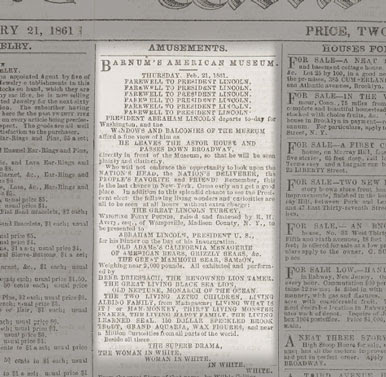
Adams sold the collection to P.T. Barnum in 1860 and was hired to show the animals. Adams, who had a terrible head wound from an old bear attack that could not be treated with 1860 medicine, died on October 25 of that year. Barnum's American Museum mention Samson as a live exhibit several times. Abraham Lincoln would have seen Samson when he brought his family there in 1863. Barnum, of course, couldn't resist boosting his star bear's size. An ad in the New York World (February 21, 1861) reads, "OLD ADAMS’S CALIFORNIA MENAGERIE OF AMERICAN BEARS, GRIZZLY BEARS, &c.THE GREAT MAMMOTH BEAR, SAMSON, Weighing near 2,000 pounds." 


The mystery: I've never found a source that said when Samson died or what happened to him.

One source says he had "been removed" just before the 1865 fire, and the New York Times expanded on this by saying he had been sold in New Orleans. I have so far found nothing later. Whenever he died, he was probably not stuffed for exhibit (or at least there are no accounts of it in online archives) but it seems strange the mammoth skeleton was not saved. Does it still exist? Is it in a museum? Or is Samson, like its species in California, gone for good?


Thursday, March 18, 2021

The endless weirdness of sharks

Back when I was a kid reading about sharks, there were "more than 200" living species. Then 300, then 350, and now it's over 500.  In addition to being numerous and of global distribution, the shark clan also boasts creatures so weird they could (and do) create nightmares.  Prehistoric sharks, were, if anything, stranger. 

In the oceans today swim the 15-meter whale shark, the 7-meter great white, the blimplike megamouth, and several species of the bizarre hammerhead. In the oceans of yesterday swam the 15-18m Megalodon, the bizarre "ironing board shark" Stethacanthus, and Helicopreon, which had a "wheel" of teeth" - it looks like it tried to swallow a (vertical) power saw blade.

Helicopreon (artist unknown, license marked "Free to Share and Use"  by Bing)


Stethacanthus  (artist unknown, license marked "Free to Share and Use"  by Bing) 

We have new species of present and past sharks, and they continue the weirdness.  

From the modern sea, far far below the Pacific near New Zealand, comes the 1.8m kitefin shark, the largest luminous vertebrate in the world. I always thought a glowing shark like the ones in the Meg novels wouldn't be able to find prey down there (it's like swimming around with a big neon sign saying "SHARK!").  Apparently, though, enough inhabitants of its realm are just too curious about light sources.   

From the past we have  Aquilolamna milarcae. Thanks to pectoral fins that rolled out like glider wings, its 1.8m "finspan" made it longer than it is wide.   This Cretaceous resident was more a drifter than a hunter-killer.  

The sharks... still full of surprises. 


Sunday, March 14, 2021

The Deadly Mantis

Yesterday I watched my favorite big-bug movie, "The Deadly Mantis" (with MST3K commentary). It's a decent story and well-acted, but I'd forgotten how slow it is. It's as if the model mantis (which has decent texture and movement, for the time/genre) had in its contract it only needed to appear 10 percent of the time, so 90 percent is people talking in offices. It opens with a LOT of footage from Air Force training films of the military's early warning radar nets watching the Arctic skies for Russian bombers. It also has the usual glitches of these movies: American planes shoot rockets at the mantis, but when the camera pans back to the planes the rockets are still there under the wings. The stock footage is pretty good throughout if you like 1957-era planes.


The scientist character from a natural history museum tries hard to make it all believable. Someone wrote some dialogue that at least sounds "sceincy." (OK, not the part where he suggests mammoths frozen in Siberia might have been ALIVE when unearthed.)

Still, one of my favorite movie monsters of all time. It ranks, for this era, with the giant ants in Them!

https://mst3k.fandom.com/wiki/MST3K_804_-_The_Deadly_Mantis

Trivia: An Eskimo village is Canada is found abandoned because the mantis attacked and everyone fled. The story is circulated endlessly in paranormal websites and literature as having been a real unexplained disappearance. I wrote once to the RCMP to nail it down, and they politely replied they'd searched their records many times and it hadn't happened.
Other trivia: the newspaper headline in the film (below) is a tribute to my hometown.

UNtil next time, visit me at MattBille.com

Friday, February 26, 2021

A Living Thylacine? Alas, No

 Well, there was a lot of hype, but in the end the much-heralded thylacine photos were not of the "Tasmanian tiger," but of a small kangaroo relative called a pademelon.  We talked about this last night on Untold Radio.  My best guess was we lost the thylacine around 1990.  I always hope I'm wrong about these things, but I'm not wrong often enough for my liking.  (OK, that sounds weird, but I hope it makes sense.)  By the way, did you know you could buy dog jackets that make Rover look like a thylacine? 

I do feel sorry for Neil Waters and his friends in the Thylacine Awareness Group of Australia. They've put years into this search.  Take a look at the initial announcement. He's so enthused about it that the result has to be an enormous letdown for him. 


Thursday, February 25, 2021

A Night on Untold Radio

 I had a great time chatting with Doug and Joel at Untold Radio.  My brain glitched a couple of times early on, but we had a good discussion of cryptozoology and books.  I even worked in Dunkleosteus. Thanks, guys! 

Episode 23 – Matt Bille – Author, Historian, and Science Writer – Untold Radio AM


Monday, February 15, 2021

New life discovered - past and present

First, the past. A coelacanth fossil discovered by accident turns out to be amazing.  The coelacanth may be five meters long, far larger than any prehistoric or modern coelacanth (1.5m is a normal adult specimen.)

Speaking of coelacanths, because the modern one looks very much like its ancestor (hence the rather problematic term "living fossil"), its genome has diverged quite a bit from prehistoric examples.  That doesn't make the modern one any less important, but it's very interesting. When the living animal's genome was sequenced in 2013, sceintists thoought it had changed very little.  


Modern coelacanth, Latimeria chalumnae (Smithsonian)


As for newly discovered life, news from Antarctica startled pretty much everybody.  Life has pushed into all kinds of unlikely and hostile environments, but no one thought life, especially multicellular life, would turn up at the bottom of a 900-meter hole drilled through the Antarctice ice sheet.  The animals are presumably chemosynthetic, but the details have everyone puzzled, and will until samples are obtained.  Which, of course, is no easy task.  

"Life finds a way." - Dr. Ian Malcom


Tuesday, February 09, 2021

Brooding over new Bryde's whale relative

A population of Bryde's whales (pronounced, approximately, Broodus) in the Gulf of Mexico has been determined to be a new species: amazing news. It has received the common name of Rice's whale and may be over 13m in length. 

NOAA's official account, based on a paper in Marine Mammal Science, reports Dr. Patricia Rosel was the key figure in identifying these whales as a new species. It was her examination of a skull, compared via hundreds of measurements to known Bryde's skulls, that provided the final proof of the new whale's uniqueness.  

This capped off more than a decade of work by Rosel and several other scientists.  It all began back in the 1990s with the first observations, by Dale Rice, of what was thought to be a population of Bryde's whales. This group was unusual in that its range appeared limited to the Gulf, which was odd given other populations of this whale (already split into two species, a pelagic and a coastal type) had much larger ranges.  Subsequent work included DNA studies as well as examining skull morphology.  (In one of those incongruities that pops up in the study of nature, the measured whale, the type specimen, is an oddball that wandered all the way up to North Carolina, where it died and drifted ashore.)

So now we have the species called, formally, Balaenoptera ricei.

Dr. Rosel examining the skeletal remains of the type specimen (NOAA)  

Rice's whale is the latest in an astonishing series of discoveries. It's common, and reasonable, to assume we know all the cetaceans. They are big, they must surface to breathe, and we've been "collecting" them for centuries.  

And yet we have ten new species in the current century.   

We know of 23 species of the reclusive, deep-diving cetaceans called the beaked whales. The "23" is still approximate with such hard-to-study animals - some species might eventually be collapsed together, or new ones named. As shown with Rice's whale, it can take a lot of time and work to establish definitively that two similar-looking species are indeed different.

In December 2012, three cetologists on a Sea Shepard Conservation Society described what they'd found on a research cruise off the west coast of Mexico.  They took clear, closeup video and film records of what appears to be a new beaked whale species.  Even more interesting, the scientists involved were there looking for a different whale whose unidentifiable "voice" had been picked up on hydrophones.  This new species does not match that, so who knows what else is down there? 

The last new beaked whale before that (reported at sea by Japanese fishermen but not scientifically identified) washed ashore in Alaska only in 2016. It was formally described in 2019  as Berardius minimus. 

Now the bad news for Rice's whale: there are perhaps 100 of them.  That's not too small a population to to sustain itself, but it makes the species very vulnerable.  Their habitat is troubled by the usual nemeses of whales: ship collisions, entangling fishing gear, and noise pollution that makes communication and thus family/pod cohesion difficult.  More details are in a good NPR article here.    

If we have, as it seems, three sizable whales announced in the last five years, that's a strong indication humans have not yet catalogued all these intelligent, social, and fascinating co-inhabitants of the Earth.

Hope for Mars

 It's traffic jam month on Mars.

"Hope," the first space probe built by the UAE entered Mars orbit today.  The journey of exploration goes on, and it's great every time a new participant succeeds.  In this case, it's especially interesting because the UAE program leaders didn't start by doing something relatively easier, like a lunar probe.  They went for broke to study a far more distant object, and the gamble paid off. You can find more details here.

The related news includes the first photograph of Mars by a Chinese probe, Tianwen-1, which was successfully inserted into Mars orbit. Next, coming up on February 18, we have the capper to this very busy month on and around the Red Planet.  At about 3:55 EST, the NASA rover Perseverance will touch down just north of the equator in Jezero Crater, formerly the site of a lake and a likely place to detect any signs of past microbial life.  

In the Apollo days, we thought human feet would touch Mars long before now. It's taking longer than we thought, but the robotic fingerprints of Earth ingenuity are all over Mars. Despite the previous orbiters and rovers, this is a big and complex world.  No one yet knows what we'll find as we keep going.  


Image: Perseverance detaching from the upper portion of the lander (NASA). This "skycrane" approach under power is necessary because parachutes can slow a probe only so much in the thin Martian air. Any human travelers will also have to land using rockets to slow the descent.


Endangered Species: A little good news today

From Mongabay.com:   "Researchers studying the impact of conservation actions since the landmark 1992 Rio Earth Summit say that at least 21 species of birds and seven mammals have been saved from extinction through direct human intervention."  

It's all much more complex than that, of course.  In the aftermath of a 1992 conservation conference called the Rio Earth Summit, which emphasized the need to prevent further loss of species, this story says human efforts have saved 21 birds and seven mammals from going extinct.  

There is much, much more to do. We are in the middle of what some scientists call the Sixth Great Extinction in Earth history. We lose documented species at a rate of about one a year, but we're also losing species of plants and animals before they can even be found and named. So every success is something to celebrate. 

Details here. 

Sunday, February 07, 2021

Book Review: Hope for Animals and Their World

 Hope forAnimals and Their World: How Endangered Species are Being Rescued from the Brink

Goodall, Jane, with Thane Maynard and Gail Hudson (2009: Grand Central, 392pp.)


In this book, Goodall and her co-authors tell the stories of animals (and a few plants) which might well have become extinct, but survive thanks to human dedication and ingenuity. Some of the stories, like the California condor (Gymnogyps californianus), are famous, and others obscure. I’d never read about one of the most fascinating episodes, the recovery of the black robin (Petroica traversi) whose survival came down to a captive breeding effort using the only fertile female left in the world.

Some of the stories include Goodall’s own travels around the world, where she saw such creatures as Pere David’s deer (Elaphurus davidianus), Australia’s Rufous Hare-Wallaby (Lagorchestes hirsutus), and the Formosan Landlocked Salmon (Oncorhynchus masou formosanus). She also visits her beloved chimps: a photo of an infant named Flint reaching out to touch her hand will bring tears to eyes of many readers.

Some of the stories concern people who took great risks to save the last of a species. Finding Dryococelus australis, the Lord Howe Island stick insect (by an expedition sent to verify its extinction!) involved great hazards including a seemingly insane climb up a steep, rocky slope in the dark to spot the huge nocturnal insects. 

Goodall doesn’t neglect modern discoveries and rediscoveries of animals. Her chapter on the Lazarus species includes Zino’s petrel (Pterodroma madeira) on the island of Madeira, named for and watched over by three generations of the Zino family.  There’s also the Caspian horse, an ancient breed of small, gentle horses, saved by one determined woman who discovered this forgotten ancestor to the Arabian pulling carts in a remote Iranian village. She looks at resurrections like the coelacanths (genus Latimeria) and the Wollemi pine tree (Wollemia nobilis) (and if you don’t think a story about a tree can be exciting, read it).   The new finds include the kipunji (Rungwecebus kipunji), a large and unique monkey (it looks intermediate between a mangabey and a baboon) from Tanzania. Co-discoverer Dr. Trevor Jones said of the find, “…one of our team suddenly grabbed me and pointed to a monkey in a tree a hundred meters away. I grabbed my binoculars and nearly fell over. It was a surreal moment.”

Goodall has much to say about the broader topic of conservation.  She is sad but blunt about the fact that saving island species, in particular, can require using guns and poison to kill off imported cats and rats when trapping is impossible due to funds or animal numbers. She also discusses the ethics of collecting, the need for a whole-body specimen (she doubts it), the importance of indigenous participation, and the many ways people can support conservation in general or a particular species. 

Don’t just read this book. Treasure it.

“…there is yet this feeling of hope. There are surely plants and animals living in the remote places, beyond our current knowledge. There are discoveries to be made.” – Jane Goodall

Friday, February 05, 2021

Book Review: Peter the Great

 Peter the Great: His Life and World

by Robert Massie

Reviewed edition: Knopf Reprint, hardcover, 2009 (original 1981)


Even very good biographies of complex, influential people sometimes leave you thinking you've watched the person in action, but you haven't met them. In this book, you will meet Peter the Great.

Words like "complex" and "dynamic" might have been invented for him. He was a tireless reformer of Russia, pulling in technology and expertise from around the world. After reading this book, I wondered if any one ruler has ever done what Peter did: essentially raise a backward, insular, agricultural nation to a modern power in in one lifetime.

Peter never lost most of the harsh ways Russian royalty thought were natural. He was capable of great kindness to an individual human being but great cruelty to anyone who might be an enemy. He apparently never thought of the lives of the serfs, changing them only by allowing some people to move from the land to manufacturing: they remained serfs. Building his great capital city of St. Petersburg in swampy land under terrible conditions would cost thousands of lives, and he knew it. He was a very devout church-goer who had no problem watching prisoners broken on the wheel and never rebuked a general who killed 7,000 men, women, and children in razing a village the enemy might use.  

In other ways, though, Peter was atypical from youth.  He escaped the rituals of court by playing soldier, but he played it with uniforms and real weapons, testing tactics, learning to be an artilleryman, and building fortresses. When he unexpectedly became tsar, he was already better at the military arts than some of the generals in Russia's third-rate army, and he reshaped it along European lines. He was a proud Russian but had no problem importing officers and experts from other nations to teach the Russian forces and often command them.

Massie tells us as well of the astonishing range of skills and technology Peter mastered, and how he demanded that his nation master them, too. Building a navy from nothing required, as Peter saw it, personally learning all the trades that went into shipbuilding. It's amusing to read of the agreed-upon fiction that went into pretending the towering (6 feet, 7 inches), well-known Peter was an ordinary workman of the Dutch East India Company shipyard while someone appropriately dressed for a tsar handled protocol. Russian naval cadets followed in Peter's footsteps, and the navy he created was a powerful regional force with modern ships and highly competent crews. 

He went all over Europe learning about the latest scientific and technical advances and buying everything from art collections to clocks to cannons to ship home. He created the first academies to teach military skills to young Russians, and he created centers of learning in a nation that had almost none. He created a professional civil service in a government where corruption was open and blood ties were formerly all that mattered.

He was, always, a man of contradictions.  He philandered, but dearly loved his wife Catherine, and it was for her sake he suffered through official rituals and functions she loved and he endured. Friends and retainers sought his jovial company but feared his violent temper. He loved Orthodox services but attended Quaker meetings when abroad.  He suffered from seizures but nonetheless lived every day with seemingly boundless energy and appetites.  When he died, he left the country far, far different than he found it. With art that is almost magical, Massie succeeds in presenting us with a living, breathing man who contained multitudes.

Massie doesn't quote it, but what came to my mind at the end of Peter's story was Hamlet's line, "I shall not look upon his like again." This book is a monumental work of both history and biography.


Thursday, January 28, 2021

Remembering Challenger

 35 years. Coming off a 24-hour stint in a Titan II ICBM solo. Hearing it on the car radio. Rushing home to turn the TV on with my wife. Watching the video/film replays. Pointing to a tongue of pink-orange flame at the lower SRB segment and saying over and over, "That shouldn't be there." Hypothesizing there was a defect in the solid-fuel casting making a crack, and flames had blasted through the casing. Never thinking of joint failure because I couldn't remember ever hearing of one on the solids I knew best. Praying. Watching Reagan quote High Flight. Crying for them all. A morning never to be forgotten. Ad Astra.